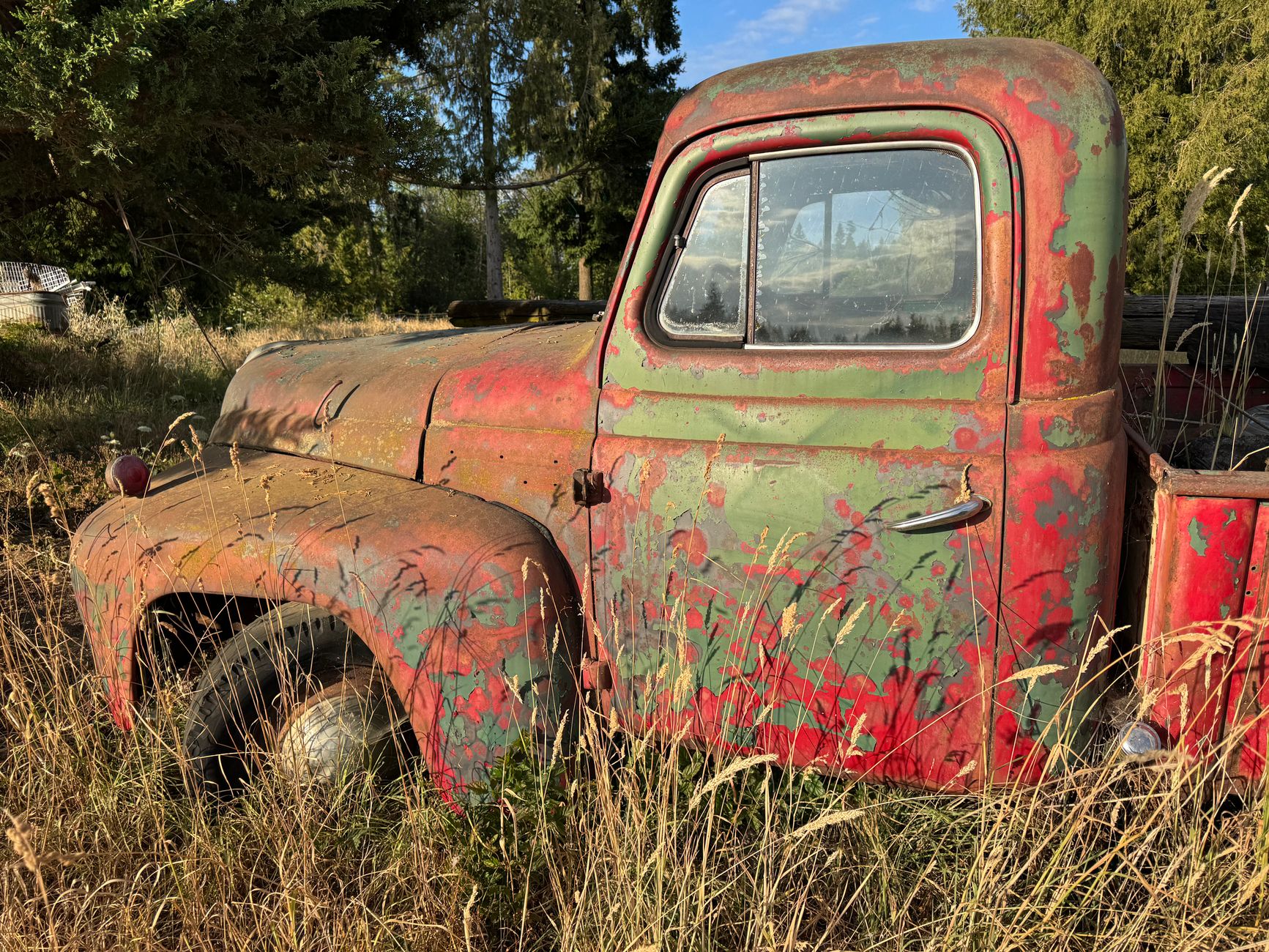
The Widow Who Learned Three On The Tree
He walked all the way around it one time. He bent, with a grunt, and looked down the side of the bed at the reflection. He put two fingers in the door gap. He looked at the cap on the dash for a long moment.
Then he took off his own cap and held it.
“He finished it,” Hoot said. “I never saw it with the trim on.”
“Two summers ago,” I said.
“Who drove it in?”
“I did.”
Hoot turned and looked at me then, a good long look, and his whole face changed.
“On the column?”
“On the column.”
“Well, I’ll be go to the devil,” he said softly. “Who taught you?”
“The Kessler boy. In my hay field.”
“How many times you kill it?”
“Eleven the first night. Once today, at the light.”
Hoot laughed, a big dry bark of a laugh. “Dale killed it at that light the first week he had it running. Sat there and flooded it. I had to go get him with the wrecker.”
The whole shop laughed. I did too. It was the first time I had laughed about Dale in front of people, and nothing bad happened.
That was when I looked up and saw Brad.
The showroom is on the other side of a glass wall from the service lane, with a door between that they keep propped open in good weather. Brad was standing in that doorway in his dealership polo. He had a customer with him, an older farmer in a feed cap I did not know, and a folder of papers in his hand.
I do not know how long he had been there. Long enough.
He was not looking at the truck. He was looking at the seat. At how far forward it was.
Hoot saw him too.
Hoot wiped his hands on a red rag, slowly, each finger.
“Nancy,” he said, and he did not raise his voice so much as set it out where everybody could reach it. “Has anybody told you what a truck like this brings?”
Nobody moved.
“I’ve had one figure,” I said.
“Well, here’s another. Short bed. Sixty-seven, first year of that body. Original six and the three-speed, not some crate motor dropped in it. Paint and gaps like that, and every nut on it turned by a man who knew what he was doing.” He folded the rag. “Forty thousand dollars. Any day of the week. Take it to an auction in Wichita and you might do better, and I would not take one dime less from any man alive, I don’t care who he is to you.”
It was quiet enough to hear the air compressor tick.
The farmer beside Brad took a step into the lane. He looked the truck over. He looked at me.
“Ma’am, he’s right,” he said. “I’ll go forty-two, and I’ve got my checkbook in the pickup.”
“Thank you,” I said. “It’s not for sale.”
“Didn’t figure.” He nodded at it. “My dad had one that color. I learned on it.” Then, because he was only making conversation, he said to Brad, “Bet you tried to buy it off her, didn’t you? I would have.”
Brad opened his mouth.
I could have said it for him. The number was sitting right there on my tongue. Thirty-five hundred, cash, keep it in the family.
I looked at my son-in-law, who has driven me to Wichita for every eye appointment for six years, and who was the color of a boiled shirt.