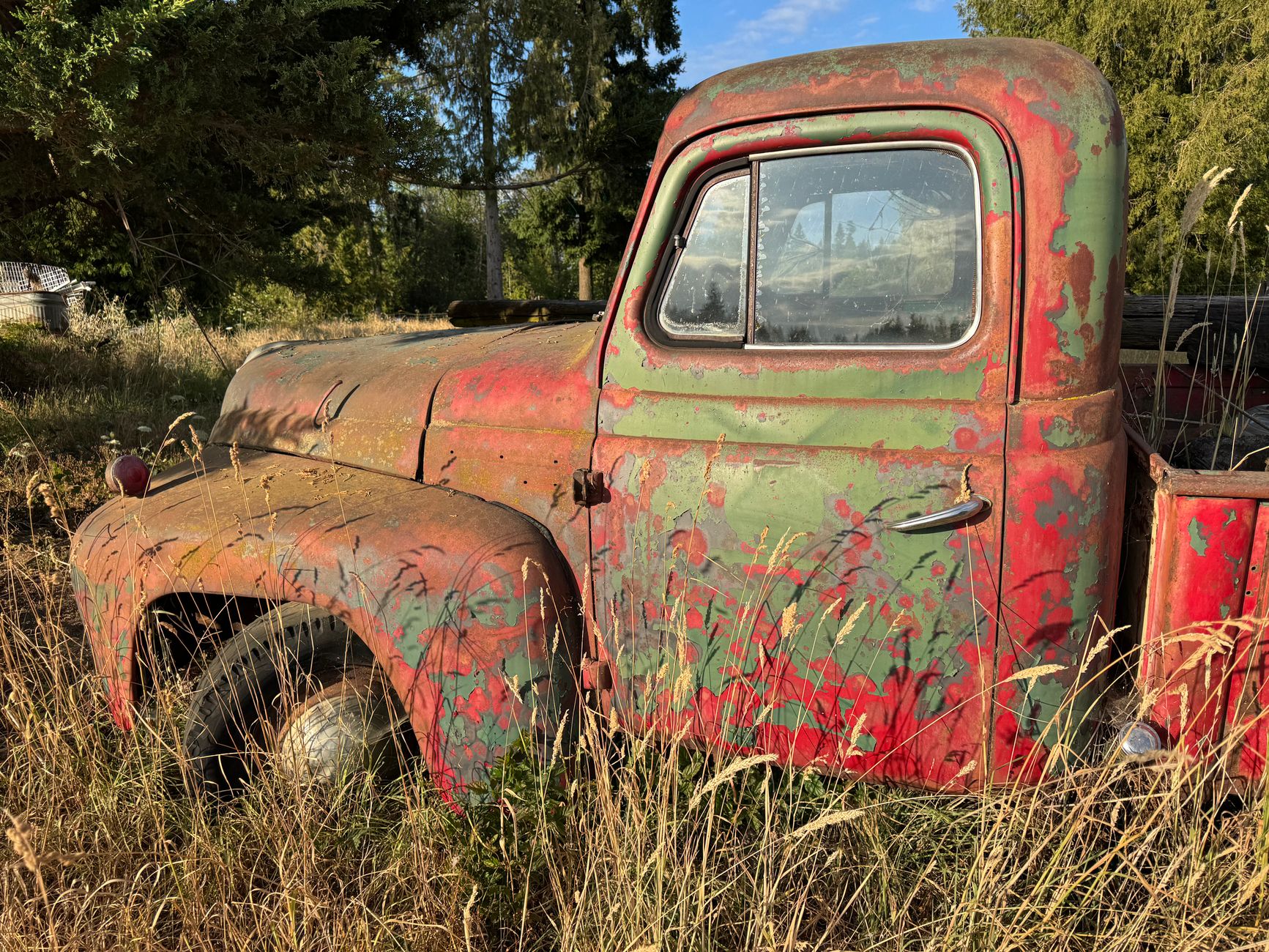
The Widow Who Learned Three On The Tree
“What’s that for?”
“For you,” he said. “For later. You’re ready.”
I had already put the seat where I needed it. The little white line was still on the track, five notches back.
I pulled out the choke, set it, clutch to the floor, and turned the key.
It is five miles to town. I drove every one of them in my own lane.
There is one stoplight, at Main and the highway. It was red.
I was the first one at the line, with a livestock trailer behind me and a boy in a lifted pickup behind that.
The light went green. I let the clutch up and I do not know what happened. I thought about it, is what happened. The truck bucked and died in front of the whole town.
The boy in the lifted pickup laid on his horn.
Six weeks before, I would have sat there and gone to pieces.
I pushed the clutch to the floor. I turned the key. I felt for the place where she starts to pull, and I held my foot right there, and I gave her a little gas, and Dale’s truck rolled through that intersection as smooth as cream.
“Everybody does that,” I said out loud, to nobody.
I turned in at the dealership at eighteen minutes to five.
The service lane there is a drive-through, two overhead doors and a shiny gray floor. You pull in and a young person comes out with a tablet computer. I had been through it a dozen times in my Equinox.
I pulled in, set the parking brake with my left foot, and shut her off.
The young man who came out was named Kyle, by his shirt. He was looking at his tablet when he started walking and at the truck when he stopped.
“Whoa,” Kyle said.
I got out. “Good afternoon. I have a quarter to five. Whitaker. An oil change, please.”
“Yes, ma’am. Is this, um. Is this yours?”
“It is.”
He walked to the windshield to scan the number the way they do. There was no number there. On a truck that old the plate is riveted to the door pillar, and Dale had shown it to me once. I pointed.
Kyle read it off and typed it in. He frowned. He typed it again.
“It says invalid. It wants seventeen digits.”
“It’s only got the twelve,” I said. “It was built before they went to seventeen.”
A mechanic had come to the mouth of the first bay, wiping his hands. Then two more came, and one from the back with a tire iron still in his fist. A girl from the parts counter. The young man who washes the cars.
Nobody touched it. They stood back from it about four feet, the way people stand at a casket or a new baby.
“That’s a ’67,” one of them said.
“Look at the gaps on that door.”
“Is that Dale’s? That’s Dale Whitaker’s truck.”
“Somebody get Hoot.”
They did not have to get him. He was already coming, from the far bay, slowly, because his knees are bad.
Hoot is seventy-four. He has been turning wrenches in that building since before it had a showroom. For twenty years his bay was next to Dale’s, before Dale went out on his own, and after that he came to our place for supper every Christmas Eve. He carried one corner of my husband’s casket.
He did not say hello to me. He looked at the truck.