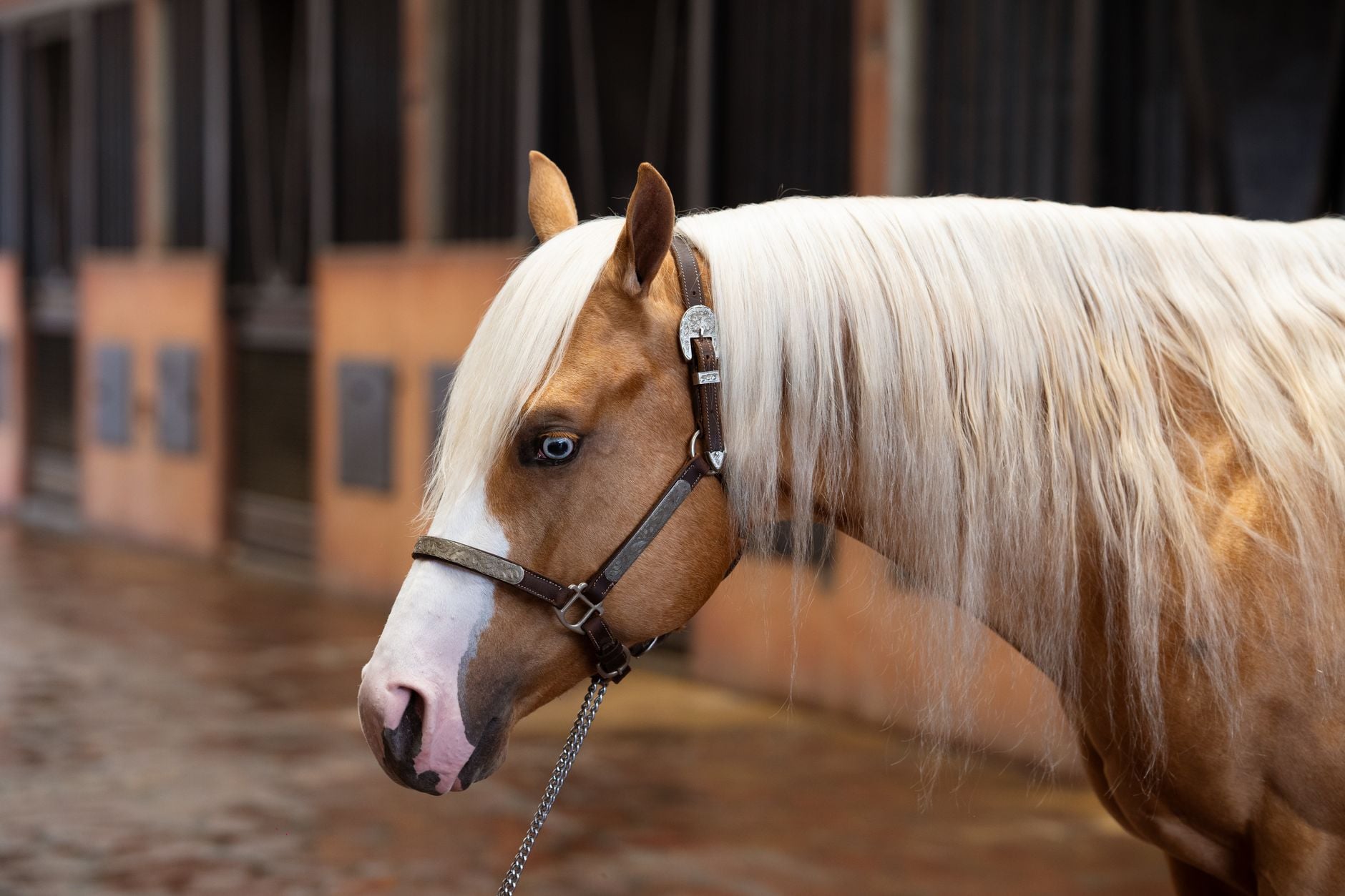
The Stall I Cleaned on Saturdays
Brooke is a nurse in North Platte with three boys. She drove that green Taurus until it had two hundred thousand miles on it.
Dale passed four years ago. I rode Chief in the line of horses at his burial, old as he was, because Mrs. Aldous asked me to. She is eighty now and lives in town, and I take her to church on the Sundays her eyes are bad. That picture she took the first morning sits on her dresser. A girl with a braid and a manure fork, grinning, with her hand on a red horse.
Last October my father brought the hay.
He is seventy-one. He cannot throw bales the way he did, so Jeff stacked and Dad handed them down off the trailer, slow. When they finished he walked over to the corral, where Kim was sitting on Chief with nothing but the halter and that old blue and white lead rope, faded nearly to gray, the knot still in the end.
“Grandpa, hold him so I can get down,” she said.
He took the rope. He stood there holding it after she had slid off and run for the house, and he turned the knot over and over in his fingers.
“You tied this,” he said.
“When I was twelve.”
“I know it. I watched you do it. On the tailgate, the day we brought him home.” He was looking at the rope and not at me. “I knew whose horse he was, Erin. I want you to know that. I have let you think all these years that I figured he was mine because I’d fed him. I never figured any such thing.”
I did not say anything. The wind was moving the dry grass along the fence.
“I was short that fall,” my father said. “Shorter than I let your mother know. And I was too proud to pick up the telephone and tell an eighteen-year-old girl that her dad couldn’t put her sister in a car without her help. So I took the horse instead of asking for it, and I told myself a story about hay.” His jaw worked. “You’d have said yes. That’s the part I can’t get by. If I had called and told you the truth, you’d have cried, and then you’d have said yes, because that’s who you are. And I didn’t give you the chance to be that. I just took it.”
Chief had put his nose down against the old man’s coat pocket, looking for cake.
“I was wrong,” Dad said. “He was yours, and I sold him, and I was wrong. I’m sorry. I should have said that at Aldous’s corral in front of all of them. I have said it in that pickup every fall for sixteen years with a load of hay behind me and never once got it as far as your gate.”
“You got it here today,” I said.
“I’m seventy-one years old. It’s a poor time to start.”
“It’s a fine time, Dad.”
He nodded. He could not talk any more and neither could I. So I did the only thing I could think of, which was to put my hand over his on that lead rope, both of us holding on to a twelve-year-old’s knot, with a twenty-six-year-old horse breathing on us.
After a while he cleared his throat.
“He needs his feet done,” he said.
“Farrier’s coming Thursday.”
“Well. Good.”
He handed me the rope. I have it still. It hangs on a peg by the shed door, where a person can reach it without looking.