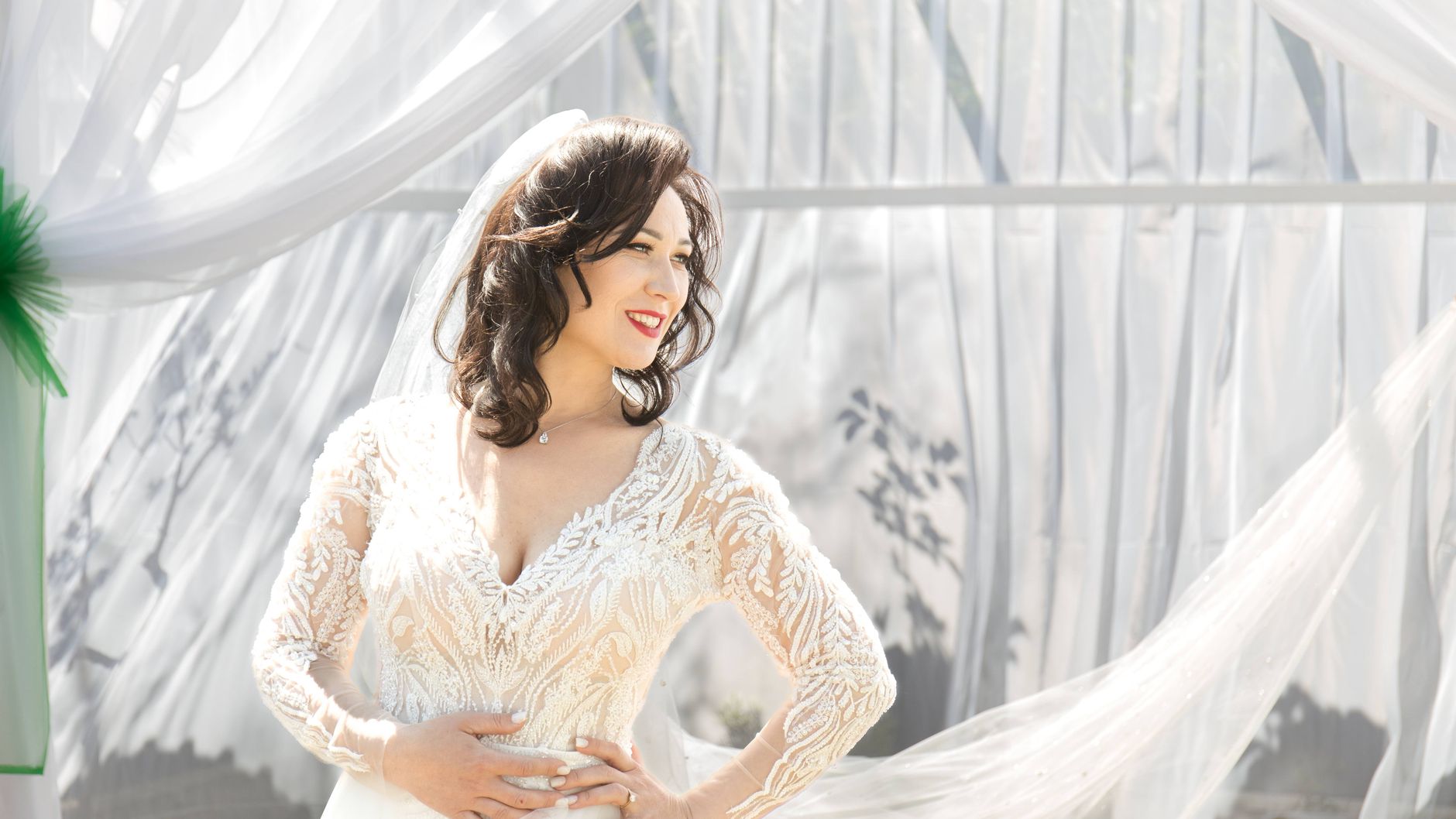
The Wedding in Grandpa Vern’s Hayfield
But there was one chair empty in the front row. It was a real chair, a church chair. I had asked for it in place of the bale.
At a quarter to one, a silver sedan turned in at our mailbox.
It came up the gravel slowly and stopped at the end of the row of pickups. For what felt like a full minute nobody got out.
Then the door opened, and Cynthia stood up out of it, alone.
She had on a cream-colored suit and pearl earrings and three-inch heels. She had her purse in both hands in front of her. She had dressed for the ballroom. I think it was the only way she knew to come.
She looked at the tent. She looked at the hay bales, and the brat cooker smoking, and the stock tank, and the tuba. She looked at one hundred sixty people in their clean jeans and their church dresses, every one of whom she had either invited to a different wedding or crossed off of it.
I know what she expected to see. She had told Luke’s aunt on the phone that we would be eating off paper plates in the mud.
She took one step toward us, and her heel sank clean into the field, right up to the sole.
She stopped. She did not try the other foot. She just stood there, stuck, a hundred yards from anybody, and I watched her face do something I had never seen it do. It got young. It got scared.
Nobody had gone to meet her. That was not meanness. Nobody knew she was coming, and half of them did not know her by sight.
Grandpa Vern saw her first.
“Hold this,” he said, and he handed me his cap.
“Grandpa, we’re supposed to walk in ten minutes.”
“They can’t start without you. You’re the bride.”
He crossed that hay stubble in his good boots, not fast, because he does not do anything fast anymore, but straight. He stopped in front of her and he smoothed down what hair he has.
“Ma’am,” he said, and he held out his arm. “I’m Vern. I’m the grandfather. You’d be Luke’s mother.”
I could not hear what she answered. I saw her lips move.
“Well, those are fine shoes,” I heard him say, “but this field’ll eat them. You lean on me and step where I step. I mowed a path.”
He had, too. I had not noticed it. Sometime that week he had taken the push mower and cut a strip right down to the dirt from the drive to the front row, packed hard and smooth, wide enough for two. He had not told anybody why.
She took his arm.
He walked her the whole hundred yards, past every pickup and every person, at the pace of an eighty-three-year-old man, and he talked to her the entire way as if she were the guest of honor. I saw him point out the barn. I saw him point out the arch. When they came by Roy, Grandpa stopped and said, “This is my brother Roy. Roy, this is Luke’s mother, Cynthia. She drove down from Onalaska.”
And Roy, who had been item number thirty-one on her list, took off his hat and said, “Pleased to know you. That’s a good boy you raised.”
Grandpa put her in the church chair in the front row. He took a folded quilt off the nearest bale and laid it over her knees, because the breeze was cool.