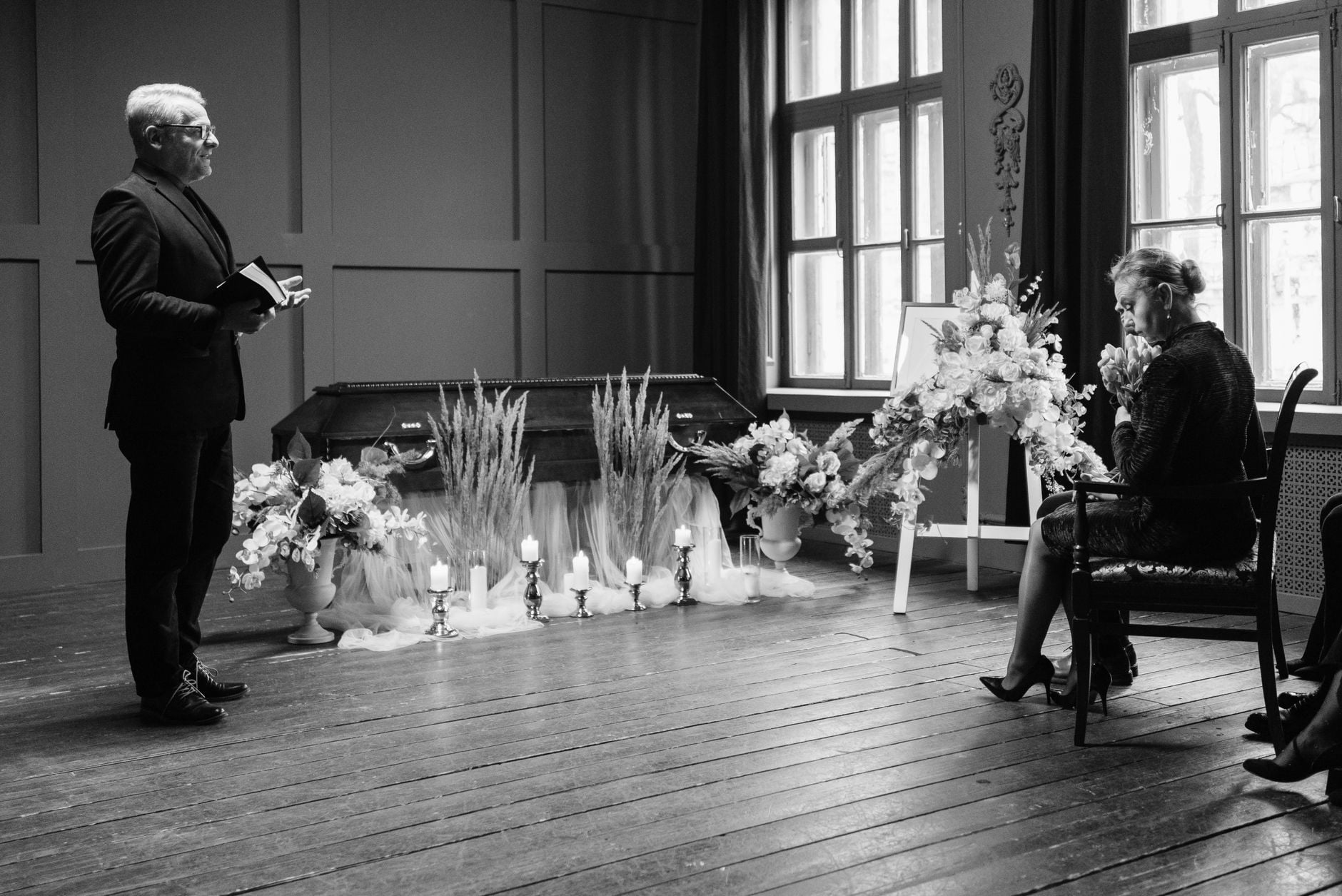
The Funeral They Said Was For Family
The Cemetery And The Fellowship Hall
We buried my father in the Fairbury cemetery, next to my mother, under a sky the color of a nickel. It was twenty-six degrees. I stood at the head of the grave, where the family stands, and the town came by one at a time to take my hand. They did not say much. Women who had spent a year tilting their heads at me now did something I have thought about every day since: they did not tilt them. They looked at me straight, and said my name, and then they looked at the ground.
The lunch was in the fellowship hall at the Methodist church. Marcy had ordered it, a ham and scalloped potatoes and green bean casserole for sixty, and she had not canceled it, and the ladies’ guild, which she had chaired for eleven years, served it anyway.
I walked in expecting to eat alone.
What happened instead was that the women who run that kitchen, five of them in their aprons and their reading glasses, came out from behind the counter all at once. The oldest, a woman in her eighties who had not spoken to me since my confirmation, took the plate out of my hand and put me at the head of the first long table, in the chair nearest the coffee urn. She filled my plate herself. She said, “You sit. We’ll bring it.”
By the end of the afternoon every person who had told me something sad and kind and false about myself had come up and put it right, in their own way. It was not tidy, and it was not painless, and I will not pretend it was a triumph. It was a town admitting it had been wrong, one plate of ham at a time.
Doyle drove me to the shop at four o’clock, in his truck, because I asked him to.
The shop sits behind my father’s house on a gravel pad, a long tin building with a cracked window and the old kerosene heater in the corner and a calendar from a feed store that still said November. Doyle unlocked the side door and flipped on the single bare bulb and stood back.
I walked to the door frame.
They were there. Pencil marks, in groups of five, each group struck through with a diagonal like a tiny fence, going all the way up the inside of the frame from the height of my knee to a little above my head, where he must have stood on the bucket to reach. Hundreds and hundreds of them. Some were dark and fresh, some faded to the gray of old dishwater. In some places the wood had been worn smooth where his thumb had passed over the marks, again and again, the way you would touch a rosary.
I counted them. I could not help it. I am a math teacher.
One thousand one hundred and six.
I sat down on the upturned bucket, the one that was still there beside the heater, and I put my face in my hands, and I cried for the first time since the phone rang before dawn on the day he died. Doyle stood in the doorway with his hat in his hand and said nothing, and I will love him for that until I die.