
I was scraping cold potato salad off a paper plate into the trash can behind the fairgrounds pavilion, three weeks out from twelve straight nights in a vinyl recliner beside my husband’s bed in the cardiac ICU, when Charlene tapped a plastic fork against her sweet tea glass and told a newspaper reporter that everything good about me, she had built herself.
I want to be fair from the start, because fair is the only way I know how to tell this. Charlene Renfro is not a monster. She has spent forty years of her life on that farm outside Harlow Springs, Kansas, cooking three meals a day for my father, driving me to 4-H meetings in a truck with a bad heater, sitting through every school program I ever stood up in after she arrived in my life. What she did on that Saturday in June was not a single cruel act. It was the last inch of a mile she had been walking for four decades, one inch at a time, so slowly that I had convinced myself for years I was the one being unreasonable for noticing it at all.
My mother’s name was Louise. Louise Renfro, though for the first thirty-one years of her life she was Louise Pruett, before she married a wheat farmer named Garland Renfro two counties over from where she grew up and became, in the way small towns collapse a woman down into a single word, simply “Garland’s wife.” She died on a Tuesday in April of 1983, of a ruptured brain aneurysm, standing at our kitchen counter making my school lunch. I was nine years old. I was in the next room watching cartoons with the volume too loud, and I did not hear the sound she must have made when she went down, and I have spent forty-one years now not knowing whether that is a mercy or the cruelest detail of my whole life. My father found her when he came in from the east field for coffee. She was gone before the ambulance from Wheat County General made it out our gravel road. I do not remember the funeral in any complete way. I remember my father’s hands shaking so badly he could not knot his own tie, and a church basement full of casserole dishes with masking tape names on the bottom, and a woman I did not know pressing a peppermint into my palm and telling me to be brave for my daddy, as though brave was a coat I could just put on at nine years old and never take off again.
My father did not remarry quickly, whatever some people in town like to imply now when they tell the story a certain way. It was two full years, two of the loneliest years either of us ever lived through, him running a wheat and cattle operation alone with a grieving daughter and no idea how to braid hair or pack a lunch that wasn’t just crackers and bologna, before he met Charlene Sadler at a Grange hall dance in Salina. She was thirty-four, divorced, raising a boy of her own named Boone who was two years older than me. She was funny in a way that cracked something open in my father’s face I hadn’t seen since before my mother died, and I remember being glad of that, at eleven years old, in the uncomplicated way a child is glad when a grown-up they love stops looking so tired.
Charlene married my father in the spring of 1985. I was eleven. Boone was thirteen. We became, on paper and eventually in fact, a family, and I want to say clearly that a great deal of what Charlene did in the years after that was good and real and cost her something. She learned to make my mother’s rhubarb pie from a recipe card in my mother’s own handwriting, because I asked her to, because I missed the smell of it more than I could say out loud at eleven. She drove me two hours each way to state 4-H competitions in a truck with a heater that only worked if you kicked the dash just right. She sat in the stands at every basketball game I played in high school, in every folding chair at every band concert, and when I got married at twenty-three in the same little Lutheran church where my mother’s funeral had been held, Charlene sewed the hem of my dress herself because the seamstress in town had botched it two days before the wedding and there was no one else to call. I do not tell you any of this to excuse what came later. I tell you because the truth of Charlene is not a simple one, and pretending it is would be its own kind of lie, the same kind she eventually told about me.
Here is the part that took me the better part of thirty years to fully see, because it never happened all at once. It happened one comment at a time, at church potlucks and county fairs and Christmas parties, in front of people who had no way of knowing any better. It started small enough that for a long time I told myself I was being petty for noticing. At a church supper when I was maybe fifteen, a woman new to the congregation asked Charlene how many children she had, and Charlene said, without missing a beat, “Two, a boy and a girl, though I only birthed the one.” I remember standing three feet away with a casserole dish in my hands, feeling something small and cold settle in my stomach, because it was technically true and somehow still not honest, the way she said it made it sound like she had simply always been my mother, like there had never been another woman standing where she was standing.
It kept happening. At my own wedding reception, in front of two hundred people, when the DJ asked Charlene to say a few words as “mother of the bride,” she stood up and told a long, warm story about me learning to ride a bicycle in the driveway, a story that had actually happened when I was six years old, three full years before she ever set foot in Wheat County. She had heard it from my father so many times over the years, I think, that in her own memory it had simply become hers to tell. Nobody in that room but me and my aunt Vada seemed to notice the arithmetic didn’t work, and Vada only caught my eye across the table and gave the smallest shake of her head, the universal signal of a woman who has decided, again, that this is not the hill, not tonight, not at my wedding.
I let it slide for the same reason I let it slide a hundred times over the following thirty years. My father was alive and happy and did not need to referee a war between his wife and his daughter over which one of us got to claim which memory. Charlene, whatever her flaws, had shown up every single day for four decades in ways that mattered, real ways, casseroles-in-the-hospital-room ways, and I did not want to be the ungrateful daughter who couldn’t let a woman have her flowers. And underneath all of that, if I am honest with myself in the way I am trying to be honest with you now, I let it slide because correcting her felt like reopening a wound that had scarred over crooked but had scarred over, and some nights that felt like the closest thing to peace our family had.
My aunt Vada, my mother’s older sister, was the only person who ever said the quiet part out loud to me. Every few years, usually after a few too many of Charlene’s stories at some family gathering, Vada would corner me by the dessert table and say some version of the same thing. “Your mother carried you to every one of your appointments in that county, Hazel. She sat up with you the whole night before your tonsils came out. I was there. I remember. It’s not fair that Charlene gets to be the one everybody remembers when Louise is the one who did the work.” I would tell Vada I knew, that it didn’t matter, that Daddy was happy and that was the important thing. I believed that, mostly, for a very long time. I did not understand yet how much a story can calcify, year over year, uncorrected, until it isn’t a story anymore. It’s simply what everyone in a town believes to be true.
Get a new story in your inbox every morning.
Facebook doesn’t show you every story we post. Our free newsletter does. Join 2,500+ readers.
The year I graduated from the University of Kansas, the Harlow Springs Ladies Auxiliary put Charlene up for their annual Mother of the Year nomination, and the nomination letter, which I only ever saw because Vada kept a copy, described her walking the floor with a colicky infant for months on end and coaxing a shy little girl out of her shell at the county fair pie contest, two things that had absolutely happened, only they had happened to Louise, with me, a full decade before Charlene ever crossed the county line. Charlene did not write that letter herself. A well-meaning neighbor wrote it from stories she’d heard secondhand at church, stories that had already, by then, lost track of which mother they belonged to. Charlene did not correct it when it ran in the Gazette’s spring edition with her photograph beside it. She kept the clipping. I know she kept it because I saw it, years later, in a scrapbook on her coffee table, and I said nothing, the same way I always said nothing, because by then silence had become the family’s whole operating system and I did not know how to be the one who broke it first.
It happened again at my daughter’s baby shower, of all places, a full twenty-eight years after my mother died, when an old family friend leaned across the punch bowl and told my daughter, sweetly, with no idea what she was doing, “Your grandma Charlene basically raised your mama from a baby, you know, they don’t make women like that anymore.” My daughter, twenty-four at the time and gently corrected the woman without even thinking twice, said, “Oh, I think that was mostly my great-grandma Louise, actually, Grandma Charlene came along later,” and I remember watching Charlene’s face across the room go tight and pleasant at the same time, the exact expression of a woman absorbing a correction she has no intention of ever repeating out loud. I did not bring it up with her that night either. I have run out, more than once over the years, of the will it takes to keep correcting the record in real time, one comment at a time, at every party, for the rest of both our lives.
What finally broke that thirty-year silence had almost nothing to do with Charlene at all, at least not at first. Three weeks before the Harlow Springs Founders Day reunion, my husband Rusty collapsed in our garage on a Sunday morning trying to lift a bag of mulch, and by that afternoon he was in emergency quadruple bypass surgery at the regional medical center forty miles from our house. I spent the better part of two weeks living out of a hospital recliner, eating vending machine crackers, watching monitors I did not understand for signs I was too afraid to name, calling my grown children with updates I tried to make sound calmer than I felt. Rusty came home nine days before the reunion, weak and gray and grateful and alive, and every instinct in my body told me to stay home with him instead of driving three hours to a fairgrounds pavilion for potato salad and small talk. But my father is eighty-four now, and two years into a vascular dementia that has been stealing him from us in pieces, and I did not know, the way you never fully know at that stage, how many more Founders Days he had left in him where he would still recognize my face when I walked up. So I kissed Rusty goodbye, left him in our son’s care for the weekend, and drove to Harlow Springs running on maybe eleven hours of sleep spread across four days, carrying a grief I hadn’t finished having and a fear I hadn’t let myself say out loud yet.
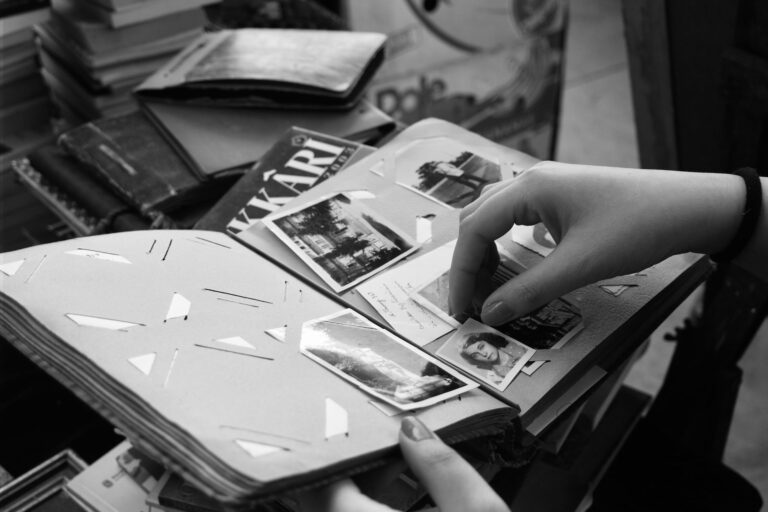
I also, almost by accident, was carrying something else. In the weeks Rusty was in the hospital, in the strange hollow hours of a waiting room at two in the morning, I had done something I hadn’t done in years. I had gone home one exhausted night, unable to sleep, and pulled down a water-stained cardboard box from my hallway closet that I had inherited after my mother died and never fully unpacked, not once, in forty-one years. It was easier, somehow, to sit on my kitchen floor at midnight going through my dead mother’s things than to sit with the fear of losing my husband too. Inside that box was a photo album my mother had kept, a plain blue cloth-bound thing with her handwriting on nearly every page, and I had spent three separate sleepless nights that month going through it page by page, crying in a way I hadn’t let myself cry in decades. I had planned to bring it to show my aunt Vada that weekend, because Vada had been asking for years if I still had it, and because some part of me, exhausted and raw and grieving in advance for a father who was already halfway gone, wanted to hold something of my mother’s close. So the album was in a canvas tote in the back seat of my car when I pulled into the fairgrounds parking lot that Saturday morning, and I had no idea yet how much that plain blue book was about to matter.
The Harlow Springs Founders Day reunion has been held at the county fairgrounds pavilion every June for as long as I can remember, three long folding tables pushed together under a metal roof, a hundred and some relatives and neighbors passing dishes down the line, my father’s whole extended family plus half the town, because in a place the size of Harlow Springs, family and town are not always separate categories. This year, the local paper had sent someone. The Wheat County Gazette had been running a summer series called “Women Who Built Wheat County,” short features on longtime local women, and someone on the church council had nominated Charlene for her four decades of hospice volunteering and her twenty-two years running the elementary school’s backpack food program. A young reporter with a county press badge clipped to her shirt pocket showed up around noon with a notepad and a camera, trailing Charlene around the pavilion, jotting things down while Charlene, in her element, told story after story for the record.
I want to tell you I saw it coming, but I didn’t, not really, not the specific shape of it. I was three tables down, dishing out potato salad, running on no sleep and a low hum of dread about my father and my husband both, when Charlene stood up at the head of the table with her tea glass in hand, tapped it once with a plastic fork, and asked for everyone’s attention because the nice reporter wanted a quote for the paper.
“I raised that girl from a baby,” Charlene said, gesturing toward me with her glass, her voice carrying easily across the pavilion the way it always has, a voice built for church announcements and school board meetings. “Every skinned knee was me. Every school program, every hospital bed, every birthday, that was me, standing right there. Louise, God rest her, was gone before Hazel could even tie her own shoelaces. Whatever this girl turned into, whatever she’s proud of in her life, she got it from being raised in my house, under my roof, by these two hands.”
The pavilion went quiet the particular way a room goes quiet when everyone senses something has shifted but nobody is sure yet how far. The reporter’s pen was moving. Boone, standing near the grill, went very still. My father, in his wheelchair at the end of the table, smiled the vague, pleasant smile he wears now for most of what he can no longer follow, and said, “That’s right, that’s right,” the way he says that’s right to almost everything these days, agreeable and lost in equal measure, and something about my own father’s confused endorsement of a lie hurt worse than the lie itself.
I want to explain why that particular sentence, on that particular day, was the one that finally broke thirty years of my own silence, because on paper it wasn’t even the worst thing Charlene had ever said. I think it was the arithmetic of it, stated so plainly, in front of a reporter who was about to print it in a paper that would sit on coffee tables and in doctor’s office waiting rooms across the whole county, in a form more permanent than any potluck story had ever been. I think it was that I had just spent three weeks watching my husband nearly die and my father slowly forgetting who I was, two griefs running at once with nowhere to put either of them, and into that exact exhausted, raw moment came a woman claiming credit for a childhood that had, in fact, been carried almost entirely by a woman who was no longer alive to defend it. Every skinned knee. Every school program. Every hospital bed. I stood there with a spoon of potato salad halfway to a paper plate and I thought, very clearly, for the first time in my adult life: that is not true, and I have the proof in the back seat of my car, and I am done letting this go.
I set the spoon down. I did not say anything to Charlene in that moment. I walked out of the pavilion, across the gravel lot in the June heat, and I opened the back door of my car and pulled out the canvas tote with my mother’s blue photo album inside it, and I carried it back into that pavilion with my hands shaking harder than my father’s had at my mother’s funeral forty-one years before.
I set the album down on the picnic table in front of Charlene, in front of the reporter, in front of my father and Boone and Aunt Vada and forty or fifty other relatives who had gone quiet in that particular fairgrounds-pavilion way, and I opened it to the first page.
“This is my mother, in the hospital, the day I was born,” I said, turning the album so the reporter could see it too, a black and white photo of a young Louise Pruett Renfro, twenty-two years old, exhausted and radiant, holding a newborn me against her chest, the date written in her own careful hand on the white border beneath: August 14, 1974. “You weren’t in this county yet, Charlene. You wouldn’t move here for another eleven years.”
I turned the page. “This is every birthday card my mother ever made me by hand, one every year from the time I was two until the year she died, because she couldn’t always afford store-bought and never once wanted me to know the difference.” I laid the cards out one by one, hand-drawn balloons and lopsided hand-lettered numbers, each one dated on the back, each one signed the same simple way: Love, Mama. The last one in the stack was dated the February before she died, the year I turned nine, a wobbly crayon rendering of a birthday cake with candles that didn’t quite line up.
I turned the page again. “This is the hospital chair my mother slept in for two nights when I broke my leg falling out of the hayloft, the summer I was eight, in 1982.” The photo showed Louise asleep upright in a vinyl hospital chair, my small leg in a plaster cast visible in the corner of the frame, a hospital admission slip tucked into the album’s plastic sleeve beside it, the printed date stamped clear as anything: July 1982. “You were living in Salina in 1982, Charlene. You wouldn’t meet my father for three more years.”
I kept going, because once I started I found I could not stop, and some part of me understood I had thirty years of silence to spend all at once. The second-grade spelling bee, my mother in the third row of folding chairs in a photograph someone else’s parent had taken and mailed to her, the printed school program glued into the album beside it, dated the spring I was seven. A photo from Easter Sunday the year I turned six, my mother’s handwriting on the back describing the exact dress I wore, a dress Charlene had, more than once over the years, described in her own stories as one she had sewn herself. I laid down a Polaroid of the door frame in our old farmhouse kitchen, pencil marks climbing up the wood with dates beside each one in my mother’s hand, the last mark dated six weeks before she died, a full two years before Charlene ever walked through that kitchen door. And last, the page I had cried over hardest at my kitchen table three weeks before, my mother’s own journal, a slim cloth notebook she had kept in fits and starts through my childhood, opened to the final entry she ever wrote, dated four days before she died. Hazel’s spring music program is next Tuesday, it read, in handwriting that had no idea it was running out of time. She’s been practicing her two lines every night at the kitchen table and she still can’t say “chrysanthemum” without giggling. I would not miss this for the world.
She did miss it. She died on a Tuesday, the same Tuesday the entry named, before the sun went down on the day of that program, and I stood in a school gymnasium four days later and said my two lines to an audience that included my father, sitting alone in the third row, and did not include my mother, who had written in her own hand four days earlier that she would not miss it for the world.
I closed the album. The pavilion was silent except for someone’s toddler fussing two tables down and the low mechanical hum of the reporter’s camera, which had not stopped clicking through most of it.
“I am not trying to erase what you’ve done for me, Charlene,” I said, and my voice was shaking but it did not break. “You have been in my life for thirty-nine years and a lot of that was real and a lot of it was good and I have never once denied that out loud, not to you, not to anyone. But you did not raise me from a baby. You did not sit through every hospital bed. My mother did the first nine years, all the way to a ruptured aneurysm at her own kitchen counter, and then she was gone, and then, two years after that, you came, and you did the rest. Both of those things can be true at the same time. I have spent thirty years letting you say only your half of it out loud, because I loved my father and I didn’t want to make trouble, and I am done doing that today.”
Boone was the first one to speak. He came around the end of the table, put a hand on his mother’s shoulder, and said, quiet enough that I almost didn’t catch it, “Mom, I’ve known that spelling bee story wasn’t right for twenty years. I never said anything because I didn’t want to hurt you. I think I did more harm not saying it than I would have saying it a long time ago.” My father, in his wheelchair, was looking at the open album on the table, and his face did something I hadn’t seen it do in over a year, a flicker of real focus cutting through the fog that dementia had laid over him. He reached out one shaking hand and touched the photo of my mother in the hospital chair, and he said, so quietly only the people closest to him heard it, “Louise never could stay awake past nine o’clock unless one of us was sick. She used to sing to you off key in that kitchen. Terrible voice. Loved it anyway.” It was the first time in fourteen months my father had said my mother’s name out loud in front of the family without prompting, and I had to hold onto the edge of the picnic table to keep my knees from going.
Aunt Vada came around the table then too, and put both hands flat on the closed cover of that blue album like she was steadying it, or maybe steadying herself. “I told you thirty years ago somebody needed to say this out loud,” she said to me, quiet, not gloating, just tired and relieved in the way you are when a weight you’ve carried alongside someone finally gets set down. “I’m sorry it took this long. I should have helped you carry it sooner instead of just standing next to you shaking my head.” A few of the older cousins who remembered my mother from church, women in their sixties and seventies now, started nodding along the table, one of them saying softly that she’d always wondered about the timeline in Charlene’s stories but had never felt it was her place to ask.
Charlene did not say anything for a long moment. Then she sat down, hard, on the picnic bench, and put both hands over her face, and when she finally spoke it was not the defensive, glass-raising voice from ten minutes earlier. It was smaller. “I know she did all that,” Charlene said, from behind her hands. “I have always known. I just, I never got to be the first wife in anybody’s memory, Hazel. I never got to be the pretty young mother in the hospital photo everybody keeps. Every year I stayed and showed up and packed lunches, I felt her getting more remembered instead of less, and it scared me. So I started saying it a little bigger every time I told it, until one day I couldn’t remember which parts were true anymore either.” She was crying by then, not performing it, just crying, an old and tired kind of crying. “I never wanted to erase her. I wanted somebody to remember me too.”
I did not forgive her fully in that pavilion, and I want to be honest with you about that instead of tying it up too neatly for the sake of a good ending. Thirty years of small erasures do not undo themselves in one conversation over a picnic table, no matter how many photographs you lay out. But something did shift that day, something real, and it kept shifting the next morning, when Charlene knocked on the door of the little motel room I’d rented in town and asked if she could sit with me on the tailgate of my truck while the sun came up over the wheat.
We talked for two hours out there, longer than we had talked honestly to each other in years. She told me things about her own childhood I had never known, the middle daughter of six, a woman who left before Charlene turned ten, a lifetime spent being the one nobody wrote poems about. I told her what it had cost me, all those years, to smile through her stories at church suppers and wedding receptions, to swallow it every single time for the sake of my father’s peace. We did not solve four decades of it on a tailgate in one morning. But we agreed, out loud, on a version of the truth we could both live inside going forward, and we have both kept to it since. My mother raised me the first nine years, through a broken leg and a spelling bee and every birthday card in that album, and she died before she got the chance to see the rest. Charlene raised me every year after that, real work, real love, real sacrifice, standing in the gap my mother’s death had left, never quite as the first mother, but never as nothing either.
The reporter’s story ran three weeks later, not as the single-subject feature the paper had originally planned, but under a new headline the young reporter had fought her editor for: two women, two decades apiece, one daughter raised whole by both of them. Charlene keeps a copy of it folded in her Bible now, and so do I. My father’s dementia has not slowed down since that Founders Day, and some visits now he does not know my name at all, but on the good days, the ones that come less often every season, he still sometimes reaches for that blue album on the shelf where Charlene put it, right beside the family Bible, and he touches the photo of a young woman holding a newborn in a hospital bed, and he says her name.
Charlene and I hung two photographs on the farmhouse living room wall this spring, side by side in matching frames, something neither of us had ever done in thirty-nine years of sharing that house. One is Louise, twenty-two years old, holding me the day I was born. The other is Charlene, thirty-nine years old, standing beside me at my wedding in the dress she hemmed by hand three days before the ceremony. Underneath both, on a little brass plate Boone had engraved without either of us asking him to, it says the only sentence that has ever actually been true: Both of these women raised her. I drive past that wall every time I visit my father now, and for the first time in my life, it tells the whole story instead of half of it, and that, more than any apology either of us could have found the words for, is the part that finally let something in me rest.
This story is a dramatization. Names, characters, and details are invented, and any resemblance to real people or events is coincidental.