
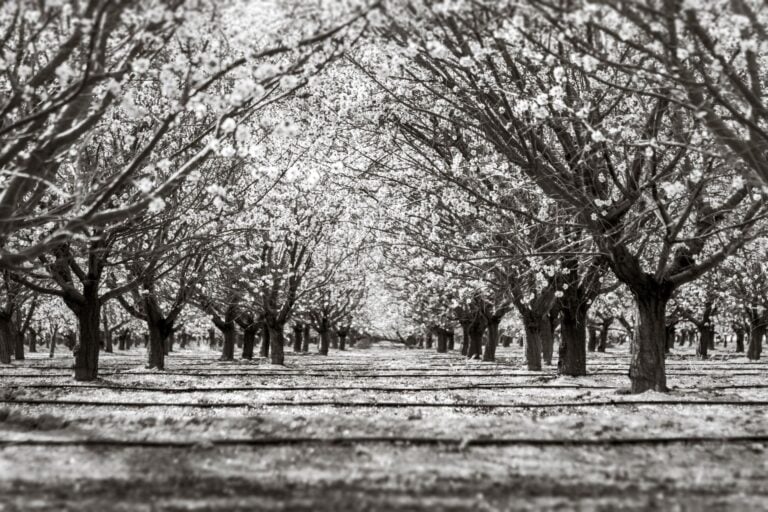
My son-in-law Bryce Halloran stood at the head of my mother’s dining table, in my parents’ house, and told my whole family that the deed to our orchard had been “lost in probate.” He said it the way a man reads a weather report. Flat. Certain. Already moving on to the next line item.
“There’s no title on file,” he said. “No recorded deed, no notarized copy, nothing the county can point to. Which means, legally, this land is sitting in a gray zone, and gray zones don’t sell. If we want any value out of it at all, we list it as unencumbered acreage and let Ridgeline take it as-is.”
I am seventy-one years old. I have picked Blenheim apricots off these same trees since I was seven, standing on a wobbly ladder my father built out of scrap two-by-fours, my mother hollering up at me to hold the rail. I have watched frost blankets go up over these rows more nights than I can count, my father out there at three in the morning in his union suit and coat, walking the rows with a lantern like he was tending something alive, because he was. I was not going to sit at that table and let a thirty-four-year-old man in a golf polo tell my family our orchard didn’t legally exist.
But I didn’t say anything. Not yet. Because the deed wasn’t lost. I had a certified copy of it, and I knew exactly where it was, and Bryce Halloran was never, in a hundred years, going to think to look there.
The orchard
The place is called Prentice Orchard, forty-one acres of Blenheim apricots, a stand of old Bartlett pears my grandfather put in during the Depression because pears sell even in bad years, and six rows of Santa Rosa plums my mother planted the year I was born, 1955, out past Fresno in the flat gold country where the Sierra foothills start to rise up blue in the distance if you look east in the evening.
My father, Elias Prentice, bought that land in 1949 with money he saved doing two jobs, one at a packing shed and one shoeing horses for the ranches out toward Clovis. He was a man who did not trust banks, did not trust lawyers much either, and trusted paper least of all things that could be lost, burned, water-damaged, or simply misplaced by somebody careless. He trusted dirt. He trusted what he could put his hands on.
He used to say the orchard was the only inheritance that couldn’t lie to you. “A stock certificate can go to zero overnight,” he told me once, out in the truck on the way to the co-op, “but a tree either bears fruit or it doesn’t, and you can see which one it’s doing with your own eyes.” He didn’t finish high school. He read the Fresno Bee cover to cover every single day of his life and he could talk crop futures with men who had agriculture degrees from Fresno State, and every one of them left those conversations a little chastened.
I took over the day-to-day of the orchard when he got too old to climb the ladders himself, sometime around 1998. My wife Marguerite and I moved into the old farmhouse. We raised our daughter Delia there, in the same bedroom that had been mine, looking out over the same rows of trees. My father lived another eleven years in a smaller house we built for him at the edge of the property, close enough that I could see his porch light from my kitchen window every night, which mattered more to both of us than either one of us ever said out loud.
He died in the spring of 2019, during bloom, which felt right in a way that’s hard to explain to anyone who hasn’t farmed. The whole orchard was white with blossom the week we buried him. Delia flew in from Sacramento for the funeral. Bryce came with her. That was the first time I really understood what kind of man my daughter had married, though it would take five more years for the full shape of it to come clear.
Delia and Bryce
Delia is my only child. She is smart, kinder than her father in the ways that matter, and she has always had a soft spot for people who talk fast and sound sure of themselves, which I think comes from growing up around a father who talks slow and hedges every claim with “far as I know” and “best I can tell.” Bryce Halloran talks like a man reading off a teleprompter that only he can see. He sells commercial real estate out of an office in Fresno, mid-rise buildings, strip centers, the kind of deals that get done over lunch and never mentioned again if they fall through.
For the first few years he was careful around me. Polite in the specific way people are polite when they haven’t decided yet whether you’re worth impressing or worth ignoring. He’d ask about “yield projections” at Thanksgiving like the orchard was a line item he was pricing in his head. I let it go. Marguerite told me I was too hard on him, that he was just a young man trying to find his footing in a family that grew fruit instead of closing deals, and she was probably right, or partly right.
The trouble started in earnest about eighteen months ago, when the Ridgeline Development Group started buying up parcels along the county road that runs past our southern boundary. Ridgeline builds the kind of subdivisions that get named after the thing they bulldozed to make room for themselves. Orchard View Estates. Meadowbrook Commons. They’d already taken the Yamada place and the old Petrocelli walnut ranch two miles down, and their site plan, which somebody at the county planning office let slip to a friend of mine, had our forty-one acres penciled in as Phase Three.
Bryce came to me directly first, back in January, over coffee at the kitchen table, Marguerite pretending to read the paper across the room so she could hear every word.
“Wally, I’ve run the numbers on what Ridgeline’s paying per acre out on County Road 9,” he said. “You’re sitting on land that could set Delia and me up for the rest of our lives. Set you and Marguerite up too, for whatever’s left. You could retire to the coast. You could stop working this hard at seventy-one.”
I told him the orchard wasn’t a retirement account. I told him my father was buried on a rise at the eastern edge of the property, under a stand of live oaks he’d planted himself, and that Ridgeline’s site plan didn’t have a line item for moving a grave. Bryce nodded like he’d expected that answer and had already planned around it.
Get a new story in your inbox every morning.
Facebook doesn’t show you every story we post. Our free newsletter does. Join 2,500+ readers.
“Nobody’s talking about your father’s resting place,” he said. “That’s not on the table. I’m talking about the working acreage. The trees.”
I said no. Plainly, the way my father would have said it. No.
The gray zone
Bryce didn’t ask again for a while. I found out later that “for a while” meant he’d shifted tactics, not given up. He started talking to Delia at home, in Sacramento, out of my earshot, about how tired I looked, how the orchard was bleeding money in a bad water year, how Marguerite’s hip surgery bills were piling up. All of that had some truth in it, which is what made it work on Delia. Farming is hard on a body and the water allocation had been brutal two years running and yes, the hip surgery cost more than our insurance covered. Bryce is good at building an argument out of real bricks. That’s what makes him dangerous. He doesn’t lie so much as he arranges true things into a shape that points where he wants you to walk.
What he needed, though, was a way in that didn’t require my signature, because he knew by then he’d never get it. And that’s when he found his opening: a filing error.
Fresno County had a records migration project that ran from 2021 to 2023, digitizing decades of paper deeds into a new county GIS system. It was a mess, by all accounts, understaffed and rushed, and a not-insignificant number of older parcel records came out the other side with gaps, misfilings, deeds attached to the wrong parcel number, whole folders that simply didn’t make the transfer. Ours was one of them. When Bryce pulled the county’s online parcel record for Prentice Orchard, purely, he claimed, out of due diligence as Delia’s husband and a man who “just wanted to understand the family’s asset picture,” what came back was a hole. No recorded deed on file. No transfer history. Just APN 042-190-15, forty-one point three acres, owner of record blank.
He did not call the county recorder’s office to ask what had happened. He did not call me and ask if I had a copy. He took that hole and he built a story around it, and the story was: the deed is lost, the land is functionally unencumbered, and if we don’t act fast, Ridgeline’s offer window closes and this family loses generational wealth over a filing cabinet.
He brought that story to Thanksgiving.
The dinner
We were all at my parents’ old house, the one my father and I built additions onto over forty years, the one that still had his reading chair in the corner nobody sat in. Marguerite had made the same dinner she makes every year, and Delia had brought her famous cranberry relish, and for about an hour it was a normal, good holiday, the kind that makes all the rest of it worth it.
Then Bryce set down his fork, cleared his throat in a way I now recognize as a man about to deliver a presentation, and told the table the deed was lost.
“I did some digging,” he said, “because frankly, Wally, at your age, I think somebody in this family needs to be thinking about these things even if you won’t. The county has no deed on file for this property. None. I talked to a title attorney friend of mine and he says without a recorded deed, you can’t clear title to sell, you can’t easily transfer it in an estate, and if the county ever wanted to dispute the boundary, you’d have no paper standing. Ridgeline’s number for the parcel is real. It’s generous. But their window closes end of quarter and if we don’t get ahead of the title issue now, this whole asset could end up tied up in litigation for years after you’re gone, Wally, and that’s not something I want Delia dealing with while she’s grieving.”
Delia looked stricken. My wife’s fork stopped halfway to her mouth. My grandson Milo, eleven years old, kept eating his mashed potatoes, blessedly unaware that his father was in the process of trying to sell the ground his great-grandfather was buried in.
“So what are you proposing,” I said. I kept my voice level. My father taught me that the man who raises his voice first has already lost the room.
“I’m saying we should let me handle a conversation with Ridgeline’s acquisitions team,” Bryce said. “Quietly. Get ahead of it before the title gap becomes public record and tanks the value entirely. I can broker the whole thing. Delia inherits eventually anyway, Wally, this isn’t me trying to take anything from you, I’m trying to protect what’s already, functionally, hers.”
There it was. Functionally hers. He’d already decided, in his head, that the orchard belonged to my daughter in some abstract legal sense that entitled him to negotiate its sale over dinner, forty pounds of turkey and a missing filing cabinet away from ever having asked me a single direct question about whether I wanted to sell.
What I had
Here is what Bryce Halloran did not know, because he never once, in five years of marriage into this family, asked my father a single question about how the man ran his affairs.
My father did not trust the county. He’d watched, over sixty years, three different clerks lose paperwork, two courthouse fires elsewhere in the state make regional news, and one whole shelf of deed books get water-damaged in a 1986 storm that flooded the Fresno County records annex basement. He decided sometime in the 1970s that he would never again rely on a single copy of anything that mattered sitting in a government building he didn’t control.
So when he refinanced the orchard’s original note in 1981 to buy the parcel that became the plum rows, he had his lawyer draw up and notarize three certified copies of the recorded deed. One went to the bank, standard practice. One he kept in a fireproof box in his own house. And one, the one that mattered most to him, he hid.
He told me where, exactly once, the winter before he died, sitting in his small house at the edge of the property with a space heater going and a cup of the terrible instant coffee he insisted on drinking until the end.
“Wally,” he said, “there’s a copy of the orchard deed, certified, notarized, good as gold, and I put it somewhere nobody in this family would ever think to look, because it isn’t in a safe or a lawyer’s office or a lockbox. It’s in the one place a man like that doesn’t go looking, because he doesn’t believe there’s anything worth finding there.”
He’d hidden it inside the housing of the old hand-crank irrigation pump at the edge of the plum rows, the one that’s been decorative since 1994, rusted solid, sitting there since before Delia was born, a piece of equipment so plainly useless that nobody, in thirty years, had ever once opened it up. My father had welded a small waterproof tin inside the pump housing itself, behind the flywheel, sealed with a gasket he’d cut by hand. He told me because he wanted one other living person to know, in case something happened to him before he could tell me himself, or in case I needed it someday and he wasn’t there to say where.
I never told Marguerite. I never told Delia. There was no need to, not until there was.
Thanksgiving, continued
So when Bryce Halloran sat at that table and told my family the deed was lost, told my daughter that her inheritance was hanging by a legal thread that only he could see and only he could fix, I let him finish his whole speech. I let him get all the way to the part where he said, “I really think, as a family, we need to move on this before the window closes.”
Then I set down my own fork.
“The deed isn’t lost, Bryce,” I said. “I have a certified copy of it. I’ve had access to it my whole life. Your title attorney friend is right that the county’s copy went missing in that records migration mess two years ago, that part’s true, I got a letter about it myself and just never mentioned it to you, because it never occurred to me that a filing gap at the county would somehow become a reason to sell my father’s orchard to a subdivision developer at my own Thanksgiving table.”
Bryce’s face did something I’ll remember for the rest of my life. It wasn’t shame, not right away. It was recalculation. I watched him try to figure out, in real time, how to fold this new information into his pitch instead of retreating from it.
“That’s, that’s great news, actually,” he said, too fast. “If you’ve got a copy, we can get it re-recorded with the county immediately and then we’re actually in a stronger position with Ridgeline, because now there’s clean title AND a motivated buyer at a great number, we could close even faster than -“
“There’s no closing,” I said. “There’s no sale. There was never going to be a sale, Bryce. I told you no in January. I’m telling you no again now, in front of your wife and my grandson, so there’s no confusion later about what was decided and by who.”
Delia
My daughter did something at that table I will be grateful for until the day I die. She looked at her husband, not at me, and she said, “Bryce, how long have you known the county copy was missing?”
He hesitated, which was its own answer.
“Since about February,” he said finally.
“You’ve had a filing gap sitting in your pocket for ten months,” Delia said, “and instead of telling my father, who you could have called anytime, you built a whole case to sell his land out from under him and dressed it up as protecting my inheritance.”
“I was trying to protect this family’s financial future,” Bryce said, and I could hear, underneath it, that he believed that. That’s the part that still unsettles me, more than a year later. I don’t think Bryce Halloran ever once thought of himself as the villain of this. I think he truly believed a spreadsheet could love this family better than an orchard could, and that everything else, my father’s grave, the pump housing, forty-one acres my family fed itself off of through three separate droughts, was just friction standing between us and the correct financial decision.
“You weren’t protecting anything,” Delia said. “You were trying to close a deal on land you don’t own, using a filing error you didn’t disclose, at a dinner table, in front of an eleven-year-old, on the one holiday my grandfather is buried three hundred yards from where we’re sitting.”
Milo, to his credit, chose that exact moment to ask if there was more pie, and it broke the worst of the tension just enough for Marguerite to get up and start clearing plates, her hands shaking slightly, the way they do when she’s furious and trying not to show it in front of company.
What happened after
The following Monday I drove out to the plum rows myself, first time in a few years I’d gone out to that old pump housing with a wrench instead of just walking past it admiring it as scenery. It took me the better part of an hour to work the flywheel loose, my hands not what they used to be, but the tin was exactly where my father said it would be, the gasket had held, and the deed inside was as crisp and legible as the day it was notarized, forty-four years ago.
I took it to the county recorder’s office myself the next morning. The clerk who helped me, a patient woman named Priya who’d clearly dealt with a fair number of digitization-migration casualties that year, re-recorded it inside of two hours and gave me a fresh certified copy with the current date stamped on it, so there would never again be a gap for anyone to build a story out of.
I did not sell to Ridgeline. I never had any intention to. I had the parcel put into a trust the following month, with Delia and Milo as the named beneficiaries and a clause, my lawyer’s suggestion, requiring unanimous consent of every living beneficiary before any portion of the land could ever be sold, refinanced, or optioned to a developer. Bryce, notably, is not a beneficiary. That was Delia’s call, not mine. She made it without me asking.
Delia and Bryce are still married. I want to be honest about that, because this isn’t a story where the villain gets cast out into the snow and the family closes ranks against him forever, however satisfying that version might read. Marriages are more complicated and more stubborn than that. Delia told me, a few months after Thanksgiving, that she and Bryce were in counseling, that he’d admitted, in a session, that he’d let his work brain, his always-be-closing brain, walk into a family conversation where it had no business being, and that he was ashamed of how close he’d come to actually pulling it off. I don’t know if I fully believe that shame is permanent in a man like Bryce. I know that Delia is watching him more closely now, and that she told him plainly, in front of me, that if anything like that ever happened again, over any asset, any inheritance, any decision that was never his to make, it would be the last conversation they had as a couple. He heard her. I saw him hear her.
The pump
The old irrigation pump still sits at the edge of the plum rows. I had a welder friend reseal the housing after I took the deed out, and I put a second copy in there myself, notarized fresh, because some habits a father teaches you are worth keeping even after the crisis that taught you the lesson has passed. Milo asked me once why there was an old broken pump just sitting out in the field doing nothing, and I told him it wasn’t doing nothing, it was keeping a secret, the way some of the most important things in a family do.
I go out there sometimes in the evening, when the light goes that particular gold color it only goes in the last hour before sunset out here, and I stand where my father is buried under the live oaks, and I look west across forty-one acres of trees that fed this family through droughts and funerals and a records migration project and a son-in-law who thought a spreadsheet could out-argue a deed. My father built this place out of distrust for anything that could be lost, burned, or misplaced, and it turned out, in the end, his distrust was the thing that saved it. Not a lawyer. Not a county database. A tin box, welded shut inside a rusted pump nobody thought to look at twice, because he understood something about people like Bryce long before Bryce ever walked into this family: the man who’s looking to take something from you is only ever looking in the places he thinks matter. He never thinks to look in the places you actually kept what mattered most.
The orchard is still ours. It will be Delia’s, and after her, Milo’s, and there is a piece of paper, certified, notarized, and now sitting safe in three separate places instead of just one, that says so in my father’s name and mine, in ink that has already outlasted one man’s attempt to write us out of our own land.
What Ridgeline never got
I never told Ridgeline no myself, because I never once told them yes, or maybe, or let’s talk. Bryce had been the one carrying on those conversations, quietly, through an acquisitions man named Colton who worked for Ridgeline out of a leased office in downtown Fresno with a lot of glass and not much furniture. I found that out only after Thanksgiving, when I finally asked Bryce, flat out, how far along those talks had actually gotten.
Further than I liked. There had been two site visits Bryce arranged without telling me, both timed for days I was at the co-op or up at the Fresno State ag extension office asking about a new rootstock for the Bartlett pears. Colton had walked the southern boundary with a surveyor, had photographs of the old barn and the packing shed, had even, according to Delia, floated a number to Bryce in the low eight figures for the whole forty-one acres, contingent on clean title.
I called Colton myself, the week after Thanksgiving, from the kitchen table, with Marguerite sitting across from me not pretending to read the paper this time, just watching.
“Mr. Prentice,” Colton said, and I could hear him recalibrating his voice the way salesmen do when they realize the actual decision-maker has finally picked up the phone, “we’d love to have a conversation about the parcel whenever you’re ready. No pressure at all, obviously your timeline.”
“There isn’t going to be a conversation,” I told him. “There’s no parcel for sale. I’d appreciate it if Ridgeline took Prentice Orchard off whatever list it’s on, and I’d appreciate it even more if nobody from your office walks my property lines again without calling me first. Not my son-in-law. Me.”
He was polite about it. Development men usually are, right up until the land actually says no to them, and then they move on to the next name on the list, because there’s always a next name. Ridgeline closed on the old Castellanos vineyard two parcels over from us that spring instead, and I hear they’re calling it Vineyard Ridge Estates, which tells you everything you need to know about how much imagination goes into naming a subdivision built on somebody else’s life’s work.
My father’s other lesson
I’ve thought a great deal, in the year since, about why my father chose that pump housing specifically, out of every hiding place on forty-one acres. He could have used a safe deposit box. He could have given a copy to his own lawyer, the way he did with the bank copy, and trusted the profession to hold it. He chose, instead, a piece of rusted farm equipment that had been decorative and useless for thirty years, sitting in plain sight the whole time, walked past by every hired hand, every insurance adjuster, every well-meaning relative who ever set foot on that land.
I think now that he understood something about the nature of the people who eventually come looking to take a family’s land away from them. They look in the places that look like they matter. Safes. Lawyers’ offices. Bank vaults. Filing cabinets at the county seat. They do not look inside a piece of junk equipment that everyone, including the family that owns it, has silently agreed is worthless. My father wasn’t hiding the deed from strangers. He was hiding it from exactly the kind of person who assesses value the way Bryce does, by what looks impressive, what shows up on a balance sheet, what a title attorney friend would flag as a problem. A rusted pump housing doesn’t show up on anybody’s due diligence checklist. That was the whole point.
He told me once, out at that very pump, showing me how the flywheel came loose if you knew the trick of it, that a family’s real assets are almost never the ones that get talked about at dinner. “The things worth protecting,” he said, “are usually sitting in plain sight, looking like nothing, while everybody’s busy arguing over the things that look like something.” I didn’t understand him fully at the time. I understood him completely by the time I was standing at that Thanksgiving table watching Bryce try to sell forty-one acres out from under a filing gap he’d sat on for ten months.
Counseling, and what Bryce actually said
Delia told me, some months after the dinner, more of what came out in the counseling sessions than she had at first. She said Bryce had admitted, to the counselor and to her, that part of what drove him wasn’t only the money, though the money was real and Ridgeline’s number was the kind of number that changes a young family’s life. Part of it, he said, was that he’d never once felt like he belonged to this family the way Delia belonged to it, the way I belonged to it, the way even Milo, at eleven, already belonged to it just by being born into rows of trees his great-great-grandfather never lived to see planted. Bryce grew up in a rental house in Bakersfield that his own family moved out of six times before he turned eighteen. He told the counselor that a deal, a closing, a signature on a contract, that was the only kind of belonging he knew how to build with his own two hands. He didn’t know how to belong to an orchard. He only knew how to belong to a transaction.
I don’t offer that as an excuse. What he did was still a betrayal, dressed up as financial planning, aimed at a grieving widow’s daughter and an old man he assumed was too tired to notice. But it helped me understand him a little better, and understanding a man doesn’t require forgiving everything he’s done, only deciding what kind of watching you’re going to do going forward. I watch him closely now. So does Delia. So, I suspect, will Milo, someday, once he’s old enough to hear the whole story properly instead of the version where his father is just the man who wanted more pie at Thanksgiving.
The trust
The trust papers took about six weeks to finalize, once I decided that a will alone wasn’t going to be enough protection against the next Bryce, whoever that turns out to be, whenever he turns up. My lawyer, a sharp, unhurried woman named Priscilla Nkemelu who has handled agricultural estates around the valley for thirty years, told me the unanimous-consent clause was the right instinct.
“You’re not trying to control your daughter’s marriage, Wally,” she said. “You’re trying to make sure that no single person, related to this family by blood or by marriage, can ever again treat forty-one acres like a line item on somebody else’s deal sheet without every living beneficiary agreeing to it first.”
That’s exactly what I wanted. Delia signed it without hesitation. Milo, of course, is too young to sign anything, but his share sits protected until he’s old enough to understand what protected even means.
Still standing
The pump still sits at the edge of the plum rows, resealed, holding its second secret the same way it held its first. The Bartlett pears my grandfather planted during the Depression are still bearing, same as they have every year since before I was born. The Blenheim apricots came in heavy again this spring, heavier than they had in three drought years combined, and I stood on the same kind of wobbly ladder my father built out of scrap lumber seventy years ago, an updated version now, aluminum, safer, but built on the same principle, and I picked fruit off trees that are still, against one determined man’s best effort, exactly where they’ve always been.
This story is a dramatization. Names, characters, and details are invented, and any resemblance to real people or events is coincidental.