
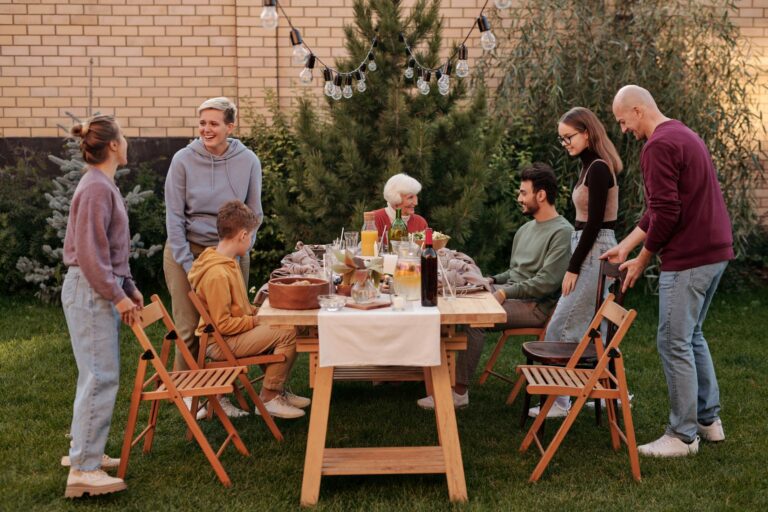
My cousin Damon stood up at the picnic table under the pecan trees, tapped his sweet tea can against the wood like he was calling a meeting to order, and told forty of my husband’s relatives that my son Nathan had probably never seen a day of real combat in his life.
“No offense to Deborah,” he said, which is the sentence men like Damon always say right before the offense. “But you know how these stories get built up. Somebody’s boy joins the Marines, does a tour driving a truck or stocking a supply shed, and by the time he’s home he’s Audie Murphy. My son-in-law did three combat deployments with the Army Rangers. I’ve heard what real war stories sound like. What I heard about Nathan always sounded like a kid who never left the wire.”
The whole table went quiet the particular kind of quiet that happens at a family reunion when somebody says the thing everyone was thinking but nobody was supposed to say out loud. Somewhere behind me a fly was hitting the screen of the porch door, over and over, and I remember focusing on that sound because it was easier than looking at the faces around that table, most of which I did not recognize.
That was the cruelest part, if I am honest. Not that Damon said it. Damon has always been a man who mistakes volume for authority, and I had long ago stopped expecting him to be kind. The cruel part was that he said it to a table of thirty-some people who had never met my son. Wayne’s family is big and scattered, farm people and oil people spread from the Panhandle to the Valley, and we only gather like this once every five years, at the old Lindstrom homestead outside Comfort, Texas, under trees Wayne’s grandfather planted. Nathan died four years ago. He had been to exactly one of these reunions in his whole life, the one before he shipped out, when he was nineteen and grinning and none of these people had bothered to drive the two hours to meet him. So when Damon stood up and rewrote my son into a liar, there was nobody at that table who could contradict him from memory. There was only me.
I want to tell you what I did, because I did not raise my voice, and I did not cry, though I wanted to do both. I reached into the pocket of my sundress, and I picked up my phone, and I found a voicemail I had been carrying from device to device for six years, the kind of file you back up before every phone upgrade because some part of you knows you will never be able to record it again if you lose it. And I set the phone in the middle of that picnic table, next to the potato salad, and I pressed play.
But I am getting ahead of the story, and my mother always told me a story is a road, and you drive it start to finish or you drive it badly. So let me back up to where this actually begins, which is not at that picnic table. It begins fifteen years ago, in a kitchen in Comfort, Texas, with a boy who could not sit still.
My name is Deborah Lindstrom. I am fifty-five years old, and I have lived in Comfort my whole life, in the kind of Hill Country town where the Dairy Queen is still the social center of the universe and everybody’s grandmother taught Sunday school with everybody else’s grandmother. My husband Wayne and I raised one son, Nathan, in a white frame house two blocks off the courthouse square. Wayne worked heavy equipment for the county road department. I did the books for a feed store and later for the church. We were not rich and we were not poor. We were the kind of family this whole country used to be built out of, before anybody had a word for middle class, back when it was just called getting by decent.
Nathan was a mover from the time he could walk. He played every sport Comfort High offered, badly at football and beautifully at track, and he was the kind of boy who could not walk past somebody struggling with a flat tire or a dropped bag of groceries without stopping. He had his father’s build, big through the shoulders, and my quietness, the kind of quiet that watches a room before it speaks in it. He was not a talker. He never had been. That matters to this story more than almost anything else I am going to tell you.
Before any of that, though, he was just my boy, and I want to give you a little more of him than a soldier, because that is the part Damon’s rumor erased first. Nathan was the kid who organized the other children on our street into a car wash for a neighbor’s medical bills before he was ten years old, going door to door with a coffee can and a hand-lettered sign, embarrassed the whole time because he did not like being looked at, only liked the looking-at to result in somebody getting help. He was the kid who worked the register at the feed store two summers running and never once shorted a farmer a nickel, because Wayne raised him to believe a man’s word on a transaction was the same as his word in a courtroom. He broke his collarbone at fifteen sliding into second base in a game that did not matter, and did not cry, and did not tell the coach how bad it hurt until the game was over, because his team was down a run and he did not want to be the reason they had to sub him out. I used to worry about that quality in him. I did not yet understand it would become the whole architecture of the man he grew into, and eventually the reason he never told a living soul what he did on a road in Afghanistan.
Get a new story in your inbox every morning.
Facebook doesn’t show you every story we post. Our free newsletter does. Join 2,500+ readers.
He enlisted in the Marine Corps three weeks after he graduated high school, in the summer of 2010. I remember Wayne standing in the driveway with his hand on Nathan’s shoulder for a long time before the recruiter’s car pulled away, not saying anything, because Wayne was not a talker either, and some things run in families deeper than blood. Nathan went to Parris Island that August, and came back to us in November a different shape of person, harder around the jaw, quieter than even his own quiet, and prouder than I had ever seen a person stand. He was assigned as an infantryman, and after his training pipeline finished he made Lance Corporal and got orders to a battalion out of Camp Lejeune, and eighteen months after he raised his right hand in that recruiter’s office, he was on a plane to Helmand Province, Afghanistan.
He called when he could, which was not often, and he wrote fewer letters than I wanted and more than most mothers of Marines get, because Nathan knew how much I needed the paper in my hand even when the words on it said nothing much. Weather’s hot. Chow’s better than people say. Tell Dad the truck better not have a scratch on it. He never once, in nine months overseas, told me anything that would have kept me up at night, and I understand now that this was deliberate, that my son was managing my fear the way he managed everything, quietly, from the inside, without asking anyone to help him carry it.
In March of that deployment, a supply convoy Nathan’s squad was providing security for was ambushed on a road outside a town whose name I still cannot pronounce right, small arms fire and then an IED that flipped the lead MRAP into the ditch and set the fuel line burning. I did not know any of this until years later. What I knew at the time, because the Marine Corps called me the way they call every mother, was that Nathan had not been hurt, that there had been an incident, that the incident was still being assessed, and that I should expect a letter home in his own hand within the week confirming he was fine. The letter came. It was four sentences long. It said the truck thing everybody heard about was scarier than it was, that he was fine, that I should not believe anything I might read in the news, and that he loved me. That was Nathan’s version of a war story. Four sentences, designed to end the conversation, not start one.
He finished that deployment and came home in the fall, and something in him had gone very still in a way that was different from his ordinary quiet. He did not sleep past four in the morning. He sat with his back to the wall in restaurants, which I noticed and did not understand until years later when I read enough to know what that meant. He would not talk about Afghanistan, not with me, not with his father, not with the boys he’d grown up with who wanted war stories the way boys want war stories, hungry and a little bit thrilled. He gave them nothing. “Nothing happened worth telling,” he’d say, and change the subject to the high school football scores, and the boys, being boys, eventually decided that meant nothing had happened, and Comfort being a small town, that decision calcified into a fact that traveled. Nathan Lindstrom did a tour and came back the same as he left. Must not have seen much.
He reenlisted for a second contract, which surprised nobody who knew how deep his sense of duty ran, and he was stationed back at Lejeune doing work-ups for another deployment that never came, because in the spring after his twenty-third birthday, on a training exercise at night in a rainstorm on a base road he had driven a hundred times, the seven-ton truck he was riding in went off the shoulder and rolled. Nathan was thrown clear and struck the truck’s frame as it came over. He was killed instantly, the casualty officer told us, though I have read enough since then to know that word is a mercy for the family more than a medical fact, and I have decided to let it be a mercy, because there is nothing to be gained from unpicking it further.
I will tell you plainly, because I promised myself a long time ago that I would stop softening this part for company: my son died on a training road in North Carolina in the rain, not in a firefight in Afghanistan, and there were people in Comfort, and it turns out people in Wayne’s extended family too, who heard “training accident” and quietly filed my son under safe, under paperwork, under the version of a Marine who never really did anything. The flag they folded and handed me at the graveside was the same flag they hand every Gold Star mother in this country, whether her son died charging a hill or died on a wet road doing the unglamorous, essential, dangerous work that gets a unit ready for the next deployment. Grief does not grade on a curve. But I have learned that some people do, even at funerals, even at family reunions, especially when they never had to sit in the folding chair at Dover and watch a casket come off a plane.
I remember the two Marines who came to my door that April night better than I remember most of the good years of my life. I remember that I knew, the way every military mother says she knows, the instant I saw the sedan’s headlights slow in front of the house instead of pass it. I remember the taller of the two Marines, a captain, taking his cover off before he had even reached the porch steps, and I remember thinking, in the strange sideways way the mind works in the worst seconds of your life, that his shoes were spotless, and that somebody had made sure of that before sending him to my door, because the Corps does not let a man deliver that news with dust on his boots. I remember sliding down the door frame onto the porch floor before he had finished the first sentence, and I remember Wayne’s sister, who lived two streets over and happened to be walking her dog past my house at that exact hour, running barefoot across her own front yard because she heard me. Grief has its own geography. I have learned every inch of mine.
Wayne died two years before Nathan did, a heart attack in the cab of his road grader on a Tuesday in July, so by the time I buried my son I had already buried my husband, and I want you to understand that when Damon opened his mouth at that picnic table, he was not just insulting a dead boy. He was insulting the last two people I had built my whole life around, both of them gone, both of them unable to defend themselves, and both of them the kind of quiet, unshowy men who let insurance salesmen like Damon believe quiet meant empty.
Because that is who Damon is, in case you are wondering how a man says something like that at a reunion. He sells commercial insurance out of Waco, sponsors a table at every civic banquet in a fifty mile radius, and married into Wayne’s family through Wayne’s brother’s daughter twenty-two years ago, which makes him a cousin by marriage that half this family has never quite figured out how to categorize. He has a son-in-law who did three deployments with the Rangers, and Damon has told that story at every gathering since, with the specific pride of a man borrowing someone else’s courage to wear like a good watch. He had never met Nathan. Not once. He married into this family the same autumn Nathan left for Parris Island, and by the time Nathan came home for good, in a flag-draped box, Damon knew him only as a rumor that had traveled through a family tree he had married sideways into, a rumor that had been shaped, unknowingly, mostly by the boys in Comfort who mistook my son’s silence for nothing to say.
I did not know, until that reunion, how far that rumor had traveled. I thought it was a Comfort thing, a small town thing, three or four men at the feed store repeating a lazy assumption to each other over coffee. I did not know it had made it two hours down the highway to Waco and lodged itself in the head of a man who had never once called to ask me a single question about my son before deciding what kind of Marine he had been.
Now. About the voicemail.
Six years ago, back when Nathan was still alive, still working up for that second deployment that never came, my phone rang on a Tuesday night at eleven forty, a Carolina area code I did not recognize. I let it go to voicemail the way you do with a number you don’t know, thinking it was a scam call about a car warranty, and I nearly deleted the notification without listening, the way I deleted a dozen strange voicemails a month back then. I only listened because Nathan had asked me, offhand, a few weeks before, if any of his buddies from Lejeune ever called the house looking for him, and something in the back of my mind connected the two and made me press play instead of delete.
It was a young man’s voice, thick with the particular slur of a person who has had four or five beers and is being honest in the specific way that only that many beers permits. “Mrs. Lindstrom, this is Cole. Cole Bennett. I’m, uh, I’m Nathan’s guy from the platoon. I don’t know if he ever, uh, I don’t know if he ever told you about the ambush back in March, out on that road, but I just wanted to call and tell somebody, because Nathan won’t tell anybody, and I think somebody in his family ought to know, before he goes and does it again on the next deployment and doesn’t come home to tell nobody himself.”
He talked for almost four minutes. I have listened to that recording more times than I can count, and I could recite it to you now word for word, but I will tell you the shape of it instead, because some things a mother keeps whole, unbroken into other people’s sentences.
Cole told me that when the lead MRAP flipped and caught fire on that road in Helmand, he had been in the vehicle behind it, and that the truck commander in the burning vehicle had been knocked unconscious and pinned against the door by the angle of the roll, with small arms fire coming from a tree line less than a hundred meters off and the fuel line already smoking. He told me that my son was the first man out of his own vehicle and across open ground under fire, that Nathan had pulled the pin on the jammed door with his bare hands hard enough to tear the skin off three of his knuckles, that he had gotten the unconscious truck commander out and slung over his shoulder and moving before the flames reached the fuel cell, and that he had gone back a second time, into the same open ground, under the same fire, for Cole himself, who had a shattered ankle and could not walk, and had carried him nearly sixty yards to the tree line where the rest of the squad had set up a defensive position. Cole said the whole thing from door to tree line took under ninety seconds, and that it was the fastest ninety seconds of his life and also the longest.
He said Nathan never told anyone. He said Nathan had been recommended for a Navy and Marine Corps Medal for it, that the paperwork had gone up the chain and then gotten lost somewhere in a battalion transition, the kind of bureaucratic accident that happens more than the public ever hears about, and that when Cole had asked Nathan about the medal months later, Nathan had said, “Forget it, man. I didn’t do it for a medal. I did it because you and Fitz were my guys.” Cole said Nathan had a rule after that day, that he never talked about it, not because he was ashamed, but because two other men in that convoy, men Nathan had also tried to reach, had not made it, and Nathan carried that the rest of his short life like a stone in his boot that he refused to take out and show anybody, because showing it would have meant explaining who he could not save, and Nathan had decided a long time before that his silence was the only gift he had left to give those two men’s families, a refusal to turn his own survival into a story with himself as the hero.
“He’s the reason I’m alive to have kids someday,” Cole said, near the end, his voice breaking. “He’s the reason I got a whole leg to walk my daughter down an aisle with, someday, if I ever have a daughter. And nobody knows it. And that’s not right, Mrs. Lindstrom. That’s just not right. I had to tell somebody. I’m sorry it’s this late and I’m sorry I’ve had a few. I just had to tell somebody who loves him.”
Then the line went dead, no goodbye, no number to call back on that worked when I tried it the next morning, just a click and then the automated voice telling me the message had ended. I sat at my kitchen table until two in the morning with my hand over my mouth. When Nathan called two weeks later, I asked him, carefully, if he had a friend named Cole. He went quiet the particular way he had gone quiet since Afghanistan, and then he said, “Yeah. Cole’s a good dude. Don’t believe everything a drunk Marine tells you, Mom,” and laughed it off, and changed the subject to whether I’d gotten the truck’s oil changed. I let him change the subject, because that was the deal we had, unspoken, the whole rest of his life. He protected me from the weight. I let him.
I never told him I had kept the voicemail. I never told anybody. I almost deleted it that first night, out of habit, out of thinking it was nothing. I have thanked God more times than I can count that some instinct in me pressed play instead.
After Nathan died, I petitioned the Marine Corps, quietly, with the help of a veterans service officer at the county building, to have the medal recommendation looked into, and eighteen months after his death, in a small ceremony at the VFW post in Kerrville with maybe twenty people there, a Marine colonel presented me with the Navy and Marine Corps Medal my son had earned and never worn, awarded posthumously, for his actions on that road in Helmand Province. I remember the colonel’s hands shook slightly folding the citation into my palm, and I remember he told me, quietly, off script, that he had read hundreds of these citations in his career and that this one had kept him up the night before the ceremony, thinking about a young man who went back into open ground a second time for a friend when the paperwork alone would have forgiven him for staying put after the first trip. I remember Cole Bennett was there, in his dress blues, standing at the back of that VFW hall on a cane because his ankle never set quite right, and that he could not look at me during the reading of the citation, and that after it was over he came and stood in front of me and could not speak at all, just took both my hands in his and held them, and that was its own kind of voicemail, wordless and complete. I have the medal in a shadow box in my front room next to his folded flag. I did not bring it to the reunion. I did not think I would need it. I thought the voicemail alone would be enough, and I was right.
So there I was, at a picnic table under my husband’s family’s pecan trees, with a man I barely knew telling thirty relatives my son never left the wire, and I set my phone down next to the potato salad and I pressed play, and Cole Bennett’s slurred, honest, six-year-old voice filled up that whole quiet yard, telling a table full of strangers what my son did with his bare hands on a burning road while Damon’s son-in-law’s deployments were still years off in the future.
I did not say a word until it finished. Nobody did. Somewhere down the table a woman I did not recognize, one of Wayne’s cousins from Amarillo, had her hand pressed flat against her chest. When the message ended, I looked at Damon, and I said, “His name was Cole Bennett. He has two daughters now. Neither one of them would exist if my son had decided silence meant safety instead of sacrifice. Nathan never told a single soul in this family what happened on that road, Damon, not because it didn’t happen, but because that was the only kind of gift he knew how to give the two men he couldn’t save. You mistook his humility for an empty story. That is your mistake to live with, not mine to correct twice.”
Damon did not have anything to say to that. He set his tea can down, and he looked at the table, and for the first time since I had known him, twenty-two years of Thanksgivings and reunions and civic banquet toasts, he looked like a small man instead of a loud one. His own son-in-law, the Ranger he had spent two decades using as a measuring stick against my dead son, was sitting two seats down, and I watched that young man’s face while the voicemail played, and I want to be fair to him, because he did not deserve to be dragged into Damon’s cruelty either. He had his elbows on his knees and his eyes on the grass, and when it was over he was the first one to speak, quietly, to Damon, not to me. “Dad,” he said, “that’s not a story. That’s a Navy and Marine Corps Medal writeup that got lost for six years. You don’t know what you’re talking about.” Damon had no answer for his own son-in-law either.
I am not going to pretend the rest of that reunion was easy. It was not. There were tears at that table, and there was a long line of relatives who came and found me by the dessert table over the next hour to tell me they were sorry, that they had never known, that they wished they had asked. One older cousin of Wayne’s, a woman named Peggy who I had only ever exchanged Christmas cards with, held onto my arm for a long minute and told me she had a boy of her own who came home from Desert Storm and never said a word about it either, and that she had spent thirty years assuming that meant there was nothing much to say, and that she was going to go home and ask him some real questions before one of them ran out of time to answer. I told most of them the same thing I am going to tell you now, because I think it is the only part of this whole story that matters more than Damon’s cruelty or Cole’s courage or even Nathan’s medal.
My son was not quiet because there was nothing to say. He was quiet because some men decide that carrying a hard thing without setting it down on other people is its own kind of duty, the same duty that put him on that road in the first place. I do not think he ever wanted a medal. I do not think he wanted a story told about him at a family reunion either, and there is a part of me that felt, even as I pressed play, like I was breaking a promise I never made out loud. But I have decided that a mother’s job does not end at the graveside. I buried my husband and I buried my son and I am the only person left standing who knows the whole shape of what my family gave this country, and I will not let a man who never bothered to ask a single question shrink that shape down to a rumor at a picnic table.
Nathan Lindstrom, Lance Corporal, United States Marine Corps, pulled two men out of fire on a road most of us will never see, and never told a soul, and I carried the proof of it on a phone I almost cleared out six years ago because I thought it was nothing but a wrong number.
It was not nothing. It was my son’s whole heart, recorded by accident, by a grateful drunk Marine at midnight, and kept, on purpose, by a mother who has learned that sometimes the truest thing you can do for the dead is refuse to let their silence be mistaken for absence.
I called Cole Bennett the night I got home from that reunion. He lives in Ohio now, married, two daughters just like he’d hoped for that drunk night on my voicemail, and when I told him what had happened under the pecan trees, and that I had finally played his message for somebody besides myself, he went quiet on the phone for so long I thought the call had dropped. Then he said, “Good. It was time somebody heard it besides you, Mrs. Lindstrom. You’ve carried it alone long enough.” He asked if he could send his girls a picture of Nathan someday, so they’d know the name behind the reason their daddy walks without a limp most days. I told him I would mail him the whole shadow box’s photograph myself, and I did, the following week, with a letter that took me three tries to get through without crying.
I go to that reunion every five years now and I bring the shadow box. Nobody at that table has ever again asked me what my son did in the war. They already know.
This story is a dramatization. Names, characters, and details are invented, and any resemblance to real people or events is coincidental.