
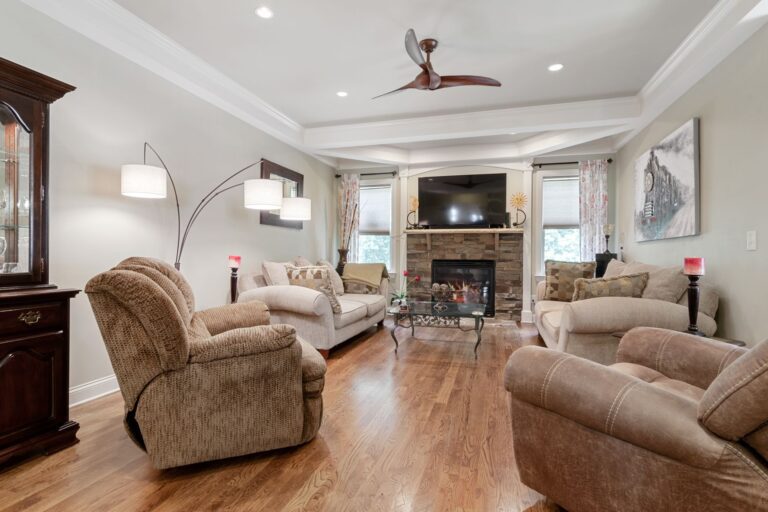
“It was an ugly old thing nobody wants, Bonnie. You’ll thank me when the house shows better.”
That is what my daughter-in-law Dana said to me, standing in my own kitchen with a measuring tape in her hand, on the Sunday she had my husband’s recliner hauled to the curb while I was at church.
I want you to understand what she took, because to her it was furniture, and to me it was the last place on this earth that still held the shape of my husband.
My name is Bonnie Kesler. I am sixty-nine years old, and I have lived in the same white house on Dooley Street in our little corner of west central Missouri for forty-one of the forty-four years I was married to Gene. It is the kind of town where the grain elevator is the tallest thing on the horizon and the second tallest is the water tower with the high school mascot painted on it. People here wave at you from their trucks whether they know you or not. The Casey’s runs out of breakfast pizza by eight. When somebody dies, casseroles appear on porches like the town itself is trying to hold you up.
Gene died fourteen months before that Sunday. Heart failure, the slow kind, the kind that gives you two years of warnings and takes him anyway. And for the last two of our forty-four years, that recliner in the corner of the living room, the big brown one with the worn arms and the lever that stuck, was where my husband lived his life.
So when I walked in from the eleven o’clock service at First Baptist, still in my good shoes, still carrying the bulletin with the hymn numbers on it, and I looked at the corner by the front window and saw nothing there but four dents in the carpet, I did not understand what I was looking at. I stood in my own living room the way you stand in a parking lot when you cannot find your car. My mind simply refused it.
Then Dana came out of the kitchen with her measuring tape and her phone and that bright, busy voice she uses when she has already decided something on your behalf.
“Doesn’t it open the room up?” she said. “The stager said that corner was the first thing buyers would see.”
“Where is Gene’s chair,” I said. It did not come out as a question. It came out flat, like a door closing.
And that is when she said it. She did not even look up from her phone.
“Bonnie, it was an ugly old thing nobody wants. I had the junk men come while you were at church so it wouldn’t upset you. You’ll thank me when the house shows better.”
So it wouldn’t upset me. She scheduled the removal of my husband’s chair around my worship schedule, the way you would schedule a tooth pulled around a work shift. She had thought about my feelings exactly long enough to plan around them.
I need to back up and tell you about the chair, because otherwise you will think this is a story about furniture, and it is not.
Gene bought that recliner in 1998 at the furniture store two towns over, the one that used to give away a free lamp with every living room set. It was floor-model brown, a color the salesman called “saddle” and Gene called “gravy.” He sat in it exactly once in the showroom, put the footrest up, closed his eyes, and said, “Bonnie, I have looked my whole life for this chair and didn’t know it.” He paid cash. He was proud of that. Gene drove a propane delivery route for thirty-one years, and he was a man who counted his money in a little spiral notebook and did not spend it twice.
That chair sat in the corner by the front window because Gene liked to watch the street. He watched the school bus pick up every kid on Dooley Street for two generations. He listened to Cardinals games in it with the radio on the sill, because he said baseball was meant to be heard, not watched. He read the county paper in it front to back, obituaries first, which used to bother me until I got old enough to do it myself.
Our son Scott learned to walk holding the arm of that chair. He would pull himself up on it, wobble, and Gene would put one finger out, just one, for him to grab. I have a photograph of it somewhere, Scott in his diaper, Gene in his work shirt with his name stitched on the pocket, that one finger extended like the two of them were closing a business deal.
And then, at the end, the chair became something else.
The last two years, when Gene’s heart got bad, he could not lie flat anymore. Lying flat made him feel like he was drowning, that is how he described it, drowning in a dry room. So he slept in the recliner. Every night. I would help him settle in, tuck the plaid blanket around his legs, and set his water glass and his pills on the TV tray. And every night I moved to the couch, three feet away, because forty-two years of sleeping next to a man does not end just because his heart is failing. It just changes rooms.
I slept on that couch for twenty-two months. I could hear his breathing change before the machines ever caught it. Twice I called the ambulance at three in the morning because the rhythm of him went wrong, and twice I was right. The paramedics started calling me “the monitor.” The last night, the very last one, he woke around four and asked me to hold his hand, and I knelt on the carpet next to that chair and held it, and he looked out the front window at the streetlight and said, “Bus will be along soon.” The school bus. Sixty years of watching for other people’s children. He died that afternoon at Golden Valley, but he left that morning, in the chair, watching for the bus.
That is what Dana had hauled to the curb. An ugly old thing nobody wants.
Get a new story in your inbox every morning.
Facebook doesn’t show you every story we post. Our free newsletter does. Join 2,500+ readers.
Now, about Dana. I want to be fair, because I have had months to be unfair to her in my head, and it is a sin I have worked on.
Dana married my son Scott nine years ago. She is smart, organized, and good at her job, which is something to do with medical billing, and she runs their household like a shift supervisor. There are things I admire about her. My grandchildren have never once missed a dentist appointment. But Dana is a person who believes that efficiency is the same thing as kindness, and that if she can just get you moved to where you are supposed to be, you will eventually agree you are happier there.
And for about a year, where I was supposed to be, in Dana’s mind, was Maple Court. The senior apartments off Highway 2. “Independent living with supports,” she called it. She had brochures. She had a spreadsheet. She had a friend, Kristi, who had just gotten her real estate license and needed listings, and I promise you that fact is not a small one in this story.
The campaign started gently. The house is a lot for one person, Bonnie. Those stairs to the basement, Bonnie. What if you fell, Bonnie. Then it got less gentle. The property taxes. The roof, which is nineteen years old. The furnace, which is older. Every visit, Dana would find the house guilty of something new, and Scott would sit there turning his coffee cup in circles and not looking at me.
I will say this about my son, and it costs me to say it. Scott is a good man with a soft spine. He loves me. He also has not won an argument in his own home since the second Obama administration. When Dana decided the house should be sold, Scott’s contribution was to look tired and say, “Mom, we just worry about you,” which is what he says when he means “I have already lost this fight and I am hoping you will lose it too so I can have some peace.”
I told them no. I told them no in October, and at Thanksgiving, and in February when the furnace made a noise and Dana nearly put a down payment on my behalf. I said, “I was born nine miles from this house and I will die in it, and that is the whole conversation.”
I thought a grown woman saying no in plain English settled a thing. I was wrong. To Dana, my no was not a decision. It was an obstacle, and Dana is very good at scheduling around obstacles. I was the recliner, you understand. She was just waiting for me to be at church.
So. That Sunday.
After she said it, the ugly old thing nobody wants, there was a piece of time where I did not trust myself to speak. I am a Baptist woman of a certain generation. I do not scream at people in my kitchen. But I stood there in my church shoes with my heart going like a rabbit and I understood, for the first time in my life, how ordinary people end up on the news.
“Who took it,” I finally said.
“Some junk-hauling kid with a truck. I found him on Facebook. Twenty-five dollars.” She said the price like it proved something. Like my husband’s deathbed had been appraised and had come in at twenty-five dollars, removal included.
“Call him.”
“Bonnie.”
“Call him right now and get it back.”
And here is the moment I will not forgive quickly, even though I am working on it. Dana sighed. She sighed the way you sigh at a child who wants to keep a dead goldfish, and she said, “It’s already gone, sweetheart. It’s probably at the dump by now. Honestly, the sooner the house stops being a museum, the sooner you can start your next chapter.”
A museum. My marriage. My forty-four years. A museum, and she was the woman from the county come to condemn the building.
She left around two, after measuring my dining room for what I later learned was Kristi’s staging plan. I stood at the front window in the corner where the chair had been, in the little patch of carpet with the four dents in it, and I watched her back her SUV out of my driveway, and then I did something I had not done since the funeral. I sat down on the floor of my living room, in my church dress, and I cried until my ribs hurt.
You want to know the cruelest part? It was not the chair itself. Things are things; I have buried enough people to know it. The cruelest part was that the chair still smelled like him. Fourteen months, and the left arm, where he rested his head when the footrest was up, still smelled like Gene, like Lava soap and propane and the cough drops he ate like candy. Some mornings that year I would come downstairs before coffee and put my hand on that arm the way you’d touch a shoulder. Dana did not take a chair to the curb. She took the last of his body out of my house, and she billed it at twenty-five dollars.
Monday morning I got up with a purpose, because grief with a purpose is at least grief that gets dressed. I found the junk hauler myself. It took me two hours on the Facebook, going through the buy-sell-trade page for our county, until I found the ad Dana must have used. “HAULING. Junk, brush, appliances, anything that fits in the truck. Fair prices. Cody.” A phone number and a picture of a red Silverado older than some of my shoes.
I called it four times Monday. Voicemail, the automatic kind, not even his voice. I called twice Tuesday. I texted, which for me is an event: “Hello, this is Bonnie Kesler on Dooley Street. You picked up a brown recliner Sunday. It was taken in error. I will pay whatever you ask to have it back. It belonged to my late husband. Please.”
Nothing.
Tuesday afternoon I drove to the transfer station out on Route D, which is what we have instead of a dump, and I asked the man in the booth if anyone had brought in a brown recliner Sunday or Monday. He was kind about it. He also gestured out at a hill of mattresses and carpet rolls and broken hutches the size of a church, and I understood that even if my husband’s chair was in there, it was gone in every way that mattered. I sat in my car in that gravel lot for a long while. There is a particular flavor of foolish you feel, being a sixty-nine-year-old woman crying at a landfill, and I tasted all of it.
Wednesday is when I found the paper.
I was in my own dining room, watering the violets, and there on the sideboard, half under a placemat where Dana had been measuring, was a printed folder. Kristi’s folder. “COMPARATIVE MARKET ANALYSIS: 214 DOOLEY ST.” My address. Inside was a suggested listing price, a photography schedule, a staging checklist with items to REMOVE marked in red (the recliner was line one; it actually said “brown recliner, corner, priority”), and, at the back, a listing agreement. Filled out. My name typed on the seller line, unsigned, and a yellow sticky note in Dana’s handwriting: “Get B to sign Sun after church? Or S has POA?”
S has POA. Scott does not have power of attorney over me. I am sixty-nine, not ninety-nine; I do my own taxes and I won our church’s Bible trivia night two years running. But there it was in ink, my daughter-in-law wondering aloud on a sticky note whether my son could sign my house away over my head, and whether the asking could be timed, again, around church.
I sat down at my dining room table and I put my hand flat on that folder, and I was not sad anymore. I want to be honest about what I felt, because this is a confession, not a Christmas letter. What I felt was cold. Gene used to say I ran warm until the moment I ran cold, and a smart man knew which one to worry about.
I called Scott at work. I read him the sticky note word for word. There was a silence on that phone I could have parked the truck in, and then my son said, “Mom, I didn’t know about the chair until after,” and I believed him, and it did not help, because after fourteen months of his wife measuring my life for removal, “I didn’t know” is not innocence. It is just absence with an alibi.
“You’ll both come Sunday,” I said. “After church. Seeing as everything in this family happens after church.”
Then came Thursday, and Thursday is why you are reading this.
It was almost seven in the evening. I was at the stove making the kind of supper you make when nobody is watching, eggs and toast, when I heard a vehicle slow down out front. Diesel knock, then a squeak of brakes. I looked out the front window through the space where the chair should have been, and there was a red Silverado backing into my driveway, careful, like a young man parking in a stranger’s driveway tries to be. And in the bed of that truck, standing upright, wrapped in a blue moving blanket and held with two ratchet straps like it was somebody’s grandmother, which in a manner of speaking it was, sat Gene’s recliner.
I did not put shoes on. I want that on the record. Sixty-nine years old, out the storm door in my house slippers in the first week of a Missouri June, moving faster than I have moved since the Reagan years.
The young man who got out was maybe twenty-four. Sunburned neck, work boots gone white at the toes, a Mizzou cap that had seen weather. He had his phone in his hand and he was looking at it, then at me, then at it, like he was checking an address.
“Ma’am, are you the lady that texted about the recliner? Bonnie?”
“That is my husband’s chair,” I said, which did not answer his question and answered it completely.
“Yes ma’am.” He shifted like his boots didn’t fit. “I’m Cody. I’m real sorry, I was on a job in Sedalia three days, my phone charger quit, I didn’t get your messages till last night, and then I, well.” He stopped and started over. “Ma’am, I need to tell you something, and I need you to know right up front I didn’t take anything. That’s kind of the whole reason I’m here.”
The chair had never gone to the transfer station. That is the first thing. Cody told me, standing in my driveway with his cap in his hands now, that when the lady, Dana, had waved him in Sunday and pointed at the recliner, he had sized it up as too good for the dump. Solid frame, no rips, and, he said this shyly, he had just moved into a rented place over in Windsor with a mattress, a card table, and one lawn chair, and a man gets tired of eating supper in a lawn chair. So he took it home for himself. Twenty-five dollars and it rode home in the rain blanket, and he ate his supper in my husband’s recliner Sunday night watching the Cardinals drop one to the Cubs, and I have decided Gene would have liked that better than any of us knew.
Monday night, Cody said, the footrest lever stuck on him. Gene fought that lever for twenty years; it had a trick to it, you had to lift and turn, and no stranger would know it. So Cody, being a young man who fixes what sticks, tipped the whole chair over to look at the mechanism underneath. And when he did, the seat cushion shifted, and he saw what nobody, not me, not Dana, not the boys who moved it, had seen in twenty-eight years of that chair sitting in my corner.
The underside of the seat cushion had a zipper. Most of them do; it is how they stuff them. But this zipper had a bread tie twisted through the pull, old-man style, keeping it shut. And the cushion, Cody said, had felt wrong when he lifted it. Heavy in one corner. Stiff.
“I want you to know I opened it because of the weight,” he said. “I thought maybe a mouse had got in there and died. And then when I saw what it was, I about had a heart attack in my own kitchen, and I have spent two days trying to get ahold of you, ma’am, because there was no way in this world I was keeping it, and there was no way I was trusting it to anybody but the owner.”
He reached into the cab of the truck and brought out a canvas bank pouch, the old zippered kind, gray-green, with FARMERS BANK OF GREEN RIDGE stamped on it in letters half worn away. That bank has not existed under that name since the nineties.
My knees knew what it was before my head did. Because I knew that pouch. I had not seen it in thirty years, but I knew it. Gene used to take the propane route collections to town in it every Friday, back when customers still paid cash at the tank.
“Ma’am, maybe you want to sit down,” Cody said, and then he looked around my empty driveway, and then, and I will love him a little for this until I die, he climbed up into the truck bed, unstrapped my husband’s recliner, walked it down on the tailgate ramp like it was made of eggs, and set it on my driveway facing the sunset, and said, “Here. Sit in your chair.”
So I sat in Gene’s recliner in my own driveway in my slippers, and I opened the pouch.
Money. That is the first thing, and I will not be coy about it, because Cody had counted it, terrified, and taped his count to the inside flap on a piece of notebook paper like a bank teller. Eleven thousand, two hundred and sixty dollars, in twenties and fifties, in rubber-banded rolls, some of the bands so old they had gone to powder. Under the money was Gene’s little spiral notebook, the counting kind he carried his whole life, and under the notebook was an envelope, soft at the corners from years of being sat on by the man who wrote it, and on the envelope, in that blocky propane-route printing I would know at the bottom of the ocean:
BONNIE. IF YOU FOUND THIS YOU WENT LOOKING OR I’M GONE.
I am going to tell you what the letter said. Not all of it, because some of a forty-four-year marriage gets to stay private, but the part you need.
“Bonnie. If you’re reading this I expect I’m passed, because you never could sit crooked in a chair long enough to feel the lump. This is the roof-and-taxes money. I started it when Dr. Patel told me about my heart, because I did the arithmetic and I know what the roof costs and I know what the county wants every December, and I was not going to leave you where anybody could stand in your kitchen and tell you the house is too much for you. The house is not too much for you. You are more than the match of that house and everything in it, including me, which you have proved since 1982.
I put it in the chair because you check the bank statements and I wanted this to be a surprise and not an argument. Also because nobody on God’s green earth would ever steal this chair. It is the ugliest thing either of us has ever owned and I have loved it like a brother.
Fix the roof. Pay the taxes. Sleep in our room and not on that couch, your back is worth more than my ghost. And if Scotty’s wife ever gets to circling the house like a turkey vulture, and Bonnie, we both know she will, you show her this letter, and you tell her the man of this house left standing orders.
Nobody sells your chair out from under you. Nobody sells your house out from under you either.
All of it, always. Gene.”
The spiral notebook was the ledger. Two years of deposits in his printing, twenty dollars here, sixty there, “sold the trolling motor,” “propane bonus,” “coin jar,” “poker night, don’t tell Bonnie,” which, for the record, Gene, I knew about the poker the whole time and it was a dollar-ante game with the Legion boys and I hope you took every dime.
The last entry was dated eleven days before he died. He could barely walk to the mailbox by then. Forty dollars. “Sold V. the socket set.” He was still hauling himself around this town selling his tools to strangers so his wife could keep her roof, and sleeping every night on top of the proof, and saying nothing, because that was Gene. He did not tell you he loved you. He built you a floor and let you find out you were standing on it.
I sat in that chair in my driveway and I read my husband’s letter twice, and Cody stood by his tailgate with his cap in his hands and looked at the water tower the whole time, which is what a well-raised country boy does while a widow cries.
When I could talk, I said, “Cody, there is a reward.”
“No ma’am, there is not,” he said, fast, like he’d rehearsed it on the drive. “It’s your money. It was your chair. I’m just sorry it took me three days.” Then he grinned a little and said, “I do want to know how the lever works, though. Thing beat me two nights straight.”
Lift and turn, I told him. You have to lift and turn. Some things about a chair only a wife knows.
Sunday came. After church, like I promised.
Scott and Dana arrived at one. The recliner was back in its corner by the front window, and I will tell you, I had not moved it one inch off its four dents. Dana saw it the second she walked in, and to her credit as a shift supervisor, she recalculated fast. “Oh good, you found it,” she said brightly. “Well. We can have Cody take it again when we get closer to photos.”
We can have Cody take it again.
I did not raise my voice. I am proud of that. I set three things on the coffee table in front of my son. Kristi’s folder with the sticky note. The bank pouch. And Gene’s letter, unfolded.
“Read it out loud, Scott,” I said. “Your father liked things read out loud.”
And my son, who has not won an argument in his own house in twelve years, read his father’s letter out loud in his father’s living room, and I watched him hit the line about the turkey vulture, and I watched him stop, and I watched him look up at his wife, and for one long moment I saw the boy who used to hold his daddy’s one finger to keep from falling, deciding whether to keep holding it.
“You put a sticky note asking if I had power of attorney,” he said. His voice was not loud either. It runs in the family. “Over Mom. You asked Kristi if I could sign away Mom’s house.”
Dana said it was taken out of context. Dana said the market was about to turn. Dana said everyone was overreacting and that she had only ever wanted what was best, and you know, I think that last part might even be true, which is the saddest sentence in this whole story. Some people never learn the difference between what is best and what is theirs to decide.
“The house is not for sale,” Scott said. “It was never for sale. Mom said no in October.” He picked up the sticky note and put it in his shirt pocket, like evidence, like a man impounding something. “And you are going to apologize for the chair. Not for the misunderstanding. For the chair.”
She did apologize, eventually, in the doorway, in the stiff way people apologize when they are still mostly sorry they got caught. I accepted it in the stiff way you accept those, which is to say we are polite now, Dana and I, careful, like two women who have both seen the sticky note. She has not measured anything in my house since. Kristi found other listings. Scott comes by Tuesdays now, by himself, and fixes things whether they are broken or not, and we do not always talk about why, and we do not have to.
The roof got done in August. Torres Brothers out of Clinton, four days, paid in twenties and fifties, and when the foreman raised an eyebrow at the rubber bands I said, “My husband is paying for this,” and he looked at me a second and then said, “Yes ma’am,” and that was that. The county got its taxes in December, Gene, right on time, out of your notebook money, and I slept in our room like you ordered, most nights anyway.
And Cody. You were maybe wondering about Cody.
He would not take the reward, so I stopped calling it that. He hauls my brush now, and cleans my gutters, and he is under strict standing orders to be at my table every Sunday at one for pot roast, an order he has missed exactly twice in a year, once for a wedding and once for a fish he still claims was a state-record crappie, and no photograph exists. When he got engaged this spring to a girl from Windsor who teaches second grade, I gave them Gene’s socket set. I had to buy it back first from a man named Virgil, who turned out to be “V.” from the notebook, and who, when I told him why I wanted it, sold it to me for exactly forty dollars and would not take a penny more. Small towns keep better books than banks do.
Cody asked me once, over pot roast, why I thought Gene never just told me about the money. He was young enough to think that was a mystery instead of a marriage.
I told him what I will tell you. Some men love you out loud. Gene loved me in load-bearing ways. He loved me in shingles and property taxes and rubber-banded fifties, in twenty-eight years of sitting guard on a hidden zipper, in a lever that only worked if you knew the trick. The chair was never the point. The chair was just where he kept the proof.
It is back in its corner, on its four dents, by the front window. In the evenings I sit in it, and the footrest sticks, and I lift and turn, and I watch the street, and along about seven the kids come by on their bikes, and somewhere out on Highway 2 a truck downshifts, and the streetlight comes on.
Bus will be along soon.
An ugly old thing nobody wants. Well. Dana was half right. It is ugly.
But it was wanted. Lord, it was wanted. And so, it turns out, was I. There is eleven thousand dollars of proof in the county’s books and a new roof over my head, and a boy who was raised right eating pot roast at my table, and a letter in my nightstand with standing orders from the man of this house.
Nobody sells my chair out from under me. Nobody sells me out from under me either.
All of it, always, Gene.
All of it, always.
This story is a dramatization. Names, characters, and details are invented, and any resemblance to real people or events is coincidental.