
We were on the third verse of “Blessed Assurance” when the back doors of Harmony Grove Missionary Baptist Church opened and a man nobody knew walked up the center aisle carrying a wooden crate like it was a casket for a child.
I was standing at the deacons’ bench, hymnal open, not singing so much as moving my mouth, which is what I had been doing for four months. My name is Ambrose Tillery. I am seventy-five years old, and I have been a deacon at Harmony Grove for forty-one years, senior deacon for nineteen. I have carried that church’s communion trays, its mortgage worries, its funerals, and its secrets. I thought I knew every way a Sunday morning could break your heart.
The stranger was maybe sixty, heavyset, in a pressed blue shirt with a collar that didn’t fit him and dress shoes that had clearly spent the morning on gravel. He walked slow, like a man who had practiced this in his truck the whole drive over and still didn’t trust himself to get it right. The singing thinned out row by row as he passed, the way a field goes quiet ahead of weather. By the time he reached the front, the pianist’s hands had stopped on the keys and Pastor Odell Grant had come down off the platform with that look he gets when a drunk or a grieving man wanders in mid-service and he isn’t sure which one he’s dealing with.
The man set the crate down on the communion table. Our communion table. The one with “THIS DO IN REMEMBRANCE OF ME” carved across the front by a man dead now sixty years.
Then he looked out at all of us, two hundred or so faces, and said the first words anybody at Harmony Grove ever heard from Cyrus Blankenship.
“I believe I have something that belongs to you all. And I believe somebody in this room knows how I got it.”
Three pews back, on the end, in the seat he had held for twenty-two years, our church treasurer Lowell Sperry went still as a stump.
To understand what was in that crate, and what it did to us, you have to go back. Not four months. A hundred years.
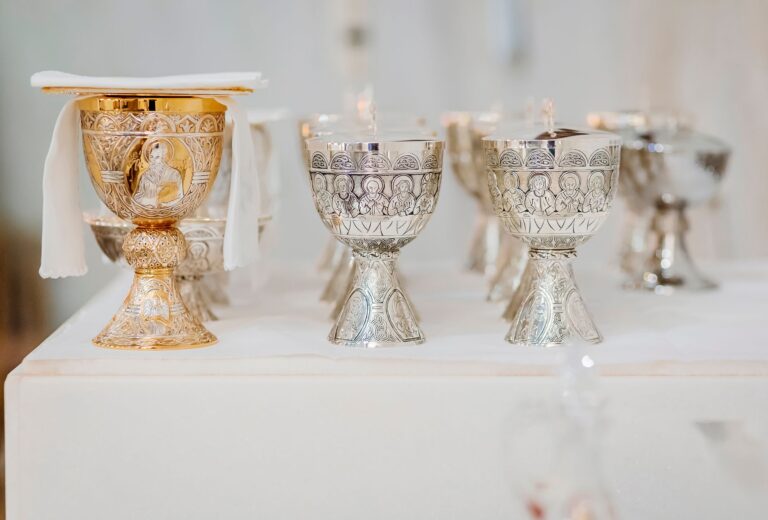
Harmony Grove sits on County Road 12, eight miles outside Delphia, Tennessee, in a bend of bottomland the congregation has held since 1921. The first building burned. The second one flooded. The third one, the one we worship in now, was raised in the summer of 1926 by farmers and laundresses and one blind carpenter who checked every joint with his thumbs. That October, on the first Sunday of the month, the Willing Workers Circle, which was the women’s society, presented the new church with a communion service they had saved three years to buy. A silver tray for the bread. Four silver cups. A silver pitcher with a hinged lid. A matching plate. Every piece engraved along the rim: Presented to Harmony Grove Baptist Church by the Willing Workers Circle, First Sunday of October, 1926.
You have to understand what those women did to buy that silver. They took in washing. They sold eggs and quilts. They cleaned houses in town for fifty cents a day and put nickels in a coffee can for three years, in a decade when a nickel was groceries. Mother Zephia Neal, who is ninety-six now and sits in the second pew on the left every Sunday the Lord sends, tells it the same way every time: her mama was a Willing Worker, and the day the set was presented, those women stood across the front of the church in their white dresses and cried like it was a wedding. “They wanted the Lord’s table set proper,” Mother Zephia says. “They had spent their whole lives serving off other people’s fine things. They wanted one fine thing that served everybody the same.”
For a hundred years, it did. Every first Sunday. Through the Depression, when the offering was sometimes eleven dollars and a sack of sweet potatoes. Through the war years, when the cups were passed with the names of boys overseas read out over them. Babies were christened with water poured from that pitcher. Couples married fifty years renewed their vows in front of it. My Pearline drank from one of those cups the Sunday before she passed, six years ago now, her hands shaking so bad I held the cup to her lips myself, and she looked up at me after and whispered, “Still sweet.”
My father polished that silver the first Saturday of every month for thirty years. When his hands got too unsteady, I took it up, and I have done it every first Saturday for thirty-one more. It is not a chore. It is the closest thing I have to a conversation with every soul who ever loved that church. You work the cloth into the engraving and you think about washwomen and nickels and you handle it gentle, because none of it was ever yours. That was the whole point of it. It belonged to everybody and to nobody, which is the only way anything holy can be owned.
This year, 2026, was the centennial. A hundred years since the Willing Workers set the Lord’s table proper. The homecoming was planned for the first Sunday of October: dinner on the grounds, the old hymns, descendants of the Circle women coming in from as far as Detroit and Fort Worth. The communion set was to sit at the center of all of it, because it was the center of all of it.
Get a new story in your inbox every morning.
Facebook doesn’t show you every story we post. Our free newsletter does. Join 2,500+ readers.
On the first Saturday of March, I let myself into the church at seven in the morning with my polishing cloths and my key, the same as always. I made coffee in the fellowship hall. I hummed. I unlocked the cabinet in the pastor’s study where the set has been kept my whole life, behind a glass door, on a shelf my father padded with felt.
The shelf was empty.
I stood there a long time. I want to be honest about that. I did not shout or run. I stood there with the cabinet key in my hand and felt the floor of my life tilt about two degrees, the way it did when the doctor first said Pearline’s diagnosis out loud. I remember thinking, very calmly, that I was looking at the wrong shelf, in the wrong cabinet, in the wrong room. Then I called Pastor Grant, and Pastor Grant called Lowell Sperry, because Lowell was the treasurer, and the treasurer held the only other key.
Lowell got there in forty minutes. I will tell you exactly how he came through that door, because I have replayed it a thousand times since. He came in already talking. Before he had seen the cabinet, before he had asked one question, he came in saying, “I knew it, I knew it, I’ve been telling y’all that window latch in the choir room was broke, anybody could get in here at night, I’ve been saying it for a year.”
He had not been saying it for a year. But grief makes you stupid, and shock makes you agreeable, and we all walked back to the choir room together and looked at a window latch that was, in fact, broken, and nodded like men studying a dead mule.
Lowell said he would handle the sheriff’s report. Lowell said he would call about the insurance. Lowell was a deacon of twenty-two years and the treasurer for most of them, a man who had held the church’s checkbook through two roof replacements and a well pump, a man whose wife Renata had been on dialysis for three years and who still showed up to count the offering every single Monday. Nobody handles things like a man who is drowning. I know that now. I did not know it then.
He told the church family on Sunday. Stood right up at announcement time and said there had been a break-in, that the communion silver was gone, that the sheriff had been notified and there wasn’t much hope. Thieves melt silver down within a day or two, he said. He said that last part with his eyes down, like it hurt him to know it. He had an answer for every question before anybody thought to ask it, which is a thing I have learned, too late, to listen for.
You would have thought somebody died. Mother Zephia had to be helped out to the car. Women who hadn’t cried at their own husbands’ funerals cried in the parking lot. For the next four first Sundays, we served communion off a stainless steel tray somebody bought at the restaurant supply in Jackson, and I am ashamed to say I could hardly take the cup. It tasted like nothing. It tasted like exactly what it was, which was a substitute, and I sat there with the little plastic cup in my big foolish hands and grieved a set of dishes the way a man grieves his dead, and felt stupid for it, and grieved anyway.
Because here is the thing nobody tells you about objects. The silver was never the treasure. The silver was the proof. Proof that people who had nothing gave anyway. Proof that a congregation of field hands and washwomen set a finer table for the Lord than the families they worked for set for themselves. You cannot melt that down, but you can steal the proof of it, and when the proof is gone you are left trying to explain to your grandchildren why a tray mattered, and watching their faces stay polite and blank.
I could not let it sit. That is not virtue, that is just how the Lord made me, and Pearline would tell you it is not always a blessing. Something about the whole thing itched at me. The latch was broken from the inside, for one thing, though I only half noticed it at the time, the way you half notice a smell. So in the last week of March I drove into Delphia and stopped by the sheriff’s office to ask about the report, thinking I could add a description of the engraving, something to give the pawn shops.
The clerk looked it up twice. There was no report. Nothing filed for Harmony Grove Baptist Church. Not in March. Not ever.
I sat in my truck in that parking lot for half an hour. I told myself there were ten innocent explanations. Lowell was scattered. Lowell was busy. Lowell had called some other office, some state number, some insurance line. Renata had taken a bad turn in February, everybody knew that, and the man was carrying more than any of us. I drove home and I prayed about it, and I want to be truthful about what I prayed, because this is a confession, not a eulogy of myself. I did not pray for Lowell. I prayed that I was wrong, which is a different thing entirely. I prayed that God would make the ugly thing I was thinking be untrue, so that I would not have to do anything about it.
At the April deacons meeting, I asked Lowell, gentle as I knew how, for the report number, so we could follow up for the insurance claim. The room got a particular kind of quiet. Lowell looked at me across that folding table, a man I had prayed next to for two decades, a man whose daddy’s funeral I had helped carry, and he said, “Ambrose, you are an old man polishing cups nobody drinks from anymore. Let it go.”
Nobody said a word. Not Pastor Grant, not the other deacons, nobody. And I will tell you what shames me most in this whole story, more than anything Lowell did: neither did I. I let it go. Not because I believed him. Because he had found the exact soft place to put the knife. Old man. Nobody drinks from them anymore. Every fear I had about my own usefulness, about being a relic polishing relics in a church full of young people looking at their phones, he said it out loud in the deacons meeting with witnesses, and I folded like a card table. I went home and I did not go back to the sheriff, and April went by, and May, and the centennial committee quietly started pricing a “commemorative replica set” from a church supply catalog, and I sat in my recliner on first Saturdays with clean hands and nothing to polish, and I let it go.
God did not.
Here is Cyrus Blankenship’s side of it, which he has told me since across my own kitchen table, more than once, because we are friends now, which is one of the strange mercies this story left behind.
Cyrus runs an antiques and estate business out of a storefront in Marbury, three counties east, the kind of shop with a cast iron dinner bell out front and a hundred dead families’ china inside. In late February a man had come in, no appointment, carrying a communion service wrapped in bath towels inside a cardboard box. Said it had been his grandmother’s, out of a country church that closed years back. Said the family wanted it sold quiet, because they didn’t want scattered former members thinking they had a claim on it. Asked for cash.
Cyrus told me he had a feeling even then. Forty years in the business, he said, and you develop a nose for a story that has been rehearsed in the car. But the silver was real, coin silver, old and heavy, and the man had a deacon’s way about him, steady-eyed and churchy, and the tale about the closed congregation explained the engraving well enough. Cyrus paid him nine thousand four hundred dollars and put the set in his back room, meaning to research it proper before he priced it.
It sat there until June. That is the part that makes Cyrus shake his head at his own self. “Four months, Ambrose,” he told me. “It sat on my shelf four months while y’all were passing plastic cups.”
In June he finally got it out to catalog it. He polished into the tarnish on the tray rim to read the full engraving, and there it was. Harmony Grove Baptist Church. He was suspicious enough by then to go looking, and it took him one search on his computer to find us: the little church webpage Pastor Grant’s granddaughter keeps up, with the service times, and the photograph from two years ago of the homecoming table, and centered on that table, plain as daylight, the silver sitting in his back room. And under the photograph, the announcement. One hundred years of the Willing Workers communion service. Centennial homecoming, October 2026.
Not a closed church. A counting-the-days church.
Cyrus Blankenship is not a churchgoing man. He will tell you that himself, and he would say it stronger than I will write it. He told me he stood in his back room a long while doing arithmetic that had nothing to do with money. He had paid out nine thousand four hundred dollars of real cash. He had a bill of sale with a signature on it. The law, he figured, would mostly take his side. He could have called the sheriff, which would have been right and easy, and let the machinery grind it out, deputies and depositions and a church’s name in the county paper.
“But I kept looking at that engraving,” he told me. “First Sunday of October, 1926. Some ladies bought this thing for their church a hundred years ago, and some fella sold it to me out of a cardboard box with bath towels around it. And I thought, this don’t need a deputy. This needs to go home the same way it left. In front of everybody.”
So on the third Sunday of June, Cyrus Blankenship closed his shop, packed the set into a wooden crate he had built for it the night before because the cardboard box “wasn’t fit,” put on his one blue dress shirt, and drove seventy-some miles of two-lane blacktop to a church he had never seen, to hand a small fortune in silver back to strangers and ask, in front of God and everybody, who had sold it to him.
Which brings us back to the third verse of “Blessed Assurance.”
Pastor Grant reached him first. Cyrus talked low to him for a moment, and I watched our pastor’s face go through about four seasons in ten seconds. Then Pastor Grant stepped back and gave him the floor, which tells you something about Odell Grant, because most preachers would not hand their pulpit to a stranger holding a crate. Cyrus opened it right there on the communion table and lifted out the tray.
I have heard two hundred Baptists shout. I had never heard two hundred Baptists gasp. It went through the sanctuary like wind through a wheat field. Mother Zephia stood up out of the second pew, ninety-six years old, no cane, nobody helping her, stood straight up with both hands over her mouth. Somebody behind me said “Lord Jesus” the way you say it when you mean it. And I stood at the deacons’ bench with my knees going soft, because from twenty feet away I could see the engraving I had polished for thirty-one years catching the light from the east windows.
Cyrus set the tray down gentle. Then the cups, one, two, three, four. Then the pitcher. Then the plate. He handled them like a man setting a table for company, and when he was done he stepped back from it and said his piece.
He told it plain, no flourishes. A man had come to his shop in late February and sold him this set for cash. Said it came from a closed church. He described the man without a name: his height, his build, his gray felt cap, his wire-rimmed glasses, the pale line on his finger where a ring had been pawned or put away. He said he had the bill of sale folded in his shirt pocket with the man’s own signature on it. He said he had not come for his money back, and he had not called any sheriff yet, and did not much want to. “I came to bring it home,” he said. “The rest belongs to y’all to sort. But I expect the man I’m describing is in this room this morning, because it’s a fifteen-minute drive from here to his mailbox and I passed it on my way in.”
You could hear the ceiling fans. I promise you that. You could hear the fans turning and one car going by out on County Road 12 and two hundred people not breathing.
I did not look at Lowell. That is the truth, and I am neither proud nor ashamed of it, it is just what I did. I looked at the silver. But I heard the third pew creak.
Lowell Sperry stood up the way a man stands up out of deep water. He came out into the aisle and stood there swaying a little, gray cap nowhere in sight, wire glasses right there on his face, and Renata beside him with her hand pressed over her heart, looking at her husband the way a woman looks at a house burning with everything she owns inside it. It was plain in one second that she had known nothing. That was its own kind of terrible, and I have thought since that her face in that moment was the worst punishment Lowell will ever receive in this life.
“It was me,” Lowell said.
He said it to the floor first, and then he made himself lift his head and say it to the church. “It was me. There wasn’t any break-in. I broke that latch myself with a screwdriver on a Tuesday night. I carried the set out under my coat in two trips and I sold it to this man and I lied to every face in this room. I lied to the sheriff by never calling him. I lied at this table.” He put his hand on the end of the communion table and took it back quick, like the wood was a stove. “I have been lying so long I got good at it. And the worst thing I can tell you is how easy y’all were to lie to. Because you loved me.”
The rest came out in pieces, his voice going in and out like a station on the far edge of the dial. Renata’s kidneys. Three years of dialysis, the drives to Jackson, then the transplant last fall that everybody had praised God for, and the anti-rejection medicine after it, eleven hundred dollars a month that the insurance danced away from. The notes he had signed at a finance company against his truck and his repair shop. The interest that grew back faster than he could cut it, like johnsongrass. He had gone in for four thousand dollars two years ago, and by February he owed twenty-two, and they were coming for the shop, and the shop was where every dollar came from. And one night he stood in the pastor’s study with his treasurer’s key in the cabinet lock, and a hundred years looked back at him through the glass, and he took it anyway.
“I told myself it was just things,” he said. “I told myself y’all would be sad awhile and get over it, and Renata would keep breathing, and nobody would ever know. And then I sat in that pew four first Sundays in a row and watched Ambrose Tillery try to take the Lord’s Supper off a plastic tray.”
He turned then, and the whole church turned with him, and I stood at the deacons’ bench while Lowell Sperry, the man who had called me an old man polishing cups nobody drinks from, looked me in the eye and said, “Ambrose, what I said to you in that deacons meeting was the lowest thing I have ever said to another human being. I said it because you were the only one still pulling the thread, and I knew right where to cut you so you’d quit pulling. You didn’t deserve one word of it. Those cups get drunk from. I’m asking your pardon.”
I want to tell you I said something wise. I have been a deacon forty-one years. I have sat with the dying and the divorcing and the boys in the county jail, and I keep a scripture in my pocket for most occasions. I stood there empty as that felt shelf. What I finally got out was five words.
“Lowell, come up here front.”
And the man came. That is the part people who weren’t there never quite believe. He walked up the aisle he had walked for twenty-two years, past all those faces, to the altar rail, and he got down on his knees on the same red carpet where he had knelt to be ordained, and he laid the whole rest of it out loud with his eyes shut: the figure he owed, the figure Cyrus had paid him, where every dollar of it had gone. Medicine. Not a boat, not a bottle, not another woman. Medicine. And it did not make it right, and he said so himself, on his knees: “Needing it don’t clean it. I stole from the Willing Workers. I stole from women who took in washing so this table could be set.”
Pastor Grant is a young man by our congregation’s standards, fifty-one, third generation of Grants in that pulpit. He came and stood over Lowell, quiet, for a long moment. Then he said the thing I expect I will still be turning over on my own deathbed.
“Church, we have got a thief at our altar this morning,” he said. “And we have had one at every altar since the day the Lord hung between two of them and promised one of them paradise before supper. So we are on old ground. The question before Harmony Grove is not whether Lowell did it. He did it, and he’ll carry it. The question is whether we believe the things we have been singing in this room for a hundred years, or whether we just like the tune.”
Here is what we did, and it took weeks, not minutes, and I will not pretend it was one golden Sunday and a hug. Grace is not a mood. Grace, I have learned, is a series of business meetings.
Lowell resigned as treasurer that same afternoon, before he ever got up off his knees, and the board accepted it that week. That part was never negotiable and he never asked it to be. Trust that gets mishandled has to be earned back in years, not tears, and a church that hands its checkbook back to a confessed thief out of sentiment is not being gracious. It is being foolish, and it is setting a temptation in front of a struggling man twice. The books he kept were audited front to back by a retired banker from the Methodist church in town, and I will tell you plainly what the audit found, because the church deserves it on the record: nothing else. Twenty-two years of clean columns and one catastrophe. Most of us are not so different, we just never got audited.
The church voted, by a count I still get proud of when I think on it, not to prosecute. There were voices for calling the district attorney, and I will not name them, because they were not wrong. They were just outvoted, and it was Mother Zephia who settled it. She stood up in the business meeting with her hand on the pew in front of her and said, “My mama bought that silver so the Lord’s table would be set proper. Wasn’t one thing on that table ever meant for locking a man up. If y’all send Lowell Sperry to jail over my mama’s cups, you can send me along with him, because I will go set with him.” Then she sat down. You go ahead and try voting against that.
There was still the matter of Cyrus Blankenship’s nine thousand four hundred dollars, paid in good faith and already swallowed by the finance company’s hole. Here is what Cyrus did, and this is a man who does not go to church, so make of it whatever you like. He tore up his claim to nearly half of it, called that portion “the price of not checking a story I knew smelled wrong,” and took a payment plan on the rest. Seventy-five dollars a month, no interest, with one condition, and he wrote the condition into the paper like a contract lawyer: the payments had to be hand-delivered to his shop in Marbury, so he would have company once a month. Lowell drives over the first Monday of every month. Some months I ride with him. Cyrus keeps the coffee going and the three of us sit among a hundred dead families’ china and argue about baseball, and if you think the Lord was not in that clause, I cannot help you.
The church did one more thing, and this one was Pastor Grant’s doing. He put it to the congregation that the same finance-company hole that swallowed Lowell Sperry was standing open under half the families in the county, quiet as a cistern with the boards rotted, and that a church that could keep a hundred-year-old communion set proper could keep its own people out of loan paper too. There is a benevolence fund now with real money in it, and the same retired Methodist banker sits down free of charge with anybody drowning in interest, no questions asked from the pulpit. Over Lowell’s loud and repeated objection, it is called the Sperry Fund. Pastor Grant overruled him from the pulpit. “We name funds after what happened,” he said. “That is what a testimony is.”
Renata’s medicine is part of what it covers now. The Sunday that got voted, she stood up to say thank you and could not get one word out, and did not need to.
And on the first Sunday of October, 2026, one hundred years to the very Sunday since the Willing Workers Circle stood across the front of Harmony Grove in their white dresses, we held the centennial homecoming. Dinner on the grounds, fried chicken and butter beans and four kinds of pound cake. Descendants in from Detroit and Fort Worth, just like the committee planned back when the plan was the easy part. Mother Zephia in the second pew with her mama’s photograph in her lap. Cyrus Blankenship in the back row in the blue shirt, sitting like a man half afraid the pew might object. It did not. The pew has seen worse.
The communion set sat at the center of the Lord’s table, and it shone. It shone because on the first Saturday of that month, same as every first Saturday since June, two old men had polished it together in the pastor’s study with the coffee going.
That was my doing, and I had to fight him for it. I asked Lowell the week after he confessed. He thought I was mocking him and got up to leave the room. I told him to sit down, and then I told him the truth: a man ought to know the weight of a thing he took, and the only way to learn the weight of that silver is to hold it once a month with a cloth in your hand and think about washwomen and nickels while you work the polish into the engraving. He shows up at seven o’clock sharp. He polishes slower than any human being I have ever watched. He always takes the tray, the tray every time, and some Saturdays his shoulders shake while he works on it, and I drink my coffee and keep my eyes on my own cup and let the Lord handle what is the Lord’s.
At the centennial service, Pastor Grant did a thing he had cleared with the deacons and with nobody else on this earth. When it came time to serve, he called the deacons forward, and then he called Lowell Sperry forward, and in front of the visitors from Detroit and Fort Worth and every soul who knew the whole story, he put the silver tray in Lowell’s two hands and had him serve the second pew. Mother Zephia took her cup off that tray from the hands of the man who stole it. Then she reached up and patted those hands, and she said, loud enough for ten rows to hear, because Mother Zephia has not said anything quietly since the Nixon administration, “Still sweet.”
I took my cup last, at the deacons’ bench, the way I always do. Pearline was in my mind, the way she is every first Sunday, her shaking hands and mine holding the cup steady at her lips. I thought about how close we came to a replica set out of a catalog, and to a church that would have spent its second hundred years drinking from a copy and never knowing. I thought about a man three counties away who did not have to close his shop on a Sunday and build a crate at midnight, and did it anyway. I thought about how the silver was never the treasure, it was the proof, and how it turns out the proof was never really the silver either.
Cups nobody drinks from anymore. That is what he called them, in the meanest minute of his life, and for two months I believed him, which was my sin in this story, and I have confessed it here same as he confessed his. The meanness came off, in time. Most tarnish does, if somebody is willing to sit with it and work the cloth.
Every first Saturday now, seven o’clock, the coffee goes on and the study smells like polish, and two old men set the Lord’s table proper. Between the two of us, one was a thief and one was a coward who let it go, and neither of those is what the engraving says. It says Presented. It says Willing. A hundred years on, that is still the whole gospel of the thing.
And it still holds the light.