
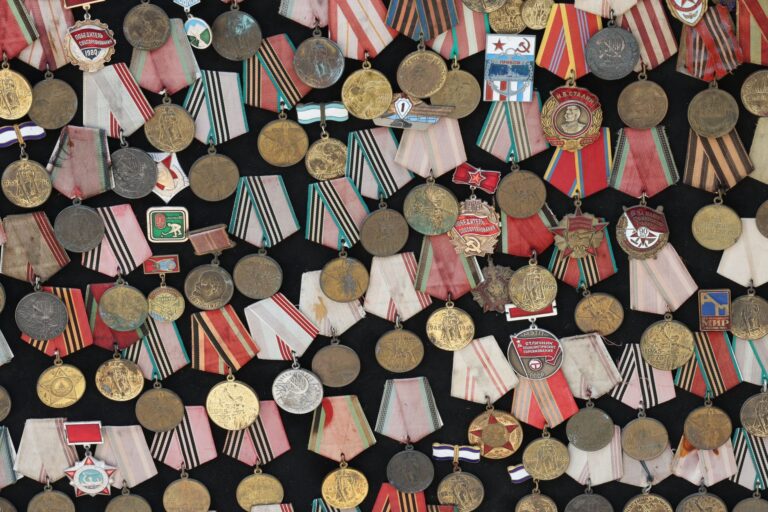
My own children sold Russell’s war medals for twelve dollars while I was inside making coffee, and when I came out with the tray they were already laughing about how easy it had been.
I want you to understand that I heard the laughing before I understood the words. That is how it goes when you are seventy-two and your hands are full and the screen door bangs behind you. You hear your grown son and your grown daughter out on the driveway, and the sound of them together makes you feel, for one foolish second, like you did when they were small and the noise from the yard meant they were happy. There was a summer, years and years ago, when the two of them would play out on that same driveway until the streetlights came on, and I would stand at the kitchen window with a dish towel in my hands and just listen to them, and I remember thinking that I would never in my life hear a sweeter sound. So when I heard them laughing out there that June morning, some old part of me softened before the rest of me could catch up. Then the words arrive a beat behind the sound, the way thunder arrives after the flash, and the world you were standing in is not the world you are standing in anymore.
“Twelve bucks,” Bradley said. “The guy didn’t even haggle. I thought he’d talk me down.”
“For a box of old junk,” Denise said. “You did good. That’s twelve dollars we don’t have to split later.”
I stood on the top step of the porch with the coffee tray, and I looked past them to the folding table on the driveway where three days of my life were laid out under the Ohio sun. The estate sale. My children had called it that, an estate sale, as if Russell and I were both already gone and strangers were picking through what was left. Russell had been gone eight months. I was standing right there.
I need to go back, because if I just tell you about the twelve dollars you will think this is a story about money, and it is not. Money is the smallest thing that happened on that driveway.
Russell Delaney was my husband for forty-nine years. He was a Sergeant First Class in the United States Army, and he went to Vietnam in 1968 when he was twenty years old and I was nineteen and we had been married four months. I did not know yet how to be a wife, and he did not know yet how to be a soldier, and we learned both of those things a long way apart from each other, me in a rented room in Marysville, Ohio, and him in a place he would not name for thirty years.
He came home in 1970 with a limp that never fully left and a way of going quiet that I learned to read like weather. He did not talk about the war. That was not unusual for men of his kind and his generation. There were nights, early on, when he would wake beside me with the sheets soaked through and his heart going so hard I could feel it against my back, and he would get up and stand at the window in the dark until the shaking passed, and in the morning neither of us would mention it. I learned that his silence was not emptiness. It was a full thing, a loaded thing, a room he kept locked with the light on inside. What was unusual, what I did not understand until the very end, was how much he had carried out of that country that was not about himself at all.
The medals lived in a shadow box on the wall of the front room for as long as our children were alive to see them. Russell made the box himself in the garage the winter Bradley was two. I can still smell that winter if I try, the wood smoke and the mineral spirits and the cold coming off the concrete floor. He cut the frame from oak he had saved from a fence line his father took down, and he sanded it by hand for three evenings running until it was smooth as a river stone, and he lined it with a piece of dark blue felt I bought at the fabric store on Main Street for less than a dollar. He arranged the medals on it with a care he did not give to much else in this world. His hands were not gentle hands, they were a mechanic’s hands, thick and scarred, but they went soft over that felt. There was a Bronze Star. There was a Purple Heart, because of the leg. There were the service ribbons and the unit citations that mean nothing to most people and everything to the men who earned them. He hung the box at eye level in the front room, and every so often over forty-nine years I would catch him standing in front of it, not looking at it exactly, just standing near it, the way you stand near a grave. I never asked him what he saw when he stood there. I wish now that I had. I told myself I was giving him his privacy. The truth is I was afraid of the answer, and I dressed my fear up as respect, the way we do.
I want to be fair to my children, because a mother should try, so I will tell you what I know about how they became people who could laugh about twelve dollars.
Bradley is fifty-one. He sells cars in Columbus, or he did, or he does again now, I lose track. He has been married twice and he is behind on things a man his age should not be behind on, and he learned somewhere along the way that his father’s silence was a thing he could resent instead of a thing he could try to understand. When Bradley was seventeen he told Russell that the Army had made him cold. Russell did not answer. He just went out to the garage. I found him later sitting on the workbench in the dark, and he said, “Maybe the boy’s right, Marion.” That was all. He never defended himself to his own son.
Denise is forty-eight. She was daddy’s girl until she was about fourteen, and then something turned in her the way it turns in some girls, and she decided that everything hard about our family was Russell’s fault, the money that was always tight, the way he flinched at fireworks, the trips we never took. She married a man named Craig who talks about investments at the dinner table, and she started to look at Russell and me the way Craig looks at a house he is thinking about flipping. Not as people. As an asset that was not performing.
I tell you all this so you understand that the driveway was not a surprise so much as an arrival. It had been coming for years. I just did not think it would come while I was inside making coffee.
Get a new story in your inbox every morning.
Facebook doesn’t show you every story we post. Our free newsletter does. Join 2,500+ readers.
Russell died on a Tuesday in November. Congestive heart failure, though the doctors said the leg wound from the war had been quietly working against his whole system for fifty years, so in a way you could say Vietnam finally caught up with him at seventy-four, which was longer than a lot of his friends got. He died at home in the bed we had shared for four and a half decades, in a gray afternoon with the first hard snow of the year coming down past the window, and I was holding his hand. His hand had gone light by then, all the strength gone out of it, and I remember thinking that I had held that hand across a car seat and across a delivery-room rail and across the top of two small coffins we buried his parents in, and here it was, feather-light, at the end of everything. The last thing he said to me was not goodbye. He did not say my name, or that he loved me, though he did not have to, we had said those things forty-nine years running. The last thing he said to me was a name I did not recognize. His eyes came open and found the ceiling and then found me, and he said, “Tell Alcott I’m sorry.” He said it plain, not the mumble of a dying man but clear, urgent, like it was the one errand he could not leave undone. Then he was gone, and I sat there in the snow-light with his light hand in mine, and I did not know a single Alcott, and I filed it away as the wandering of a dying mind, and I grieved my husband.
The children came for the funeral. They were kind for exactly as long as the funeral lasted. Bradley gave a eulogy about a father he did not seem to have known. Denise cried in the front pew in a way that photographed well. And then, before Russell was even a month in the ground, they started talking about the house.
I was seventy-two. I did not want to leave the house, but I could not run it alone, and the truth is I did not have the strength that winter to fight my children about anything. Craig had “run the numbers.” The house would sell better empty. I would move into a senior apartment in town, a nice one, they kept saying, nice, as if the word made it mine. And everything in the house that was not coming with me to a one-bedroom apartment would be sold.
An estate sale. In June. In the driveway and the garage and the front yard of the house where I still lived.
I let them do it. I want to be honest about that, because I have spent a lot of nights since asking myself why I let them. I have lain awake in the dark of the new apartment turning it over like a stone in my hand, and I have not been able to put it down. Part of it was grief, which makes you go slack, makes you let the current take you because fighting the current means feeling how strong it is. When you are grieving you will do almost anything to not feel the full weight of what you are carrying, and going along is easier than standing still. Part of it was the old habit of a woman my age, raised to keep the peace, to not make a scene, to let the men run the numbers. My own mother went to her grave having never once raised her voice to a man, and she called that dignity, and maybe it was, and maybe it was just the same fear I was feeling passed down the female line like a color of hair. And part of it, the ugliest part, was that some small starved thing in me thought that if I let them have their way they would love me. That is the part I am most ashamed of. Seventy-two years old, a grown woman who had buried a husband and raised two children and kept a home for half a century, and still down inside me was a little girl holding out her hands, trading pieces of the best man she ever knew for the hope that her children would turn around and love her back.
So on a Thursday in June the strangers came. They came in their trucks and their minivans and they walked up my driveway and they touched my things. Russell’s fishing gear. My mother’s china. The rocking chair I nursed both those laughing children in. Bradley worked the money and Denise worked the tables, and I mostly stayed inside, because I could not watch it, and every so often I would carry out coffee and lemonade because I did not know what else to do with my hands.
I did not know the shadow box was on the table.
I need you to believe that. I have told this story enough times now that I have seen the flicker on people’s faces, the small suspicion that a wife would know where her husband’s medals were. But you have to understand what those months did to me. I had been packing a house around my own body for weeks. The box had come off the wall of the front room in a wave of boxes and newspaper and Bubble Wrap, and I had lost track of it the way you lose track of a single face in a flood. Bradley told me later, when he was trying to defend himself, that he “found it in a box of stuff for the sale.” That is the phrase he used. A box of stuff. He priced my husband’s Bronze Star and Purple Heart at twelve dollars and set them on a folding table between a lamp and a stack of paperbacks, and when a quiet man in his sixties offered him the twelve dollars, my son took it and did not think about it again until I came out with the coffee.
“For a box of old junk,” Denise said.
I set the tray down on the porch rail. I do not remember deciding to. I remember the cups sliding and one of them going over, and the coffee running dark across the white paint, and neither of them looking up, because to them a spilled cup of coffee was a bigger event than what they had just done.
“Where is your father’s shadow box,” I said.
I did not shout it. I have thought about that too. Somewhere in me I must have already known, because my voice came out flat and small and very far away, the voice you use in a hospital hallway.
Bradley finally looked up. I watched it move across his face, the moment he understood which box I meant. He had the twelve dollars still in his hand. Three ones and some change, I think, or a five and some ones, I never did count it, but it was crumpled, it was the kind of money you shove in a pocket. He looked at it and he looked at me and he said, “Ma, it was in the sale pile.”
“Where is it,” I said.
“A guy bought it,” Denise said, and here is the thing I will carry to my own grave, she said it with a little laugh still in her voice, the tail end of the laugh from before, the laugh had not fully left her face yet. “Some old guy. Like twenty minutes ago. Ma, it’s fine, it was just the ribbons and stuff, we kept the flag from the funeral, that’s the one that matters.”
The one that matters.
I want to tell you that I did something. I want to tell you that I was a woman in a movie, that I drew myself up and said something that cut them to the bone, something they would remember on their own deathbeds. I did not. I turned around and I went into my house and I closed the door and I stood in the front room where the pale rectangle on the wall showed exactly where the box had hung for forty-nine years, brighter than the wall around it, and I put my hand flat on that clean bright rectangle and I made a sound I had not made since the day the Army car came to my mother’s door with the wrong news about the wrong soldier in 1969, a mistake they corrected two days later, two days I lived through certain I was a widow at twenty. I made that sound. In an empty room. With my whole family’s worth of strangers out on the lawn.
The sale went on. Of course it did. My children were not going to shut down a sale over a box of ribbons. I heard the transactions through the window, the drift of the numbers, and I stayed in the front room with my hand on the wall until the light changed, and I decided, somewhere in there, that I would not speak to Bradley or Denise again until they understood what they had done, which I believed, in my grief, would be never, because you cannot make a person understand a thing they have decided not to see.
Then the man came back.
It was three days later. The sale was long over. The house was emptier than a house should be, echoing, half of my life carried off in strangers’ trunks, and I was sitting at the kitchen table with a cup of coffee I had not touched, when a truck I did not recognize came slow up the drive and stopped. An older pickup, clean, the kind a careful man keeps. A man got out. He was maybe sixty-five, built low and solid, gray hair cut short, and he moved the way Russell used to move, deliberate, like every step was a decision. He had something in his hands, wrapped in a soft cloth. He stood at the bottom of the porch steps and he took off his cap.
“Mrs. Delaney,” he said. “My name is Gene Alcott. I bought something from your family a few days ago, and I have come to give it back.”
Alcott.
I stood up so fast the chair went over behind me. I came out onto the porch and I looked at the cloth in his hands and I knew, before he unwrapped it, what it was. He folded the cloth back and there was Russell’s shadow box, the oak frame, the dark blue felt, the Bronze Star and the Purple Heart and the ribbons, all of it, whole, in the hands of a stranger who had driven back up my driveway to return it.
“I did not know whose it was when I bought it,” he said. “I saw a shadow box on a table for twelve dollars and I could not walk past it. A man’s medals on a folding table between a lamp and some paperbacks. I have seen a lot of things, ma’am, but that one stopped me cold. I bought it so it would not sit there. Then I got it home and I really looked at it, and I saw the unit.”
He said the name of Russell’s unit. I will not print it here, because it is Russell’s and I have already given away enough of him to strangers, but Gene Alcott said it the way you say the name of a church you were baptized in.
“I served with a Delaney,” he said. His voice did a thing. “1969. He pulled me out of a place I was not going to get out of on my own. I never knew his first name. We didn’t, back there, half the time. I knew him as Delaney. I have thought about that man for fifty-six years, ma’am, and I have looked for him for the last twenty, and I could not find him, because I only had a last name and a face I could not describe to anybody who mattered. And then I bought a shadow box at an estate sale in a town I only stopped in for gas, and I turned it over, and there was a little card taped to the back.”
He turned the box over gently and showed me. Russell had done it. Of course Russell had done it, my Russell, who labeled everything, who could not stand for a thing to go unexplained. On the back of the shadow box, in his small square hand, on an index card gone soft with age, he had written: RUSSELL J. DELANEY, SFC, US ARMY. And under it, the unit. And under that, a line I had never seen, because in forty-nine years I had never once taken the box off the wall and turned it over.
The line said: “For the men I brought home, and the ones I could not. Especially the boy from Toledo, Alcott, who I hope made it. I never knew.”
I read it three times standing on my own porch. The boy from Toledo. Alcott. Tell Alcott I’m sorry.
My husband had spent fifty-six years not knowing if the boy he pulled out of that place had lived. He had gone to his grave with a stranger’s survival as the open wound of his life, apologizing with his last breath to a man he thought he might have failed, a man he had actually saved. And that man had spent the same fifty-six years looking for him. They had been circling each other across half a century, two men who had touched once in the worst moment of both their lives, and they had missed each other by eight months. Russell died in November. Gene Alcott drove into town for gas in June.
If my children had not sold the box, Gene Alcott would never have found it. That is the thing I cannot get my mind around, even now. The cruelty and the mercy came through the same door. My children threw my husband away for twelve dollars, and the throwing away is the only reason the box ever left that wall to be seen by the one man in the world who needed to see it.
Gene Alcott stayed for three hours that afternoon. He would not take coffee at first, and then he took coffee, and then he took the sandwich I made him because a body needs feeding, and he told me my husband. Not the silent man in the front room. The other Russell, the twenty-one-year-old, the Delaney who, according to Gene, was known in that unit as the one who counted heads. “He counted heads,” Gene said. “Every time we moved, before and after, Delaney counted heads. If a man was missing, Delaney went back. Officers hated it. He went back anyway. That’s how he got me. I was down, and I had made my peace with being down, and I heard somebody counting, and then there were hands on me.”
I sat at my own kitchen table and I learned who my husband had been from a man I had known for two hours. Forty-nine years of marriage, and the deepest thing about Russell Delaney, the thing that ran under all that silence like a river under a field, I learned from Gene Alcott of Toledo, Ohio, over a ham sandwich, eight months too late to tell Russell that the boy made it.
Before Gene left, he tried to give me the twelve dollars back. He set it on the table, the crumpled bills, my son’s crumpled bills. I pushed it back to him. “You keep that,” I said. “You paid it. It’s yours. The box was never for sale.”
He would not take the box, either. He tried. He said it was mine, it was the family’s, he had only come to return it. And I want you to understand what I did next, because it is the one thing in this whole story I am not ashamed of.
I gave Gene Alcott the Bronze Star.
I took it off the felt with my thumbnail, careful, the way Russell would have, and I put it in Gene’s hand and I closed his fingers over it. “Russell earned that pulling men out,” I said. “You are one of the men. He carried you for fifty-six years and never knew he could set you down. You take it. You are the proof he did his job.”
Gene Alcott, sixty-five years old and built like a man who does not cry, cried at my kitchen table. And I held the hand of the boy from Toledo, the way I had held Russell’s hand eight months before, and for the first time since November I did not feel like the current was taking me. I felt like I had done one true thing.
Bradley and Denise do not know about Gene Alcott. That is my choice, and I will tell you why, and then I will tell you what I did about the rest of it, because a story should finish and I promised you it would.
I did not tell my children about Gene because they did not earn it. The story of who their father really was is not a reward you get for selling him. If they want to know their father now, after they priced his life at twelve dollars, they can do the work I did. They can sit at a table with a stranger and be humbled. They have not asked. Eight months later, they still have not asked what happened to the box, because to them it was ribbons and it is gone and that is a closed matter. Denise sent me a card on my birthday with a gift card in it. Bradley calls on the first Sunday of the month and talks about his truck. They think we have moved past it. They think a mother’s silence is a mother’s forgiveness. They are going to be very surprised someday, and I have made sure of that, which brings me to the will.
I changed it. I did not do it in anger, and I want that on the record, because anger is a poor foundation and I have built enough of my life on poor foundations. I did it in clarity, which is a different thing and a colder thing and, I have come to believe, a truer one.
The house sold. I live in the senior apartment now, the nice one, and I have made it mine in the ways a person can. Russell’s shadow box hangs on the wall by the door where I see it every time I go out, and there is a small clean space in the felt where the Bronze Star used to be, and I like that space. It is the shape of a thing I gave away on purpose to the right person, which is the opposite of everything that happened on that driveway.
The money from the house, and there was real money, more than Craig’s numbers, goes into a trust when I die. Not to Bradley. Not to Denise. It goes to a fund for veterans of my husband’s war who are still, at this late hour, trying to find the men they served with, and to the men those men are looking for. There is a foundation that does this work, that reunites them while there is still time, and my lawyer has set it up so that every year, in Russell Delaney’s name, they will bring some of these old men back into a room together while they can still fill it. My children will get the birthday-card version of an inheritance, a small sum, enough to be a message and not enough to be a comfort. And in the letter my lawyer will read to them, there will be one line, and the line is the only thing I have left to say to Bradley and Denise, and it is this:
Your father counted heads. He went back for the ones who were missing. He would have gone back for you. But you have to be lost before someone can find you, and you two decided a long time ago that you were fine right where you are.
Gene Alcott and I write letters now. Real ones, on paper, because that is what men like him and women like me do. He tells me about the reunions he goes to, the ones the fund pays for now, and last spring he sent me a photograph of himself standing with three other old men in a VFW hall in Toledo, all of them holding their caps, and on the back, in a hand not so different from Russell’s, he had written: “The ones who came home. Delaney counted right.”
I keep that photograph tucked into the corner of the shadow box, behind the glass, next to the empty space where the Bronze Star used to be.
My children sold their father’s medals for twelve dollars while I was inside making coffee. It is the worst thing anyone has ever done to me, and it is the reason a man from Toledo got to lay down a weight he had carried for fifty-six years, and I have stopped trying to make those two truths into one truth, because they are not one truth. They are two, and they came through the same door, and a person my age learns to hold two things at once or she does not survive at all.
Russell, if you can hear me from wherever the men you counted are: the boy from Toledo made it. He made it. You can set him down now. And I found out who you were, my love, forty-nine years late and eight months too soon, and I am not sorry I know, only sorry I did not know it while your hand was still warm in mine.
I made coffee for the wrong people for a long time. I know that now. I am making it for the right ones from here on out.
This story is a dramatization. Names, characters, and details are invented, and any resemblance to real people or events is coincidental.