
For fifty years I let people believe I had nothing to say about Vietnam.
That was easier than the truth. The truth is that I had too much to say, so much that I could not find the front door to any of it, and a man who cannot find the front door learns to tell people there is no house. I told my wife there was no house. I told my daughter there was no house. I told the men at the VFW who would have understood, the ones who carried their own locked rooms around inside their chests, that there was no house, and then I would buy them a beer and change the subject to the price of feed corn or the Steelers secondary or anything, anything at all, that had not happened in a country on the other side of the world in 1969.
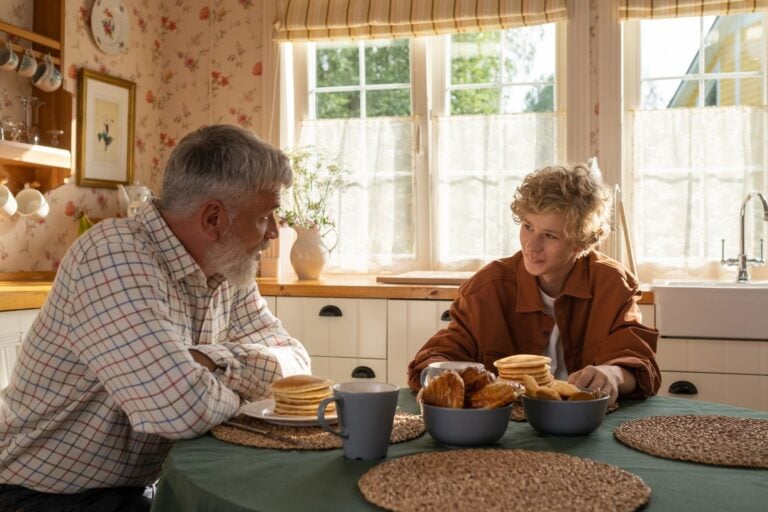
I am seventy-four years old. My name is Hollis. And the thing that finally opened the door was not a counselor, and it was not a church, and it was not even my own wife of forty-one years, God rest her. It was a twelve-year-old boy with a yellow pencil and a sheet of paper from his social studies teacher, sitting at my kitchen table on a Tuesday afternoon, asking me if it was okay if he recorded this on his mother’s phone.
His name is Eli. He is my grandson. And he is the reason I am able to write any of this down.
Let me start where it started, which was an ordinary day in October, the kind of day where the light comes in low and gold across the linoleum and you think you have your whole life figured out because you have nothing left to figure.
Eli came off the school bus at the end of my lane the way he always did on the days my daughter Karen worked late, dragging his backpack by one strap so it scraped the gravel. I had a snack out for him, peanut butter crackers and a glass of milk, the same thing my own grandmother used to set out for me, and he climbed up on the stool at the counter and did not touch any of it.
That was the first sign something was different. Eli always ate.
“Grandpa,” he said, “I have to interview a veteran.”
I was at the stove with my back to him, and I am glad of that, because I do not know what my face did. I have spent fifty years controlling my face. I am good at it. But I was not ready, and a man is never as good at controlling his face when he is not ready.
“For school,” he said. “Mr. Dawson said we have to interview somebody who lived through history. Like a real person who was there. And everybody’s doing their grandpa or their uncle and Mason’s doing his neighbor who was in the Gulf one, and I thought.” He stopped. “I thought maybe you.”
I want to tell you what went through me in that second, because it is the whole point.
What went through me was no. A clean, hard, automatic no, the same no I had been saying for half a century, the no that had become so much a part of me that it was not even a decision anymore, it was a reflex, like pulling your hand off a hot burner. I had said that no to better men than a twelve-year-old. I had said it to my own father when he was dying and reached for my hand and said, son, you never told me what happened over there. I had let my own father die without telling him. That is the kind of no it was.
And then I turned around and I looked at my grandson sitting at my counter with his school paper in front of him, and the paper had a list of questions printed on it in a row, and his hands were folded on top of it the way you fold your hands when you are nervous and trying not to be, and he was not looking at me. He was looking at the peanut butter crackers he was not eating. And he said, real quiet, “You don’t have to. I can do Mason’s neighbor too. He said I could share.”
He was giving me the door. He was twelve and he was giving me the door out, because he was a kind boy and he had felt my no before I even said it.
Get a new story in your inbox every morning.
Facebook doesn’t show you every story we post. Our free newsletter does. Join 2,500+ readers.
And something in me that had been clenched for fifty years just, I don’t know how to say it any better than this, it just got tired. It got tired of being clenched. I was an old man and my wife was gone and my father was gone and the men I had served with were mostly gone, and here was this boy who shared his crackers and shared his neighbor and would have let me off the hook without a word of complaint, and I thought: if not him, then nobody, and if nobody, then it dies with me, and then it is like it never happened, and they deserve better than that.
So I pulled out the other stool. And I sat down across from my grandson at my own kitchen table, the table I had eaten ten thousand meals at, and I said, “Read me your first question.”
He looked up so fast I thought he might fall off the stool.
“Really?”
“Read it before I change my mind,” I said. “I’m seventy-four. I change my mind a lot.”
He smiled then, that gap where his tooth had come out, and he smoothed the paper flat with both hands like it was something precious, and he said, “Can I record it? Mom said I could use her phone. Mr. Dawson said the recording is for accuracy.”
For accuracy. Twelve years old.
“Record it,” I said.
He set the phone between us, leaning it against the napkin holder so it could see both of us, and he pressed the red circle, and he read the first question off his sheet in the careful, formal voice kids use when they are reading something printed.
“Question one. What branch of the military did you serve in, and what was your rank?”
It was such a small question. It was the kind of question with an answer, a real answer, a fact, and a fact is a thing you can hold. I had been so afraid of the feelings that I had forgotten that it starts with facts, and facts you can say.
“United States Army,” I said. “I was drafted in 1968. By the time it was over I was a sergeant. E-5. Eleven Bravo, that’s infantry. A rifleman.” I cleared my throat. “I was nineteen years old when I went.”
Eli wrote it down even though the phone was recording, his tongue poking out the side of his mouth the way it did when he concentrated. Then he read question two.
“Question two. What is one thing you remember most?”
And there it was. There was the door, standing wide open, and a boy with a pencil waiting on the other side of it.
I am going to tell you what I told him, and I am going to tell it the way it came out of me that afternoon, which was not in order and not clean, because nothing about it was ever in order or clean. But Eli was patient. That is the thing I keep coming back to. A grown man would have pushed. A counselor would have nudged. But a twelve-year-old just waits, because he does not yet know that silence is supposed to be filled, and so when I stopped he just sat there with his pencil ready, and the waiting pulled more out of me than any question ever could.
I told him about the heat first. You can always start with the heat. The heat is safe. I told him about how the air in the Central Highlands was so thick and wet that it felt like breathing through a wet sock, and how the red dirt got into everything, your boots, your food, your teeth, the creases of your hands, so that for two years I had red dirt in the lines of my palms like my hands had been drawn on. I told him about the smell of the jungle after rain, green and rotten and alive all at once. I told him about C-rations and how the ham and lima beans were so bad we called them ham and something I will not write here, and Eli laughed, and the laugh helped, it loosened something.
And then, because he just waited, I told him about the men.
I told him about Doc Pelletier from Maine who could find a vein in the dark. I told him about a kid we called Tennessee who could not have been more than eighteen and carried a harmonica he could not play, just held it sometimes, and how he would say he was going to learn when he got home. I told him about our lieutenant, a man named Brubaker, who was twenty-three and pretended to be older and was scared the whole time and never once let us see it, which I did not understand the courage of until I was twice his age.
And then I got quiet for a long time. And Eli, my Eli, he did not say anything. He just slid the plate of crackers a little closer to me, like maybe I needed them more than he did.
So I told him about Vernon.
I had not said that name out loud in fifty years. I want you to understand that. Not once. Not to my wife, not to my father, not to a soul. I had kept it folded up so small and so deep that I was not sure I could even still say it, and when I did say it, when the two syllables of it came out of my mouth at my own kitchen table, my voice broke on the second one, and my grandson reached across that table and put his small hand on my big old wrecked hand, and he did not say it was okay, because he was too smart to say something was okay when it plainly was not. He just left his hand there.
Vernon was a private. PFC. He came to us as a replacement in the spring of 1969, eighteen years old, from a town in this very state, two counties over, though I did not know that then, none of us asked where exactly, you did not want to know too much about a man’s home in case you had to write the letter. He was a skinny kid with ears that stuck out and a way of saying yes sergeant that made you feel a hundred years old. I was twenty by then. To him I was an old man. To me he was a child. The whole war was children, that is the thing nobody tells you, it was children all the way down.
In June of 1969 we were moving up a slope toward a treeline. I am not going to put you inside the firefight, because that is mine and I have decided some of it stays mine, but I will tell you what matters, which is that the world came apart, and when it came apart Vernon went down ahead of me, and he was hit bad, in the leg and the side, and he was screaming, and the slope between me and him was the longest forty feet of ground that has ever existed in the history of the world.
I went and got him.
I am not telling you that to make myself sound like anything. I want to be very clear about this because it matters to the whole rest of the story. I did not feel brave. I have read the word hero in newspapers my whole life and it has never once described any feeling I have ever had. What I felt was that there was a boy from somewhere in my own state lying on that slope screaming, and that I was not going to be a man who let him scream alone, and so my body went and got him before my mind could file the paperwork on whether that was a smart thing to do. I got my arms under him and I got him up over my shoulders and I carried him back down that slope while the world kept coming apart around us, and I put him down behind cover, and Doc Pelletier went to work on him, and there was so much blood, there was so much blood, and the dust-off came and they loaded him on, and the last thing I saw was his hand. Just his hand, reaching up off the litter, grabbing at the air.
And then the helicopter lifted and turned and got small and was gone.
And I never found out what happened to him.
That is the thing I carried for fifty years. Not the firefight. Not the heat or the dirt or even the friends I buried over there with full knowledge of how they died. What I carried was Vernon’s hand reaching off that litter, and the not knowing, the not knowing whether that boy lived an hour or a day or a lifetime, whether I had carried him down that slope to save him or only to die slower somewhere with tubes in him, whether the most important thing I ever did with my two arms had meant anything at all or nothing at all. They moved my unit. They moved everybody. In a war that big a single private goes into a helicopter and out of your life and there is no way, there was no internet, there was no way, you just never know. I came home in 1970 and I did not know, and I built a whole life on top of not knowing, a farm and a marriage and a daughter and this grandson, fifty years of not knowing stacked up like cordwood, and I told everyone there was no house.
I told Eli all of it. It took two afternoons. He came back the next day with a fresh page of questions and we did not use any of them, we just sat, and I talked, and he waited, and that waiting of his was the kindest thing anyone has done for me in my whole long life.
And then, on the second afternoon, my grandson did the thing that broke this story open like an egg.
He had been writing down details. Good details. He had Vernon’s rank, and the year, and the part of the country, the Central Highlands, and the fact that Vernon was from two counties over, from a town in our own state, because I had mentioned it, the only thing I knew about where he came from. And Eli, who is a child of his time the way I was a child of mine, looked at all of it written down on his page and he said the most natural thing in the world to a boy his age.
“Grandpa, did you ever look him up?”
I said no. I said you cannot look a man up, son, it was a war, men disappear into wars.
And Eli, very patient, the way you would explain something to a very old person, which I suppose I am, said, “No, I mean look him up. Like online. Vernon, from two counties over. There can’t be that many.”
I want to tell you that I knew right then. I did not. I told him it was foolish. I told him it had been fifty years and the boy was probably gone, killed in country or dead since of all the things that kill old soldiers, and that I had made my peace, which was a lie, I had made no peace, I had only made a long quiet truce with the not knowing.
But Eli already had his mother’s phone in his hand.
And he asked me Vernon’s last name. And I told him. I had not said the whole name, first and last, in five decades, and I said it to my grandson across the kitchen table, the boy’s full name, the way you would read it off a roster, and Eli typed it in with his two thumbs, this child, faster than I could have written it, along with the name of the county and the word veteran and the word Vietnam.
And then he went very still.
I have learned, in seventy-four years, to read a room. I knew something had landed before he said a word. His face changed. He looked up at me, and then back at the phone, and then up at me, and his eyes were huge, and he turned the phone around so it was facing me, and on the screen was a photograph.
It was the photograph from a newsletter, a little county veterans’ group, the kind of thing churches and Legion halls put out. And it showed a row of old men in folding chairs at some breakfast, the way old men sit at breakfasts, and the caption under it had names, and one of the names was Vernon’s full name, and there, third from the left, in a windbreaker with a cap that said the unit on it, our unit, the actual designation of our actual unit which I had not seen in print in fifty years, was an old man with ears that, even now, even at seventy, stuck out from the sides of his head.
He was alive.
He was alive, and he was forty minutes away, and he had been forty minutes away for who knows how long, the two of us breathing the same state’s air, buying gas at the same kind of stations, sitting through the same winters, while I told everyone there was no house.
I do not remember standing up. Eli told me later that I stood up so fast the stool fell over backward. I remember holding the table. I remember my grandson coming around to my side of it and putting both his arms around my middle, this twelve-year-old boy, holding his grandfather up at the kitchen counter, because his grandfather’s legs had stopped working, and I remember saying, over and over, he made it, he made it, he made it, and I remember that I was crying in a way I had not cried in fifty years, in a way I had not allowed myself, a way that comes up from somewhere underneath everything, and Eli just held on.
Now I have to tell you about the meeting. Because everyone always wants to know about the meeting, and I understand, I wanted to know about the meeting too, all those years, I just never let myself believe there would be one.
Karen, my daughter, drove. I could not have driven. We went on a Saturday, two weeks later, because it took two weeks, because you do not just show up. Eli had found a phone number through that veterans’ group, and Karen had made the call, and a woman answered, Vernon’s daughter, and Karen explained who we were, and there was a long silence on the line, and then the woman started to cry, because Vernon, it turned out, had a story too. Vernon had spent fifty years not knowing the name of the man who carried him off that slope. He knew there was a man. He had been told there was a man, a sergeant, who carried him down under fire. But in the chaos of the dust-off and the hospital and the long road back, nobody ever got him the name, and so Vernon had spent his own fifty years with his own locked room, the mirror image of mine, an old soldier who owed his whole life, his daughter, the woman crying on the phone, his grandchildren, all of it, to a man whose name he never knew and never got to thank.
We had been carrying the same fifty years from opposite ends.
The house was a small brick ranch with a flagpole in the yard and a wheelchair ramp. His daughter met us at the door. She could not speak. She just held the screen door open and put her hand over her mouth, and we went in, and there in the front room, in a recliner, with a cap on that said our unit, was Vernon.
He was an old man. Of course he was an old man. We were both old men. His hair was white and his face was a map of seventy-some years, and he had a cane against the chair, and one of his legs, the leg, did not work the way the other one did, fifty years and that leg still remembered June of 1969. But his ears stuck out. And when he saw me, when his daughter said, Daddy, this is him, this is the man, his face did the thing my face had been doing for fifty years, it tried to control itself, and it could not, and it just came apart, soft and old and undefended.
I crossed the room. My own legs barely held me. And I knelt down, an old man kneeling, my knees screaming, in front of his recliner, the way I had knelt next to him on that slope, and I took his hand, the same hand, I swear to you it was the same hand that had reached off that litter, and I held it in both of mine.
And here is what I finally said. After fifty years of saying there was no house. After letting my own father die without it. Here is what came out of me, kneeling on that man’s living room carpet with my daughter and my grandson and his daughter all weeping behind us.
I said, “I am sorry it took me so long to find you.”
That is what I said. Not you’re welcome. Not it was nothing. Not any of the brave-sounding things. I said I was sorry I was late, fifty years late, and Vernon shook his head, he could not talk yet, and he brought my hand up and he pressed it against his face, against that old soft cheek, and we stayed like that, two old men and one hand, for a long time, while everyone around us came apart.
When he could finally talk, his voice was a ruin. And he said, “I prayed for you. Every single day. I never knew your name so I just called you the sergeant. I’d say, Lord, watch over the sergeant. For fifty years. I didn’t even know if you made it home.”
I had carried not knowing if he lived. He had carried not knowing if I lived. And every day, this man, this stranger I bled for and never knew, had been talking to God about me by a name that was not even a name.
We sat in that front room until it got dark. We talked about Doc Pelletier and Tennessee and Lieutenant Brubaker, and Vernon knew, he had heard, that Tennessee did not make it, and we sat with that together, two men who could finally grieve a boy out loud because there was finally someone else in the room who had loved him. We talked about the heat and the red dirt. His daughter brought coffee nobody drank. And the whole time, sitting on the floor by my knee, was Eli, my grandson, twelve years old, with his mother’s phone in his lap, recording, for accuracy, because Mr. Dawson said the recording was for accuracy, and thank God for Mr. Dawson, and thank God for that assignment, and thank God most of all for a boy who shared his crackers and would not let his grandfather sit there with a locked house inside him one more year.
Vernon and I had fourteen months. That is what we got. Fourteen months of Sunday dinners and phone calls and one fishing trip where neither of us caught a thing and it did not matter at all. He passed last spring, in that same recliner, with his daughter holding one hand. I would like to tell you I was holding the other but I was not, I was forty minutes away when the call came, and I drove those forty minutes one last time and I sat with him after, the way you sit with a brother, and I was there for the part that comes after, the flag and the rifles and the bugle, and when they folded that flag into its tight blue triangle his daughter walked across the cemetery grass and put it in my hands instead of keeping it.
She said her father had told her to. She said he had been very clear about it. He said the sergeant should have the flag, because the sergeant was the reason there was a flag to fold.
I have that flag on the mantel now. Eli got an A on his project. Mr. Dawson read it out loud to the whole class and then he asked Eli if his grandfather would come in and talk to the students, the real students, the live ones, and I said yes, and I have done it three times now, and I am going to keep doing it as long as my legs hold me, because I spent fifty years telling everyone there was no house, and it turns out the house was full the whole time, full of men who deserved to be remembered out loud, and I had been keeping them locked in the dark all by themselves, and that was the real failure, that was the thing I should have been ashamed of, not the war, the silence.
So this is me telling it. Out loud. With the door wide open.
His name was Vernon. He was a private, PFC, eighteen years old, from two counties over, with ears that stuck out and a leg that never worked right again. I carried him forty feet down a slope in June of 1969, and for fifty years I did not know if it mattered, and it turns out it mattered more than anything I have ever done, because it made a life, a whole long life, with a daughter and grandchildren and a man who talked to God about me every single day by a name that was not even my name.
And the only reason I know any of it is that a twelve-year-old boy needed to interview a veteran for his homework, and he picked his grandfather, and he was patient enough to wait while an old man found the front door at last.
If you have someone in your family who never talks about it, do not let them tell you there is no house.
Sit down. Slide them the crackers. And wait.