
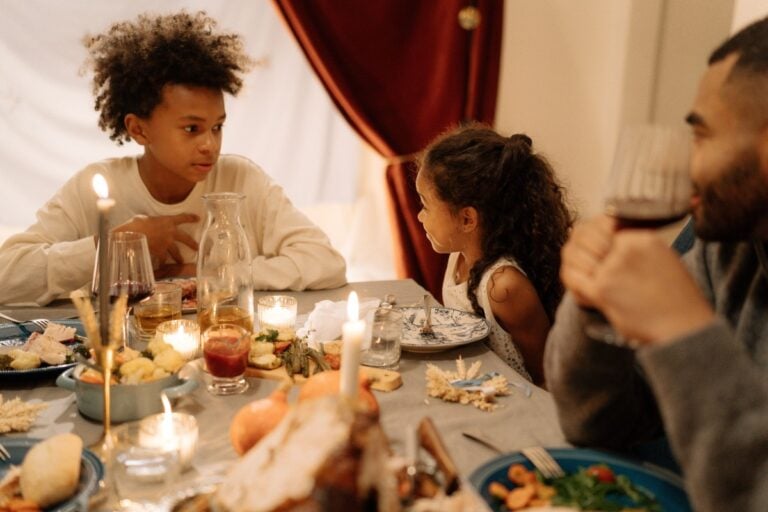
The chair at the head of my mother’s table was burgundy velvet. She had owned it for thirty-two years.
It was not an expensive chair. The armrests were worn down to the weave on the right side where she always rested her elbow, and one of the back legs had been repaired twice with wood glue and a prayer. She had found it at an estate sale the year my parents moved into the house, the year my brother Kevin and I were small enough to hide underneath the dining room table and think we were invisible. She had paid eleven dollars for it and brought it home in the back of a station wagon and refinished it herself in the garage over two weekends, and every Thanksgiving for the next three decades she sat in it at the head of a table she had made beautiful with nothing more than a linen cloth and whatever the season offered: pine cones, apples from the tree in the back, whatever the grandchildren brought home from school that week.
She died in April, seven months before the Thanksgiving in question, which meant there was a chair at the head of the table with no one to sit in it, and a table with no one to run it, and a house full of people I had spent the whole summer keeping together by myself.
Her name was Diane. She had a laugh that could rearrange the furniture in any room she walked into, and she made a sausage stuffing that nobody has been able to replicate since, and she spent the last fourteen months of her life in a hospital bed we set up in the den. I set it up. I drove her to the treatments and timed the medications and learned to talk to insurance companies in the flat, official voice that sometimes got things done and sometimes did not. I managed the paperwork and the phone calls and the visits from the hospice team, and I held her hand through the nights that were hardest, and I was the one in the room at the end.
Kevin lived forty minutes away. Kevin had a demanding job and two kids in travel soccer and a wife named Brianna who had a great many opinions about most things, including things that were not hers to have opinions about. He came when he could, which was not often, but he called, and the calls were always warm and a little guilty and over in about fifteen minutes, and I learned not to expect more than they were. You learn to fit your expectations to the container that is actually being offered.
Brianna came once, in March. She stayed for two hours and organized the pantry without being asked and told my mother she looked “so much better than last time,” which was not true, and told me in the kitchen that I was “such a saint” in a voice that managed to make it sound like a problem.
My mother heard it. Her hearing had stayed sharp all the way to the end. Later that evening she took my hand and said, “Baby, when this is over, you watch that pantry.” She was always saying things I did not fully understand until later.
So: Thanksgiving. The first one without her. I had offered to host it because the house still had her things in it and because I could not stand the thought of the holidays moving somewhere else before I was ready, and because somebody had to and I was, apparently, still somebody. Eleven people said they were coming. Kevin and Brianna and their two boys. Three cousins and their families. An aunt who had been close with my mother. I had been cooking for two days. I had found my mother’s recipe for the stuffing in her handwriting in the back of a card file and I had stood in the kitchen for a long time just holding it before I could bring myself to start.
They arrived in waves. The cousins with the children first, cheerful and loud and genuinely glad to be there. My aunt, who hugged me for a long time without saying anything, which was exactly right. And then Kevin and Brianna, last, Brianna in a new coat and earrings I had never seen before, carrying a store-bought pie in a plastic container.
I was in the kitchen when they came in. By the time I walked to the dining room doorway to say hello, Brianna was already sitting down.
Get a new story in your inbox every morning.
Facebook doesn’t show you every story we post. Our free newsletter does. Join 2,500+ readers.
In the burgundy chair.
She had set down the pie container on the table and pulled out the chair and settled into it with the ease of a person who has already decided where they belong, and she was already talking to one of the cousins, already laughing at something, already at home.
I stood in the doorway holding a bowl of cranberry sauce and I felt something shift behind my sternum, like a table being moved in a room you’ve walked through for years.
I set the bowl down. I went back to the kitchen. I finished what I was doing. I am not a dramatic person by nature. I do not make scenes. But when everyone was seated and the food was on the table and the chair at the head of it was still occupied by my sister-in-law in her new earrings, I leaned down and I said, quietly, not unkindly, “Brianna, would you mind moving down one? That was Mom’s chair.”
The table went quiet the way tables do when something happens that everyone was watching for without knowing they were watching.
Brianna looked up at me. She had a smile that she used when she thought she was being patient with someone. She used it then. “Oh, I just figured, since she’s not here.” And she stayed where she was.
Kevin, across the table, looked at his plate. Not at me. At his plate.
“It matters to me,” I said. Still quiet. Still not making a scene, or trying not to. “It’s the first Thanksgiving. I’d just like for her chair to stay hers.”
And then Kevin looked up and said, “Ellen. Don’t do this.”
Three words. After fourteen months of me not doing this, of me doing everything, of me staying when he could not stay and learning what needed to be learned and sitting in the dark beside a woman we both loved while he drove forty minutes home to his travel soccer life, he looked up from his plate and said, “Ellen. Don’t do this.” Like the problem in the room was me.
I did not say anything else. I sat down in the nearest empty chair, which was not at the head, which was beside my aunt, who put her hand over mine under the table and left it there.
Brianna stayed in my mother’s chair for the entire meal.
I do not remember much of that Thanksgiving. I remember my aunt’s hand. I remember one of the little cousins spilling grape juice and everybody rushing to clean it up and the moment of chaos being a relief. I remember the stuffing turned out right, which felt like something. My mother would have said it was a sign. She was always finding signs.
Everyone left by eight. I cleaned up alone, which was nothing new. I washed the dishes and put away the food and wiped down the table and finally stood in the dining room in the quiet, looking at the burgundy chair, which still held the shape of where Brianna had been. I straightened it. I put my hands on the worn armrests, on the place my mother had worn them down over thirty-two years of Thanksgivings. And I talked to her a little, the way I had gotten in the habit of doing.
I told her I was sorry I hadn’t done better. I told her I didn’t know how to do this part.
Three weeks later, I was looking for the pearls.
My mother had a pearl necklace. Small, real, warm yellow in the way that real pearls go yellow with age, and a pair of matching studs that had been a gift from my father before he died. She had told me, more than once, that they were mine. Not in the will, which was a simple document we had walked through together, just the house and its contents divided, which I had understood to mean the things in it. She had said it directly, more than once. Sitting in the kitchen over coffee, wearing the pearls, running her fingers along them the way you do with something you’ve had a long time. “These are yours when I’m gone, baby. You always liked them best.” She had said it so many times it wasn’t a conversation anymore. It was just a fact, the way a lot of things between us were just facts.
The pearls were kept in a small wooden box on her dresser. I had not moved anything in her room. I hadn’t been able to. I went in to dust and open the windows and that was all. But three weeks after Thanksgiving, I opened the dresser to look for something of hers I wanted to wear to a work event, something of hers that still smelled like her, and the wooden box was there but the pearls were not.
I checked everywhere a person checks. I went through the dresser twice. I looked in the bathroom cabinet, in the nightstand, in the places you put things when you put them somewhere safe and then can’t find them. They were not anywhere I looked. And then I stopped, standing in the middle of my mother’s room with her curtains breathing a little in the draft from the window, and I thought about Brianna standing in the kitchen in March, reorganizing the pantry.
I thought about what my mother had said. *When this is over, you watch that pantry.*
I called Kevin that evening. I asked, as calmly as I could, whether Brianna had taken anything from the house after the funeral, during the weeks I was back at work and the house was sometimes empty.
He was quiet for a moment. Then he said, “She helped clear some things. I told her that was fine.”
“What things?”
Another pause. “I didn’t take inventory, Ellen.”
“The pearls are gone, Kevin.”
“Maybe you moved them.”
“I didn’t move them.”
“Mom might have given them to someone.”
“Mom gave them to me. She told me. More than once. You were there when she told me.”
He said he didn’t remember that. He said he was sure there was a simple explanation. He said I had been under a lot of stress, which is a thing people say when they have decided not to believe you and want it to sound kind.
I did not yell. I have never been a person who yells. I said, “Kevin, I need you to ask Brianna about the jewelry box. Just ask her.”
He said he would. He did not call back.
I gave him two weeks, because I had given him the benefit of every doubt I had, for my whole life, because that is what you do for the people you love. Then I called again. He said Brianna said she hadn’t taken anything, and that was that, and that he thought I needed to talk to someone because I wasn’t handling the grief well.
That was the last conversation we had for eight months.
I won’t tell you I handled those eight months gracefully. I handled them the way you handle things when the ground you thought was under you turns out not to be. I went to work. I came home. I took care of the house. I cried more than I had let myself cry since my mother died, because when she died I had been too busy keeping everything running to fall apart properly, and now there was nothing left to run. I missed her with an intensity that surprised me even after seven months of practice.
And then one day, in early summer, my cousin Patrice called. She said she’d had Brianna’s mother at her book club, the way these things sometimes happen in a small county where everyone eventually ends up in the same room. And she said the mother had admired Patrice’s table setting, and in the course of the admiring had mentioned that Brianna had found “the most beautiful old pearls” while helping settle a family estate, and hadn’t they cleaned up nicely.
I want to tell you I felt vindicated. In the moment, I mostly felt sick.
I wrote Kevin a letter. Not an email, a letter, the way our mother had taught us to say the real things, on paper where they could not be deleted. I told him what Patrice had told me. I told him I was not asking for an apology and I was not asking to fight. I told him I was asking for the pearls, which were mine, which his wife had taken from my mother’s house without asking, and that if they were returned I would consider the matter done.
He called three days later. He was quiet in a way I had never heard him be quiet before, a different kind of quiet than the looking-at-his-plate quiet. He said he hadn’t known. He said she had told him she’d only taken a few things that “no one would want.” He said he was sorry, in the small, broken way men sometimes say it when they have been humiliated by the gap between who they thought they were and what they actually allowed.
I told him I believed him. And I did, mostly. I believed he hadn’t known the specific thing. I was less certain he hadn’t known the general thing, hadn’t sensed the shape of it and chosen to look at his plate.
The pearls arrived in the mail ten days later, in a padded envelope with no note. They were wrapped in a cloth. They were fine. I took them out and I put them on, standing at the bathroom mirror, and I stood there for a long time, and I talked to my mother again. I told her I had done what she told me to do. I told her I had watched the pantry.
Kevin and I are not what we were. I don’t know that we will be. He calls on Sundays now, which is something, and last spring he came and helped me with the gutters, and we are learning to be careful with each other in the new shape we are, the shape that does not have her in it holding us together. Brianna has not been back to the house. I do not know if she will be. I don’t spend much time thinking about it.
What I think about, on the hard days, is the table. The linen cloth and whatever the season offers. The stuffing I got right. The burgundy chair with the worn armrest, in its place at the head.
This Thanksgiving I sat in it.
Nobody said a word. The cousins came, and my aunt came, and Kevin came without Brianna, and I sat in my mother’s chair at the head of her table and I said the grace the way she used to say it, the short one she liked, the one that always ended with something she added herself, different each year, whatever she wanted to say to the room. I sat in her place, and I said her words, and I wore her pearls.
The stuffing turned out right again.
I think that was her, telling me I’d done okay.