
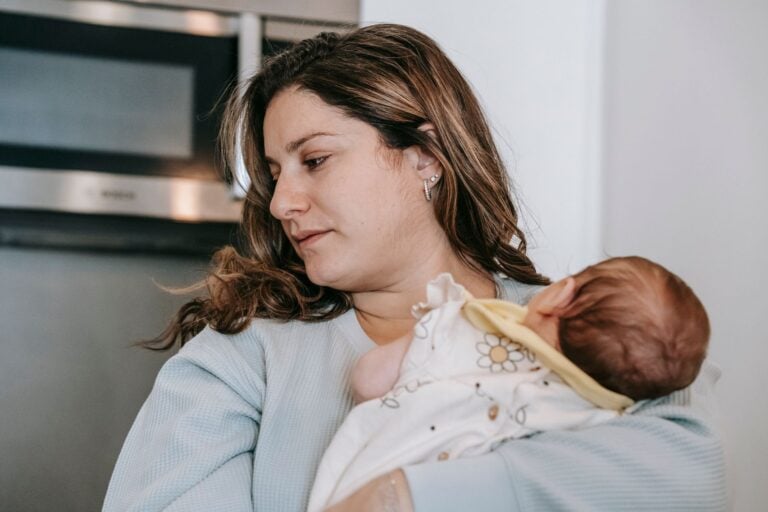
The casserole arrived before I did.
I want you to understand the timeline, because the timeline is the whole problem. I came home from the hospital on a Thursday, four days after my son was born, stitched up and leaking and running on a kind of sleep deprivation that I did not know was medically possible. My husband Daniel carried the car seat. I carried the diaper bag and the small, terrifying realization that they were just letting us leave with a human being and nobody had checked whether we were qualified.
And on my kitchen counter, where I had left a clean, empty stretch of laminate on Monday, there was a casserole dish. Foil over the top. A sticky note in handwriting I knew too well. “Heat at 350 for 40 min. You won’t have time to cook. Love, Mom.”
Her name is Carol. She is Daniel’s mother. And she had a key.
I stood in my own kitchen and looked at that dish like it was a flag planted on the moon. Because that is what it was. It was a flag. I just did not know yet that I was looking at the opening shot of a war that would run for the next eleven weeks, end at three in the morning over a smoke alarm, and turn the woman I was ready to scream at into the only person on Earth I trust with my son.
But I am getting ahead of myself. Let me tell you about the casseroles.
There were so many casseroles. I want that on the record. By week two I could chart them. Tuna noodle on Mondays. Some chicken and rice situation on Wednesdays. A king ranch thing on Fridays that I will admit, under oath, was incredible, which only made me angrier. Carol would let herself in while I was upstairs trying to get the baby to latch, and I would come down with my shirt half open and my hair in a state and there she would be, at my stove, in my apron, the one Daniel gave me, humming.
“Oh, you’re up,” she would say, like I was the visitor. “Sit down, honey. You look tired.”
I did look tired. I was tired. But there is a specific flavor of tired that comes from being told you look tired by a woman who is currently reorganizing your spice rack alphabetically without being asked. I did not know where my cumin was for a month. She moved it. She moved everything. She had opinions about where everything went, and her opinions had the quiet, total confidence of a woman who had run her own kitchen for forty years and could not understand why mine was so badly arranged.
It was not badly arranged. It was arranged the way I liked it. Past tense.
And it was not just the kitchen. It was the baby.
His name is Theo. He was eight days old the first time I had to physically wait my turn to hold my own son. I had finally, finally gotten him down for a nap, the kind of victory that makes you want to lie on the floor and weep with gratitude, and I heard the front door, and I heard Carol’s voice go up an octave the way it did only for him, and by the time I got to the living room she had scooped him up out of the bassinet and he was awake and she was bouncing him and saying, “There’s my boy, there’s my handsome boy, did your mama let you sleep too long?”
Get a new story in your inbox every morning.
Facebook doesn’t show you every story we post. Our free newsletter does. Join 2,500+ readers.
Did your mama let you sleep too long.
I want to be fair to her, because I have had a lot of time to think about this, and being fair to Carol is something I am still learning to do. She did not say it to be cruel. Carol is not cruel. That is the thing that took me eleven weeks to understand, and I will get there. But in the moment, standing in my pajamas at noon, having not showered in three days, watching her wake up the baby I had just spent an hour putting down, the word “let” went through me like a knife. As if it was a choice I had made. As if I was doing it wrong.
I went back upstairs and cried in the bathroom with the fan on so nobody would hear me, which is, I have learned, the official break room of new motherhood.
Here is what I did not do. I did not say anything. I am going to be honest about my own part in this, because for a long time I told this story like Carol was the villain and I was the saint, and that is not true, and the not-true version is less interesting anyway.
I did not say anything because I was raised to be polite, and because she was Daniel’s mother, and because some small exhausted part of me was afraid she was right. That was the part I could not admit. She had raised three kids. She had done this. And I was twenty-eight years old and could not get my son to stop crying at four in the afternoon for reasons that had no name, the witching hour, they call it, and when Carol walked in and took him and he stopped crying in ninety seconds flat, it did not feel like help. It felt like proof. Proof that she could do the one thing I could not, which was soothe my own child.
So I said nothing, and the casseroles kept coming, and the spice rack stayed alphabetized, and I got quieter and quieter, and meaner and meaner inside, where nobody could see it.
Daniel, God love him, was no help at all. I asked him to talk to her. He said, “She’s just trying to help, babe.” Which is the single most useless sentence in the English language, and I have thought a great deal about having it engraved on something. Of course she was trying to help. That was never the question. A bulldozer is trying to help when it clears a lot. You still do not want it in your living room.
I should describe a normal night, because I want you to feel the texture of it, the grind underneath the comedy. The nights were the worst of it. Theo did not sleep more than two hours at a stretch for the first month, and neither did I, and there is a particular kind of three a.m. that only new mothers know, where the whole house is dark and quiet and the rest of the world is asleep and you are standing in a nursery swaying side to side with a screaming infant, doing math on your phone in the dark. If he eats now and goes down by four, and I fall asleep by four fifteen, and he wakes at six, that’s an hour and forty-five. I can do an hour and forty-five. I would tell myself that. I can do an hour and forty-five. Then he would wake at four thirty and the math would start over and I would want to lie down on the carpet and never get up.
In one of those four a.m. stretches I texted my own mother, who lives three states away and could not come, and I typed out the whole thing about Carol, the key and the casseroles and the spice rack, and my mom, who is wise, texted back one line. “She raised the man you married. Whatever she did, she didn’t do it badly.” I stared at that for a long time in the blue light of the phone while Theo finally, finally drifted off on my chest. I did not know what to do with it. It did not fix anything. But it stayed with me, that line, all the way to the night the kitchen caught fire.
Because here is the thing nobody warns you about. You can be furious at someone and need them at the same time. I needed Carol. On the afternoon Theo ran a fever for the first time and I was too scared to think straight, it was Carol I called, not the pediatrician, Carol, and she talked me through it in a voice so steady it brought my own heart rate down, and she was at my door in twenty minutes with infant Tylenol and a thermometer that worked better than mine, and she sat with me until the fever broke at midnight. I was grateful and resentful in the same breath, all night, and I could not untangle the two, and that, I think, is the real shape of those early weeks. Not the casseroles. The casseroles were just the part I could point at.
The thing finally cracked open over the casserole dishes. The actual physical dishes. She had so many in my cabinets by week six that I could not fit my own pots in there, and one afternoon I was trying to find a pan and a tower of her Pyrex came down and one of them shattered on the floor two feet from where Theo was lying on his play mat, and I lost it. Not at her. She wasn’t even there. I lost it at the dish. I stood in a pile of glass and casserole residue and cried so hard I scared the baby, and then I had to stop crying to comfort him, which is its own special cruelty, and that night I told Daniel that I could not do it anymore. That I needed his mother to stop having a key to our house. That I needed one room, just one, that was mine.
He looked at me like I had suggested we put her in a home. And he said the magic words, the ones that finally got me to do something, which were, “I think you’re being a little dramatic.”
Reader, I was not being a little dramatic. But I will tell you what those words did. They made me decide to handle it myself. No more waiting for Daniel to fight a battle he could not even see. I was going to talk to Carol, woman to woman, the next time she came over, and I was going to be calm and kind and clear, and I was going to ask her, gently, for some space.
I even rehearsed it. I want you to know how hard I tried to do this the grown-up way. I practiced in the shower, which was the only place I got to be alone, whispering it to the tile. Carol, I love you, and I am so grateful, and I need you to ask before you come over. Carol, the kitchen is mine, and I need it to stay mine. I had a whole speech. I was kind in the speech. I was generous. I had thought about her feelings.
And then she came over the next day while I was napping, the first real nap I had gotten in nine days, because Theo had finally given me a four-hour stretch, and I woke up to the smell of pot roast and the sound of my own washing machine running a load of Theo’s clothes I had been planning to do, folded in a way I do not fold, and my whole rehearsed speech evaporated, because how do you tell a woman to stop while she is washing your baby’s onesies at her own expense. You cannot. I could not. So I said nothing again, and the speech went back in the drawer with all the other things I could not say, and I hated myself a little for being a coward, and I hated her a little for making cowardice the only polite option.
So I waited. I told myself I would find the right moment. There is never a right moment. That is the lie that lets a thing go on for eleven weeks.
That is not what happened, the calm woman-to-woman talk. What happened was the night of the casserole.
It was a Saturday. Theo was nine weeks old and going through something the internet called a sleep regression, which is a polite term for the baby deciding that sleep is for the weak. He had been up since one. It was now nearly three. I had tried everything. I had walked the hallway until my feet went numb. Daniel was asleep, because Daniel could sleep through a marching band, and I had stopped resenting it around hour two because resentment takes energy I did not have.
And I heard a key in the front door.
At three in the morning. I thought I was being robbed by the world’s most considerate burglar. I came down the stairs with Theo screaming on my shoulder and there was Carol, in her coat over her nightgown, holding a casserole dish, and she looked as wrecked as I felt.
“I couldn’t sleep,” she said. “I thought, she’s probably up with him. I’ll bring her something for the morning. So she doesn’t have to think about it.”
And something in me, some load-bearing wall that had been holding all eleven weeks of politeness up, just gave out. I did not yell. I was too tired to yell. I said, in a flat little voice I did not recognize, “Carol. I can’t. I can’t with the casseroles. I can’t with the spice rack. I can’t with you holding him better than I can. I just can’t anymore.”
She went very still. And then she put the dish on the stove, and she turned it on, because she said it would warm us both up and we were going to be up anyway, and she sat me down at my own kitchen table at three in the morning, and she told me the thing.
She told me that when Daniel was born, her own mother-in-law had moved in for two months. That she had taken over Carol’s kitchen and Carol’s baby and every opinion Carol had left. That Carol had sat in a bathroom with the fan on, twenty-eight years old, and cried because the baby stopped crying for someone else. The exact same bathroom. The exact same fan. Forty years apart, the same woman crying.
“I swore I would never do that to my son’s wife,” she said. Her hands were shaking around her coffee. “I swore it. And then Theo came, and I was so afraid of being useless. Of being the kind of mother-in-law you put up with. The kind that sits in a chair and gets handed the baby for ten minutes and goes home. I couldn’t stand it. So I cooked. I cooked because if I was feeding you I was needed, and if I was needed you couldn’t decide you didn’t want me around.” She looked at the dish on the stove. “I have been doing to you the exact thing that nearly broke me. And I couldn’t see it. I’m so sorry, honey. I’m so sorry.”
I did not know what to say. I had spent eleven weeks building her into a fortress, and she had just opened the front door and shown me there was a scared person inside, the same scared person I was, and the war I had been fighting turned out to be two terrified women on the same side, both convinced they were failing the same baby.
That is when we smelled the smoke.
We had both forgotten the casserole. The two of us, the alphabetized spice rack and the king ranch and the foil over the top, and neither of us remembered to watch the stove. The smoke alarm went off. Theo, who had finally, mercifully fallen asleep on my shoulder during the conversation, woke up and screamed. Daniel came thundering down the stairs convinced the house was on fire. And Carol and I, standing in a smoke-filled kitchen at three in the morning over a casserole burned to charcoal, looked at each other and started to laugh.
I mean we laughed until we could not breathe. Daniel stood in the doorway in his boxers, waving a dish towel at the smoke alarm, looking at the two of us like we had both lost our minds, and that only made it worse, and Carol had to sit down, and I was crying again but the good kind this time, and Theo eventually decided that whatever was happening was not actually an emergency and went back to sleep against the noise of two women laughing in the dark.
We scraped the casserole into the trash together. She washed, I dried. And somewhere in there, at maybe half past three, we figured out the rest of it without ever quite saying it out loud.
We made rules, though we never called them rules. She gave back the key, and I told her she did not need a key, she needed to text, and she could come over any time she texted, and she would. The kitchen was mine. If she wanted to cook, she cooked with me, not instead of me, and it turned out that cooking next to Carol is one of the great pleasures of my life, because the woman knows everything, and she taught me the king ranch, and now I make it for her. The spice rack I put back the way I liked it, and she never touched it again, and once she even said, “I can never find anything in here,” and I said, “Welcome to my world,” and she laughed so hard she had to hold the counter.
And Theo. Here is the part I most want you to understand. I stopped seeing her hands reaching for him as a verdict on mine. Because she told me, that night, that the reason he settled for her was not that she was better. It was that he could feel that she was not scared. “Babies feel the fear,” she said. “You’re scared because you love him so much you can’t stand the size of it. He feels that. I’m not scared, because I already did this, and we all lived. That’s the only difference. You’ll get there. You’re already there. You just can’t see it because you’ve never not been scared long enough to notice.”
She was right. I can see it now. He is seven months old as I write this, and he settles for me, and he settles for her, and when she walks in the door he does this whole-body wiggle of joy that I used to resent and now love, because there is one more person on this Earth who would walk into a burning building for my son, and she proved it, more or less, the night she set my kitchen on fire trying to feed me.
Daniel still does not fully understand what happened that night. He tells people his mother and his wife “had a moment.” He has no idea. A moment is not the word. What we had was a treaty, signed in burned casserole and laughter at three in the morning, between two women who loved the same baby and the same man and finally, finally got out of each other’s way long enough to be on the same side.
Carol comes over twice a week now. She texts first. She brings casseroles, sometimes, but now she brings two forks and we eat them together at the table while Theo bangs a spoon on his high chair tray and presides over the whole thing like a tiny drunk king.
And every now and then, when one of us is being a little much, the other one only has to say one word. “Spice rack.” And we both crack up. And whoever was being too much backs off, and we are fine.
I almost lost her. I want you to hear that, if you are where I was, in the bathroom with the fan on, building your own Carol into a fortress. I almost lost the best thing that ever happened to my mothering because I was too tired and too proud and too scared to find out that the fortress was just a frightened person holding a casserole.
The casserole arrived before I did. And it turned out to be a peace offering eleven weeks early, from a woman who was trying, the only clumsy way she knew how, to tell me I was not alone.
I just had to burn one to hear it.