
The Pulse of a Shared Meal
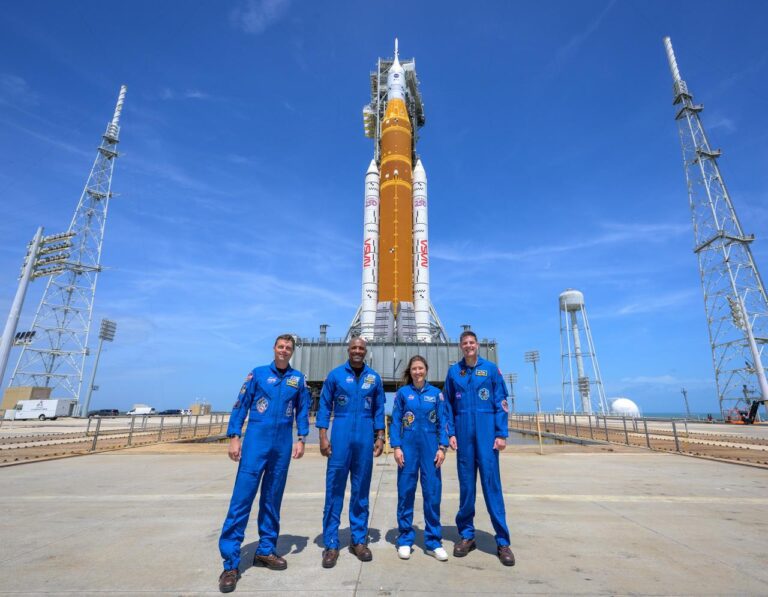
We all have a memory of a dinner so unappealing we tried to hide it under a napkin: that gray, unidentifiable meatloaf or the over-boiled vegetables of a childhood kitchen. Now, imagine being 248,000 miles from Earth and realizing your only food for the next ten days is a dry block inside a plastic pouch. For the crew of Artemis II, including mission specialists Christina Koch and Jeremy Hansen, a bad dinner is not just a disappointment: it is a threat to the mission’s psychological health. As the Orion spacecraft travels around the far side of the Moon, familiar flavors like barbecued beef brisket and maple cream cookies become the most important anchors to the world they left behind.
The Science of the “Lunar Cold”: Why Taste Changes
The most surprising hurdle in space dining is not the lack of gravity, but the stuffy-nose effect. On Earth, gravity pulls fluids down to our legs. In microgravity, these fluids disperse equally, leading to what NASA calls a puffy face as fluid blocks the nasal passages. This congestion severely limits the sense of smell, which accounts for up to 80% of what we perceive as flavor.
As a result, favorite foods on Earth can taste like cardboard in space. Astronauts frequently crave intense flavors: sweet, salty, and especially spicy. This is why the Artemis II menu features five different types of hot sauce and bold entrees like vegetable quiche and spicy green beans. Without these stimulants, the crew would struggle with a loss of appetite that can lead to a dangerous caloric deficit.
“Familiar flavors like barbecued beef brisket and maple cream cookies become the most important anchors to the world they left behind.”
Get a new story in your inbox every morning.
Facebook doesn’t show you every story we post. Our free newsletter does. Join 2,500+ readers.
The Physics of Launch Mass Savings
Dehydrating space food is a fiscal and physical necessity. Since the Space Launch System (SLS) generates 9 million pounds of thrust to leave Earth, every ounce of Upmass requires a significant amount of fuel. By removing approximately 80% to 90% of the water from food, NASA dramatically reduces the total weight that the rocket must overcome.
We can calculate the Launch Mass Savings (Ms) by comparing the weight of a standard fresh meal allotment (Wf) to the weight of its dehydrated counterpart (Wd), multiplied by the total crew count and mission duration.
Ms = (Wf − Wd) × Crew × Days
According to NASA Johnson Space Center flight data, a daily food allotment per person is approximately 1.5 kg. Dehydration through sublimation reduces that to 0.3 kg. For the 4-person Artemis II crew on a 10-day mission:
Ms = (1.5 − 0.3) × 4 × 10 = 1.2 × 40 = 48 kg (roughly 106 lbs)
This 106-pound reduction allows the Orion spacecraft to allocate more mass to critical life support systems and scientific equipment. The saved weight is eventually recouped in orbit by using water generated as a byproduct of the spacecraft’s fuel cells to rehydrate the meals.
If you’re following the Artemis II mission: you can now track the crew in real time above, and understand why their food choices are a mission-critical decision, not just a comfort perk.
If you’re interested in food science or nutrition: microgravity scrambles your sense of smell so severely that bold, spicy flavors aren’t a preference, they’re a caloric survival strategy.
Bottom line: Space food is a 106-pound engineering problem and a deeply human comfort story rolled into one vacuum-sealed pouch.
Conclusion: The Future of Space Dining
The Artemis II mission is proof that as humanity ventures further into the void, we are taking our culture with us. From Jeremy Hansen’s maple cookies to Christina Koch’s mac and cheese, the menu is a bridge back to the world they left. We aren’t just sending explorers to orbit the Moon: we are ensuring that they remain humans while they do it.
Are you watching the rocket, or the menu?
Works Cited
- NASA. “Artemis II: NASA’s First Crewed Lunar Flyby in 50 Years.” 2026. nasa.gov
- Space.com. “What Will the Artemis 2 Astronauts Eat During Their Historic Moon Mission?” April 2026. space.com
- Scripps News. “What Artemis II Astronauts Eat: NASA Space Menu for Moon Mission.” April 2026. scrippsnews.com
- Kennedy Space Center Visitor Complex. “Artemis II.” 2026. kennedyspacecenter.com
- NASA. “NASA Answers Your Most Pressing Artemis II Questions.” April 2026. nasa.gov
- National Geographic. “The Food on Artemis II Is Surprisingly Tasty.” April 2026. nationalgeographic.com