
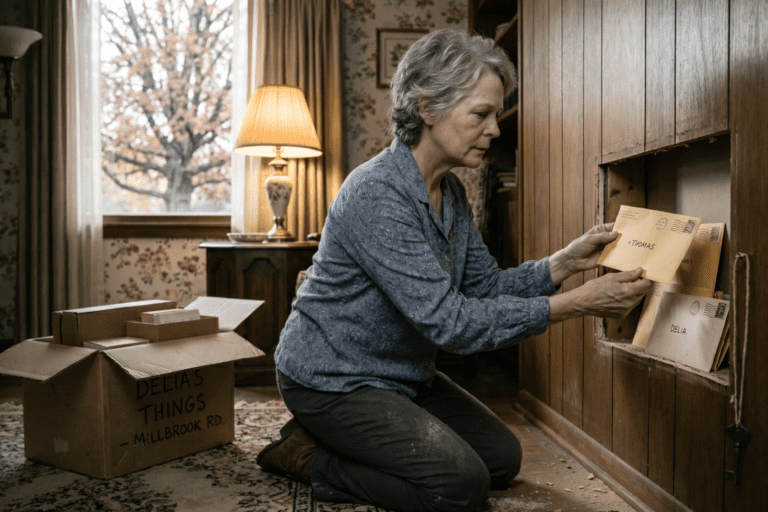
Ruth drove to the house her daughter was selling without telling her. A contractor was already opening the walls. Behind the east wall, sealed since before Ruth was born, she found a metal box. Inside: seven letters addressed to her father in a dead woman’s handwriting. She read the first line and her world stopped.
Chapter Two: Delia
The date on the envelope said October.
Outside, through the window Ruth had looked through ten thousand times, the maple was doing what maples do in November, which is let go of things with a kind of patient indifference that Ruth had always found either comforting or devastating depending on the year. Today she could not decide which.
She unfolded the letter again.
She had read it twice already. She was going to read it a third time because the first time her hands were shaking and the second time she kept stopping at certain lines the way you stop at the site of an accident, unable to look away and unable to fully look. The third time she was going to read it the way she had taught her students to read anything that mattered. Slowly. From the beginning. With the understanding that every word was chosen.
Dear Thomas,
I have started this letter eleven times since August and thrown away ten of them. The ones I threw away were either too much or too little, and I could not find the middle distance that a letter like this requires. I am not certain I have found it now. But I am running out of time in which to find it, and so this is the one that goes.
I want to begin by saying that I am not writing to ask anything of you. I know how it ended between us and I have made my peace with the shape of it, or something close enough to peace that I have learned to call it that. What happened in those three days in June was its own complete thing and I do not wish it undone. I am writing because there is something you need to know, and because I believe, in spite of everything, that you are a man who would want to know it.
You were the only person who ever came back.
I mean that as a plain statement of fact about this town and about me. My mother came here from Savannah in 1931 and told herself it was temporary and died here in 1958 having never left. I came back from two years in Nashville in 1962 thinking I would stay long enough to settle her affairs and then go somewhere worth going to, and here I still am, seven years later, tending the house on Millbrook Road and working at the library on Tuesdays and Thursdays and watching people pass through the way water passes through cupped hands. They come for a season or a reason and then they go and the town fills back in behind them like it never noticed the gap.
You came through in the spring of 1963. You were here on a surveying contract for six weeks and then you were gone, which was what I expected and what I told myself I had prepared for. I was not as prepared as I believed.
Then in June of this year you came back.
I have thought about those three days more times than I am comfortable admitting. You showed up at the library on a Tuesday afternoon the way you used to, like no time had passed, like you had only stepped outside for a moment. You said you were passing through on your way to a job in Richmond. You stayed for three days. We did not talk about your wife. We did not talk about what those three days were or were not. We talked about the things we always talked about, books and the light in this town in the early morning and whether a person can belong to a place they never chose. On the third morning you left before I was awake and I found the note you left on the kitchen table and I sat with it for a long time before I threw it away.
I am telling you this not to reopen anything but to give you the full picture before I tell you what I need to tell you.
Get a new story in your inbox every morning.
Facebook doesn’t show you every story we post. Our free newsletter does. Join 2,500+ readers.
Thomas. I am going to have a child.
I am not writing this to make demands or to upend the life you have built. I have thought carefully about what I want from you, and the honest answer is very little. I do not want your money and I do not want your name and I do not want you to blow your life apart on my account. What I want is for you to know. That is all. Whatever you do with the knowing is your own business and I will not hold it against you either way.
What I will tell you is that I intend to keep this child and raise it in this house on Millbrook Road, which is paid for and mine, and I will be adequate to that task if not always graceful at it. I am thirty-four years old and I am not fragile and I am not asking to be saved. I am only asking to be known, which is a different thing.
I did not put a return address on this envelope because I am not certain you will want to write back and I did not want to make that decision awkward for you. If you want to find me you know where I am. I have been here all along.
There is a loose board on the back porch that I keep meaning to fix. The kitchen still smells like the coffee I burned the morning you left. The maple in the front yard has gone considerable since you were here in the spring. Everything is almost exactly as you remember it.
I think about the way you said the light here was different. I think you were right about that.
With everything that word can hold,Delia
Ruth folded the letter.
She sat very still on the couch she had chosen in 2003 in the house she had bought in 1987 from the estate of the Cutter family who had purchased it in 1974 from a woman named Delia Marsh who had died in these rooms in 1971 without, as far as any record showed, ever having had a child.
She looked at the other six envelopes.
October 14th. November 2nd. November 29th. The dates moved through the fall and into the following spring. The last envelope was dated March 8, 1971. Eight months before Delia died.
Seven letters written over a year and a half.
None of them with a return address.
None of them, Ruth now understood, ever sent.
“They had been written and sealed and addressed and then kept. Hidden inside the wall of the house where they were written. By a woman who had sat in this same room and written the truest thing she knew to a man who never came back.”
They had been written and sealed and addressed and then kept. Hidden, eventually, inside the wall of the house where they were written, in the wall of the room where Delia had sat and thought about a man who had come back once and then not again. Ruth did not know yet whether her father had ever received a single one of them. She did not know whether he had known. She did not know whether she had a sibling somewhere in the world who had been born in this house and raised in it and sold it in 1974 and never known what was in the wall.
She looked at the envelope dated November 2nd.
Then she heard the van start.
She had forgotten about the contractor.
She looked at her watch. Two hours and twenty minutes had passed since she had asked him to give her a moment alone. She stood up from the couch, moving with a deliberateness that surprised even her, and she laid the letter back in the box with the other six envelopes and closed the latch and looked around the room for a moment with the particular attention of a woman taking inventory.
Then she picked up the box and walked to the hallway closet and placed it on the high shelf behind the winter blankets, in the back left corner where it had been dark since 1987, and she closed the closet door.
She went outside.
The contractor was standing by his van with his phone out, looking at something on the screen with the expression of a man who had been patient long enough and was now calculating how much longer patience was going to cost him.
“Mrs. Calloway,” he said. “I need to get back in there and finish the section by the window or I’ll have to come back tomorrow.”
“Of course,” Ruth said. Her voice was completely level. “I’m sorry to have kept you. I was going through some of my late husband’s things.” She paused just long enough. “It’s harder than I expected.”
The man’s expression shifted the way expressions shift when grief enters a conversation, a softening and a slight withdrawal, the instinct to give a grieving person a wider berth. “Take all the time you need,” he said. “I’ll be out of your way in an hour.”
“Thank you,” Ruth said. “I appreciate your patience.”
She went back inside and stood in the hallway and listened to him gather his tools and resume the work on the east wall.
She had not been going through her late husband’s things.
She had been reading a letter written by a woman who had died in this house having never sent the most important thing she ever wrote to the one person she wrote it for.
She had lied with perfect smoothness to a stranger on her own front porch and felt almost nothing about it except a small cold clarity, the clarity of a woman who has just understood that the rules she had been living by, the rules of patience and deference and making things easy for other people, those rules were made by people who had something to gain from her following them.
She went to the kitchen and filled the kettle and stood at the window while it heated and looked at the maple and thought about a woman named Delia who had looked at this same tree in the fall of 1969 and written the truest thing she knew and then sealed it in an envelope and addressed it to a man who never came.
The kettle began to sound.
Ruth had six more letters to read.
And she had a decision to make about who she was going to tell.
Someone in this town knew Delia. Ruth is going to find her. And what she knows is going to change the question entirely.
Come back tomorrow at 1pm. The link will be in the comments on the Facebook post.
Reading Delia’s letter, what did you feel toward her?
The letters were never sent. They were sealed, addressed, and hidden in the wall. What does that tell you about Delia?
Ruth lied to the contractor without hesitating. How did that make you feel about her?
Delia had a child. Ruth may have a sibling she never knew about. Where do you think that thread leads?
Be honest. How are you feeling about this story right now?
Saving your response…
Chapter Three: The Woman Who Remembered drops tomorrow at 1pm.
Go back to the Facebook post and tell us what you really thought.Did Delia feel real to you?
That letter took a long time to get right. If it landed, we want to know. If something felt off, we want to know that too.
Go back to the Facebook post and tell us exactly what you thought. Every comment tells us something we can’t learn any other way.
We are reading every single one.
Chapter Three arrives tomorrow at 1pm · The Letters in the Wall