
He spent eight years living under a false name. While he was gone, he sent his father fifteen hundred dollars a month and trusted his brother to look in on things.
When Ray finally came home to the Okanagan lake house he had bought his father with everything he owned, the front gate was open. There was a lockbox on the pillar. And his father was in the yard with a rake, looking at his own son like a polite stranger.
This is what happens when a good son stays gone too long and a bad one stays too close.
What Was Left of Him
The gate was open. That was the first wrong thing, and I registered it the way you register wrong things after years of work that depends on noticing them: quietly, without reaction, while the rest of me kept moving.
My father had been locking that gate since 1978, the year someone broke into our house in Burnaby and walked off with my mother’s jewelry box and the television set my parents had saved eleven months to buy. After that he locked everything. Doors, windows, the car when it sat in our own driveway. You could tease him about it. My mother used to. He would give her that slow look of his and say that unlocked things invited the wrong kind of attention. Forty-seven years of locking things. Right up until the morning I drove away.
I sat in the rental car and read the wooden sign mounted between the stone pillars. LAKESHORE PARADISE RETREAT. PREMIUM VACATION RENTAL. BOOK NOW.
Beneath it, a brass lockbox screwed to the pillar’s face. I put the car in drive and went through the open gate.
Eight years ago I had bought my father the best thing I had ever owned, which was nothing, because I spent everything I had on the property and borrowed what was left. Three point two million dollars for three acres on the Okanagan lake: a stone and timber house with a private dock, Douglas firs framing the long driveway, the mountains rising behind it in a way that made you feel the world still had some size to it.
He had cried when I handed him the keys. Not the open weeping kind, that was never my father. His eyes went glassy and his jaw tightened the way it did when something moved him more than he was prepared to handle, and he had to clear his throat before he could speak.
“You’ve done too much, Ray.”
“You raised me right. This is just the receipt.”
He laughed at that, surprised out of his composure, and said that if your mother could see this place she would have the kitchen reorganized before we were through the front door. I can still hear exactly how he said it. The warmth in it. The grief softened by the image of her moving through a new kitchen with her particular efficiency, already knowing where everything should go.
Three days later I drove to Vancouver and became someone else for the RCMP’s organized crime unit. Drug networks mostly, some weapons, the occasional thing you don’t commit to paper because paper gets read. I sent fifteen hundred dollars a month to my father’s account without interruption. I arranged for my younger brother Kevin to look in on him, take him to appointments, make sure the taxes got paid and the dock got maintained and the man did not rattle around three acres by himself on the hard days.
Kevin promised he would. There are things you believe when you need to believe them.
The driveway curved through the firs and opened toward the house. Three vehicles sat in the yard: a Range Rover, a Tesla, a navy Mercedes SUV with a lease-payment heft to it. Music floated from somewhere inside, the cheerful studied kind they play at brunch places. Through the big front window I could see people moving in the great room, young, wearing expensive athleisure, someone photographing the kitchen island with her phone while her husband poured wine at two in the afternoon.
I was fifty-eight years old. I had been shot at four times, cut once, and had a bag put over my head in a Hamilton parking garage by men who were seriously discussing whether to use it. None of it had prepared me for looking through my father’s window at strangers on vacation.
I parked at the edge of the drive and walked toward the house and was halfway up the front path when I saw him. An old man near the side of the house, bent over a rake. I stopped walking.
Get a new story in your inbox every morning.
Facebook doesn’t show you every story we post. Our free newsletter does. Join 2,500+ readers.
Frank Colby had never been a small man. Even past seventy, even with the reading glasses and the careful movements of age, he had always seemed rooted, substantial, a man built from decades of labor and stubbornness and the quiet dignity of someone who has survived things without advertising them. Korea, for one. Fifty years of marriage. My mother’s death. The man I was looking at now seemed reduced. His canvas jacket hung loose. His hands looked bony around the handle. He paused for breath and in that pause I could see how much the work was costing him.
I walked toward him slowly. He looked up when my boots found the gravel. His eyes were cloudy.
“Good afternoon,” he said. Polite. The courtesy you extend to a stranger.
“Hello, Mr. Colby.” I kept my voice even.
Something moved in his face at his own name. A ripple of recognition that came and went before it could settle.
“I served with someone who knew you. From Korea.”
“Korea.” He nodded. “Haven’t had many visitors. The guests keep things busy.” He gestured toward the house with the rake handle. “Mr. Kevin’s guests. He rents it out now. Good income, he says.”
“And where are you staying, Mr. Colby?”
He pointed toward the back of the property without looking up. Near the tree line I could see it: a shed with vinyl siding the color of old dishwater, two small windows, a stovepipe angling out one wall at the angle of a job done by someone who did not plan to look at it much. The padlock on the door was a new one. My father’s door. Padlocked from the outside.
“Got a little place out there. Kevin says the guests need the full run of the main house.”
“Do you have children, Mr. Colby?”
“Two boys. Kevin lives here in Kelowna. Good boy.” A short silence. “Had another son. Raymond. Ray.” His voice changed around the name, softened and tightened at the same time, the way a wound changes when you touch it. “He passed. Eight years ago now. Line of duty. He was RCMP.”
He cleared his throat.
“Very proud of that boy.”
He said it the way a man says something he has told himself so many times it has worn smooth, like river stone.
I have been in rooms with men who were deciding whether to kill me. I have been cold-terrified in the operational way that does not show while your blood runs with ice. None of it hit like hearing my father tell a stranger I was dead with that worn-smooth grief, the loss given time and shape, made into a fact he could carry.
“I’m sorry for your loss,” I said.
He nodded politely and went back to raking. I walked to the car and sat behind the wheel with both hands on it until the shaking stopped.
I called Kevin from a gas station three miles up the road. He answered on the second ring, voice easy and unhurried, the voice of a man who had not yet done the math.
“It’s Ray.”
The silence that followed told me everything. Not shock. Calculation.
“Jesus. Bobby.” Nobody else still called me that. “When did you get back?”
“I’m in Kelowna. I went to the house.”
“He’s in a shed, Kevin.”
“It’s been renovated. There’s heat and plumbing and a kitchenette—”
“I saw it.”
“There’s context that you don’t have. I think we should sit down.”
We sat down the following morning at a coffee shop on Bernard. He came in wearing a jacket I could not have afforded on my best salary year and a watch that caught the light every time he moved his wrist. He looked rested. Prosperous. He ordered a latte with three qualifications. I got black coffee.
He started with context. I let him run through it: the dementia, the difficulty managing the property alone, the Airbnb as a practical solution to the upkeep costs. He spread his hands when he talked, the gesture of a man presenting a burden rather than a crime, and I watched his eyes while he did it and noted what he was not saying.
“He thinks I’m dead,” I said.
“He kept asking where you were, why you didn’t call. After a while I thought closure was kinder than an open question.”
“You gave our father a dead son so he would stop asking inconvenient questions.”
“You weren’t here.” His voice had an edge now. “I was the one handling the appointments, the property, the money, all of it. For eight years. I don’t think you walk in after that and start—”
“Show me the care account.”
His jaw tightened in the way our father’s used to, that same architecture of stubbornness, and something about that made it worse. He stood, pushed back from the table, and walked out without looking back. Through the window I watched him get into a black Audi. New. I wrote down the plate number out of habit.
Eight years undercover teaches you that truth lives inside systems people assume are too tedious to examine. Land title records. Bank statements. Power of attorney documents. It took me three days.
The rental income went directly into Kevin’s personal account, reported as his own. The line of credit he had taken against the property two years prior — four hundred thousand dollars — had paid off his car loans, his and his wife Linda’s credit cards, a boat, renovation work on their house on the south side of town. My monthly deposits and my father’s pension were being redirected: forty-three thousand dollars a year that my father never touched. The traceable costs of his actual care came to nine thousand a year. Groceries. Basic prescriptions. Shed utilities.
Over three years. He was going to sell it. Projected ask: three point nine million. The Airbnb income, the credit line, the patience of it had all been running the clock until he could get the old man’s hand steered onto a deed transfer. The power of attorney signature on the line of credit: someone had controlled his hand. He didn’t understand what he was signing.
I drove to the property on foot that night. Cut through the trees from the north, wet pine needles soft under my boots, the lake black and cold through the gaps in the firs. The main house was lit and occupied, voices drifting out across the dock, someone laughing at something they found very funny. Ordinary people on vacation, paying eight hundred a night to stand in my father’s kitchen.
The shed had one window with a light behind it. I looked through.
My father was sitting on a cot in a room the size of a generous bathroom. He was still wearing his work jacket. On the narrow dresser to his right sat a framed photograph. My RCMP graduation portrait, the one my mother had taken outside the depot in Regina: me in Red Serge, my father beside me with the expression of a man who has been proud before but not quite like this. He was grinning in it. He looked like he had won something no one else could name.
He reached out slowly and touched the photograph with two fingers. His lips moved. I could not hear him through the glass but I could read the shape of it. Bobby.
I stood in the cold outside a shed on property I had bought him with everything I owned, and watched my father reach out in the dark to touch a picture of the son he had been told was dead.
I did not make any sound because I did not trust what would come out of me if I opened my mouth. I went back through the trees to the road and sat in the rental car and let it come. In the dark, alone. All the way out. I had not cried since my mother’s funeral and I found that the machinery for it still worked fine. Then I wiped my face and drove back to the hotel and got to work.
The warrants came through on a Saturday. Corporal Walsh called me from outside Kevin’s house at eight in the morning. Both of them. Kevin and Linda. Fraud over five thousand. Theft. Exploitation of a vulnerable person. Forgery.
“They found emails,” she said. Her voice had the controlled anger of someone bound by procedure but genuinely furious underneath it. “Him and Linda discussing whether your father would be visible from the deck once they redid the landscaping.” She let that sit a moment. “The groundskeeper. That’s how he referred to him in the emails. The groundskeeper.”
My father. A man who had survived Kapyong. Who worked thirty-two years and never once asked for anything extra. A groundskeeper on his own property, padlocked into a shed so the guests would not be inconvenienced by the sight of him.
The guardianship hearing was brief. The judge listened to the physician’s testimony and the Veterans Affairs inspector’s report and my own account, and then looked at me and said that my father was fortunate to have a son willing to come home and stay. I had the shed demolished the following week. Where it had stood I planted a garden, because my father had always grown things, and because my mother would have taken one look at that open ground and already known where the tomatoes should go, and the beans along the south edge for the afternoon light, and the lavender along the path because she loved the smell of it after rain.
I brought my father home on a Thursday in June. Six weeks at a veteran-focused memory care residence had given him something back. He was steadier. He had gained weight. He knew me most mornings. When I pulled up the driveway he looked through the windshield and went still. The property was clean. Stone washed, gutters cleared, the dock rebuilt and restained. No lockbox on the pillar. No sign. His home.
“Is this really mine?” he said softly.
“Has always been.”
We walked through every room at his pace. He touched things: the back of the kitchen chair, the window frame above the sink where you could see a corner of the lake if you stood at exactly the right angle. In the bedroom I had set up on the ground floor he stopped when he saw the graduation photograph on the dresser and stood and looked at it for a long time.
“That was a good day,” he said finally.
“Best one I can remember.”
“Your mother cried through the whole ceremony.”
“She did.”
“She was not a woman who pretended to feel less than she felt.”
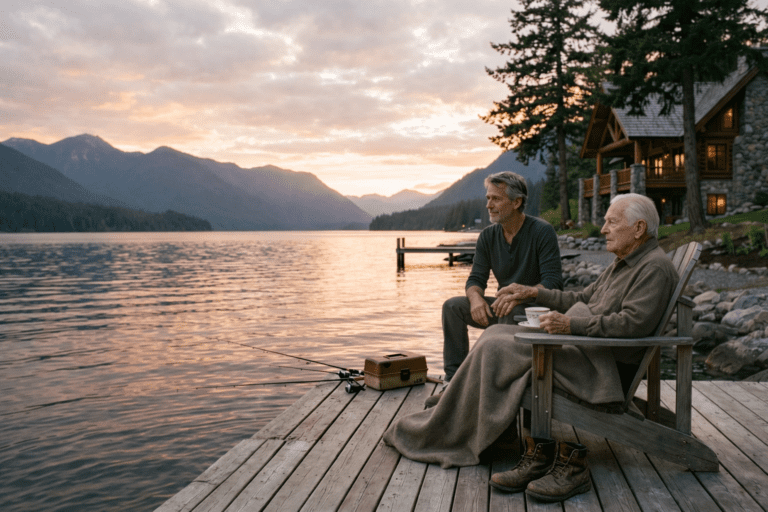
We sat on the dock that evening. The mountains held their shapes against the last light. A loon called once out across the water and then went quiet. My father had a blanket over his knees and a cup of tea gone cold in his hands and the particular stillness of an old man who is finally, genuinely at ease, which is one of the rarest things I know how to recognize.
After a while he said, can you tell me where you were, Ray. All that time. So I told him some of it. Not the parking garage. Not the Surrey night. I told him the cities by their weather and the years by their seasons. I told him I had spent a long time working inside the confidence of men who built their lives on the vulnerability of others, men who counted on no one ever pushing back. I told him I had helped take them down, one careful case at a time, across eight years and six provinces.
“And Kevin.” His voice went thin as paper. “What he did.”
“Yes.”
“He’s my son.”
“I know.”
“But he hurt me.”
“Yes, Dad. He did.”
We sat in the kind of silence that does not ask anything of you. Birds settling for the night. The water touching the dock below us with its patient repetition. Then he reached over and took my hand. His grip was weak but there was something certain in it, something that had nothing to do with the dementia or the years or any of what had been done to him. It was my father’s hand. I had known that hand since I was four years old.
“I knew you weren’t dead. Every morning I told myself you weren’t. Something in here did not believe what Kevin said.” He pressed my hand against the front of his jacket, over his chest, and held it there. “You came back for me.”
“Of course I did.”
“You’re not going again.”
“No.”
His eyes filled and he looked away toward the water, and we sat there while the light went out of the mountains and the first stars appeared and did their old reliable work on the surface of the lake. He fell asleep in the chair around nine. I sat with him another hour before I helped him inside. I put him to bed and turned off the light and stood in the doorway for a moment listening to him breathe. Then I went back out to the dock and sat alone.
Home. Finally. Without apology. Without a cover story or a borrowed name or a weapon within reach. Just a man on a dock in the mountains in June, with his father asleep twenty yards away and his mother’s garden in the ground where a shed used to be.
Home.
We publish one complete story like this every week. No chapters. No cliffhangers. Just a story that takes fifteen minutes and stays with you longer than that.
Go back to the Facebook post and tell us what hit hardest. We read every comment.
When Frank Colby looked up at Ray and said “Good afternoon” — like a stranger to his own son — what hit you hardest?
The shed. Padlocked from the outside. A man who survived Korea, living in a shed on land his own son bought him. What did that image do to you?
Ray watched his father touch the graduation photo through the glass. His lips moved: Bobby. What did that do to you?
Kevin. Be honest about how you feel about him.
You finished. How are you?
More stories like this, every week.
Go back to the post and tell us what hit hardest. We read every comment.Drop the link in your comments. Let the post do the work.
When he finally came home, his father was living in a shed behind the main house.
His brother had turned it into an $800/night vacation rental. His father thought Ray was dead.
What Ray found when he looked through that shed window at night is something I haven’t stopped thinking about.
Full story in the comments. 15 minutes. Read the whole thing.
Did Ray feel real to you?
That shed window scene took a long time to get right. If it landed, we want to know. If something felt off, we want to know that too.
Go back to the Facebook post and tell us exactly what you thought. Every comment tells us something we can’t learn any other way.
We are reading every single one.