
Ruth went to the library and found Margaret Osley, who had worked alongside Delia for years. Margaret had kept a sealed envelope for fifty years, waiting for the right person. Inside: a letter explaining where the letters were hidden. Then Margaret said a name Ruth had never expected. The woman who came to Dellwood and took Delia’s baby was named Eleanor Aldrich. Ruth’s mother.
Chapter Four: Eleanor
The second letter was dated November 2nd, 1970.
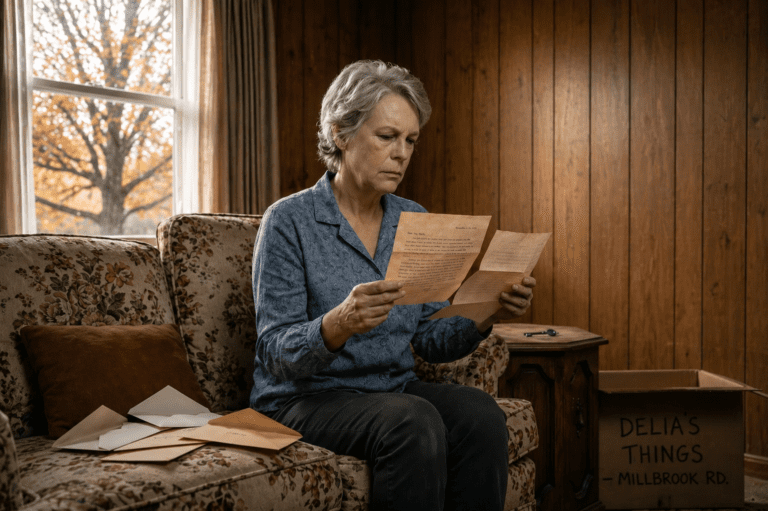
Ruth read it in the living room of the house on Millbrook Road with the contractor’s plastic sheeting still taped across the dining room doorway and the smell of sawdust still in the air and the box open on the cushion beside her the way you leave a book open when you have to set it down but are not finished with it and cannot quite bring yourself to close it.
Outside the window the maple stood in the last of the afternoon light and Ruth looked at it once before she unfolded the paper and then she did not look at it again.
Dear Thomas,
She was here. I imagine you know that by now. I imagine she went home and told you what she had done and I imagine you let her, because that is what you have always done and I do not say that with cruelty, only with the understanding that has come to me these past weeks, which is that I spent six years believing you were a man who would one day make a decision and what I understand now is that you are a man who lets decisions be made for him and calls it circumstance.
She came to the library first. On a Tuesday, which I think was deliberate. She knew I would be there. She sat across from me at the reading table near the window, the same table where you and I used to sit in 1963 when you were supposed to be reviewing survey maps and were instead telling me about the way your father’s farm smelled in August, and she was very calm. She had the kind of calm that is not the absence of feeling but the result of having already made up your mind before you walked through the door.
She told me she knew about James. She told me she had known since July, which means you told her, Thomas, or she found out in some other way that I do not want to think about. She told me that she was not there to cause trouble and that she understood the situation was complicated and that she was willing to help.
I want you to know that I listened to her for a long time before I understood what she was offering.
She said that James deserved stability. She said that a single woman in a small town with no income beyond a part-time library position was not stability. She said it the way people say things they have rehearsed, which is to say she said it kindly and without heat and with the particular gentleness of someone who has decided that gentleness is the most efficient way to get what they want.
She had a name. A couple in Raleigh. She said they were good people. She said James would want for nothing. She said she had already made the arrangements if I was willing.
Get a new story in your inbox every morning.
Facebook doesn’t show you every story we post. Our free newsletter does. Join 2,500+ readers.
I told her to leave.
She left. She came back the next morning. And the morning after that.
On the third morning I was very tired, Thomas. I want you to understand that. I was thirty-five years old and I had been alone in this house since April with a child I loved and a body that was not recovering the way it should and a job I could not afford to lose and a winter coming, and your wife sat across from me for the third morning and she was so calm, and I was so tired, and I made a decision that I will spend the rest of my life with.
I signed the paper she brought.
I want you to know that James was healthy when they took him. I want you to know that he had your eyes, which are gray and direct and the kind of eyes that look at you like they intend to understand something. I want you to know that he did not cry when they took him because he was sleeping and I had wrapped him in the yellow blanket my mother made and I held him for a long time before I gave him over.
I want you to know that I did not watch the car leave.
Your wife was kind to me after it was done. She sat with me for an hour and she made tea and she said things that were probably meant to be comforting. I do not remember what they were. I remember the sound of the door closing when she left and I remember standing in the kitchen for a long time looking at the yellow blanket I had forgotten to send with him.
I do not know what I am writing to you for. I think I am writing to you because you are the only person in the world who knows all of it and there is a particular loneliness in being known only by someone who has chosen not to be present.
I am going to be all right. I want to say that plainly because I know it is the thing you most want to hear and also because I believe it is probably true.
I just wanted you to know what she did.
DeliaRuth put the letter down on the cushion.
She sat for a while without reading. The room was very quiet. Somewhere in the house the furnace ticked the way furnaces tick in old houses, the sound of metal contracting in the cold, and outside the light continued to go and the maple stood in it and lost nothing because it had already let go of everything it was going to lose this year.
Her mother.
Eleanor Grace Aldrich, who had taught Sunday school at First Methodist for twenty-two years and made the best lemon pound cake in Dellwood County and kept a kitchen so clean you could eat off any surface and who had, in the fall of 1970, traveled to a small town to sit across a table from a frightened woman on three consecutive mornings until the frightened woman was tired enough to sign a piece of paper.
“She had mistaken it for gentleness her entire life.”
Ruth knew her mother’s calm. She had grown up inside it. It was the calm of a woman who did not raise her voice because she did not need to, who could make you feel that whatever you were considering was slightly foolish without ever saying so, who sat across tables and waited with a patience that was not the absence of intention but was intention itself, refined and focused and dressed in good manners.
She had mistaken it for gentleness her entire life.
She picked up the third letter.
Dear Thomas,
I have been sitting with the question of whether to write this letter for three weeks and I have decided to write it because the alternative is to carry it alone and I find that I am no longer willing to do that.
I have been making inquiries.
I have a friend who knows someone at the county clerk’s office in Wake County and I have been asking questions about adoption records from this past spring. I want you to understand that I am not writing to threaten anything or to make trouble for anyone. I am writing because I believe I have the right to know where my son is and I intend to find out.
What I have found so far is that there is no record of an adoption finalized in Wake County in the spring of 1970 that matches the description your wife gave me. I do not know yet what this means. I am still looking.
I want to say something to you plainly, Thomas, and I want you to hear it the way I mean it and not the way fear might translate it.
If your wife lied to me about where James went, I will find out. Not to cause harm. Not to undo what cannot be undone. But because he is my son and he is somewhere in the world and he deserves to know that someone looked for him.
I am thirty-five years old and I am in this house and I am going to spend the rest of however long I have finding out the truth of what happened to him. Your wife’s calm does not frighten me the way it used to. I have found that I have a calm of my own.
I thought you should know.
DeliaRuth folded the letter.
She sat in the room for a long time.
Her mother had lied.
Not about the couple in Raleigh, perhaps, or perhaps about that too. But about the records. There were no adoption records in Wake County. Delia had looked. And fourteen months after writing that letter, Delia was dead at thirty-six of heart failure, which was young for heart failure, and Ruth was sitting in the house where Delia had lived and died and written seven letters and hidden them in a wall and trusted that the house would know what to do with them when the time came.
She thought about her mother at Sunday school. At the kitchen table. At the counter with the lemon pound cake. The way her mother had looked at her sometimes, with a kind of measuring attention that Ruth had always interpreted as love, which it probably was, in part. Love and something else. The way you look at a thing you have protected and are still protecting and will go on protecting because the alternative is a world where the thing you did cannot be contained.
James was fifty-six years old.
Or he was not alive.
Or he was somewhere that was not Raleigh and was not anywhere Delia had been able to find in the fourteen months between November 1970 and the morning in November 1971 when her heart stopped at thirty-six years old.
Ruth stood up.
She walked to the hallway where Paul’s old desk still stood against the wall, the desk she had never been able to bring herself to move, and she opened the top drawer and took out a pad of paper and a pen. She sat down at the desk and she wrote a name and two dates and a county in North Carolina and a question she did not yet have the answer to, and she looked at what she had written for a moment, and then she folded the paper once and put it in her coat pocket.
Then she took out her phone and opened the browser and typed: North Carolina adoption records 1970 how to search.
She had told herself she would read the letters before she did anything.
She had read three of them.
It was enough.
There were four letters left and an open house scheduled for the fourteenth and a daughter who did not know any of this and a mother who had been dead for eleven years and could not explain herself, and somewhere in the world or not in it was a man named James who had been born in April of 1970 in a house on Millbrook Road and who had your eyes, which were gray and direct and the kind of eyes that looked at you like they intended to understand something.
Ruth intended to find him.
She did not know yet what she would say when she did.
That part could wait.
Ruth’s daughter is about to find out everything. The house she is selling. The woman who died in it. The brother neither of them knew existed. And what their mother did.
Come back tomorrow at 1pm. The link will be in the comments on the Facebook post.
Eleanor sat across from Delia three mornings in a row until she was tired enough to sign. How do you feel about Eleanor now?
Delia’s second letter shows her starting to fight back. She found there were no adoption records in Wake County. What do you think happened to James?
Ruth realizes she mistook her mother’s calm for gentleness her entire life. Has that ever happened to you with someone you loved?
Ruth calls Sandra at the end of this chapter. Was that the right decision?
Four chapters in, one day from the end. Where are you?
Saving your response…
Chapter Five: Sandra drops tomorrow at 1pm.
Go back to the Facebook post and tell us what you really thought.Did Eleanor feel real to you?
Not a villain. A woman. That was the hardest thing to write in this chapter and we want to know if it landed.
Go back to the Facebook post and tell us exactly what you thought. Every comment tells us something we cannot learn any other way.
We are reading every single one.
Chapter Five arrives tomorrow at 1pm · The Letters in the Wall