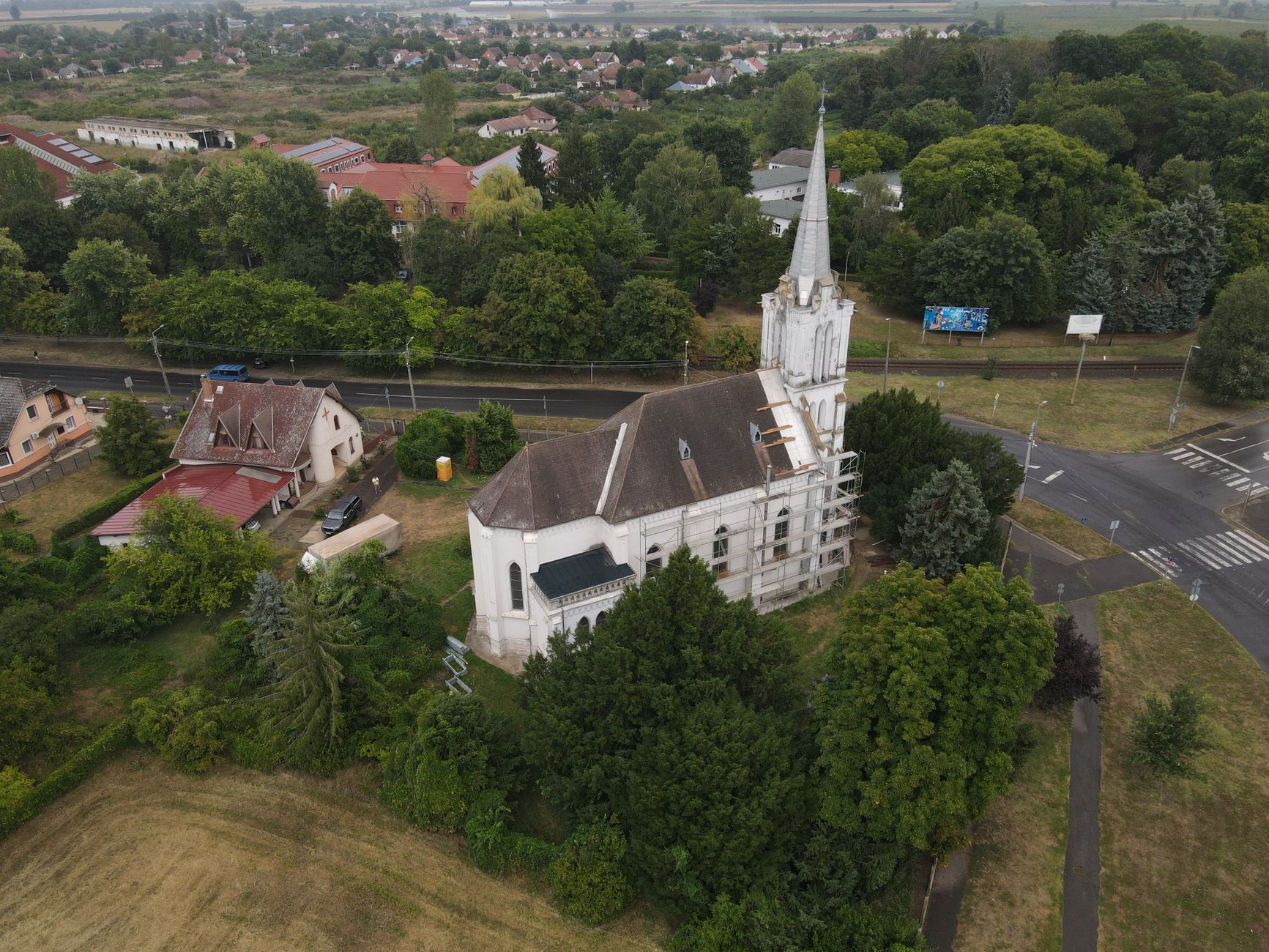
The Steeple I Painted Every Ten Years
Daddy’s ladder
The first time I ever saw that steeple up close, I was twelve years old and holding the foot of a ladder.
It was the summer of 1966. My father, Orville Pruitt, ran a hundred and twenty acres of hay and cattle, and every ten years the church asked him, politely, to do the other thing he was good at, which was hang from a building by his fingernails.
He had painted it in 1946, the year he came home from the Navy. He painted it again in 1956. In 1966 he let me stand at the bottom with my boots planted on the rung and my whole twelve-year-old weight leaning in, and he went up that ladder one rung at a time with a bucket on a hook and a scraper in his back pocket.
I watched him get smaller. I remember my neck hurting. I remember thinking that if he fell, it would be my fault for not leaning hard enough.
He did not fall. He came down three days later with white on his eyebrows and sat on the church steps, and the ladies brought him a glass of tea with a mint leaf in it, and he drank the whole thing without a word. That was how my father said he was proud of himself. He drank tea.
Ten years later, I was twenty-two, two years into an apprentice lineman’s job with the electric co-op, and a Farmall had rolled on my father in a hay field. It broke his back in two places. He came out of the hospital in Rolla in a brace with orders never to climb anything taller than a hay wagon again.
The steeple was due that fall. Everybody at Liberty Ridge knew it. You could see it from the road, the old paint chalking and the wood showing at the louvers.
The church called a meeting after services. A painter from Rolla had quoted eleven hundred dollars for the job. The building fund held two hundred and twelve.
My father sat in the back pew in his brace, looking at his hands. Nobody wanted to say what everybody was thinking, which was that Orville Pruitt’s steeple was going to go gray.
I was standing in the vestibule door, because I was the youngest man there and had not been invited to sit. I heard myself say it.
“Give me the paint money, and I’ll do it.”
Old Mr. Teague turned around in his pew. He was a deacon then, a tall, dry man with ears like cup handles. “Son, you ever been up that high?”
“Every day, sir. I climb poles for a living.”
“A pole is not a steeple.”
“No, sir. A steeple’s got a place to tie off.”
Somebody laughed. Then somebody else said amen, and that was the whole vote.
My father did not look at me during the meeting. But that evening he came out to the barn on his cane and brought me something wrapped in a feed sack. It was a ladder hook, a good one, forged, with a wooden handle gone dark from a lot of hands.
“That’s your granddaddy’s,” he said. “And I want to tell you one thing about the top, and then I never want to hear about it again.”
“Yes, sir.”
“Under the lip of the cap on the north side, where the brush won’t reach, there’s three dates. In pencil. Mine. You do the work, and when you’re done you put yours under it.”
“Why?”
“So somebody knows.” He looked at the barn floor. “Don’t tell anybody. It’s nobody’s business but the man on the ladder.”
He handed me a flat carpenter’s pencil, sharpened with a pocketknife. I have it still.