The Fence Line Between Two Brothers
Alton
The fourth Saturday was Easter weekend, bright and cold, and Alton Kratzer came out on his side-by-side at about ten o’clock to see how we were doing.
Alton is eighty-three. He has leased our south pasture for his heifers for thirty-one years, ever since my father decided that cattle were more trouble than they were worth after his second heart scare. He wears a John Deere cap that has gone the color of tea. He stopped his machine about thirty feet from us and let it idle.
“You’ve got her nearly done,” he said.
“Half a mile to go,” I said.
He sat there looking at us, and then he looked down the line toward the creek, where we had not started.
“You boys put that corner in,” he said. “The one down at the water. I was here that day. Your dad had the hole dug and you were sixteen, Roy, and you had your shirt off, and Curtis there was about twelve and carried staples in a coffee can.”
“Thirteen,” Curtis said.
I turned and looked at him.
“I was thirteen,” he said, to Alton. “Dad let me hold the plumb line.”
“That’s right. He did.” Alton nodded slowly. “Your daddy told me that night at my kitchen table, he said, those two boys can’t be apart five minutes without finding something to argue about, but you put a fence in front of them and they’ll build it straight as a rule.”
He did not say another thing. He put his hand up, the way men out here do, two fingers lifted off the wheel, and he drove away across the south eighty.
“I forgot about the plumb line,” he said finally, in an ordinary voice, and I understood he was not talking to me. He was just saying it out loud to the field.
“He let me hold it too,” I said. “The next year.”
“Did he?”
“Yeah.”
Curtis nodded. And then he turned back toward the work, and so did I.
That was a lot, for us. That was nearly a conversation.
The creek corner
On the fifth Saturday we got to the creek.
I had been avoiding it, I think. We both had. The last two hundred feet of Dad’s line drops down through a cut in the bank to a water gap, a place where the fence crosses Mulberry Creek on a swinging apron of chain and old cable, so the water can pass but a cow cannot. The line turns a corner on the far bank, and that corner is a big old hedge post with an H-brace, two horizontal rails and a diagonal wire, the whole thing holding the weight of the fence on both sides. If that post goes, a half mile of wire goes slack. You build the fence out toward the brace. The brace is what makes it a fence.
We stood at the top of the bank at seven in the morning and looked at it. It was the last thing on Dad’s list, the corner post at the creek, rotted through. Dad had been right. You could put a pocketknife into it up to the handle, and the post had a lean on it like a man favoring a bad knee.
“I’ll dig,” Curtis said.
“I can dig.”
“You’ve got stitches.”
“They came out Wednesday.”
“I’ll dig,” he said. “You’ve got the chain.”
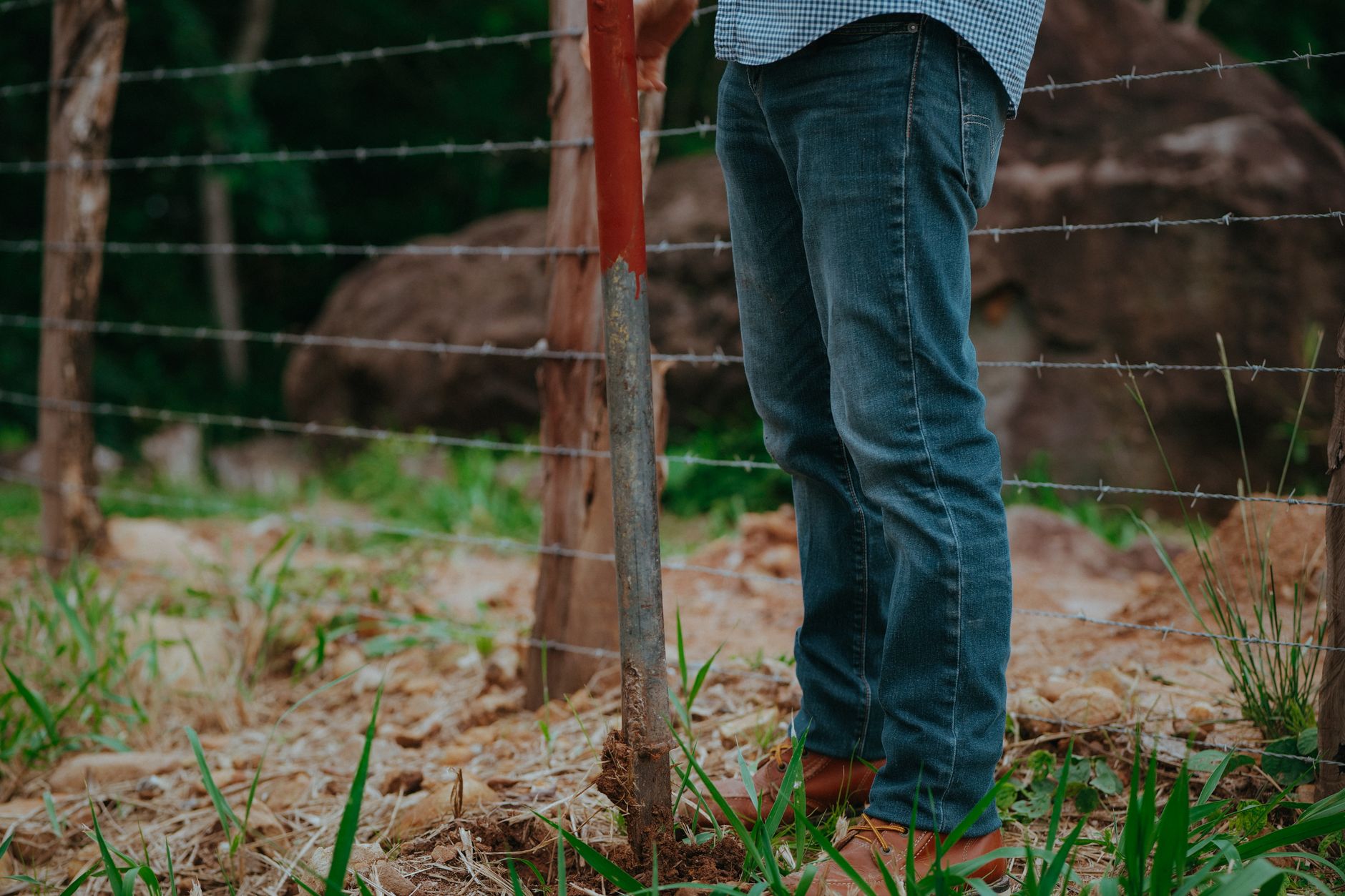
So I took the log chain and he took the digger. We pulled the old post by wrapping the chain around it and winching it out of the bank with my truck, and it came up in two pieces, the top half pale yellow and hard as bone, the bottom half gray mush. The hole it left was black and wet. Curtis climbed down into the hole to his knees and started working it wider, a shovel’s width at a time.