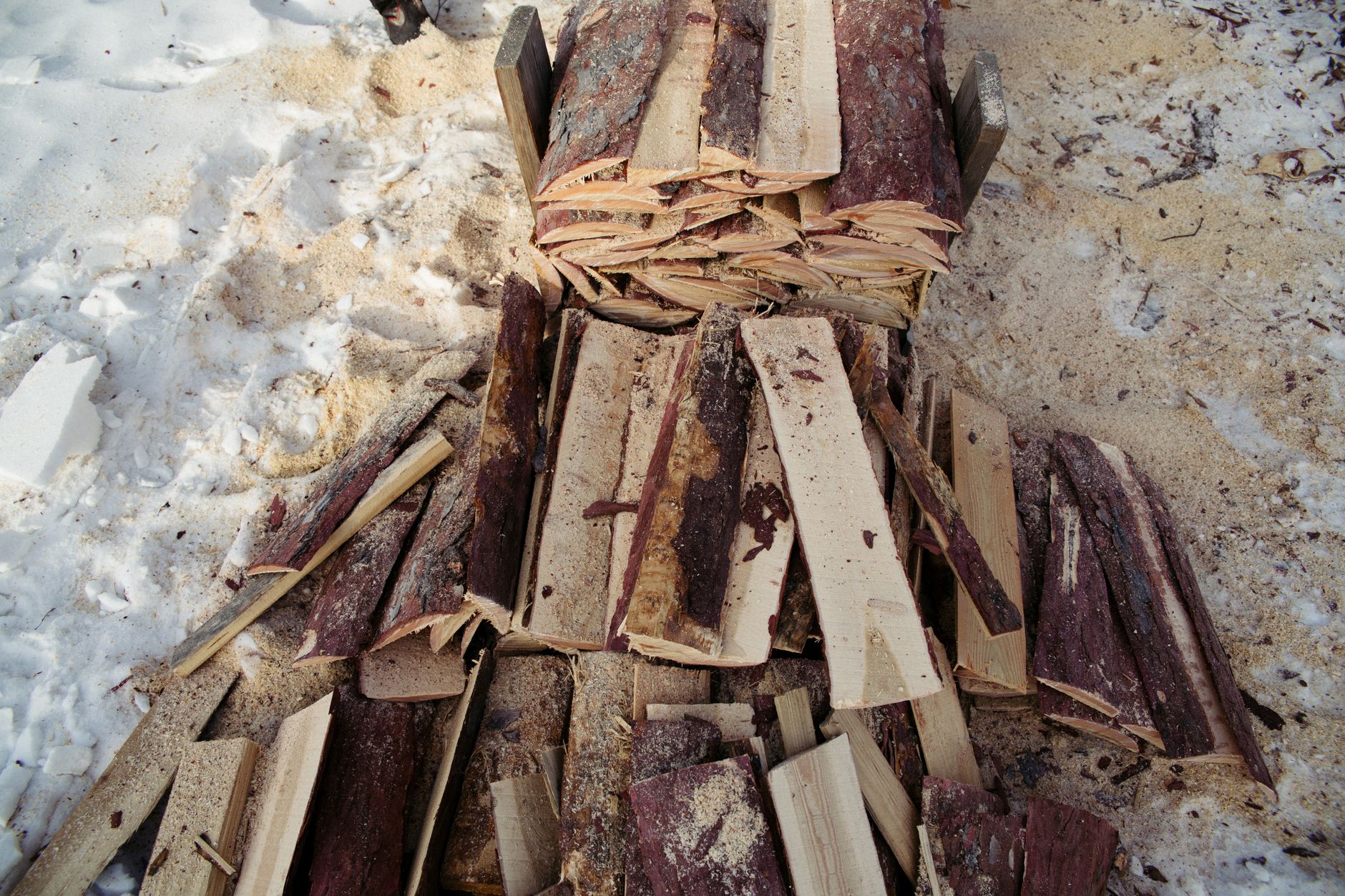
Who Left the Firewood at My Door
The wood was there. Not eleven splits that morning. Twenty-two.
Twenty-two, in two neat stacks, one on top of the other, and kindling for two days. And the thermos, which I had not set out, was sitting on the rail, full.
I opened it with shaking hands. Coffee. Black, with two sugars, still warm.
I stood in the open door with the cold coming in around my ankles and held that thermos in both hands until the steam quit rising. And this time when I said “Thank you,” I said it to the Lord first and the stranger second.
We’d had a dry winter, the driest anyone could remember. Hard frost, a little blowing powder, nothing that held a track. I think the person knew that. I think they had been counting on it.
Then on the fourteenth of February the sky turned the color of a dishrag, and Ethel called to say they were calling for six inches. It came down thick and wet and silent, the kind that clings to fence wire. It stopped sometime before four. I know because I lay awake and listened to it quit.
Which brings me back to my back storm door in my robe and slippers, and the barn coat.
The prints came up the lane from the road, sharp as if cut with a knife. The big ones were a man’s work boots, lug soles, size eleven or twelve. They went to my back step, to the stack, and back. The small set came with him, in little snow boots with a round heel, running ahead in places, hopping in the big prints in others. At the stack I could see where a small person had crouched, two knee marks in the snow, to set the kindling down by itself.
A child. Ten years old, maybe. Eleven.
The man’s prints did not go straight back down the lane. They turned off at the corner of the house and went out across the yard to Ray’s pile of unsplit rounds. Both sets stood still in front of that heap a long time, the snow scuffed and trampled like people shifting from foot to foot. And there, in front of the pile, was the print of a man’s knee.
I got into Ray’s overshoes, three sizes too big, and put up the hood of his barn coat, and started down the lane after the prints. The snow was above my ankle. It was a quarter mile to the road. I walked it with my breath smoking and one hand on the fence wire.
A pickup sat in the gate at the bottom with its parking lights off and its motor idling. Dark blue, with a ladder rack and road salt up to the door handles. A man behind the wheel. Beside him, much smaller, a girl in a pink stocking cap with a pompon on top.
And in that small person’s lap, held tight in both mittens, was a red-lidded thermos.
So I walked up to the driver’s window and tapped on the glass with one knuckle.
The window came down slowly.
I knew the face. I had waved at that face for ten years as the county plow went past my mailbox at five-thirty in the morning, and he had always lifted two fingers off the wheel. A tall man somewhere in his forties, a heavy brown beard going gray at the chin. He had the look of someone who had braced himself for a long time and now found it was easier than he’d feared, and harder.