Who Left the Firewood at My Door
“I’ll manage.”
I did not want a hired man in Ray’s yard, working Ray’s pile. Grief makes you proud about the strangest things.
So I did the arithmetic. A full cord of seasoned hardwood ran two hundred sixty dollars that fall, delivered, and my check was fourteen hundred and twelve a month. I turned the furnace down to fifty-eight and wore Ray’s cardigan over my own.
I was also angry. I had stopped praying the week of the funeral, the way you quit a phone call with someone who has let you down. I still went to church. But when Pastor Bunting said, “Let us pray,” I looked at my hands.
It was twenty-one degrees that morning, the first hard freeze. I came downstairs at six, wearing two pairs of socks, and went out the back door to take the trash to the barrel.
I nearly fell over it.
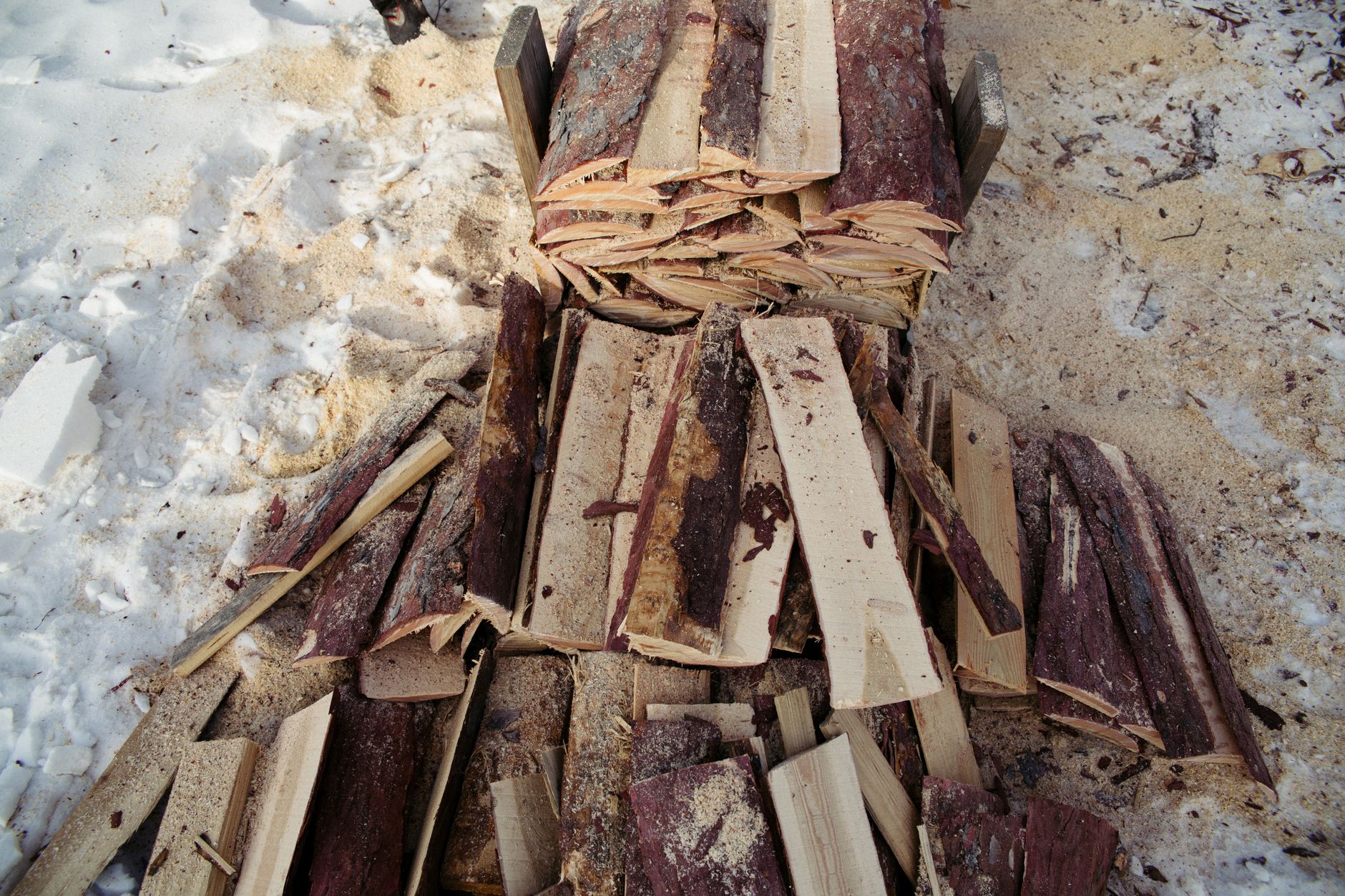
Against the back wall of the house, right where Ray had always kept the kindling and the day’s wood, sat a stack of split ash. Neat as a bookshelf. Eleven pieces, bark side out, all sixteen inches. Frost sat on every one.
Beside it was a bundle of kindling, thin dry sticks no thicker than a pencil, gathered up and tied with a length of orange baling twine.
I looked at the yard. Not one footprint. The grass was too frozen to take one. The gravel of the drive told me nothing.
My first thought was Ethel Teig, a half mile down the road, who has known me since we were girls. My second was the Methodist men. My third was a very Iowa thought, that somebody had got the wrong house.
I carried in an armload and lit the stove. The front room filled up with that smell, ash burns clean, almost sweet, and for the first time in three weeks I took off one of my two pairs of socks.
Then I stood in the kitchen and looked at the knot.
It was on the kindling. Orange baling twine, doubled over, with the loose end pulled through in a hitch I had watched my husband tie ten thousand times. A double half-hitch with a little tuck to it, that held a bundle without slipping and came apart with one pull. Ray said he’d learned it from his father. I had never seen anyone else tie it that way.
The next morning there was another stack.
There were eleven splits every day, not ten and not twelve. The stack was never taller than a person could lift in one carry, and never too small to matter. On the milder days there was nothing, and I was ashamed to notice I felt the nothing as a loss.
I asked.
I asked, and I want that on the record. I asked Ethel, and she looked honestly bewildered and then honestly hurt that it wasn’t her. “I’d have told you, Marian,” she said. “And you’d have said no.” Which was fair.
I asked Pastor Bunting after church, and he looked at me over his glasses the way he does at a funeral lunch when somebody asks if there is more ham. He hadn’t a clue.
So I tried a different way. On the eleventh of November I wrote a note on the back of a church bulletin, in pencil, in my best penmanship. It said: Thank you. I don’t know who you are. I wish you would let me thank you. Marian Oakes. I weighted it under a rock on the porch rail.