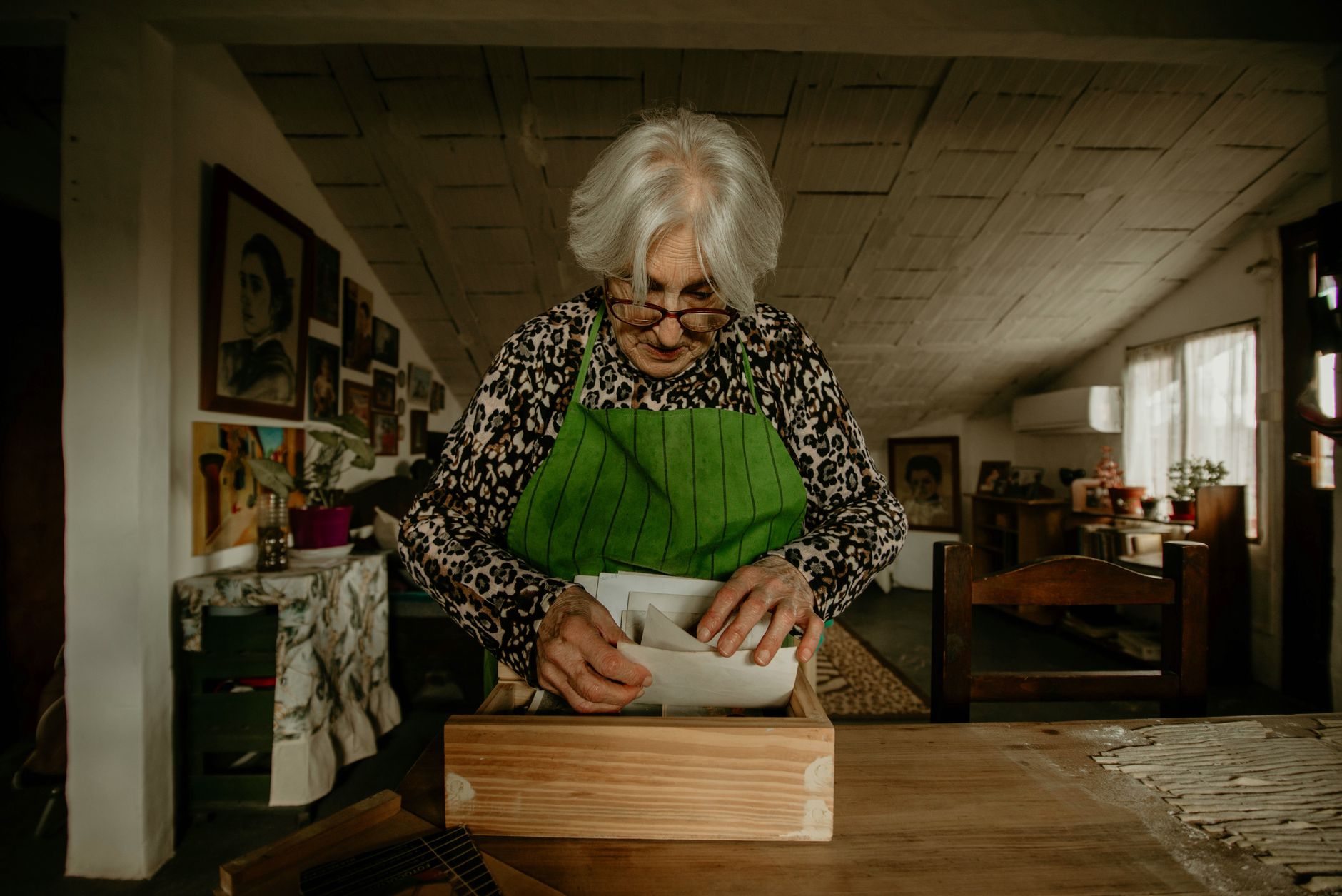
The Recipe Box That Came Back
“Thank you, no.” He shook his head. “I’m no good in somebody’s kitchen. I’m a porch man.” He glanced at Dean, and Dean, to my surprise, nodded as if this were a perfectly sensible thing to say. “I bought that box because of the lid. My wife Clarice had a pan that left a ring just like it on our dresser, forty years ago. I held it up in the shop and I thought, somebody loved this. I took it home to the kitchen table.”
“Marge didn’t tell you whose it was.”
“Marge didn’t know.” He shook his head. “I read the cards.”
He said it flatly, like a man owning up to a ding in a stranger’s fender.
“All of them. It took me three evenings. I know it is not a thing a person ought to do. I’m sorry for it, and I want to be honest and say I am not as sorry as I should be. I’d like you to read what I wrote and then decide how sorry you want me to be.”
“What you wrote?”
“There’s a card at the front. It’s mine.” His thumb went to the cap again. “It’s not much. I carried the mail for twenty-eight years, Marlene, I’m no writer. But I found your name in the Garner Mills Gazette archive. The obituary. Your mother’s. It lists the girls.”
“It does,” I said.
“The girl at the Gazette office looked up the Teagues in the church listings for me. Then I stood in my kitchen a while. Then it was a Saturday, and I had a thing to do.”
“You took a month.”
“A man my age doesn’t do anything in a hurry.” He almost smiled. “I wrote it six times. I used up a package of cards.”
He put his cap back on, and took it off again, and held it.
“I’d rather you read it after I’m gone,” he said. “If that’s all right. I’m not good with watching.”
“Of course,” I said, and heard those two words go out of my mouth again, and felt them go all the way through me.
He nodded to Dean. He went down the three porch steps one at a time, with a hand on the rail, and out to a gray Buick with a dent in the rear quarter panel. He did not look back. He drove to the corner, signaled, though there was not a car for a mile, and turned toward Mill Street.
I stood there with the box.
“Marlene,” Dean said.
“I’m going to sit.”
“I’ll put coffee by you.”
“Thank you.”
He went in. I took the box to the top step and sat down with it on my knees and the September sun on the back of my neck, and the whole yard smelled of cut grass and somebody’s burning leaves. I undid the brass hook. It stuck the way it always stuck.
The card was at the front, behind nothing, on top of the first divider. A plain white three-by-five, the lined kind you buy in a package of a hundred at the drugstore. It was printed on both sides in blue ballpoint, in small square capital letters that never once wandered off the line. The letters of a man who spent a career writing addresses fast and right.
I put on my glasses.
I read it.
I will give it to you the way it was written, because I have not been able to improve on it.
To the family of Norma Kimmel.
I paid three dollars for this at the Methodist shop and I read every card. I should be sorry. I am not very.