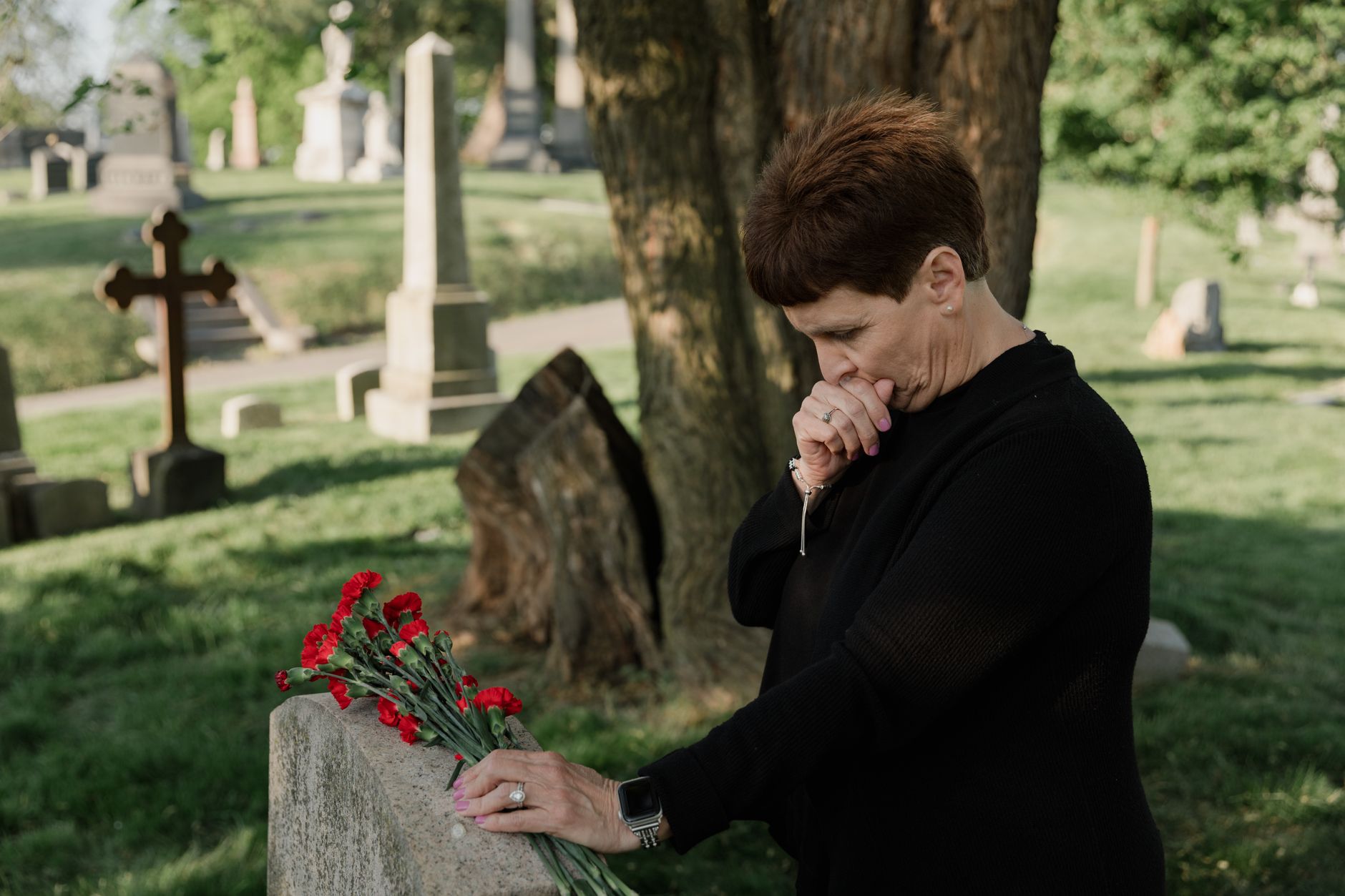
The Grave Beside My Husband
“I can’t give out customer information.” He pushed the slips back toward me, not unkindly, the way you’d hand a child’s spelling test back. And then, because I think some part of him could not quite stand it, he said, “Their service is Saturday at 11. It’s in the paper. I’m sorry. I really am.”
I picked up the pink slips one at a time and put them back in the yellow box.
I said, “Thank you for telling me.”
I did not cry at that window. I was not going to give a stranger my tears over a counter.
I walked out to the car and sat behind the wheel with the box in my lap. The oaks in the old section were turning, the first yellow in the tops. From the lot I could see the row of stones where Cal lay, and the empty space to the right of him where for eleven years I had been going to lie down.
I should tell you about that space, because without it nothing I did next makes sense.
Cal and I were married 43 years. We farmed 160 acres outside Larkin, Michigan, in the Thumb, navy beans and sugar beets and corn, and Cal sold seed for a company out of Saginaw on the side, because a quarter section and a good heart will not pay the light bill. We buried my parents at Oak Rest, and his mother and his baby brother, and when Cal went, there was no question where.
On the day of the burial, after the neighbors had eaten the ham and gone home, I drove back out alone. I do not know why. The wind was coming off the lake, the way it does, and the grave was open still, with the green carpet pulled over the dirt. Chester Pugh stood by the backhoe with his cap in his hands. He was the sexton then. He had dug that grave himself, because Cal had once pulled Chester’s truck out of a ditch in the winter of ’88 and Chester had never forgotten it.
I stood there and said, “Chester, I want to be right here when it’s my turn.”
“I know you do, Iris.”
“I haven’t got it. The money. There’s the farm note and the funeral bill.”
“Well.” He turned his cap around once in his hands. “You pay what you can. I’ll hold it.”
“You can’t just hold it.”
“I’m the sexton,” he said. “I can hold what I like.”
That was the whole contract. He took a pencil from behind his ear and a card out of his shirt pocket and wrote on it against the side of his truck, and he told me the price was $1,320 and I could pay it off at $120 a year, whenever I came out to see Cal. He wrote me a receipt every time. For eleven years I came out that first week of October, and Chester came out of the office with his booklet, and we stood a while on the grass and talked about the weather and nothing. Then he tore off the pink slip, and I put it in the candy box.
One hundred and twenty dollars a year. It was the one piece of my husband I could still pay for.