The Folder My Cousin Could Not Lose
I did not call a single person. No one was organized and no one was asked. On the morning of the 20th, a Tuesday, in clear cold sunshine with the bank sign reading 9 degrees, I found my father waiting on his front porch in his best brown suit, his Army cap, and a Vietnam Veteran pin on the lapel.
“Your mother would’ve made me wear the good overcoat,” he said.
I helped him into it. It hung on him now. He had lost 30 pounds in two years.
We parked in front of the courthouse at 9:20. There are 14 steps up to the front doors. My father stood at the bottom with his cane, looking up.
“I’m not as spry as I was,” he said.
“Take your time.”
He took my arm, and I carried the folder in my other hand. On the sixth step he stopped to breathe. On the ninth, his hand began to shake on the cane. I did not hurry him, and we went up one at a time, like two men going up a hill.
Halfway up, I heard the doors open behind us. Bernie Kolb, who is 79, was coming down in his VFW jacket, and behind him Lester Voigt, a retired county road grader operator, and Fritz Mahler, and a man in a Marine Corps cap I did not know at all. They did not speak. They came down and fell in around us, and when my father started to climb again, they climbed with him.
“Eldon,” Bernie said.
“Bernie.”
“Didn’t think you’d go in there alone, did you?”
“I wasn’t alone,” my father said. “I had the boy.”
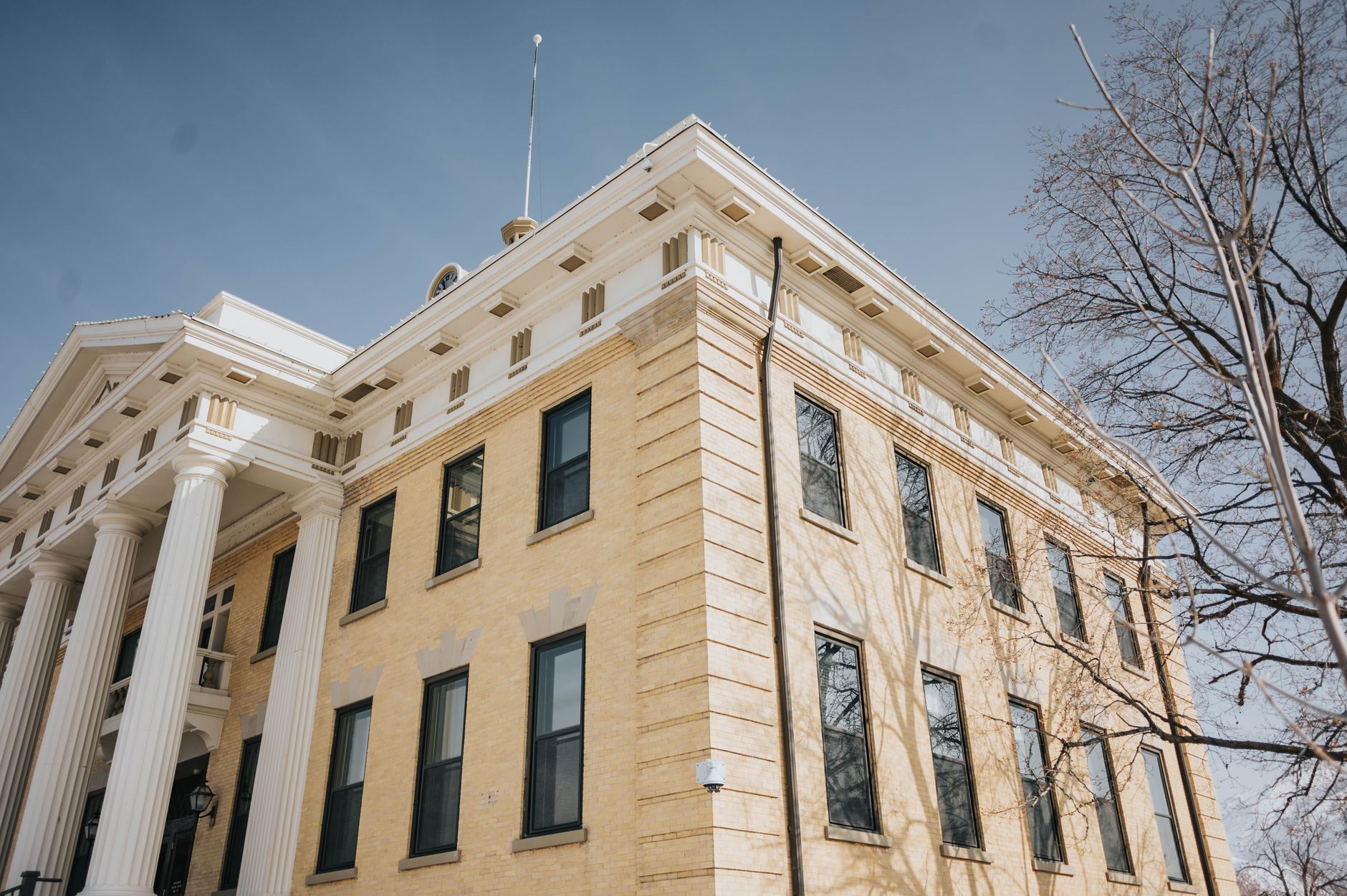
The commissioners’ room is on the second floor, long, with tall windows and a flag. There are five commissioners at a raised table. That morning there were ten of us in the folding chairs. I counted, because it kept my hands from shaking.
My father sat in the front row, with Bernie on one side and me on the other. The commissioners came in at 10 sharp. Merle Keller, the chairman, is 77, a tall man with a farmer’s neck, a retired loan officer from the Dalton Building & Loan, and an Army man himself, 1969 to 1971. Beside him sat Monte Bauer, Sherry Kopecky, Abner Dvorak and Mitchell Hennessy. I had known all five most of my life.
Rhonda was at the end of the second row with her briefcase on her lap. She did not look at us. Deb Lutz sat behind her, near the door, with her purse in both hands. A man in a seed cap there about the culvert bid and a young sheriff’s deputy there about the transmission made ten.
They went through the roads report and a culvert bid and the sheriff’s request for a squad car transmission. At 10:41 Merle looked down at his agenda.
“Mr. Hartwell. You have 10 minutes.”
I stood up and walked to the microphone with the folder under my arm. I’m not a speaker, and my mouth was dry.
“Mr. Chairman, members of the board. My name is Dennis Hartwell. My father is Eldon Hartwell, in the front row. He’s 83, a disabled Vietnam veteran, and he has had the homestead exemption for disabled veterans every year since 2011.”
I said it plainly. I said the bills, one by one: $2,436, $2,499, $2,571. I said we had mailed the form every June, certified, and I held up the green cards and asked Shirley Dostal to hand copies to the board.