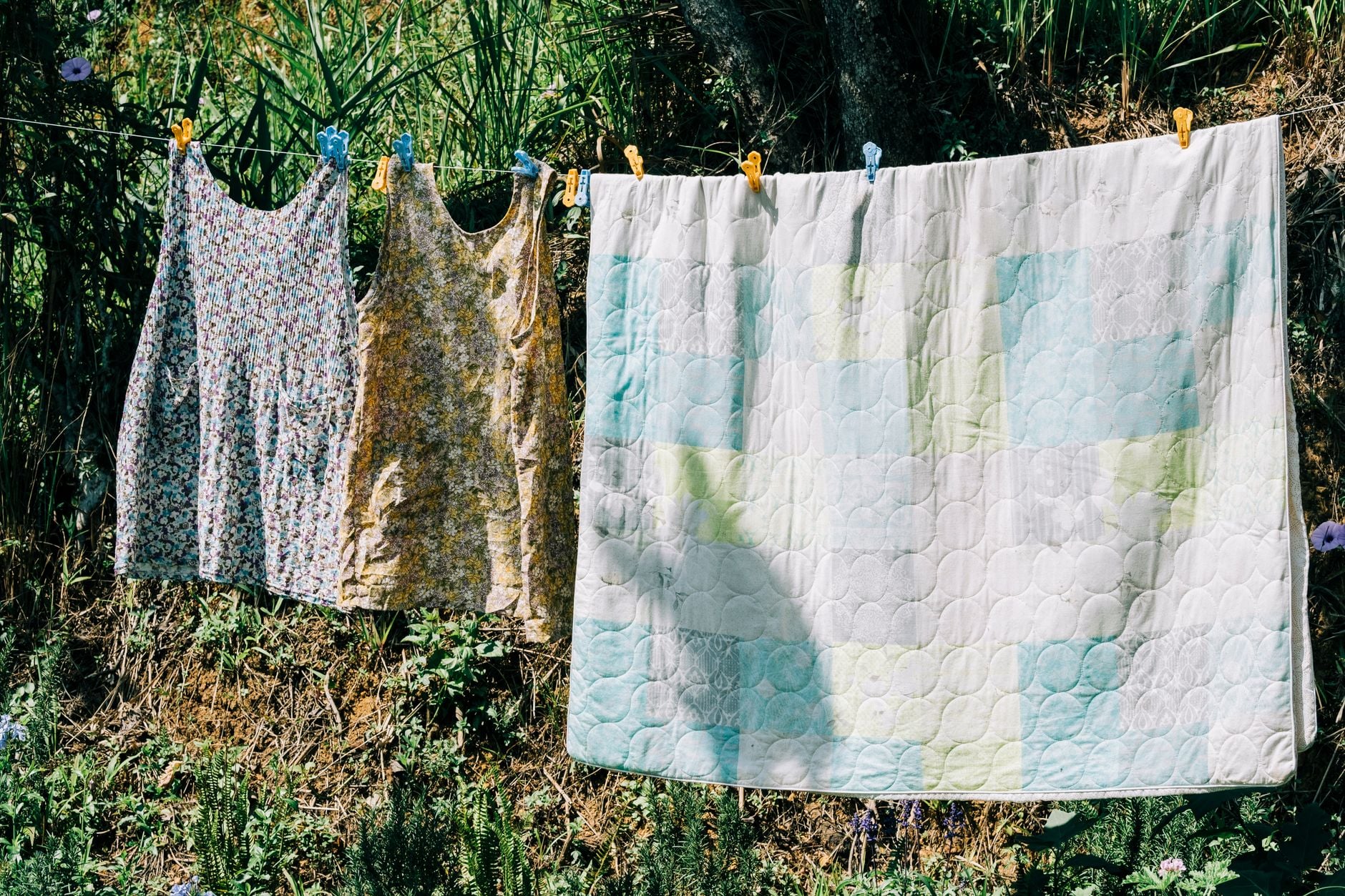
The Monday the Quilts Came Out
The quilters
Dorothy is eighty-six. She is my mother’s cousin by marriage, and she has led the Tuesday quilting circle in the basement of the Methodist church since before I was born.
She walked straight past me to the line and put her hand flat on the Double Wedding Ring.
“Fifty-six,” she said. “I was sixteen. I sat on the end of the frame and threaded her needles all winter because her eyes got tired at night.” She ran her thumb over a pink square. “This was my sister’s Easter dress. Your mother asked for the scraps.”
I had not known that. I’d had that quilt in my house for seven years and I had not known that.
“Earl called Joan,” Dorothy said, “and Joan called me, and I’m calling the rest.” She took a little flip phone out of her coat pocket. “You got coffee?”
By ten there were six old women in lawn chairs in my backyard, and two more on the picnic bench, and I had made two pots of coffee and opened a can of the oatmeal cookies I keep for funerals.
They walked the line one quilt at a time, like people at a viewing. They touched the stitches. They argued about whose fabric was whose.
“That brown in the Log Cabin is my dad’s old work shirt,” said Marilyn Pruitt, who is seventy-eight. “She asked my mother for his shirts after he passed. I was mad about it for years. I didn’t know she’d put them in a quilt.”
“She put everybody in a quilt,” said Dorothy.
Joan Schaefer stood at the Lone Star for a long time without saying anything. Then she said, “Tell her about this one, Dorothy. I can’t.”
So Dorothy told it.
In the summer of 1993, the rivers came up all over Illinois. The Illinois River went over its banks down by Havana and Beardstown, and the Mississippi took whole towns on the west side of the state. Families who had farmed the bottoms for a hundred years lost their houses, their equipment, their seed, everything.
Our church held a pancake supper and took up a second offering. And my mother sat down that August and made the Lone Star in six weeks, and the church raffled it off at a dollar a ticket.
“Eighteen hundred and forty dollars,” Dorothy said. “In 1993. From a town of nine hundred people. Every dime of it went to the families down at Beardstown.”
“Who won it?” I asked. I was working the teller window at the bank in town that year, with a little boy at home. I remembered the raffle. I did not remember the winner.
“Vern Hollister,” said Joan, and her voice went funny. “Old bachelor farmer from out past the cemetery. He bought two hundred tickets. When they drew his name, he walked up, folded that quilt nice, and carried it across the fellowship hall to Edith.”
“He said,” Dorothy finished, “‘Ma’am, a thing like this ought to stay with the woman who made it.’ And then he put his cap back on and went home.”
Nobody said anything for a minute. The wind moved the Lone Star on the line and the red points flashed in the sun.
I must have heard about it at the time, the way you hear about things when you are working and raising a child. But I had not heard it like that, standing in my own yard with the quilt in front of me and the woman who saw it happen holding my arm.