The Monday the Quilts Came Out
Monday
I was up at five thirty. I did the wash first, because it was Monday and that is what Monday is for.
Sheets, pillowcases, towels, Roger’s work shirts. I will tell you something I am not proud of and not ashamed of either: I hung Roger’s union suits on the rack in the basement that week. There was no call to make a point with a man’s underwear. That wasn’t what this was about.
By a quarter to eight the sheets were dry enough to come down, because there was a good west wind and the sun was out clean and bright. I folded them into the basket and carried them in.
Then I carried out the first eight quilts.
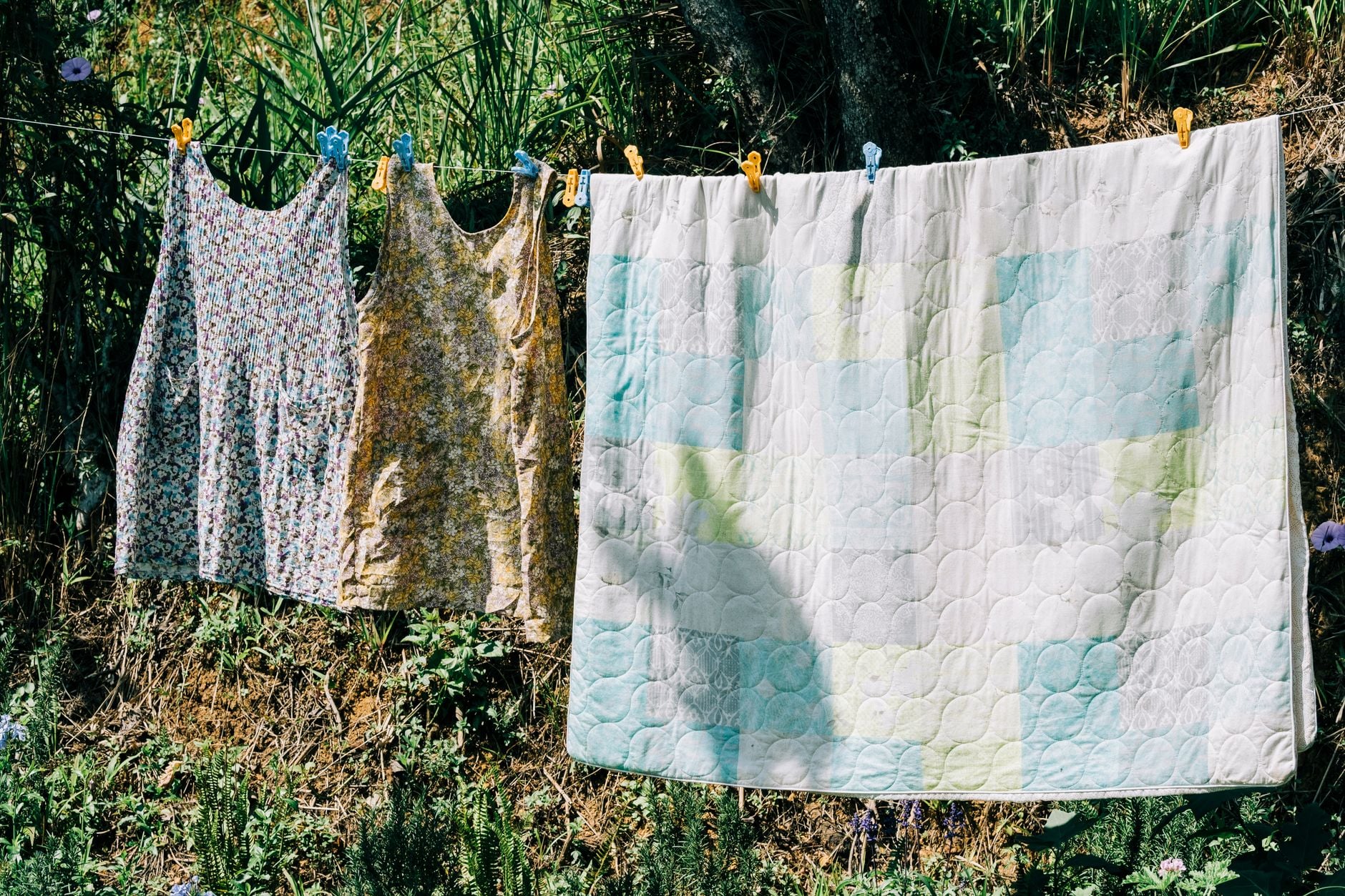
You fold a quilt over the wire about a third of the way and pin it every couple of feet. You never let it hang by the corners, because that pulls the stitches. Mother taught me that before I could reach the line.
The first one I hung was Mother’s own wedding quilt.
It is a Double Wedding Ring in pinks and greens and a yellow gone soft as butter. She pieced it the winter before she married my father, in 1956, out of feed sack prints and three yards of good green cotton bought with egg money.
Next to it I hung the one she made for me and Roger in 1986. Another Double Wedding Ring, in blues, because I told her I didn’t want pink. She grumbled about it for a month and then made the prettiest quilt I ever saw.
She made one for every wedding in our family after her own. Both my brothers, six nieces and nephews, and my son in 2014, when her hands were already bad. Those are in other people’s houses now, where they belong.
Then the Grandmother’s Flower Garden, all those tiny hexagons, every one cut out of a feed sack. The Sunbonnet Sue she made when I was a little girl. A Log Cabin in browns and rusts that she called her “fall quilt.” A Lone Star in reds and golds that I’ll come back to.
And at the end of the second line, plain as a dish towel next to the others, a nine-patch in faded blue and white.
I pinned the last clothespin and stepped back.
The wind came up and all eight of them moved at once, like something breathing.
I looked over at the deck. Courtney was standing at the railing in her pink robe with a mug in her hand. She was not holding her phone.
She looked at the line for a long time. Then she turned around and went inside, and I heard the slider shut, not hard this time.
The cars
The first car slowed down at about eight thirty.
It was Earl Dunbar in his blue Chevy pickup, on his way to the co-op for coffee like every morning of his life. He came down our road at his usual twenty miles an hour, and then he came down it at about five, and then he stopped altogether and rolled down his window.
“Marlene,” he called. “Somebody die?”
“No, Earl. It’s airing day.”
“Huh,” he said. He looked at the line a while. “My mother used to do that.”
“Most mothers did.”
“Huh,” he said again, and drove on. I knew perfectly well he was going straight to the co-op to tell eleven men about it over coffee.
The next one was the rural bus, coming back from the second route, empty. Kathy the driver gave two short toots on the horn and waved out the window.
Then a minivan I didn’t know. Then two high school boys in a pickup who slowed down, looked confused, and sped back up.
At nine fifteen a white Buick pulled all the way into our drive. Dorothy Kessler got out of it with her cane.