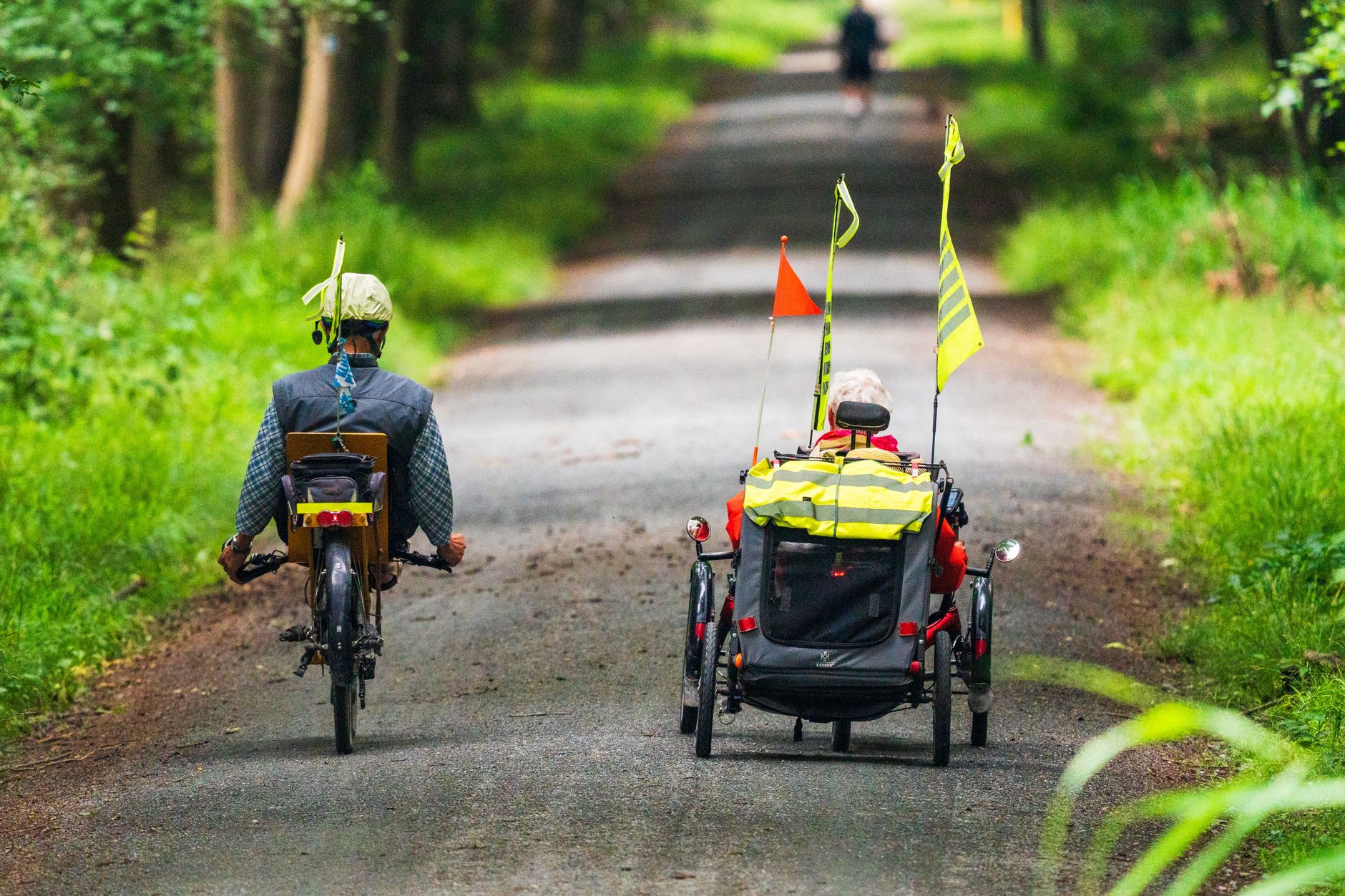
The Red Tricycle Outside His Office Window
We walked the trikes up the hill, four old women in a row, pushing, stopping twice to breathe. At the gate Shirley parked hers and took a pot of geraniums out of her basket.
“You go on,” Wilma told her. “We’ll wait.”
We stood at the gate and watched her cross the grass, slow, in her blue windbreaker. She found the stone. She stood there a moment. Then we heard her, because sound carries on that hill.
“Don,” she said. “I came by myself.”
Wilma took my hand. Donna turned and looked out at the fields. Nobody said a word, and nobody needed to.
Shirley had not been to her husband’s grave without someone waiting in a car with the engine running since the winter she gave up her license. She stayed twenty minutes. She set the geraniums down and straightened them twice. When she came back her face was wet and she was smiling.
“Well,” she said. “Who’s buying the ice cream?”
That is what four miles an hour will buy you, if you want to know. Not speed. Time enough.
All that while, my son did what he had promised. I will give him that. He called every evening at six. He offered rides I did not need. On Saturdays he came and mowed my lawn, which he had done since his father died, and he looked at the red trike in the carport, in the exact spot where the Buick used to sit, and he did not say a word about it.
He looked terrible. He had gone gray under the eyes. Kim told me on the telephone he was up at four most mornings.
“He thinks you’ll get hit,” she said. “He’s worse now than he was before. Dorothy, I told him not to do it that way. I told him to talk to you first. I want you to know I said that.”
“I know you did, honey. You’re the one who cut the cake.”
I thought about that a good deal. A man who takes his mother’s car out of plain bossiness sleeps fine afterward. He sleeps like a judge.
So it was not bossiness. And I still did not have my answer.
I decided to get one of my own.
The first week of June I rode to the clinic and asked for Dr. Keller’s longest appointment. He has been my doctor for twenty-two years.
“Jeff,” I said, “I want you to examine me as if you were deciding whether to take my license away. Do not be nice about it.”
He was not nice about it. He tapped my knees and my elbows with the little hammer. He had me stand on one foot, then the other. He had me get up from a chair, walk ten feet, turn around and sit back down while he held a stopwatch. He had me remember three words, draw the face of a clock with the hands at ten past eleven, and count backward from one hundred by sevens, which I did faster than he could check me, because a telephone operator of my day carried half the county’s numbers in her head.
“Dorothy,” he said, “you’re in better shape than I am.”
“Put it in writing.”
He did. On the clinic’s letterhead, signed. No medical condition that would limit the safe operation of a motor vehicle.
The next week I rode to the eye doctor on the square. I had my cataracts done four years ago. She put me through all of it, the letters and the side lights and the glare. Twenty over twenty-five in both eyes with my glasses. Full side vision. She wrote that down for me as well.