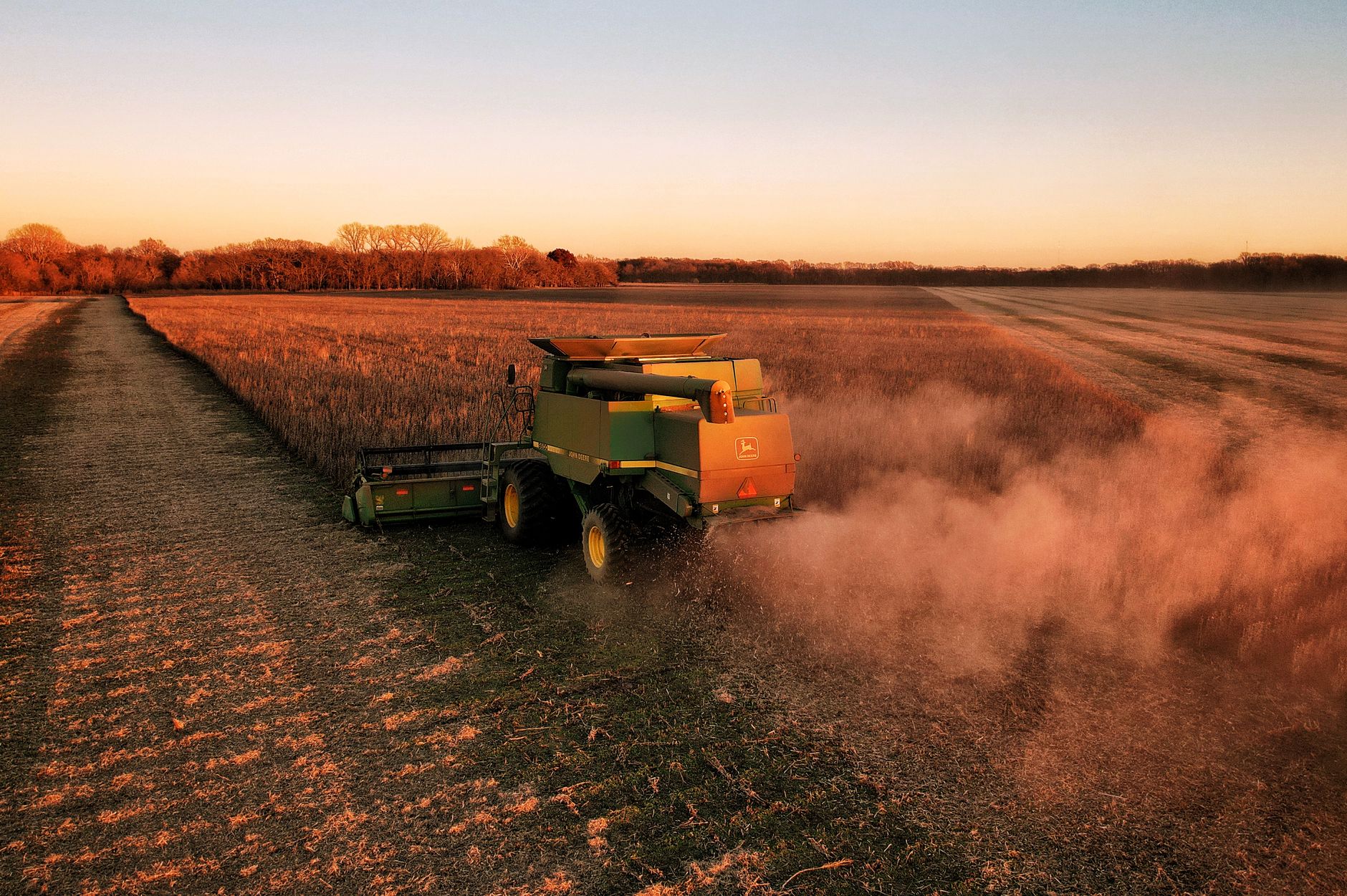
The Half of the Wheat I Cut Myself
A pickup was stopped up on the road. It had been sitting there, I realized, since before the bang. The door opened and Don Schmidt got out, eighty years old if he was a day, who had farmed the section west of ours next to my father for forty years. He came across the stubble in his bib overalls at his own pace and looked at what I was holding.
“Feeder drive,” he said.
“Yes sir.”
“I ran a 1460 from ’81 to ’97.” He turned around and started back toward his truck. “I never throw anything away. Drives Carolyn out of her mind. Give me twenty minutes.”
He was back in twenty-five with a belt still in its cardboard sleeve, the sleeve so old the printing had gone yellow. He would not take money for it. He also would not put it on for me. He stood there with his thumbs in his bibs and watched me do it, and twice he said, “Other side of that idler,” and once he said, “There you go,” and that was the whole of his help, and it was exactly the right amount.
When I had the shield back on he looked out over what I had cut.
“Your dad used to say you had better hands on a combine than the boy did,” he said. “He never told the boy that. Might’ve been a mistake. Might’ve been a kindness. I never could decide.”
Then he put his cap back on and went home to dinner.
I cut until dark that night to make up the time. Fifty-eight acres done. Maddie fell asleep on the toolbox with her head against my leg about nine o’clock, covered in dust, and I drove the last two rounds with one hand on the wheel and the other on her hair.
Friday the third was the day everything turned.
It came up hot and still, with that brass color in the sky by noon that anyone raised out here knows. The radio in Mom’s truck said a line of storms was building out west and would come through between ten and eleven that night with sixty-mile wind and hail.
Ripe wheat cannot take that. Hail will thresh it right onto the ground, and you can be looking at forty-five bushels at supper and nothing at breakfast. Every machine in the county was running flat out.
I had twenty-two acres left. At the rate I was going, I would finish by suppertime.
Russ had left the home quarter for last, the way he always did, after his own ground and his rented ground. He had pulled into his south eighty Thursday afternoon with the big green machine, a thirty-five-foot header, cutting in one pass what took me nearly two. We had worked that same field all Thursday evening like two people in a church pew who are not speaking.
About two o’clock Friday his machine stopped.
I saw it from the far end. It just sat there in the middle of a round. Ten minutes went by, and then I saw Ordell’s pickup leave the field going faster than I had ever seen Ordell drive.
Mom brought the news back with the next empty truck. “Feeder house chain let go and took a bearing and a shaft with it,” she said. “The dealer in Hutchinson has the parts. Ordell’s gone after them. It’s an hour and a quarter each way and then three hours to put it together, if nothing else is torn up.”
I did the arithmetic. So had she. So, down at the south end beside a dead quarter-million-dollar combine, had my brother.
He would be running again around eight thirty, maybe nine. He had thirty-four acres still standing. It was the last wheat he had in the field and it was the best on the place. He could not possibly get it before the storm.