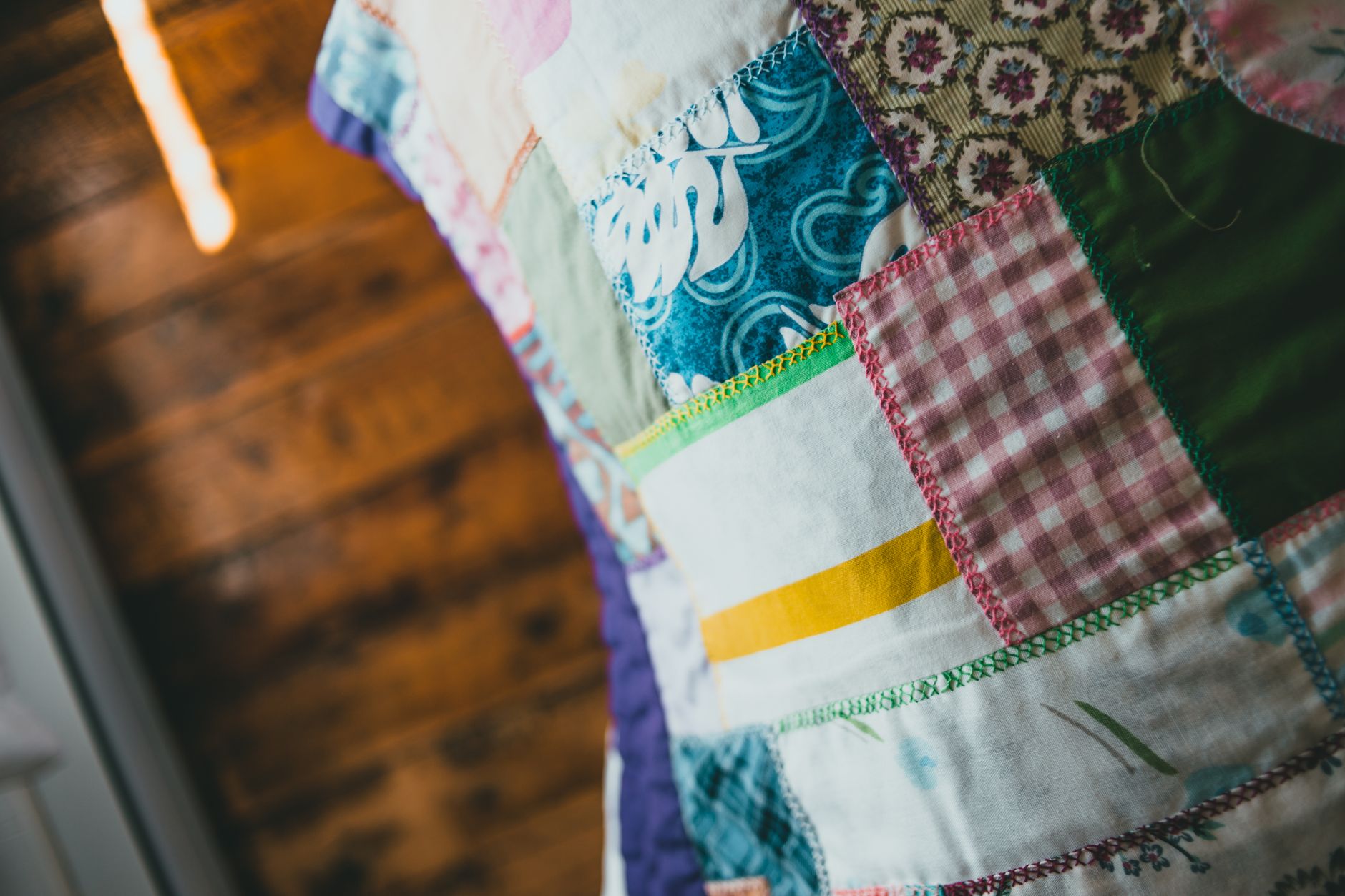
The Quilt in the Dog Crate
“Number thirty-one,” Dale said.
Two boys from the youth group carried the rack to the front and turned it under the lights.
Mrs. Lindahl took up the card. She looked at it, and then she took off her glasses and looked at the room instead.
“I am going to say something before I read this,” she said. “I have run this auction twenty-two years. I want you to look closely at this one. Every piece you see is smaller than a quarter. There are over a thousand of them. There is not one machine stitch in this quilt.”
It got quiet. You could hear the roasters ticking in the kitchen.
She put her glasses back on.
“Grandmother’s Flower Garden. Hand pieced and hand quilted. Four hundred hours.” She stopped and said it again. “Four hundred hours. Made for a baby girl who spent her first nine days in our NICU. The maker is Denise, of Hutchinson, taught by her grandmother, Helen.”
A woman behind me said, “Four hundred,” under her breath, the way you would say the price of a car.
I did not look at the board table. Mark put his hand flat on my knee under the table and left it there.
“Folks, you heard the lady,” Dale said. “Who’ll give me a hundred dollars?”
“Five hundred,” somebody called from the left, before he had finished.
“Five, now six.”
“Six.”
“Seven.”
It went up by hundreds like a man climbing stairs. Eight. Nine. A farmer’s wife I knew from the credit union had her card up, and so did a man in a Pioneer seed cap, and so did a woman in the third row in a gray cardigan I could only see the back of.
“One thousand,” said the gray cardigan.
The room made a sound.
Now I looked at the board table. I could not help it. Courtney was sitting very still with her hand on the edge of the carrier. One of the doctors’ wives leaned over and said something to her and pointed at the quilt, smiling, and Courtney smiled back with only her mouth.
Twelve hundred. Fifteen. The seed cap dropped out at sixteen and shook his head, laughing. The farmer’s wife went to two thousand and then put her card face down on the table and patted it.
That left the gray cardigan, and a man by the kitchen door who was bidding for his mother.
“Twenty-five hundred,” the cardigan said.
“Twenty-six,” said the man by the door.
“Three thousand.”
She said it in a plain voice, not loud. The man by the door lifted both hands and sat down.
Dale pushed his hat back. “Ma’am, I’ve been doing this a long time, and I’ll tell you that is the most I have ever had on a crib quilt. Would you stand up so folks can see you?”
She stood and half turned, embarrassed, and I knew her then. I had seen her go past that waiting room every day for nine days with a stethoscope around her neck. It was Dr. Reyes, from the NICU.
“I have three thousand dollars,” Dale said. “Three thousand once.”
“Thirty-one hundred.”
It came from the very back of the hall, by the coat racks. A man’s voice.
I had known that voice since I was three years old.
I turned around in my folding chair.