The Limited Access Guest Badge
The check-in line
My name is Dana Faye Ott, and I was thirty-four years old the day my own family decided I wasn’t worth a dinner plate at my brother’s wedding.
I want to tell it plain, the way it happened, because for the longest time I could not say it out loud without softening it into something it wasn’t. I would tell people there had been “a mix-up with the seating.” I would smile and wave my hand and let them believe it was a caterer’s mistake. It wasn’t a mistake. I know that now. Some things are only accidents if you refuse to look straight at them, and I refused to look straight at my family for the better part of my life.
We are from Coldwater, a nothing town in the flat middle of the country where the tallest thing for twenty miles is the co-op grain elevator and everybody knows whose truck that is going down the county road at eleven at night. My people are farm people. My grandfather broke that ground and my father worked it until his hands stopped closing right, and I grew up thinking that if you just kept your head down and did the next needed thing, you would always have a place at the table. That was the lie I was raised on. A good lie, mostly. It gets you through a lot of years before it fails you.
The wedding was for my brother, Wade. He was marrying a girl named Brynn Callahan from over in the county seat, a pretty girl with a laugh you could hear across a parking lot, and I liked her fine. The reception was booked at the Hartwell barn, which is not a real barn anymore but one of those restored ones with a chandelier hung up in the rafters and string lights and a gravel lot they charge you four thousand dollars to park cars in. It sits out past the Lutheran cemetery on Route 9, and I had driven past it my whole life back when it still had cattle in it.
I got there early because I always got there early. That was my role in the family and I wore it like a coat. Dana will handle it. Dana will get there and set up. Dana doesn’t mind. I had spent the morning already, if you want the truth, ironing my mother’s blouse and running to the drugstore in the next town for the bobby pins nobody remembered to buy, and I had done it happily, because being needed felt so much like being loved that I had stopped being able to tell them apart.
The ceremony itself was at the country church, First Christian, the one with the cracked bell they ring anyway. It was short and sweet the way our weddings are. Wade stood up front in his good suit looking like a man who had never once doubted a room would rearrange itself around him, because a room always had. Brynn came down the aisle on her daddy’s arm and there was that little intake of breath everybody does, and my mother cried into a tissue, and I stood in the third pew because that is where I had been told to stand, and I clapped when the pastor said you may kiss the bride, and I meant it. I want that on the record. Whatever came after, I was happy for my brother in that church. I loved him. That was never the problem. The problem was that I had always assumed he loved me back the same size, and he did not, and the badge is how I found out.
We drove out to the Hartwell barn after, the whole line of us on Route 9 with our headlights on for the procession the way you do. I parked way out at the back of the gravel because I figured the good spots should go to the guests who came far, and I walked up in my one nice dress, a navy one I’d bought at the outlet mall in Springfield and worn to three funerals and now a wedding. The evening light was coming in gold and low across the soybean fields and I remember thinking it was a beautiful thing, all of it, my family in one place and the corn tall and my brother married. I remember being happy walking across that gravel. I want to hold onto that, that I was happy right up until the table.
There was a check-in table set up at the barn door with a girl behind it, one of Brynn’s cousins I think, young, with a clipboard and a little wooden box of badges. Name badges, the kind you clip on. I got in the line behind an older couple in matching tan, friends of the Callahans, and I watched the cousin hand them each a heavy badge, cream cardstock with a gold edge and their names done up in that fancy looping print, and underneath each name a table number. Table Six. Table Six. She smiled at them so warm and pointed them in toward the lights and the music.
Then it was my turn.
She did not look up at me. That is the part I keep. She looked at her box and she looked at her clipboard and she reached down under the table, not into the box with the nice ones but down under it, and she brought up a little rectangle of plain white printer paper, cut with scissors you could see the wobble of, and she held it out to me between two fingers.
No gold edge. No looping print. No table number. Just black letters from an office printer.
LIMITED ACCESS GUEST.
I looked at it. I turned it over like there might be more on the back. There was nothing on the back. I looked up at her, waiting for the thing that fixes it, the little laugh, the oh gosh I grabbed the wrong stack, the reach back into the box. She was already looking past me at the next people in line. She was already smiling her warm smile at somebody else.
What my mother said
I stood there with the paper going soft between my fingers, and I felt that thing happen where all the sound in a place seems to drop away and go far off, like your head has gone underwater in the stock tank and you can hear the pump but not your own name. I was drawing breath to ask, to say excuse me, I think there’s been some kind of mistake, when my mother came up beside me.
She did not come up confused. She did not come up to fix it. She came up the way a person comes up who has been watching for the moment and does not want to miss it. My mother, Lorraine Ott, in her ironed blouse that I had ironed, with her good hair set, leaned in toward me close and friendly, the way you’d lean in to point out where the restroom was.
“That just means no dinner plate,” she said.
That was all. Light. Pleasant. Not one thing in her face that said she was ashamed of it. She might have been telling me they were out of the sweet tea and only had unsweet. Then she patted my arm, once, and she walked away into the barn toward the good tables and the string lights, and she left me standing in the doorway holding a scrap of paper that told me, in eleven letters, exactly what I had spent thirty-four years refusing to know.
I want to try to make you understand what it is to be told that by your own mother and to have some animal part of you still not believe it. Because I still did not believe it. I stood there and I built her an excuse in about four seconds flat, the way I’d been building this family excuses my whole life. The list got messed up. The caterer charges per head and Wade and Brynn were on a budget and somebody had to be trimmed and it fell on the sister who wouldn’t make a fuss, and Mother was just relaying the bad news in her clumsy way, and it wasn’t cruelty, it was money, it was logistics, it was anything, anything at all except the plain fact of it.
So I did what I always did. I made it small enough to carry, and I walked inside anyway.
Inside the barn
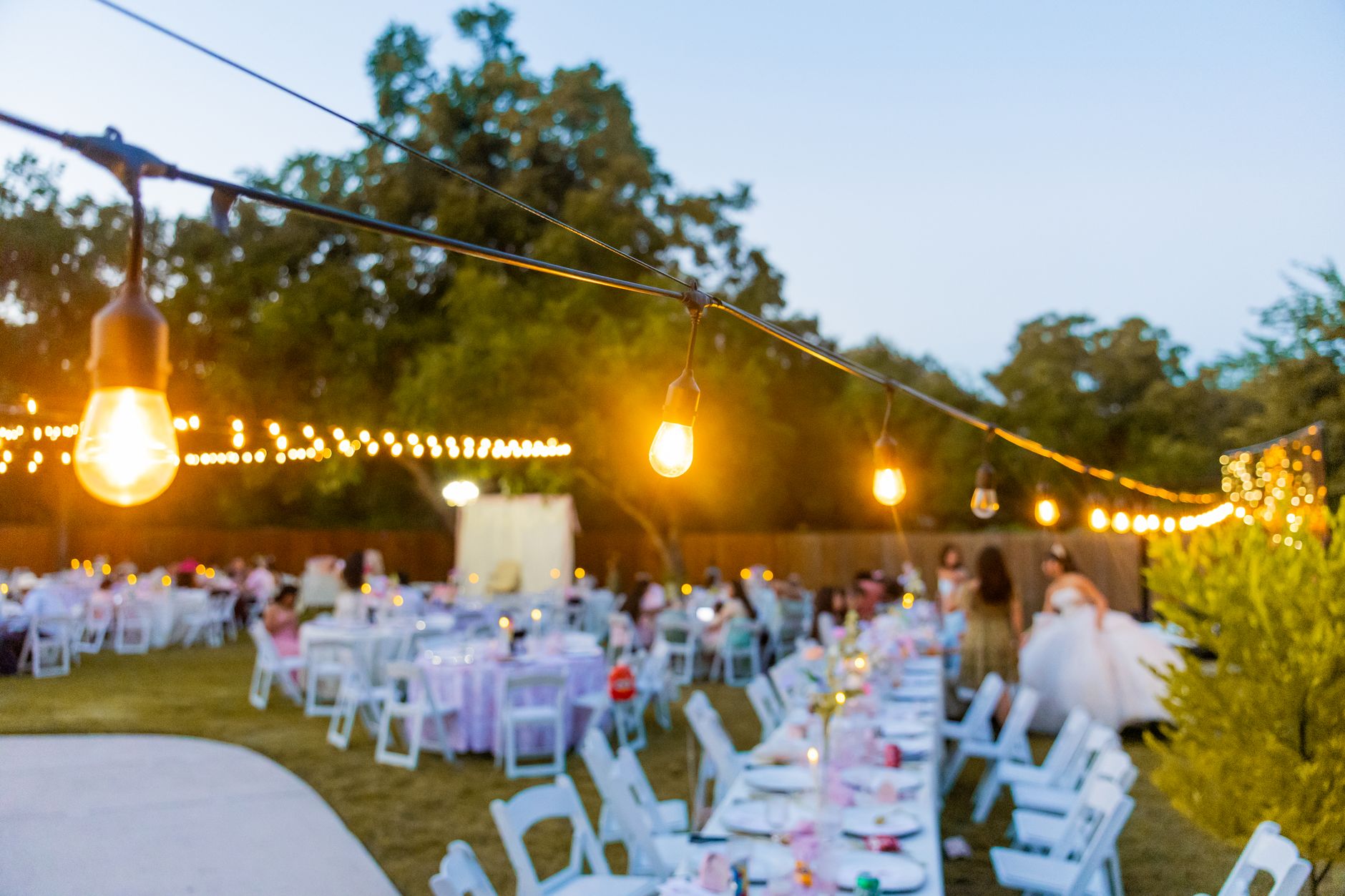
The smell hit me first, and Lord, it was a good smell. Somebody had done a proper spread. Roast beef and those little potatoes with the rosemary, and yeast rolls, and warm butter, and underneath it the sugar smell of a cake waiting on its own table. The caterers were the outfit from the county seat, the ones you book a year out, in their black aprons moving through the room with trays held up on flat hands. The chandelier was lit in the rafters and the string lights were on and the whole barn glowed like the inside of a lantern.
And the tables. Real plates, not the foam kind we use at the church suppers. White plates with a thin gold ring, cloth napkins folded up standing like little tents, and at every single place a card with a name on it in that same looping calligraphy. Water glasses. Wine glasses turned up. A centerpiece of white flowers on every table with a candle going.
I started walking the tables. I did not decide to, my feet just did it. I told myself I was looking for my seat because surely there was a seat, there is always a seat, a family does not leave one of its own without a chair. Table One, up by the head table. I read every card. Mother. Daddy, in his wheelchair spot with the card that said Gerald Ott and a little space cleared for the chair to roll in. Wade. Brynn. Brynn’s mother and father. Table Two, the Callahan aunts. Table Three, cousins I grew up with, Denny and his wife, the Pruett girls. Table Four. Table Five. Table Six, the tan couple, already sat down and buttering their rolls.
I walked every table in that barn. I read every card. I even went to the back where they keep the folding chairs stacked, where you’d squeeze in a straggler, the plus-one nobody counted on, and I looked along the wall where an extra setting might be tucked. I looked twice. I looked slow.
There was no Dana. There was no card with my name in the looping print. There was no plate with the gold ring and no cloth napkin standing up in its little tent and no chair pushed in and no water glass. Not at the family table, not at the cousins’ table, not tucked in the back against the wall. Nowhere in that whole glowing barn was there a single square foot of table that had been set aside for me.
And that was when the excuse I had built finally came apart in my hands, because you cannot forget to seat someone you love. Forgetting leaves a gap, an empty chair, an oops. This was not a gap. This was a plan. Somebody had sat down with the list and counted the heads and looked at my name, Dana Faye, thirty-four years old, the one who ironed the blouse and ran for the bobby pins, and had crossed it clean off. Somebody had told the caterer one fewer plate. Somebody had cut a piece of printer paper with wobbly scissors so I would have a badge to hold that matched exactly how much I was worth to them, which was nothing with a hole cut out of the middle.
I wasn’t forgotten.
I was left out on purpose.
The years behind it, the short version
You would want to know why, and the honest answer is that there is no single why. It is a thousand small whys stacked up over a lot of years until they made a weight.
I was the plain one and Wade was the golden one, and that started before either of us had any say in it. He was the boy, and on a farm the boy is the future and the girl is the help. He was charming from the crib and I was serious from the crib, and my mother loved charming the way some people love sugar. Wade could break a thing and grin and the grin fixed it. I could fix the same thing with my own two hands and get told not to make such a production of it.
I stayed. That is the part that matters. When Daddy had his stroke six years back and his hands quit closing and he went to the wheelchair, it was me that moved home. Wade was off in the city selling something, cars then insurance then a thing I never understood, always about to hit big. I was the one who came back to Coldwater and slept in my old room and learned to run the front-office end of the farm because Daddy couldn’t hold a pen anymore. I sat with the lender in the county seat. I did the FSA paperwork. I drove Daddy to the VA in the city for his appointments, two hours each way, because he’d done his time in the service and earned that care and somebody had to get him there, and that somebody was never Wade.
And the money. I have to say the money part because the money is the whole back end of this story. When the farm got behind, when the corn came in low two years running and the note at the bank came due and my mother would not hear of selling one acre my grandfather broke, it was me who quietly covered it. I had a job in town at the insurance office, I lived cheap, I never married, and I took what I saved and I kept that farm current. Not once. Over and over. I paid the fall note in the bad year. I paid the propane the winter Daddy was so cold. I co-signed the operating loan the spring the bank wanted a second name on it, and it was my name they wanted, not Wade’s, because the bank in a small town knows exactly who is good for it and who is grin.
Nobody ever thanked me for that in a way you could hold. My mother would say things like “we’re family, we look out for each other,” and then in the same breath she’d tell the whole church supper how Wade sent a card on her birthday, a card, like it was a kidney. I told myself it didn’t matter. I told myself doing the thing was the reward. That is what the reliable ones tell themselves right up until somebody hands them a paper badge.
So there I stood in the glowing barn understanding, finally, all the way down, that in the ledger my family kept, all those years and all that money and all those drives to the VA had not bought me one plate with a gold ring on it. Wade’s grin outweighed my whole life. And they were so sure of me, so certain I would swallow it the way I swallowed everything, that they’d let me drive out here and iron the blouse and read every card in the room before I found out.
The gift table
I looked toward the gift table.
It was set up near the door, a long table with a white cloth, and it had the usual on it, the wrapped boxes and the gift bags with the tissue coming out the top, and the card box, one of those little decorated boxes with a slot in the lid for the envelopes. And there, in among the others, was mine.
I need to tell you what my gift was, because everything turns on it.
I had not brought a toaster. I had not brought a card with a twenty in it. Months back, when Wade told me he and Brynn were getting married and the whole family got swept up in it, I had made a decision the way I made all my decisions, quiet and alone at my kitchen table with the checkbook out. Wade and Brynn wanted to buy the old Merrick place, the little farmhouse and forty acres that comes up for sale maybe once a generation out our way, and they did not have the down payment, and I did. I had it because I had spent fifteen years not spending. And I loved my brother, God help me, and I wanted him to have his start the way I never had mine, and I wanted Brynn to have a real house and not a rented double-wide out by the highway.
So the envelope on that gift table, my gift, in among the toasters, was a cashier’s check for eighteen thousand dollars, made out to Wade and Brynn Ott, for the down payment on the Merrick place. Eighteen thousand dollars. Every dollar of it scraped out of an insurance clerk’s salary a little at a time over more years than I want to count. I had gone to the bank on Thursday and had them cut the cashier’s check so it would be official, so it would be real, so on the best day of my brother’s life I could hand him the thing that would set his whole life going.
That is what I had brought to the wedding where they would not give me a plate.
I stood at that gift table for what felt like an hour and was probably ten seconds. And something in me that had been bending my whole life, bending and bending and never once breaking, finally just quietly stopped bending. It didn’t snap. There was no scene. I want you to know there was never a scene, not that night, because a scene is what they expected of the sister who wouldn’t make a fuss and I was done being anything they expected.
I reached out and I picked up my envelope. My own envelope, my own name in my own hand on the front. I put it in my purse. And then I turned around and I walked out of that barn, across the gravel lot, past all the parked trucks with their weddings still going on inside them, out to my car at the very back where I’d parked so the far-away guests could have the good spots.
I sat in my car in the dark for a minute. I did not cry, which surprised me. I had cried plenty over that family in my life and I would cry more, but not right then. Right then I felt something I had not felt in a long time, which was quiet. A clean, wide quiet, like a field after the combine’s finally shut off.
Then I drove home.
What they found out
Here is the part people always want, the part where they get theirs. I’ll tell it, but I’ll tell it true, because it did not happen the way you’d write it if you were angry. It happened slow and small, the way real life pays people back, which is almost never with a scene at the wedding and almost always with a Tuesday months later when the truth just quietly arrives in the mail.
Nobody noticed I was gone that night. That is the first thing, and it still stings if I let it. A grown woman drove out to a wedding, walked the whole room, and drove home, and not one person in my family texted to ask where I went. They were dancing. Wade had his bride and his string lights. Why would he count to see if his sister was still there. He had never once had to count on me being anywhere but exactly where he needed me.
The call came eleven days later. Wade. First real call from him in I could not tell you how long, not a text, a call, and I knew before I answered what it was about because I knew the closing on the Merrick place was that week. I let it ring twice. Then I answered.
He was warm at first, so warm, Wade could turn it on like a spigot. Hey sis, big week, and he laughed, and then he got to it. The down payment. He said it like I’d forgotten, like I was a bank that had misplaced a wire. “So the title company needs the funds by Thursday, and Mom said you had that handled, so if you can just get that over to them.”
Mom said you had that handled. There it was, the whole family in one sentence. I had the plate taken from me and the gift I never even got to give was already spent in their heads, already spent and counted and assumed, the way everything I did had always been assumed.
I asked him one question. I asked it quiet, no anger in it, I really did keep the anger out of my voice. I said, “Wade, at your wedding, what badge did I have?”
There was a silence on the line. A long one. And in that silence I heard him understand, all at once, that I had been there, that I had walked the room, that I had seen. He started to say my name in that voice, the fixing voice, “Dana, come on, Dana, that was Mom, that was a dumb thing Mom did with the seating, you know how she gets, that had nothing to do with -“
“There was no plate for me, Wade,” I said. “In the whole barn. I looked. You want me to wire eighteen thousand dollars to buy you a house, and you couldn’t find me a chair.”
He got quiet again. And then, because he was Wade and it always came back to this, he got angry. He said I was being dramatic. He said I was holding a paper badge over his entire future, that Brynn was already picking paint, that this was the pettiest thing he’d ever heard, that a real family doesn’t nickel-and-dime each other over hurt feelings.
I told him I was not giving them the down payment. I told him kindly, which I think made it worse. And then I hung up, and I turned my phone face down on the kitchen table, and I sat in the same chair where I’d sat all those years with the checkbook, and this time I let myself cry.
They lost the Merrick place. It went to a family from two counties over. I heard about it at the co-op, the way you hear everything.
My mother, at the feed store
My mother did not call me for a long time. She sent word through people the way she does, let it get back to me that Dana had “ruined Wade’s start out of spite,” that “all over a name tag she couldn’t buy her own brother a house,” and the town, some of the town, believed her, because my mother has been telling her version at the church supper and the beauty shop for fifty years and I was never there defending mine because I was always out at the VA or under the tractor.
But small towns are strange. The truth in a small town is like water under a floor. It takes its time, but it finds the low places, and it gets where it’s going.
What got around, eventually, was the bank part. It could not not get around, because when the fall note came due that year, there was no me to quietly cover it. My mother went to the bank in the county seat expecting the arrangement that had always been there, and the arrangement had a name on it, and the name was mine, and I did not sign that year. And the loan officer, a decent man named Cal Pruett whose girls I’d read the wedding cards for, could not carry it on a grin.
So it came out, the way it had to, that all those years the farm had been kept afloat by the daughter nobody would seat. My mother had told everyone Wade was the one keeping his father’s place going. That was the story at the beauty shop. And now here was Cal Pruett’s paperwork, and here was the fact plain as a fencepost, that Wade had never put one dollar into that ground, that it was Dana, the plain one, the one who wouldn’t make a fuss, whose name was on every hard year.
I did not spread that. I want to be clear. I never once went to the beauty shop with my side. I did not have to. The town did it for me, and they did it the way the country does it, not with a confrontation but with a slow cooling, a thing you can feel but not point to. Fewer people took my mother’s word. My daddy’s old friends, the men from the VFW who knew who had been driving him to the VA all those years, they knew, and they did not forget, and the VFW is where the truth in our town gets ratified.
My mother came to me finally at the feed store, of all places, both of us there on a Saturday, and she stood by the salt blocks and she could not look at me, the same as that cousin at the check-in table could not look at me, and I understood they were the same look. She said, “I suppose you think you proved something.”
I said no. I said I didn’t think I proved anything. I said I just wasn’t going to pay to be treated like that anymore, and there is a difference between spite and finally charging a fair price for your own dignity, and I had spent thirty-four years giving mine away at a discount and I was closing the account.
She didn’t have anything to say to that. My mother, who always had something to say, stood by the salt blocks with nothing. And I paid for my seed and I left, and that was, I think, the quietest and the biggest thing I have ever done.
Daddy
The one good thing, the thing that keeps this from being only sad, is my father.
Daddy could not do much by then. His words came slow after the stroke and his hands stayed closed. But he was in that wheelchair at the head table at the wedding, with his own card and his own plate, and he had watched his wife lean in and say a thing to his daughter and watched his daughter walk the room and walk out, and he could not get to me across that barn, could not roll himself through that gravel, could not make his mouth say what he needed to fast enough.
But some months on, when it had all come out, I was over at the home place doing his paperwork like always, because I never stopped doing that, I want you to know, I never once let my father go without because of what his wife did. And he took my hand, my father with his hands that don’t close, he got his hand over mine on the kitchen table, and he worked his mouth for a while, and he got it out. Three words. He said, “You. Kept. Us.”
That’s all. You kept us. And then he cried, my daddy, the toughest man I ever knew, cried at his own kitchen table, and I understood that he had known the whole time, all those years, exactly who was carrying that family, and that the not-being-able-to-say-it had been eating him alive from the inside longer than the stroke had. You kept us. I have those three words the way other people have a deed. They are worth more than the plate. They are worth more than the eighteen thousand. I would have paid twice the eighteen thousand for those three words and I told him so, and he laughed, which after a stroke is a hard and beautiful sound.
Where it all landed
Wade and Brynn are still married, out in that rented place by the highway, the one Brynn was going to get out of. He speaks to me now, a little, careful, the way you speak to a person you finally understand has a floor and you found it. There’s no warmth like there was, but there’s a truth like there wasn’t, and I have come to think truth wears longer than warmth anyway. He sent me a Christmas card this year, the first one, with his own handwriting in it, and inside he wrote just, “I’m sorry about the barn.” That’s all. I keep it in the drawer with Daddy’s three words.
My mother and I are cordial. We are not close and I have stopped grieving that we are not close, which is its own kind of freedom. I sit with her at church. I bring the green bean thing to the potluck she likes. I do not iron her blouse anymore and I do not run for the bobby pins and when she needs a thing done she asks me plainly now, out loud, like a favor, instead of assuming it off me like weather, and that small change, her having to ask, is the whole difference between how it was and how it is.
I still have the eighteen thousand. It sat in my account for a long time and I could not touch it, it felt like a thing that had a shape, Wade’s house-shaped hole in it. And then last spring the Merrick place came back around, the family from two counties over couldn’t make it go, and it went up for sale again, and I want you to know how the country works: I bought it. Me. The plain one. The sister with the paper badge. I own the little farmhouse and the forty acres now, in my own name, no co-signer, and I put a table in that farmhouse, a big one, oak, that seats twelve, and every seat at it is real, and there is always, always a plate for anybody who walks in, and none of them are paper.
I had a supper out there this fall. Daddy came. Cal Pruett and his girls came. The men from the VFW came. Wade came, and sat, and had a plate. My mother came late and stood in the doorway a minute the way she always stands in doorways, and I got up and I pulled out a chair for her, a real chair at the real table, and I said, “Sit down, Mama. There’s a plate.” And her face did something I had not seen it do in my whole life, and she sat.
That is the thing I learned, out of all of it, and it took a paper badge to teach me. You cannot make people give you a seat. You can beg for one, you can earn one for thirty-four years, you can pay eighteen thousand dollars for one, and they will still hand you a scrap of printer paper if that is who they’ve decided you are. But you can, if you finally stop paying to sit at their table, go and build a table of your own. And it turns out the people who belong at it will find their way there. And the ones who left you standing in a doorway holding a badge will stand in your doorway one day, and you will get to decide, the way they decided about you, whether there’s a plate.
There is always a plate at my table. That is how I know I am nothing like them.
My name is Dana Faye Ott. I was thirty-four years old the day my family gave me a paper badge that said Limited Access Guest, and it was the most expensive gift I never got to give, and the cheapest thing that ever set me free.