The Seat They Gave Me At Her Recital
The seat they gave me
My eight-year-old daughter had a piano solo at the spring concert, and my husband’s family told me to sit near the back because I made her too nervous. I tried to be reasonable, so I agreed. I told myself it was one night, that a mother could give up a good seat for one night if it meant her little girl felt calm. Then the principal walked to the microphone and introduced my daughter using my sister-in-law’s last name. And a second later, from the middle of that stage, my little girl looked past every one of them, straight to the back of the gym where they had put me, and she played the secret song we only used when she needed me to come and get her.
For a moment I did not recognize my own child in that pale pink dress.
Not because she looked like a stranger.
Because she looked handled.
Her hair had been wound into tight little ringlets that were not hers. Her shoes were the stiff white ones my sister-in-law loved and Josie always said pinched her toes. A small pearl clip sat above her ear, and my daughter hated anything clipped in her hair. She looked like a doll someone had dressed for a photograph and forgotten to ask.
And when she stepped onto that stage under the lights, she did not look at the front row, where my husband and his mother and his sister sat shoulder to shoulder like a wall.
She looked over the top of all of them.
To the back of the room.
At me.
My name is Dana Pruitt, and until that night I believed the worst thing happening in my marriage was that my husband had quietly stopped loving me. I thought I understood the size of the problem. I thought I could out-patience it, out-work it, keep my head down and hold my family together the way the women in my family always had.
I was wrong. It was so much bigger than that, and it had been growing in my own house for the better part of a year while I served coffee and folded laundry and told myself I was imagining things.
The man I married
Travis and I had been married four years. He was not Josie’s father by blood. Her father left before she was born and never once looked back, and for the first three years of her life it was just the two of us in a rented duplex on the edge of town, close enough to the highway that you could hear the trucks downshift at night.
Travis came into our life when Josie was three. He worked at the co-op then, and he had a slow, easy way about him that made a scared little girl trust him faster than she trusted most grown men. For a long time I believed love mattered more than blood, and Travis gave me every reason to believe it.
He used to pack her lunch with little notes tucked inside, drawn in ballpoint because his handwriting was terrible. A stick-figure dog. A sun with a smile. He taught her to ride a bike in the church parking lot on a Sunday afternoon, running behind her seat with his hand not quite touching it, letting her think she was doing it alone. When she fell asleep in the truck on the long drive back from her grandmother’s, he carried her in without waking her, every time, his boots quiet on the porch steps so the screen door would not slap.
One whole Saturday he spent down at the creek behind the Hendricks place helping her gather smooth flat stones because she had gotten it in her head that she wanted to paint them like ladybugs. He came home with wet knees and a bucket of rocks and never once complained. That was the man I married. That was the man I keep in my mind on the bad nights, because that man was real, and I need to remember he was real.
Then his sister moved back to town, and the man I married started to disappear a little at a time, so slowly that I kept blaming the light instead of admitting the sun was going down.
When Charlene came home
Charlene Calloway had been gone for years, out in the city working some job she never fully explained, and she came back that winter with a leased SUV and a lot of opinions. She and her husband Merle had tried for a long time to have a baby of their own and it had not happened, and for a while that softened everything I felt about her. I knew that particular ache secondhand from my own aunt, and I did not wish it on anyone. When Charlene first sat at my kitchen table and watched Josie pick out a hymn on the little keyboard we kept by the window, and her eyes filled up, I thought I understood her. I thought, that woman just loves my daughter. What is the harm in that.
The harm came quiet, the way frost comes.
Charlene started showing up without calling. She had a key from Travis’s mother and she used it. I would come in from hanging wash and find her already in my kitchen, already reorganizing my spice rack, already telling Josie that a young lady sits up straight at the piano and does not slouch like she was raised in a barn. She bought Josie dresses I never picked and hung them in my daughter’s closet without asking, dresses with sashes and buttons up the back that an eight-year-old cannot get out of alone. She frowned at the mac and cheese I made and said children who eat like that never amount to anything.
She told me Josie needed real training. She told me Josie needed proper discipline, a serious teacher, a plan. She used the word future the way other people use a hammer.
As if my child were not a little girl at all, but a project that had come into the family unfinished, and Charlene had appointed herself the one to finish it.
Travis’s mother, Loretta, fed it. Loretta was a widow who ran the flower committee at church and had run every one of her children the same way, with a smile and a grip like a bench vise. She would sit in my living room with her coffee and say, Charlene has such a gift with her, such an instinct. She knows how to bring a gifted child along.
A gifted child.
Not my daughter. Not Josie. Just a gifted child, the way you would say a valuable animal, a prize calf that needed the right hands.
In the beginning I told myself I was being small. Insecure. Jealous of a woman who could not have what I had. Josie was gifted, that part was true. She could sit at that dime-store keyboard and find a song by ear after hearing it once on the radio, both hands, in the right key, like it was nothing. When she was nervous she hummed under her breath without knowing she was doing it, a little private engine of a sound. Music had always been the thing between us, hers and mine, since before she could talk.
The song that was only ours
When Josie was five and terrified of starting kindergarten, so scared she threw up the morning of the first day, I made her a little song to carry with her. Four notes and one line. I am no musician. I cannot read a note. But I hummed her four notes going up and coming back down, and I put words to them.
Come on home, little bird.
That was all. That was the whole thing.
It became our signal. Our come-and-get-me song. I told her, if you are ever somewhere and you are scared, or somebody is making you do something and you cannot get the words out, you hum our song and Mama will hear it. It does not matter how quiet. Mama’s ears are tuned to it. I will come.
For three years it was a small private thing between us. She hummed it walking into the dentist. She hummed it the night we heard about her cousin’s accident. Nobody else knew what it meant. It was not written anywhere. It was ours the way a scar is yours, made once, kept forever.
So when I heard those four notes come off that stage, quiet, almost swallowed by the shuffling and the coughing of a full gym, every drop of blood in me turned to creek water. Because my daughter would not play that song in front of two hundred people for no reason. She had reached for the one rope she knew I had given her, in front of everybody, because it was the only way she had left to reach me.
Two days before
Two days before the concert, Travis told me Josie did not want me sitting up front.
I was standing at the sink with my hands in the dishwater. He said it to the back of my head, which should have told me something right there. A man who believes what he is saying looks at you.
He said, she gets tense when you are too close. Her teacher thinks the front row is a lot of pressure on her.
I turned around, my hands dripping. I said, Josie told you that.
He said, she didn’t want to hurt your feelings. Charlene noticed it first. When you’re right there in front, Josie keeps looking at you instead of the music. She freezes.
I said, that does not sound like my daughter. My daughter looks for me on purpose. That is not freezing. That is a little girl finding her mother’s face in a crowd so she knows she is safe enough to keep going.
Travis sighed the way he had started sighing, long and tired, like I was a chore that would not get done. He said, Dana, not everything is somebody attacking you. Sometimes a kid needs a little room from her mother. That’s normal. That’s healthy.
That sentence landed exactly where he aimed it, and he knew where to aim it, because he had watched me for four years and he knew the soft place under my ribs.
I had been a single mother. I built my whole life so I could be there. I worked from home doing medical billing for a clinic two counties over so I could pick her up from school every single day, so I could be the one in the pickup line, so I never missed a fever or a science fair or a night terror. I did every recital, every parent meeting, every dentist visit, every stomach bug at two in the morning. For years, being there was the one thing I was proud of, the one thing nobody could take from me.
And lately that same thing had a new name in this family.
Travis called it overprotective. Charlene called it smothering. Loretta called it an unhealthy attachment, and she said it in her church voice, soft and sorrowful, like she was praying for me.
They always said it gently. That was the trick of it. If they had yelled, I would have fought. But you cannot fight fog. You just keep walking into it and coming out more turned around than before, until one day you are standing in the back of a gym wondering how you got there.
Row eleven
So on the night of the spring concert, when a girl from the PTO smiled at me by the double doors and looked at her little chart and said, oh, you’re in row eleven, hon, I swallowed the knot in my throat and I walked to the back like they wanted. I told myself, one night. I told myself, do not make a scene at a children’s concert, Dana, that is exactly what they will say you always do.
The front row was full of Calloways.
Loretta sat on the aisle in her good church cardigan. Charlene sat beside her in a dress the exact same shade of pink as my daughter’s, which I noticed and made myself not think about. Travis sat next to Charlene. On his other side there was one empty folding chair, and for half a heartbeat I thought, they saved it for me after all, and I hated how fast that hope came up in me.
It was not for me.
Merle came in late holding a cellophane cone of white roses and took the empty seat. So the front row, the row for my daughter’s family, held Travis’s mother, Travis, his sister, and his sister’s husband, and a bouquet the size of a Sunday ham. And me, her mother, the woman who taught her every song she knew, was eleven rows back next to a family I had never met, blinking at the ceiling lights so I would not cry in front of strangers.
To keep my hands busy I opened the folded program the PTO had printed on the good yellow paper.
I read down the list of little performers. The kindergarten choir. A boy on the trumpet. A girl reciting a poem about spring.
And then the fourth line, and my whole body went still.
Piano Solo. Josie Calloway.
Calloway.
That is not my daughter’s name. My daughter’s name is Josie Pruitt. It is her name on her birth certificate, her name at the doctor, her name I have written on the inside tag of every coat and the bottom of every lunch box for four years. Travis never adopted her. We had talked about it once, early, and then Charlene came home and the subject quietly went away, and now I understood why. Nobody was going to change my daughter’s name to Travis’s family name through a courthouse. They were going to do it through a school program printed on yellow paper, one line at a time, until it looked normal, until it looked like it had always been true.
And underneath, in smaller print, one more line.
Presented by the Calloway Young Artists Fund.
I had never heard of the Calloway Young Artists Fund. There is no such thing. There was no such thing until somebody in that front row decided there ought to be, and had it printed under my child’s stolen name, in my child’s school program, for the whole town to read.
Four notes
I started to stand up. I do not know what I meant to do. Make some kind of noise, walk to the front, something. But before I could get my knees under me the principal was already at the microphone tapping it once with his thumbnail.
He was a kind, dull man named Mr. Reedy who I had shaken hands with a dozen times. He said, we are so proud tonight to introduce a young lady with a real gift, who I understand has been accepted into a private advanced arts program starting this fall. Folks, please welcome to the piano, Josie Calloway.
The gym filled up with applause. Two hundred people I mostly knew, clapping for a name that was not my daughter’s name, for a program that did not exist, arranged by people sitting in the front row wearing pink.
I could not make my hands come together. They lay in my lap like they belonged to somebody else.
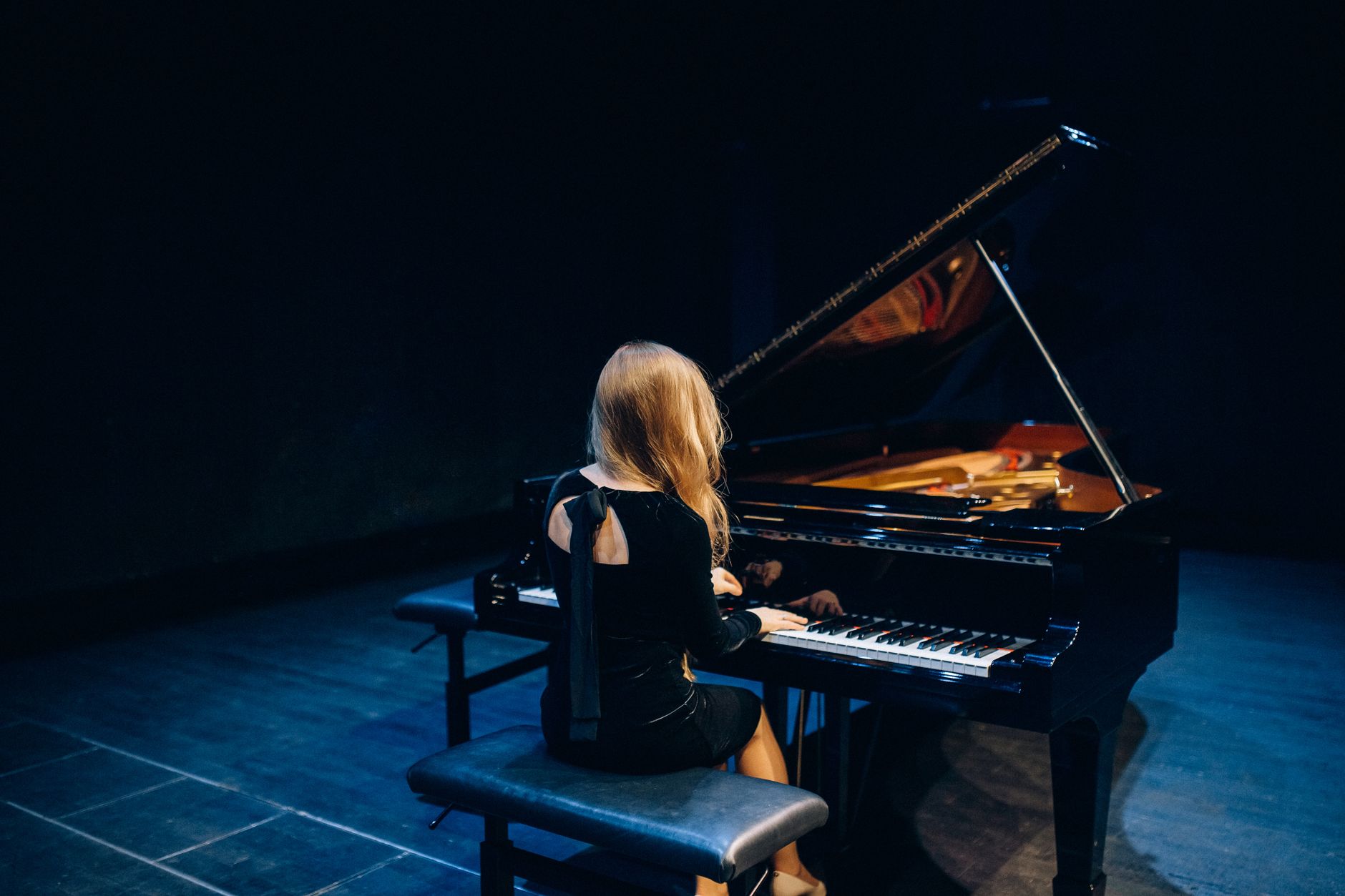
Josie came out from the side of the stage slow, one foot then the other, in those stiff white shoes. She looked so small under the lights. She looked smaller than she does in our kitchen, smaller than she does asleep. She climbed up onto the bench and her feet did not touch the floor and she folded her hands in her lap for a second the way she does before she plays, and she looked out at the room.
She looked at the front row.
Past Loretta.
Past Charlene in her matching pink.
Past Travis.
And her eyes came up, and up, over all of them, all the way to the back where they had hidden her mother, and she found my face. I watched her find it. I watched her shoulders come down half an inch when she found it.
Then she put her hands on the keys, and instead of the recital piece, she played four notes.
Up and back down.
Come on home, little bird.
Just once. Quiet. Almost nobody in that room heard it, or if they heard it they thought it was a child warming up her fingers. Charlene did not react. Travis did not react. They did not know the song, because the song was never theirs. It was mine and it was Josie’s, made one scared morning three years before any of them decided my daughter was a gifted child that needed better hands.
But I heard it. My ears have been tuned to those four notes since she was five.
My body moved before my mind caught up. I was on my feet and into the side aisle and walking, fast, down along the wall toward the stage, and I did not care anymore what anybody printed on yellow paper or whispered in my kitchen or said in a church voice. My little girl had called me, in the only language they had not been able to take, and I was coming.
On the stage Josie’s hands started into the real piece, the one she had practiced, a simple pretty little arrangement of a hymn. Her fingers were perfect. She never missed. That is the part that broke me, that her hands were doing exactly what they had been trained to do while her face was falling apart above them. She played it flawless, and she cried the whole time, quiet, the way a child cries when she has learned that crying loud gets her in trouble.
The stage door
Near the little steps at the side of the stage a woman stepped into my path. It was Mrs. Alderman, Josie’s music teacher from the school, a heavyset woman close to sixty with reading glasses on a beaded chain. Her face was the color of paper.
She put her hand on my arm and she said low, Mrs. Pruitt. Thank the Lord you came. I have been trying to figure out how to reach you for two weeks and every road went through them.
I said, what is going on. What is this. Why is my daughter’s name.
She said, not here. Come with me. And she pulled me through the door beside the stage into the little cinderblock hallway where they keep the folding chairs and the risers, and the applause came muffled through the wall as Josie finished her piece.
Mrs. Alderman held both my hands. Hers were shaking.
She said, three weeks ago your sister-in-law came to me and said she was handling all of Josie’s arts paperwork now, that you were, and she used this word, overwhelmed, and that you’d asked the family to step in. She had a folder. She had a lot of it looking official. She wanted the school program printed with the name Josie Calloway, she said it was a family matter and the courthouse part was already in motion. She wanted the little Calloway Fund line added because she said they were sponsoring an arts scholarship in the family name.
I said, none of that is true. None of it. I never asked anyone to step in.
She said, I know. I know that now. Because your daughter told me. She said she watched my face while she talked, and then she said, and this is why she went pale, she said, two days ago Josie asked me if a mama can be taken away from a kid if enough grown-ups say she’s too much. She asked me that, Mrs. Pruitt. An eight-year-old.
What they had built
The whole thing came apart in that cinderblock hallway and in the days after, and I am going to lay it out plain because for months I could not, because nobody believes it the first time and I stopped trying to make them.
They had not lost their minds and they had not done it in a fit. It was patient. Charlene wanted a child and could not have one, and instead of grieving that like a person, she went looking for a child that already existed and had, in her eyes, the wrong mother. Mine. She decided over that winter that I was unfit, and then she went to work building the paper that would make a judge someday agree with her, and she pulled Travis and Loretta along because it is easier to steal a child when the child’s own household hands her over.
The dresses and the shoes and the tight little ringlets were part of it. They were dressing my daughter as evidence. Look how she blooms with us. Look how she was neglected before. Every time Charlene reorganized my kitchen or frowned at my cooking or said the word smothering in front of a witness, she was laying brick. The come-and-get-me song they had no idea about, and that was their one mistake, the one door they never found because it did not have a lock or a hinge, it was just four notes a scared mother hummed to a scared little girl.
The program was the tell. You do not put a child’s name in a school concert program under a family name she does not have unless you are trying to make the false thing look ordinary, unless you are building a record. And the Calloway Young Artists Fund, that fake little line of print, that was Charlene planting a flag on my daughter in front of the whole town so that later she could say, of course we sponsored her, we always meant to raise her, ask anybody, it was in the program.
Mrs. Alderman had smelled it. Teachers who have been at it thirty years can smell it. She had felt something wrong the moment Charlene appeared with a folder speaking for a mother who was not there, and she had done the one brave thing she could do inside a system that mostly runs on politeness. She had gone slow. She had not printed the courthouse part. She had quietly gotten Josie alone and asked her small questions, the kind a scared kid can answer, and she had held onto the answers, and she had prayed, her word, that the mother would show up. That is why she was standing by that stage door. She had put my daughter’s solo fourth on the program on purpose, late enough that I would be in the room, early enough that there was time.
And Josie, my Josie, eight years old, in shoes that hurt her feet and a name that was not hers, had done the bravest thing of all of us. She could not stand up in front of the town and say my mama loves me and these people are lying, no eight-year-old can do that. So she did the only thing she had. She waited until she found my face in the back of the room, and she played the four notes that meant come and get me, and she trusted that I would.
I took my daughter home
I did not make a scene at the concert. I have thought about that a lot since, and I am not sorry. There were two hundred people in that gym and half of them were children, and my daughter had just finished playing her heart out, and she did not need her mother screaming down the front row to be her last memory of that night.
Instead I went to the edge of the stage when it was over and the lights came up, and Josie saw me and got off that bench so fast she nearly fell, and she ran to me across the front of the stage with everyone watching and I caught her and she wrapped her whole self around me and pressed her wet face into my neck and she said the thing I will hear until the day I die. She said, Mama, you heard me.
I said, I will always hear you. I told you. Mama’s ears are tuned to it.
Travis was on his feet in the front row and Charlene was saying something with her hand out and Loretta had that stricken church look, and I stood there holding my daughter with the whole town as my witnesses now, my witnesses, and I said, loud enough and calm enough, we’re going home. Josie and I are going home. And I carried her out the side door and I did not put her down until we reached the truck.
That night I did not sleep. I sat up at the kitchen table where Charlene used to reorganize my spice rack and I wrote down everything, every dress bought without asking, every uninvited visit, every soft cruel word and who said it and when. I wrote down the program and the fake fund. In the morning I called Mrs. Alderman and asked if she would tell what she knew, and she said, I already wrote it down myself, honey, two weeks ago, I have got dates. God bless that woman. And then I called a lawyer, a plain no-nonsense woman named Ruth Danvers who had an office over the bank downtown and had been doing family cases in that county for thirty years.
What it cost and what it was worth
I will not pretend the months after were clean or quick. They were not.
Travis moved out to Loretta’s within the week, and for a while he called and left messages that swung between angry and pitiful, and I saved every one of them, and my lawyer said good, keep saving them. Charlene got loud once the quiet did not work anymore, and it turned out loud was the best thing she ever did for me, because loud left a record and the fog did not. She sent messages. She said things in front of people. Ruth Danvers folded every one of them into a folder that got fatter than Charlene’s ever was, except mine was true.
The marriage was over and I grieved it, the real part of it, the man with the ballpoint dog notes and the bucket of creek rocks. I am allowed to grieve that man even though he let his sister try to unmake me. Both of those things are true and I have stopped trying to make them fit together. People you love can stand right there and let you drown because being loyal to their family is easier than being decent to you. I learned that at thirty-four in my own kitchen.
But here is the part that matters, the part I hold onto.
Charlene never got my daughter. Not one inch of her. The whole scheme rested on a judge believing I was unfit, and there was not one true thing to build that on, because for eight years the only thing I had ever done was show up. The pickup line, the fevers, the recitals, every single one, all of it that they had spent a winter renaming as smothering, turned out in a courtroom to be exactly what it always was. A mother being there. The judge read Mrs. Alderman’s dated notes and looked at that program with the fake fund line and asked Charlene one or two quiet questions, and I watched Charlene’s face do the thing my kitchen fog had done to me for a year, come apart when there was nothing solid underneath.
I got full custody. Travis has supervised visits he mostly does not use. Charlene is not permitted around my daughter at all, by order, on paper, in a courthouse, which is the one kind of paper that turned out to matter.
The recital that was ours
Josie is nine now. She still plays. We got her a real piano finally, a secondhand upright the church was getting rid of, and four men from the men’s group hauled it into our front room on a Saturday and would not take a dime. It sits by the window where the little dime-store keyboard used to be. She practices after supper with the light going gold across the county road outside, and I do her billing at the same table, and it is quiet in the good way now, the way a house is quiet when nobody is reorganizing it.
She had a recital this past spring, a small one, just Mrs. Alderman’s students in the fellowship hall at the church with folding chairs and a sheet cake after. There was no printed program on good yellow paper. There was a piece of construction paper Mrs. Alderman had lettered by hand, and it said Josie Pruitt, fifth on the list.
I sat in the front row. Front and center, close enough to see her feet reach the pedals now, which they do. She did not need to look for me in the back of any room, but she looked at me anyway, once, before she started, the way she has always done, finding her mother’s face so she knows she is safe enough to begin. And I looked right back at her and I did not blink and I did not hide it, because I have learned that a child looking for her mother in a crowd is not a weakness anybody gets to rename. It is the whole point. It is the thing I built my life around and I will build it around that until I am gone.
She played her piece perfect, both hands, and at the very end, so quiet almost nobody caught it, she slipped in four extra notes that were not on the sheet. Up and back down.
Come on home, little bird.
She looked at me when she played them and she grinned, because now it was not a rope thrown across a dark room. Now it was a joke between us, a wink, a thing that meant I am home, Mama, I never got taken, you heard me and you came. I mouthed it back at her from the front row where I belong.
Come on home.
And she did. She came down off that little stage and across the fellowship hall and climbed into my lap even though she is getting too big for it, and we ate sheet cake off paper plates, and that is the end of the story, which is a thing I did not think I would get to say. A story that ends. My daughter, in her own name, safe in the front row town where I can see her, humming the song that was only ever ours.
They gave me a seat in the back once. I sat in it for one night because I am a reasonable woman and I did not want to make a scene.
I will never sit there again.