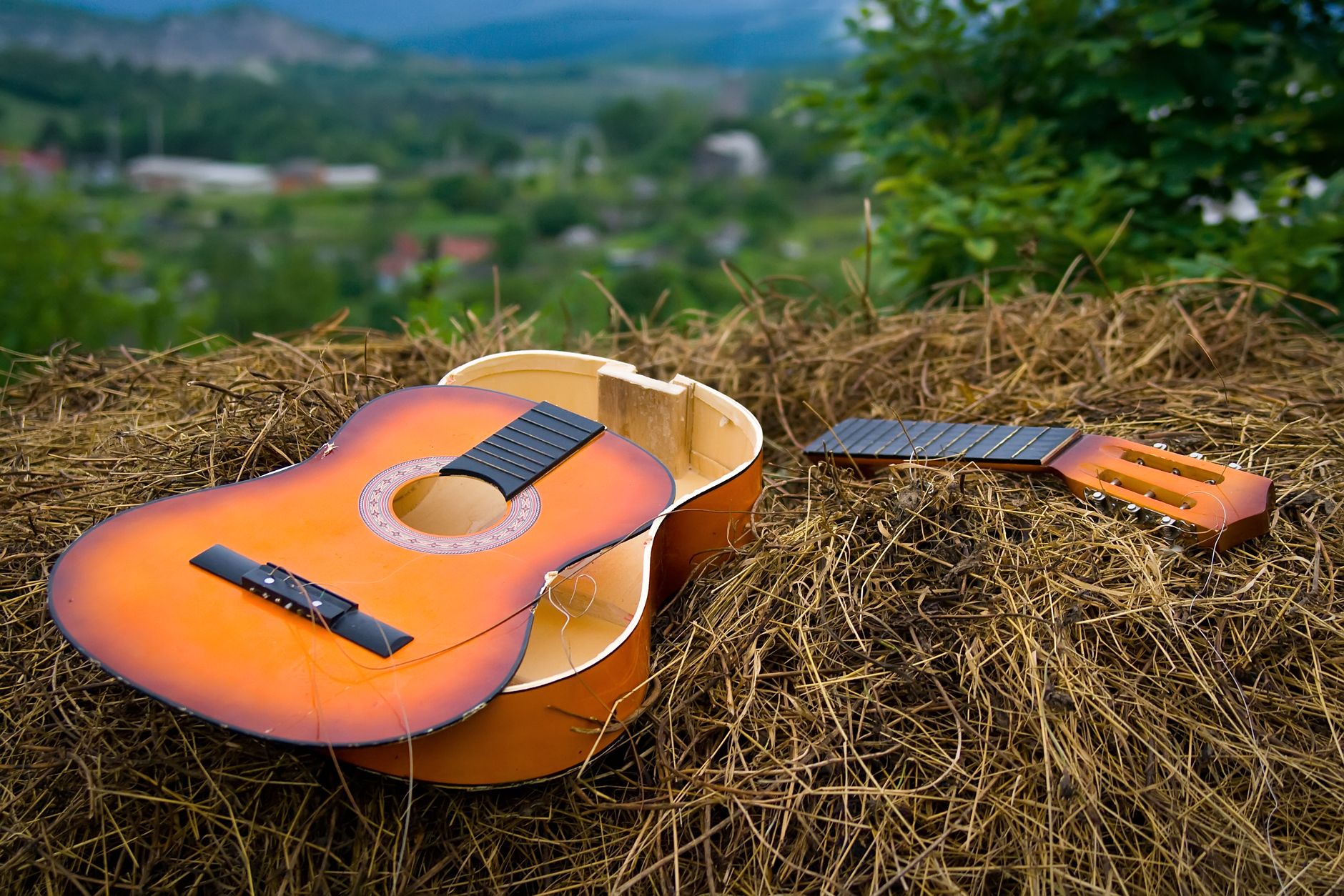
The Guitar My Nephew Smashed
The first sound was not loud. It was sharp, a clean crack that carried across the back porch and stopped every conversation in my parents’ farmhouse for about half a second.
I had been sitting on the porch steps tuning my grandfather’s guitar, the old flat top acoustic Grandpa Vernon had carried to church and to the porch and to every kitchen table for the last forty years of his life. It was Labor Day, and the whole family had come out to the folks’ place outside Renfro for a cookout, the way we always did on the long weekends. I had set the guitar down for two minutes to go turn the burgers. Two minutes.
Then came a second crack, and that one was worse, because I knew exactly what it was. Wood does not sound like anything else when it gives.
I came through the screen door with my heart already up in my throat, before my eyes even caught up to what my ears had told me.
The boy in the living room
My nephew Cody stood in the middle of the living room, nine years old, both hands wrapped around the neck of Grandpa Vernon’s guitar. He had the body of it braced against the brick of the fireplace hearth. The bridge had torn loose. The top had split straight down the grain, a long pale wound running from the sound hole to the edge. The strings hung slack and tangled, curled up on themselves like fence wire somebody had cut.
He looked right at me.
Then he laughed.
“It broke,” he said. “It was just old junk anyway.”
For one full second, nobody in that room moved.
Brent, my brother in law, was standing by the kitchen doorway with a can of pop halfway to his mouth. His face had gone a shade of gray I had never seen on him before, because Brent was a man who always had color, always had a comeback, always had something to say about everything. He had nothing right then.
I crossed the room slow. I did not trust myself to move fast. I knelt down and I took the pieces of that guitar out of my nephew’s hands, and he let go easy, the way a kid lets go of something once he has already gotten what he wanted out of it.
“Cody,” I said, and I kept my voice as level as I could make it. “Why would you do that?”
He lifted his chin at me. He was not scared. That is the part I keep coming back to. He was not scared at all.
“Dad said the old ones are worthless,” he said. “Dad said if it was any good it wouldn’t fall apart. I was just checking.”
Brent set the pop can down on the counter. “Cody,” he snapped, way too late to mean anything.
I turned and looked at him. “You told him what?”
Brent did that thing he does, that quick easy smile that has gotten him out of a hundred rooms. “I was just talking. You know how I talk. I never told him to go and break the thing.”
But Cody frowned, because now the grown ups were changing the story on him, and at nine you have not yet learned to let them.
“You did too,” Cody said. “You said Uncle Wade drags around a piece of junk and thinks it’s special. You said old stuff isn’t worth anything, it just looks poor.”
Brent’s neck went red.
I looked down at what I was holding. My grandfather’s guitar, in three main pieces and a handful of splinters. Not a decoration. Not a toy. Not a thing that could be replaced by driving to a store, no matter what anybody in that house was about to tell me.
Who the guitar was
I need you to understand what that guitar was, because if you do not understand that, none of the rest of this will land the way it landed on me.
Grandpa Vernon bought it used off a traveling preacher in 1961, for money he did not really have, back when he was farming eighty acres of rocky Caldwell County dirt and raising four kids on it. He was not a rich man and he was never going to be. But he could play. Lord, could he play. He played it at Mount Zion Methodist every third Sunday for thirty some years. He played it at his own kids’ weddings and then at his grandkids’. He played it on the porch on summer nights until the mosquitoes drove everybody inside, and then he played it in the kitchen a while longer.
He taught me on that guitar. My daddy, Roy, never had the patience for it, but Grandpa Vernon did. I was seven when he first set it in my lap, and it was so big on me that I could barely reach around it. He put my little fingers down on the frets one at a time and he told me, “Wade, a man who can make music never has to be lonesome, and never has nothing to give.” I have thought about that sentence more times than I can count.
When he passed, five years back, there was not much of an estate to fight over. A worn out truck. Some tools. The eighty acres, which went to my daddy. And that guitar, which Grandpa Vernon had told everybody, plain and in front of witnesses, was to go to me. Nobody argued. Nobody wanted it. To the rest of them it was an old beat up thing with a crack already starting in the finish and a headstock that had been repaired once with hide glue back in the seventies.
To me it was the last of him I could still hold in my two hands. When I played it, I could hear him. That is not me being sentimental. Any picker will tell you that an old guitar that has been played thousands of hours takes on a voice, and that voice does not come off the shelf. It comes from the years. You cannot buy the years.
That was the thing standing in three pieces in my hands while my nephew laughed.
When the blame turned around
That is when my sister Renae came flying in from the yard.
She saw Cody first. Not the guitar. Not me. Cody. And the second she looked at him, his whole face changed, the way a switch changes a light. His bottom lip started to go, and his eyes went wet, and he turned toward his mama like he was the one who had been wronged in that room.
“What did you do to my son?” Renae shouted. At me.
I lifted the broken guitar so she could see it. “He destroyed this, Renae. Brent had been telling him it was junk, so he decided to see if it would break.”
Renae pulled Cody in against her and wrapped both arms around him. “He’s nine years old, Wade.”
“He knew enough to laugh.”
“He didn’t understand. He’s a baby.”
“He’s nine. He understood fine.”
“It’s a used guitar, Wade. It’s not the end of the world.”
And there it was. There was the sentence that told me everything about how this was going to go. It’s a used guitar. Like the whole meaning of it was a price tag, and since the price tag was low, the loss was low.
“It was Grandpa Vernon’s,” I said. My voice was starting to shake now and I hated that it was. “It is the only thing of his I have.”
Renae blinked. For just a second, just one, something moved across her face, some flicker of the little girl who used to sit on the porch steps next to me while Grandpa played. And then it closed right back up, because Cody was crying, and Cody was hers, and everything else in the world went behind him.
“Well,” she said. “Nobody meant for it to happen.”
“Brent meant every word he said to that boy.”
“You are not going to stand in Mama’s living room and blame a child,” she said. “I won’t have it.”
It’s just a guitar
My mother, Loretta, came in from the kitchen wiping her hands on a dish towel. She took one look at Cody crying into Renae’s shirt and she made her decision before she had a single fact.
“Wade,” she said, in that soft, tired, disappointed voice she has used on me my whole life. “Stop scaring him. Look at him. You’re scaring him.”
“Mama, look what he did.”
“I see it. Now put it down and go cool off.”
Then my daddy came in. Roy Sutter, seventy one years old, arms crossed over his chest the way he crosses them when he has already decided a thing and is not going to be talked out of it. He looked at the pieces of the guitar in my hands. He looked at Cody. He looked at me.
And my own father, whose own father bought that guitar off a preacher in 1961, whose own father taught half this county to sing with it, said this to me:
“It’s just a guitar, son.”
The room went quiet.
I waited. I waited for him to hear himself. I waited for somebody, anybody, to say the obvious thing, which was that it was his daddy’s guitar and mine now and that a boy had smashed it laughing.
And instead my father said the thing that made something inside me go cold and quiet and still.
“You can get another one.”
I want to tell you I said something sharp. I did not. I just stood there holding my grandfather in three pieces while my daddy told me he was replaceable.
Nobody corrected him. Renae rubbed Cody’s back. Brent stared hard at the floor like the answer to his whole life was written in the grain of it. My mother sighed, a long put upon sigh, like I had ruined the cookout by having feelings about it.
Not one person in that room asked Cody to say he was sorry.
Not one person asked Brent why he had put the idea in a nine year old’s head.
Every ounce of comfort in that house went to the child who had broken something. Every ounce of pressure came down on me, the one who had lost something.
What they were really teaching him
Renae straightened up and squared her shoulders, and I could see she was about to close this out and move us all along to lunch.
“He made a mistake,” she said. “That’s all this is.”
“Brent made the mistake,” I said. “Cody acted on it.”
“That is a terrible thing to say about a little boy.”
“It is not terrible. It is just true.”
My mother stepped between us with that voice again. “Wade, you are being unreasonable. It’s done. It’s over. Let’s not ruin the whole day.”
My father nodded down at the wreck in my hands. “Family’s worth more than any object, son. You’d do well to remember that.”
I let the quiet stretch out a while. Then I asked, “So I am supposed to act like this did not happen.”
Renae answered too fast. “You are supposed to forgive him. He’s only a child.”
Brent did not say one word.
And Cody, tucked up under his mother’s arm, peeked out at me. The tears were already gone. Dried up completely. He was not crying anymore. He was watching. He was measuring exactly how much trouble he was actually in, and he was figuring out, correct as could be, that the answer was none at all.
That was the moment I understood exactly what my whole family was teaching that boy, right there in my grandmother’s living room.
Break what does not belong to you. Cry the second somebody gets angry about it. Let the grown ups form a wall around you. And let Uncle Wade eat the loss, because Uncle Wade always eats the loss. Uncle Wade is the one who fixes it, pays for it, drives out at midnight for it, plays for free at it, and then goes home and does not make a fuss.
I nodded. One time. Slow.
“You’re right,” I said.
You should have seen the relief go around that room. Renae let out a breath. My mother’s shoulders came down from around her ears. My father looked satisfied, like he had settled something. Brent, and I will never forget this, Brent actually looked grateful. Grateful. Like I had done him a kindness by letting his boy off.
I gathered up the pieces of Grandpa Vernon’s guitar, cradled them against my chest the way you would carry a hurt animal, and I walked out of the living room toward the front hall.
Nobody followed me.
Behind me I heard Renae say, soft, to my mother, “See? Wade understands.”
No, I thought. Wade finally understands everything.
The bowl of keys
The front hall of my parents’ house was quiet, just the hum of the window unit and the far off sound of somebody’s ATV out on the section road.
On the little table by the door sat the same wooden bowl that had sat there my whole life, the one my mother tosses everybody’s keys into when they come in. My daddy’s keys. My mother’s. Renae’s. And right there on top, black leather fob, chrome badge catching the light through the storm door, sat the key to Brent’s brand new truck.
You have to understand about Brent’s truck. Brent had bought himself a lifted diesel dually that spring, blacked out, King Ranch leather, the kind of rig that costs more than the house I grew up in. He talked about that truck the way other men talk about their kids. He backed it into every parking space in the county so the badge would show. He had told me, more than once, with a little grin, that he could not understand why a grown man would drive a twenty year old Ford and drag around an old busted guitar when he could have nice things. Real things. New things.
Through the storm door I could see it out by the gravel turnaround, gleaming, spotless, parked crooked across two spaces so everybody at the cookout would have to walk around it.
I looked back down the hall toward the living room. They were laughing again. Already. The whole thing was behind them, folded up and put away, and they had moved on to potato salad and whose kid was starting which sport.
I reached into the bowl, and my fingers closed around the cold metal of Brent’s truck key.
What I actually did
Here is where you probably think this story goes one way. I thought so too, for about ten seconds, standing there with that key in my fist and my grandfather in pieces against my chest and five years of being the family’s doormat rising up hot in the back of my throat.
I did not key that truck. I did not put it in a ditch. I did not do a single thing to it that a sheriff could have written up.
I walked out the front door and across the gravel to Brent’s shining truck, and I opened the driver’s door, and I laid one piece of Grandpa Vernon’s guitar, the torn off bridge with two strings still curled around it, right in the middle of that soft King Ranch leather seat. Then I set his key down next to it. And I closed the door soft.
I wanted him to find it. I wanted him, the next time he climbed up into the thing he loved more than his own son’s character, to have to pick up the broken piece of an old man’s guitar off his fancy seat and hold it in his hand and know, for one second, exactly what he had helped destroy and exactly how cheap he had held it.
Then I got into my own twenty year old Ford, the one that was paid off, the one that has never owed me a nickel, and I laid the rest of my grandfather in the passenger seat like a person, and I drove home.
I did not slam the screen door. I did not say goodbye. And that, in my family, was the loudest thing I had ever done.
The part they never saw
Now, if the story ended there, it would just be a sad one. A man loses the last piece of his grandfather and drives home alone. But it does not end there, and the reason it does not is something my family had never once bothered to notice.
I was the one who held that family up.
I do not say that to sound like a martyr. I say it because it is simply the arithmetic of the last ten years, and nobody had ever done the math but me. I am a maintenance man by trade. I fix things. Furnaces, well pumps, wiring, small engines, cars, whatever comes. I am good at it, and I do not charge my own people, and I never have.
Who do you think kept my daddy’s tractor running for the last six seasons? Who reroofed my mother’s back porch two summers ago in July heat and would not take a dime? Who drove ninety minutes at two in the morning the night Renae’s furnace quit in an ice storm with the baby in the house? Who has changed the oil, rotated the tires, chased the check engine lights, and done the brakes on every vehicle in that family, including, and I want you to hear this, including Brent’s precious truck, which I had serviced three times already because the dealer wanted four hundred dollars to do what I do in my own driveway for the cost of the filter?
Who co-signed the note on Renae and Brent’s first house eight years ago, when Brent’s credit was too thin to get them in the door, and never once brought it up?
Me. All of it, me. Quiet, no charge, no thanks needed, that is what family is, right? That is what my daddy always said. Family’s worth more than any object.
Well. I decided that Labor Day that I was going to take my daddy at his word, and I was going to find out just how much this family thought family was worth once the free labor stopped.
I did not announce it. I did not send a group text. I just went quiet, the same quiet I had gone in that living room. I stopped answering the calls that started with “Hey Wade, quick favor.” I stopped driving out. I stopped fixing. I went to my job, and I came home, and I sat on my own porch, and I did not pick up the phone.
The weeks that followed
It is remarkable how fast a thing falls apart when the one person holding it up finally sets it down.
The first two weeks, they thought I was pouting. I heard about it secondhand from my cousin Dale, who is the only one of them I still talk plain with. Renae was telling everybody that I was throwing a fit over a guitar, that I always had been dramatic, that I would come around because I always came around.
By week three, things started breaking, and there was nobody there to fix them.
My daddy’s tractor threw a belt in the middle of cutting his hay field, and by the time he found a man to come out and do it, the rain had come and half the cutting rotted in the windrow. That was real money to him, and it was money he had never had to spend before, because for six years there had been me.
Renae’s air conditioner quit in the last hot spell of September, and the outfit in town charged her a hundred and fifty dollars just to come look at it, and then eleven hundred more to fix what I could have fixed for the price of a capacitor. I know it was a capacitor because Dale described the noise it made and I knew before he finished the sentence.
And Brent’s truck. Oh, Brent’s truck.
The truck
The thing about a man whose whole self is built out of a truck he cannot really afford is that the truck is the first thing to go when the shine wears off.
I found out later, and it came out at a family supper I was not even at, that Brent had been drowning the whole time. The truck payment was over a thousand dollars a month. The house that I had co-signed, they were behind on. He had a boat too, financed. He had the side by side, financed. Every single thing that man used to make the rest of us feel small was borrowed, and the interest was eating him alive, and the only reason it had held together as long as it did was that his brother in law fixed everything he owned for free and had once put his own good name on their mortgage.
The week after that Labor Day, Brent’s truck started making a noise. A real noise, the kind that means something expensive. Under the old arrangement, he would have called me, and I would have crawled under it in my driveway on a Saturday, and it would have cost him a case of pop and nothing else. This time he took it to the dealer, and the dealer told him it was the high pressure fuel pump, and that on that engine, fixing it right ran better than five thousand dollars.
Brent did not have five thousand dollars. Brent did not have five hundred dollars. What Brent had was a truck he could no longer drive and could no longer pay for and could no longer hide behind.
They came and got it on a Tuesday. The recovery man from the finance company hooked it up right there in front of Tucker’s Feed and Seed, on the busiest morning of the week, with half the county standing on the sidewalk watching, and hauled Brent’s whole entire personality away on the back of a flatbed while Brent stood there in his good boots and had nothing to say for the first time in his life.
Everybody saw. In a town the size of Renfro, everybody always sees. By that afternoon it was all over the feed store and the beauty shop and the fellowship hall. The man who had spent two years telling everyone how much smarter he was with money than the rest of us, the man who told a nine year old that anything old and worn was worthless, watched the shiniest new thing in the county get repossessed in front of God and the whole town.
I did not do that to him. I want to be plain about that. I never touched his truck, never called his bank, never said one word to a soul. All I did was stop holding up a life that had never been able to hold itself up. Brent built that collapse with his own two hands, one payment at a time, one lie at a time, over years. I just quit propping the wall.
The old man at the shop
While all that was falling apart, I was doing the one thing I had left to do.
I drove Grandpa Vernon’s guitar, all of it, every splinter, over to Harlan Pryor’s place on the far side of Renfro. Harlan is pushing eighty. He has fixed and built instruments in a little cinder block shop behind his house for fifty years, and he knew my grandfather. They played together, back before I was born, at brush arbor meetings and fish fries all over Caldwell County.
I laid the pieces out on his workbench and I could not talk for a minute. Harlan did not rush me. He just looked at it, turning the broken top over in his spotted old hands, holding it up to the light from the window.
“Vernon’s box,” he said finally. It was not a question. He knew it on sight. “I put frets in this thing back in, oh, 1979.”
“A boy broke it,” I said. My voice was not working right. “They told me it was just a guitar.”
Harlan looked at me over his glasses for a long time.
“It ain’t,” he said. “But you know that. That’s why you’re here and not at the store buyin’ a new one.” He ran his thumb along the split. “Top’s cracked, not gone. Bridge tore out clean, that’s a mercy. Braces held. This here can be brought back, Wade. Won’t be quick and it won’t be free, but it can be done. She’s got good years in her yet.”
I have not cried much as a grown man. I cried in Harlan Pryor’s cinder block shop that afternoon like a child.
What was inside
It took Harlan the better part of three months. He clamped and glued and cleated that split top. He cut a new bridge out of the same rosewood by hand. He touched up the finish just enough and no more, because, as he said, “You don’t erase a man’s whole life just to make it look new. The wear is the story.”
And when he had the top off to work the inside, he found something.
Folded up small, tucked up under the top brace where it had ridden all those years, was a slip of paper gone soft and brown with age. Harlan called me and I drove out and he handed it to me without a word.
It was my grandfather’s handwriting. Same hand as the notes he used to leave stuck to the barn door. He must have slid it in there decades ago, the way old men do things and never tell anybody, just trusting that one day the right person would have this thing in a hundred pieces on a workbench and find it.
It said: “Whoever has this now, I hope you play it more than you polish it. It ain’t worth a dime and it never was. It’s worth everything. That’s the only kind of worth that lasts. Love, V.”
It ain’t worth a dime and it never was. It’s worth everything.
My grandfather answered my whole family from inside a broken guitar, five years after he died, and he was right, and they were wrong, and I have never once doubted it since.
The boy
You are probably waiting to hear what happened with Cody, and I will tell you, because it matters, and because it is the only part of this that came out better than I ever expected.
With Brent’s whole world coming apart, and his marriage to Renae hanging by a thread through the winter, that little boy got shipped off to my mother’s for weeks at a stretch while his parents fought it out. And my mother, who is not a bad woman, only a weak one when it comes to that child, did not have the first idea what to do with a nine year old for that many hours.
So she called me. Of course she did. When it got hard, they always called me.
I almost said no. I want to be honest about that. Part of me wanted to let her drown in it the way she had let me drown that Labor Day. But I kept hearing Grandpa Vernon in my head. A man who can make music never has nothing to give.
So I said I would take Cody on Saturdays. Not for Renae. Not for my mother. For the boy, who did not ask to be raised by a man like Brent.
The first Saturday, that child was sullen and rude and sure I hated him. Somewhere around noon I put the rebuilt guitar in his lap, the same one he had broken, all healed up and singing again, and the look on his face when he realized what it was could have knocked me down.
“You fixed it,” he said, real small.
“A man named Harlan fixed it,” I said. “It cost more than you know, and more than money. But it’s here. It came back. Some things do, if you’re willing to do the work. Now hold your fingers right here.”
I taught that boy his first chord on his ninth birthday, on the same guitar he had smashed at nine. He is eleven now. He comes every Saturday of his own free will, rides his bike three miles to get to my place, and he plays better than his uncle already, and last month he played “I’ll Fly Away” at Mount Zion on the same guitar Grandpa Vernon played it on for thirty years, and I watched my daddy, Roy, sit in that pew and cover his face with his hand.
Cody says he is sorry about once a month, out of nowhere, still, two years later. I tell him every time the same thing. I tell him he has already apologized the only way that counts, which is by becoming a boy who would never do it again.
Where it all landed
Here is where everybody ended up.
Brent lost the truck, then the boat, then the side by side, then most of his pride. He and Renae stayed together, barely, and only after he took a regular job at the co-op and started, for the first time in his life, living inside his actual means. He does not talk down to me anymore. He does not talk down to anybody anymore. Last time I saw him he was driving a fifteen year old Silverado with a dent in the fender, and he nodded at me at the gas station, and there was something almost human in it. I nodded back. That is as far as we have gotten, and it is far enough.
My daddy never did say he was sorry, not in those words, because men his age around here do not. But about a year after, he asked me to teach him a few chords on Grandpa Vernon’s guitar. Him, at seventy two, who never had the patience for it his whole life. We sat on the porch, and I put his stiff old fingers down on the frets one at a time, the way his own father once put mine, and neither one of us said a word about Labor Day, and both of us said everything. That was his apology. I took it.
My mother tells the story now like she was on my side the whole time. I let her. It costs me nothing, and she is old, and I am tired of keeping ledgers on people I have decided to love anyway.
Renae and I are all right. It took a long time. One night at the folks’, long after, she said to me, quiet, at the sink while we did dishes, “I should have looked at the guitar first. Before I looked at Cody. I have thought about that a thousand times.” I told her I knew, and I did know, and we left it there. Sometimes the whole apology is just admitting what you saw first.
And me, I still fix things. I still do not charge my own people. That part of me did not die that Labor Day and I would not want it to. But I fix things now because I choose to, not because I am afraid of what they will think of me if I stop. There is a world of difference between those two things, and I did not learn it until I was almost fifty years old, standing in my grandmother’s living room holding my grandfather in three pieces.
The only kind of worth that lasts
The guitar hangs on a wall hook in my front room now, where I can reach it from my chair. It has a new bridge and a healed top and a hairline scar down the grain that Harlan left showing on purpose, because the wear is the story.
Some evenings Cody comes by and we play until it gets dark and the mosquitoes drive us in, and I swear on everything I have that I can hear my grandfather in that instrument still, in the low notes especially, the years humming under the new wood.
They told me it was just a guitar. They told me I could get another one. They told me a nine year old could not understand what he had done, and that the loving thing, the family thing, was to swallow it and forgive and move along.
But I did not raise my hand against a single one of them. I never keyed a truck or filed a claim or told a lie. All I did was stop being the man who ate every loss so the rest of them never had to feel the weight of what they broke. And when I set that weight down, it turned out the whole thing had been resting on me the entire time, and they had never once looked down to see whose back they were standing on.
Grandpa Vernon told me a man who can make music never has nothing to give. He was right. But he left out the other half, and I had to learn it myself, from a broken guitar and a slip of paper and a laughing boy who grew into a fine young picker.
The other half is this. What you are willing to give freely is a gift. What is taken from you while you are told to smile about it is a robbery. And a whole family telling you to forgive the robbery before the thief has even said he is sorry is not asking you to be good. It is asking you to be quiet.
I am not quiet anymore. And it ain’t worth a dime, that old guitar, and it never was.
It’s worth everything.