The Sad Iron They Left Me
When my grandmother died, my aunt Carol stood in the middle of the farmhouse kitchen with a legal pad and a felt-tip pen and divided fifty-one years of a woman’s life into columns, and when she got to me, at the very bottom of the page, she wrote one thing. The iron. She said it out loud when she wrote it, the way you announce a small victory, and then she looked up at me over the reading glasses she had taken from my grandmother’s nightstand that same morning and said, “Well, you always liked playing house, Dana. You can have the iron.”
There were fourteen people in that kitchen and most of them laughed. Not cruelly, exactly. It was the kind of laugh a family does when the meanest person in the room has said the quiet part and everybody is relieved it landed on somebody else. My cousin Brett actually clapped me on the shoulder like I had won something. And I stood there by the back door, next to the little three-legged stand where the flat iron had sat my whole life, and I did not say a word, because my grandmother had taught me a long time ago that there is a kind of quiet that is stronger than any argument, and I was going to need all of it that day.
I want to tell you the whole of it, because for a long time I only told people the ending, the part that sounds like a lightning bolt, and it made the story into something it was not. It made it into a story about money. It was never about the money. The money was just the thing that finally made the rest of them look at what they had done. Let me start where it really started, which is a long way back, in that kitchen, with a heavy little iron heating on a wood stove and an old woman showing a seven-year-old how not to scorch a collar.
The iron
You have to understand what the thing actually was, or none of the rest makes sense.
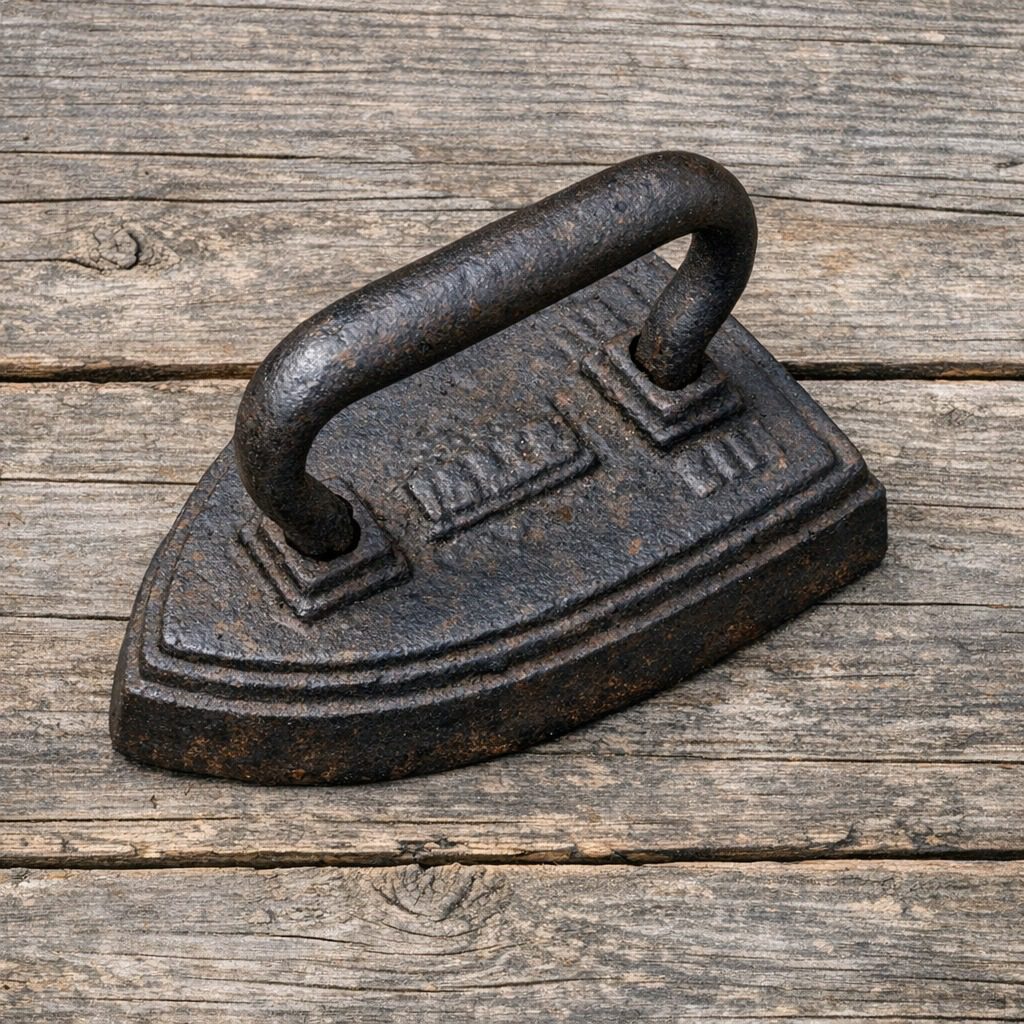
It was a sad iron. If you are under fifty you have probably never held one, and you certainly never heated one on a stove and pressed a man’s Sunday shirt with it while your arm ached. A sad iron is a solid wedge of cast iron with a handle, and the word sad does not mean unhappy, it comes from an old word that means solid or heavy, and heavy is the truest thing about it. My grandmother’s was one of the good ones, the kind with a detachable wooden handle that clipped off so you could keep two or three of the iron bases heating on the stove at once and swap the handle from one to the next as they cooled. Hers had come from her own mother, and that woman’s initials, E.M., were scratched into the base underneath, along with a date that was worn too smooth to read.
She kept it long after she had a perfectly good electric iron in the closet. She kept it on the little cast stand by the back door, and every so often, when the power went out in an ice storm or when she just felt like it, she would set it on the wood stove to heat and press pillowcases with it, and the whole kitchen would smell like hot metal and starch and clean cotton. She said an electric iron was faster but a sad iron made you pay attention. You could not walk away and answer the phone. You could not let your mind wander. The iron would tell you, with a shirt, exactly how present you had been.
I was the one who liked it. Out of all the grandchildren, all seven of us, I was the strange little girl who wanted to learn the heavy iron instead of watching television in the front room. I was maybe seven the first time she let me try, and she stood behind me with her hand over my hand the whole time, and she taught me how to test the heat with a drop of water flicked off my fingertip, how it should dance and hiss and not just sizzle and die, and how to move the iron so it never sat still long enough to scorch. I burned my knuckle that first day on the edge of the base and she pressed a slice of raw potato to it, an old trick, and told me that everything worth doing would mark you a little, and that the mark was not the same as the mistake.
For the next thirty years, whenever I was in that kitchen, the iron was our thing. Nobody else in the family ever touched it. To them it was an old chunk of metal by the door that Nana would not throw out. To me it was the first thing she ever trusted me with.
The family
My grandmother, Nora Hale, raised four children on that farm and outlived her husband by nineteen years. By the time she died she had four children, seven grandchildren, and about a hundred and sixty acres of some of the best bottomland in the county, a farmhouse her husband had built with his brothers in nineteen fifty-one, a savings account nobody knew the size of, and a reputation for saying less than she knew.
Her oldest, my aunt Carol, had spent the last decade of Nora’s life positioning herself. I do not say that with heat anymore, but I say it because it is true. Carol was the one who moved back to the county, who took Nora to her appointments, who started sitting in on the conversations with the lawyer, who by the end had her own key and her own opinions about who among us was grateful and who was not. She had decided years before that she had earned the estate, and she had spent those years quietly making sure the rest of us understood it too. My father, the youngest, had died when I was nineteen, so my branch of the family, which was just me, did not have a vote at the grown-ups’ table. I was the daughter of the dead son. In the arithmetic Carol did on that legal pad, I rounded down to zero.
The others were not cruel so much as comfortable. My uncle Ray wanted the equipment and the truck. My aunt Linda wanted the house itself, the actual building, because she had always loved it and had already, I found out later, been picking out paint. Carol wanted the land and the accounts, the real money, and she had the paperwork to make her case. And the grandchildren circled the smaller things, the china, the quilts, the good furniture, Nora’s ring.
Nobody wanted the iron. Why would they. It was worth maybe forty dollars to a collector on a good day. It sat by the door and it was heavy and it was old and it did not photograph well next to a hundred and sixty acres.
The last winter
I was with her more that last winter than anyone but Carol, and I have thought a great deal since about what she let me see, and what she was showing me on purpose.
I would drive out on Sundays. Carol had the weekdays, the appointments, the pharmacy runs, the lawyer, and she made sure everyone knew she had them. I had the Sundays, which nobody counted because they did not come with paperwork. Nora and I would sit in the kitchen and she would have me press something, anything, a stack of tea towels that did not need pressing, and while I worked the iron she would talk, and I understand now that the talking was the point and the tea towels were just something to keep my hands busy so I would not look at her too closely while she said the things she wanted me to carry.
She asked me once, that winter, out of nowhere, whether I thought a person could love their children and not trust them. I was young enough and dumb enough to think it was a general question, the kind old people ask, and I said I supposed so, and she nodded slowly and said, yes, it is the loneliest thing there is, and then she asked me to test the iron again because it had cooled. I did not understand until much later that she was telling me something specific. She was telling me about Carol. She was telling me about all of them. And she was telling me, I think, that she had made her peace with it, and made her arrangements around it, and that the arrangements were going to run right through the heavy little thing in my hand.
Another Sunday she watched me clip the wooden handle off a cooled base and onto a hot one, the swap she had taught me twenty-five years before, and she said, you are the only one who ever learned that. I said learned what, the handle. She said no. She said, that the valuable part and the part you can hold are not always the same part. You have to put the handle where the heat is. Everybody wants to hold the pretty handle and leave the heavy part on the stove. I laughed, because it sounded like something you cross-stitch on a pillow, and she did not laugh, she just looked at me over the reading glasses, the same glasses Carol would take off her nightstand within a week of the funeral, and she let it sit there in the air between us until I stopped laughing.
I did not know she was dying that fast. Nobody did, or nobody told me. Carol knew more than she said, I found out later, and had already had two more conversations with Mr. Pruitt than the rest of us combined. But Nora knew, in the way the old sometimes do, the way she knew when a shirt was about to scorch a half-second before it did, and she spent those last Sundays doing the only thing she had ever done, which was pay attention, and make sure the thing that mattered ended up where the heat was, in the hands of the one person who had bothered to learn how to hold it.
The day of the list
She had been gone three days when Carol called the family meeting. Not the funeral, the meeting. There is a special kind of person who schedules the division of the estate before the flowers on the casket have wilted, and my aunt Carol was that person, and she framed it as being practical, as sparing everyone a drawn-out fight, and maybe she even believed that.
There was a will. Of course there was a will. Carol had been at the lawyer’s office enough times to make sure of that. And the will, read aloud that afternoon at the kitchen table by a tired man named Mr. Pruitt who had done Nora’s legal work for forty years, did more or less what everyone expected. The land and the primary accounts to Carol, in recognition, the document said, of her care in Nora’s final years. The house to Linda. The equipment and the outbuildings to Ray. Specific bequests of the ring and the china and the furniture to various grandchildren by name.
And then Mr. Pruitt paused, and he looked at me, and he read the line that had my name on it. To my granddaughter Dana, my sad iron and the ironing box that goes with it, and the contents thereof, in the certain knowledge that she alone will understand what to do with them.
Carol actually snorted. In the certain knowledge, she repeated, and she shook her head with a little smile, like Nora had gotten sentimental at the end, and she wrote the iron on my line of her legal pad and made her joke about me playing house, and the room laughed, and Mr. Pruitt did not laugh. I noticed that even then, through the heat in my face. The lawyer did not laugh. He folded his hands on the table and he looked at me for a moment longer than was comfortable, and then he looked away.
I did not say anything. I want to be honest about why. It was not that I was being noble. It was that I was seven years old again with her hand over my hand, and I could hear her voice saying that there is a quiet stronger than any argument, and I did not trust my own voice not to break in front of people who would have enjoyed watching it break. So I said thank you, and I meant it, because she had left me the one thing in that house that was actually ours, and I went and I picked up the iron off its little stand by the door, and I found the wooden ironing box in the pantry where it had lived my whole life, the long low box with the worn brass latch, and I carried both of them out to my car while the family moved on to arguing about the china.
What the box held
I did not open the box for two weeks.
I know how that sounds. But grief does strange things to time, and I could not bring myself to go through the last thing she gave me while the rest of the family was still emailing me about who was owed what. Carol sent three separate messages in those two weeks, each one a little colder, about a set of Nora’s kitchen things she now believed had been promised to her and wondered if I had accidentally taken. I had not taken anything but the iron and the box. But I understood, reading between the lines, that the division had already curdled into suspicion, and that in Carol’s mind everyone was a potential thief, and I decided the kindest thing I could do for my own heart was stay out of it entirely.
It was a Sunday morning when I finally sat down on my kitchen floor with the box in front of me. I did it on the floor because that is where she and I had always folded things, on the floor in a square of sun. I opened the brass latch and lifted the lid, and the smell came up at me, that hot-metal-and-starch smell that lived in the felt lining, and I had to sit with that for a minute before I could see anything at all.
Inside, on top, were the things I expected. The detachable wooden handle. A folded pressing cloth, scorched brown in one corner from some long-ago afternoon. A little tin of beeswax she used to season the iron’s face so it would glide. Two of the older iron bases, the ones without initials, wrapped in flannel. It was exactly what an ironing box should hold, and for a moment I thought that was all it was, that the line in the will had just been her way of making sure the person who loved the thing got the thing, and that was gift enough, and I was ready to let it be that.
But the box was too heavy. Even accounting for the iron bases, it sat wrong in my hands, bottom-heavy in a way that felt off. And I remembered, kneeling there, something she had said to me once when I was maybe twelve and helping her clean the box out. She had run her thumb along the inside bottom and said, offhand, the way she said the most important things, that a good box has a false floor, and that her mother had taught her to keep the things that mattered where thieves would never think to look, because thieves always look up, at the jewelry box on the dresser, and never down, at the ugly heavy thing by the door.
I had forgotten it completely. I had been twelve. But my hands remembered before my head did, and I felt along the felt-lined bottom until I found the little notch, and I lifted the false floor out of the ironing box, and underneath it, flat and yellowed and rubber-banded in careful stacks, was the rest of what my grandmother had actually left me.
The certain knowledge
There was money. I am not going to be coy about that part, because it was real and it changed my life, but it was also, I promise you, the least of it.
There were United States savings bonds, dozens of them, the old paper kind, some of them older than I was, bought a few at a time across decades and left to mature. There were bank certificates. And there was, folded in oilcloth, a deed. Not to the whole farm. But to a forty-acre parcel along the creek, the piece everyone in the family called the bottom eighty even though it was only forty, the best-drained, richest ground on the whole place, the piece Carol had assumed was part of the land coming to her. It was not part of the land coming to her. It had been deeded separately, years before, into a small trust, and the trust, when Mr. Pruitt walked me through it the following week, named exactly one beneficiary.
Me.
The total, when it was all counted, was worth more than the house. It was worth, in fact, more than the house and the equipment together. My grandmother had spent the last fifteen years of her life quietly moving the thing that mattered down, into the ugly heavy box by the door, where thieves would never think to look, because she had known, the way she knew everything, exactly what her children would do the moment she was gone. She had watched Carol position herself for a decade, and she had let her, and she had let the will do the expected thing with the land and the house and the accounts, the loud things, the things people fight over. And underneath all of it she had put the quiet thing where only the one grandchild who ever knelt beside her at that stove would ever find it.
In the box, on top of the deed, there was a letter. It was short. She was not a woman of many words on paper, either. I have it memorized, but I will give you the part that matters.
Dana, it said. If you are reading this you found the floor, which means you remembered, which means I was right about you, which I always was. The rest of them will divide the loud things and think they have won. Let them. I am not leaving you this to make you rich, though it will, and that is fine, money is a tool and you are the only one of them who will not be changed by it. I am leaving you this because you are the only one who ever wanted to learn the heavy way to do a simple thing, and a person like that can be trusted with anything. Take care of the creek ground. Press a shirt now and then and think of me. And do not gloat. Gloating is for people who were not sure they were right. You were always sure. So was I.
What I did
Here is where the story usually gets told wrong, so let me tell it the way it happened.
I did not call a family meeting. I did not stand in the middle of that kitchen and read the letter out loud and watch their faces fall, though I will admit to you that I imagined it, in the dark, more than once, in those first weeks. The pull to do it was enormous. They had laughed at me. Carol had taken my grandmother’s reading glasses off a dead woman’s nightstand and used them to write the iron on my line of a legal pad, and I wanted, God help me, to watch her understand what she had actually done.
But my grandmother had written do not gloat in the last letter she would ever write to anyone, and I was not going to make the last thing I did with her gift the one thing she asked me not to.
So I did it quietly, the way she did everything. I called Mr. Pruitt, and I made him walk me through every page until I understood exactly what I held. And then I called my aunt Carol, and I asked her to come for coffee, just the two of us, and she came, I think, expecting me to finally hand over whatever kitchen things she believed I had stolen.
I put the deed to the creek ground on the table between us. I did not say anything for a moment. I let her read it. I watched her read it twice, the way you do when the words are simple and the meaning refuses to fit. And then she looked up at me, and for the first time in my life my aunt Carol did not have anything positioned or prepared, and I said the only thing I had planned to say.
I said, “She left it to me in the box you told me to take because I like playing house. I am not going to fight you on the rest of it. The land, the house, the accounts, they are yours, they are Ray’s, they are Linda’s, exactly like the will says. I would not undo one line of it. But this piece was never yours, and she wanted me to have it, and I am going to keep it, and I am telling you first, and in person, because that is what she would have done.”
Carol is not a stupid woman. She understood, sitting there, all of it at once. That her mother had known her. That the woman she had spent ten years managing had been managing her right back, gently, from underneath, and had hidden the best ground on the farm in the one object Carol had personally handed to the one grandchild she had personally mocked. She understood that the joke about playing house had been recorded, in some ledger that mattered more than her legal pad, on the wrong side.
She did not apologize. I did not expect her to and I did not need her to. But she got quieter, over the following year, in a way I think was its own kind of apology. She stopped sending the cold emails. At the next family gathering she was almost careful with me, and once, when Brett started to make some crack about the iron, she cut him off, sharp, before he finished it, and changed the subject, and would not meet my eye. I understood that too.
The creek ground
I still have the farm’s best forty acres. I lease the tillable part to a young couple, Sam and Whitney, who are trying to make a start the way my grandparents once did, with more will than money and a baby coming, and I charge them about half what I could, and I put the difference in a savings bond now and then, the old paper kind, out of a stubbornness I inherited and am not ashamed of. The first fall they brought in a real crop, Whitney drove out to my house to pay the lease in person, and she stood on my porch and cried a little and did not entirely know why, and I did, so I did not make her explain it. I gave her a jar of my grandmother’s kind of iced tea and told her to keep the check another month. That is the thing money is actually for, and it is a thing Carol never once understood in seventy years, and I learned it at a stove before I was eight.
I walk that ground in the spring. There is a bend in the creek where my grandmother told me she used to go as a girl, a place where the bank drops soft and the water slows and the light comes through the sycamores in the late afternoon like something poured, and I go there now, and it is mine because she trusted a seven-year-old with a hot iron and never stopped trusting her after. I took Sam and Whitney’s little girl down there this past spring, when she was old enough to toddle, and I held her hand over the water the way a hand was once held over mine, and I thought, this is the part Carol will never be able to buy or sell or write on a legal pad. This is the part that got left to the right person.
The iron itself sits by my back door, on the little three-legged stand, which I also took, though nobody wrote that on any list. Every so often, in an ice storm or when I just feel like it, I set it on the stove to heat, and I test it with a drop of water off my fingertip, and I press a stack of pillowcases until the whole kitchen smells like hot metal and starch and clean cotton, and I pay attention, because that is the whole point of the heavy way, it makes you pay attention.
The family still tells the story of the estate as a story about how much the creek ground turned out to be worth. They cannot help it. To them the lightning bolt was the money, because the money is the thing they can see. But I know what it was really about, and now you do too. It was about a woman who spent fifteen years quietly making sure that the person who loved the ugly heavy thing would be taken care of, and that the people who only loved the shiny things would get exactly, precisely, and only the shiny things.
She left me the iron off the back porch as a joke, they all said. She left me the iron off the back porch because it was the only thing in that house she was certain I would understand. My aunt Carol wrote it on the bottom line of her legal pad and thought she was writing me out.
She was writing me in.