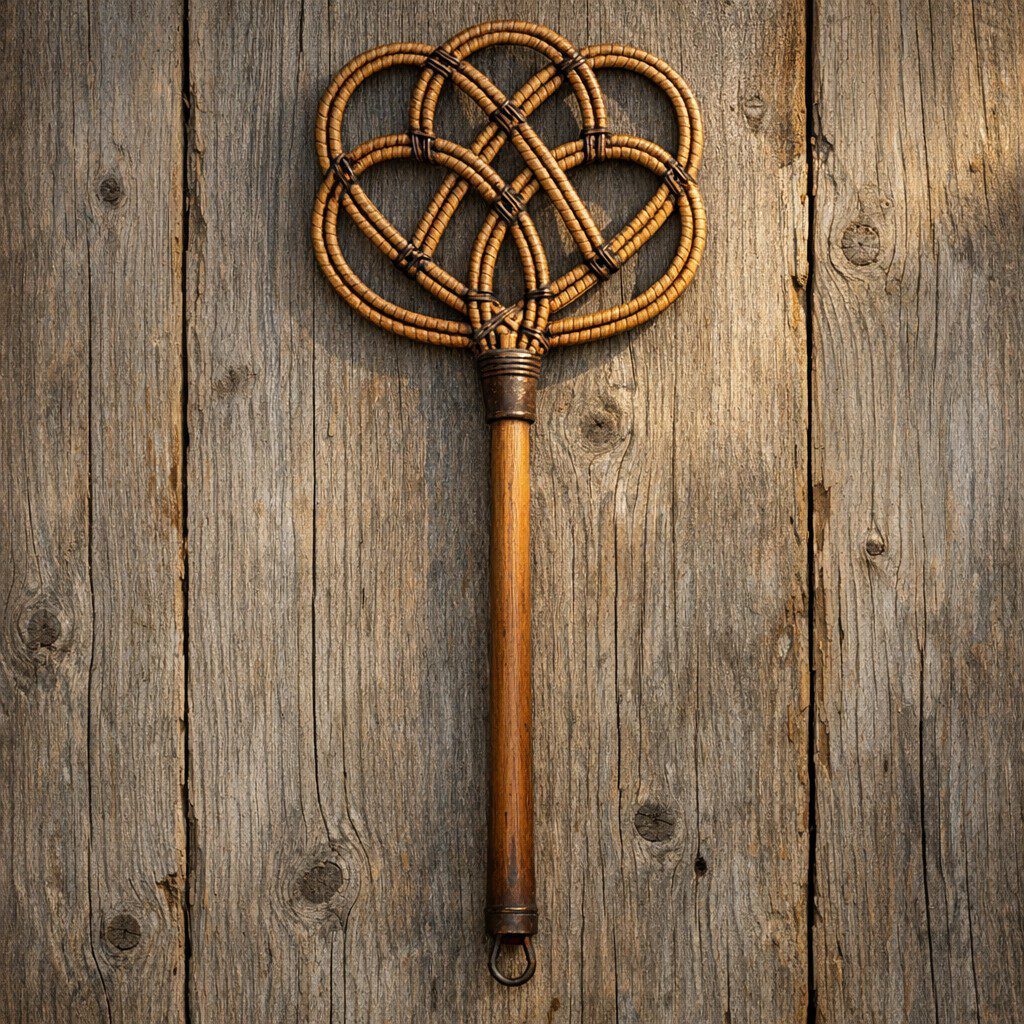
They took the money and the land so I took my grandmother’s old rug beater off the porch
The lawyer’s office smelled like burnt coffee and new carpet, and I remember thinking that was the wrong smell for the end of my grandmother. She should have been read out in a kitchen that smelled like bacon grease and lemon oil, with the radio on low and a rug hanging over two chairs to air. Instead we sat in folding chairs in a strip mall between a nail salon and a place that did taxes, and a man I had met exactly once slid papers across a table and told my family who got what.
I was thirty-eight that spring. I had driven four hours to be there, and I had taken the day off work, which for me is not a small thing. My cousins came in newer cars than mine. My uncle wore a sport coat. My mother, who had not spoken to Grandma much in the last ten years, wore black like she had a right to it. We filled the little room, and the lawyer cleared his throat, and I sat with my hands in my lap and waited for the part where my grandmother reached out from wherever she was and touched me on the shoulder one more time.
That part never came. Not in that room. It came later, on a clothesline, in the first warm week of the next spring, and it came out of a thing they laughed at me for taking. But I am getting ahead of myself. Let me tell it the way it happened, slow, the way she would have wanted, because she never once in her life told a story fast.
The reading
My grandmother’s name was Ruth, and she raised me more than my own mother did. That is not a complaint against my mother, or maybe it is, but it is also just the truth of how it went. My parents split when I was six. My mother worked doubles and dated men who never stayed, and every summer, and most weekends that were not summer, I got dropped at the farm outside a town so small the gas station closed at six. Grandma Ruth would be standing on the porch when the car pulled in, apron on, hand up, like she had been standing there since the last time I left.
The farm was eighty acres of soybeans and a creek and a house that had been white so long ago that it was more the memory of white. There was a barn that leaned a little more each year. There was a garden that fed half the county road if you counted the tomatoes she gave away. And there was the back porch, screened, with a green glider that squeaked, and by the back door, on a bent nail that had been there before I was born, hung a rug beater.
If you are under a certain age you may not know what that is, so let me tell you. A rug beater is a wand, about as long as your arm, with a head at the end woven out of stiff wire or rattan, sometimes shaped like a heart, sometimes like a clover, sometimes just a loose oval of loops. You hang your rug over a line or a fence or the porch rail, and you beat it. That is the whole of the tool. It is for knocking the winter out of a rug that has sat on a floor collecting boot dust and woodstove ash and the general grime of a family living its life. My grandmother’s was wood and wire, the handle worn smooth and dark where a hundred years of hands had held it, and the wire head was shaped like a four-leaf clover gone a little crooked.
But in that lawyer’s office nobody was thinking about a rug beater. They were thinking about the eighty acres, which turned out to be worth a great deal more than any of us had said out loud, because the highway expansion had come within a mile and the land men had been sniffing around. They were thinking about the house, which was old but sat on that land. They were thinking about the account at the bank in town, which had more in it than any of us expected, because Ruth had lived on almost nothing and apparently saved for eighty years.
The lawyer read it out. The land, split three ways, between my uncle Gary, my aunt Carol, and my mother. The house, to my uncle Gary, being the oldest and the one who “could manage the property.” The bank account, split among the three of them and their children, my cousins, in shares I did not fully follow because by then I had figured out the shape of the thing.
My name was not in it. Not the land, not the house, not the account. When the lawyer finished, he set the papers down and looked around the room, and there was a little silence, and then my aunt Carol reached over and patted my knee, the way you pat a dog that is in the way, and she said, “Honey, you understand. You don’t have kids, you don’t have a mortgage out here, you’ve got your little life up in the city. Mom knew you didn’t need much.”
What they thought I did not need
I have turned that sentence over a thousand times since. You don’t need much. As though needing little were the same as deserving little. As though the years I spent on that farm, the summers, the weekends, the last two winters when I drove down every other Friday because Ruth’s hip was bad and my uncle Gary who lived twenty minutes away could not seem to find the time, as though all of that were a hobby I had, a little life I lived, off to the side of the real family.
I want to be careful here, because I have decided in the writing of this that I am not going to lie to you the way I lied to myself for a while. I was hurt. I was so hurt I could not breathe right in that room. But underneath the hurt, and this is the part I am not proud of, there was a small mean voice that said, of course. Of course they did. Because I had always been the quiet one, the one who did not push, the one who let Carol take the good chair and let Gary carve the turkey and let my mother tell the story of my childhood however she wanted it told. I had trained them, over thirty-eight years, to believe I would not fight. And I did not fight.
What I did was ask for one thing.
The lawyer had mentioned, near the end, that any of us could take “personal effects of no significant value” if the others did not object, small things, keepsakes, before the estate company came through to clear the house for sale. My cousins had already started dividing up the good stuff in the parking lot, I found out later, Carol had called the china, my cousin Amanda had called the quilts, Gary was keeping the whole house so he kept whatever was nailed down. I did not want any of it. I raised my hand, actually raised it like a child in school, and I said, “Can I have the rug beater? The one by the back door?”
There was a beat, and then my uncle Gary laughed. Not a mean laugh, exactly, a surprised one, the laugh you laugh when a joke lands that you did not expect. “The what?” he said. And I said it again, the rug beater, the old one on the nail by the back porch door. And Carol smiled the way you smile at something sad, and my cousin Amanda actually said, out loud, “You want the junk? Take the junk,” and a couple of them chuckled, and my mother did not say anything at all, and the lawyer wrote something on his pad, and that was that. I had inherited a rug beater. They had inherited the rest of the world.
Driving home with it on the seat
I went out to the farm that same afternoon, because I did not know when I would be allowed back and I did not trust myself to ever come back if I left without it. The estate company had already put a lockbox on the front door, but the back porch was screened and the screen door had never in living memory been locked, and I let myself in the way I had ten thousand times, and the smell hit me and I had to sit down on the green glider and cry for a while.
You do not know how much a place is made of smell until the person is gone. The porch smelled like sun on old wood and a little like the woodstove and a little like the geraniums she kept in coffee cans and mostly like her, which is a smell I cannot describe except to say that if you had it in a bottle I would have paid the whole eighty acres for it. The rug beater hung on its nail. The wire clover head, the worn dark handle. I lifted it off, and the nail was so used to holding it that it seemed surprised to be empty.
I held it and I remembered. That is the thing about an object like this. It is not much to look at. But my whole childhood was in the weight of it.
Because every spring, the first warm Saturday, the one where the wind finally lost its teeth and the ground firmed up and you could smell the dirt waking, Ruth would announce that it was time. She would strip the rugs off the floors of the whole house, the big braided one from the front room, the runner from the hall, the little hooked ones from in front of the sink and the beds, and she would haul them out and hang them over the two clotheslines that ran between the porch post and the old apple tree. And she would hand me the rug beater, or the second one, the smaller one that got lost somewhere along the years, and she would show me how.
You do not swing wild. She taught me that. You start at the top and you work down, firm even strokes, and you follow the dust. And oh, the dust. The first hit sent up a cloud you could see against the morning light, a whole winter of the family coming out of the wool, and you would cough and laugh and she would say, “That’s the woodstove, that’s your granddad’s boots, that’s Thanksgiving,” like she could read the year in the dust. And your shoulders would burn after the third rug, a good burn, the burn of doing a real thing with your body, and the whole neighborhood would be doing it too, because that was how it went then. You would hear it up and down the county road, that soft steady whump, whump, whump from every yard, everybody beating the winter out at once, and it was the sound of the world deciding to be warm again.
I carried the rug beater out to my car and I laid it on the passenger seat like a person, and I drove the four hours home, and I did not turn on the radio.
The junk, up in the city
I hung it in my apartment on a nail by my own back door, which was not a farmhouse back door but a sliding glass thing that opened onto a concrete balcony over a parking lot. It looked wrong there. It looked like exactly what my family had called it, junk, an old dusty thing hung up by a woman who could not let go. My boyfriend at the time, who did not last, asked me what it was and when I told him he said, “Huh,” in the way that means a man has already stopped listening.
The months went by. The estate settled. I heard, secondhand, mostly through my cousin Amanda who had discovered she could text me now that there was gossip to share, how it all shook out. The land men came through. My uncle Gary did not sell right away, he wanted to hold out for the highway money, and there was some fighting between him and Carol about that, and some fighting between Carol and my mother about the account, and by midsummer the three of them who had split the world were barely speaking to each other. The house sat empty with the lockbox on it. Amanda got her quilts and one of them turned out to have moth holes and she was furious about it, as though a dead woman had wronged her.
I did not say much. I had trained them to expect that. I sent condolences into the family group chat that no one answered and I stopped opening it after a while.
And the rug beater hung by my sliding door, and every so often I would take it down and hold it, and put it back. I did not use it. What would I have beaten? I did not own a rug worth the name. I owned a gray builder’s carpet that came with the apartment and a bath mat from a big box store. But I could not throw the thing out and I could not stop touching it, and I told myself that was enough, that I had gotten what I wanted, the smell and the memory, and the rest of them could have the land.
Then the next spring came. And the first warm Saturday came. And something in my body knew it before my mind did.
The first warm week
I woke up that Saturday and the window was open and the air coming in had that smell, dirt waking up, and my shoulders remembered before I did. I lay in bed and I could have sworn I heard it, that whump whump up and down a county road four hours away, though of course I heard nothing but traffic. And I thought, I am going to beat a rug today if it kills me.
So I went out. There is a secondhand store two blocks from my apartment, the kind with a bell on the door, and I went in and I told the woman I wanted a wool rug, an old one, the older and dirtier the better, and she looked at me funny and then she warmed up and she took me to the back where the rugs were rolled and leaning like logs. I picked one out. It was a braided oval, reds and browns gone soft, the kind of rug that had been in some other grandmother’s front room, and it smelled like an attic, and it cost me twenty dollars, and I carried it home on my shoulder like a body.
I could not hang it on the balcony, there was nowhere, and I was not going to beat a rug in a parking lot for the neighbors to call somebody about. So I did the thing I should have done a year before. I drove out to a park at the edge of the city, one with real trees and a rail fence around a picnic area, and it was early enough that no one was there, and I hung that twenty dollar braided rug over the rail fence in the first good light of the year, and I took my grandmother’s rug beater down off the nail, where I had brought it wrapped in a towel on the seat beside me, and I started at the top and I worked down.
The dust came up. Somebody else’s winter, somebody else’s woodstove and boots and Thanksgiving, up into the morning light, and I coughed and I laughed all by myself at a rail fence in a city park and my shoulders started to burn on the third pass and I was crying again but it was a different kind. It was the kind where the person is with you. I could hear her. Follow the dust, she said. And I did.
And on maybe the twentieth stroke, the good hard even ones, low on the rug, I felt something change in the beater. A little give in the handle that had not been there. A little shift, like something loose inside a thing you thought was solid.
What was in the handle
I stopped. I turned the rug beater over in my hands there at the fence. The handle, I should tell you, was not one solid piece the way you might picture it. It was wood, but the grip end, the part your hand held, was wrapped in leather, old leather, cracked and dark and worn smooth, wound around and around and tacked at the ends with two little brass tacks. I had held that grip my whole life and never once thought about it. It was just how the handle was.
But the beating had worked one of the brass tacks loose, and the leather had shifted, and where it shifted I could see that the wood underneath was not solid either. There was a seam. The grip end of the handle had been hollowed, or had always been hollow, a little chamber maybe two inches deep, and the leather wrap had held a cap of wood over the open end, and the cap had worked loose with the loose tack.
I sat down in the grass. My hands were shaking. I picked at the leather with my thumbnail, the way you pick at a scab you should leave alone, and the second tack gave, and the wrap came away in my hand in one long curl, stiff as a strip of jerky, and the little wooden cap fell into the grass. And inside the hollow of the handle, rolled up tight, brown with age, was a piece of paper.
I want to tell you I unrolled it slowly and read it like a scene in a movie. I did not. I unrolled it fast with clumsy fingers and half tore it and had to lay the pieces together in my lap. It was two things, really, wrapped around each other. One was a paper. One was a small flat brass key.
The paper was in her hand. I knew her hand the way I knew her voice. She wrote the way she talked, slow and plain and a little crooked, and she had written this some years back, because the top of it was dated and she had written my name.
“For my girl,” it said. And then my name. And I sat in the grass in that park and I read what my grandmother had left for me inside the only thing I asked for.
The letter
I am not going to give you every word, because some of it is mine and I am keeping it. But I will give you the shape of it, because the shape is the reckoning, and you have come this far with me.
She wrote that she knew how her family was. She was not a foolish woman and she had watched her own children grow up grabbing, and she had grieved it quietly for years. She wrote that she knew when she was gone they would divide the land and the house and the money and that they would do it fast and they would do it without much thought for me, because I was the quiet one and I did not push, and they had all decided, the way families decide things without saying them, that I did not need much.
She wrote that she had watched me every spring beat the rugs with her. She wrote that of all her children and grandchildren I was the only one who ever came out to the line without being asked. She wrote that she had put this where only I would find it, because the letter would only ever reach the hands of the person who actually used the thing for what it was for, and she knew, she wrote, she knew it would be me, because they would take the money and the land and they would leave the rug beater on the nail, and I would take the rug beater and leave the money and the land, and that was the whole difference between us, and that was why she was leaving it this way.
The key, she wrote, was to a safe deposit box at the bank in town. Not the account they had split. A box. In her name and, she had made sure of it, in mine, added years ago on a quiet trip to the bank that no one knew about, a trip she took the winter my hip drives she called them, when I was coming down every other Friday. She had put my name on that box. It had been mine, legally, the whole time, sitting in the vault of the bank in town while they fought in the parking lot over soybeans.
She did not say in the letter what was in the box. She wrote only, “You will know what to do with it better than they would have. You always did the work. This is the wages.” And she signed it the way she signed everything, Grandma Ruth, with the R that always looked like it was trying to be a P.
The bank in town
I did not sleep that night. I drove down the next morning, four hours with the letter and the key in an envelope in my glovebox and the rug beater back on the seat beside me because I could not stand to leave it home, and I got to the bank in town twenty minutes before it opened and sat in the lot watching the door.
The woman at the bank was named Donna and she had known my grandmother for forty years, and when I said Ruth’s name her face did the thing faces do, soft and sad, and when I showed her the key and my ID and she went and checked the card, she came back with a different face, a careful one, and she said yes, my name was on the box, had been since a date she read off that made my throat close because it was the winter I remembered, and she took me back into the vault herself.
I am going to slow down here, because this is the part I have replayed the most, and I owe it to you to get it right.
The box was long and flat and heavier than I expected. Donna set me up in a little private room with a door that closed and she left me alone, and I sat and looked at the box for a while before I opened it, the way I had sat and looked at the safe deposit box of my grandmother’s heart my whole life before I understood what was in it.
Inside was not gold and it was not stacks of cash, and I am glad it was not, because that would have made this a different and a smaller story. Inside was paper, and paper turned out to be worth more than the land.
There was a deed. Not to the eighty acres, they had those, but to a separate forty, a parcel down along the creek that I had not known was legally its own thing, that Ruth had kept in her own name alone and never told her children about, because it had come to her from her own mother and she had decided long ago it would skip a generation. The deed named a trust, and the trust named me, sole beneficiary, drawn up by a lawyer in the next county over, not the strip mall man, years back. Forty acres along the creek, the pretty part, the part with the water, and as it happened the part the highway men wanted most of all, though I did not learn that for a while yet.
There were savings bonds, a thick brown envelope of them, bought a few every year across decades, some of them older than me, and they had been quietly maturing in the dark all that time.
There was a smaller envelope with cash in it, not a fortune, a few thousand, and a note clipped to it in her hand that said, “For the drive down and to fix whatever the estate people broke.”
And there was a photograph, and the photograph is the thing I took out first and held the longest. It was her and me, on the porch, and I am maybe eight, and we are both holding rug beaters, and there is a rug on the line behind us out of focus, and we are both squinting into the sun and laughing, and on the back, in her hand, it said the year, and it said, “My best help.”
What I did with it
I want to tell you what I did next, because the story of the finding is only half of it. The other half is what a person does when the thing they were denied lands in their lap after all.
I could have driven back to the strip mall and set the deed on the table and watched their faces. I thought about it. I will not pretend I did not think about it, on the four hours home, and for a good while after. There is a version of me that walks into the next family gathering and lets my aunt Carol pat my knee one more time and then says, real quiet, so she has to lean in, that I own the creek, and that the highway men have already called me, and that I did not need much, so I am only keeping all of it.
But that is not what my grandmother left me, and it took me a while to understand that. She did not leave me a weapon. She left me wages. There is a difference and it is the whole difference.
So here is what I actually did. I got a lawyer, a good one, in the county where the trust was drawn, and I made sure the forty acres was clean and clear and mine. When the highway men called, and they did call, I did not sell them the creek. I could have. The number they said out loud made me sit down. But I remembered my grandmother standing in that water in her rolled up pants showing me where the crawdads hid, and I put the creek forty into a conservation easement, which means, in plain words, that it can never be built on, not by me and not by anyone after me, and it stays the way she kept it, forever, with my name on the paper that keeps it that way. The easement paid, too, less than the highway men would have, but enough. Enough and clean.
The savings bonds I cashed as they came due, and I did the thing she would have done, which is that I lived on almost none of it and I saved most of it, and two years later I used a piece of it for the down payment on a small place of my own, an old farmhouse, not hers, but the same bones, an hour outside the city, with a back porch and an apple tree and two clotheslines that were already there when I bought it like the place had been waiting.
And I hung the rug beater on a nail by the back door, on a bent nail I put there myself, at the height my hand knew, and every spring, the first warm Saturday, the one where the wind loses its teeth, I strip the rugs off my floors and I hang them on the line and I beat the winter out of them, firm even strokes, top to bottom, following the dust, and my shoulders burn the good burn, and I swear if you stood at the edge of my yard you would hear it, that whump whump whump, and I like to think somewhere a neighbor hears it and it makes them think of somebody they loved.
The reckoning, such as it was
I did tell them. Not the way the mean small voice wanted. I told them plain.
The land they split fought them the whole way. The highway money got tangled in the fact that the parcel the highway most wanted, the creek forty, was not theirs and now could never be sold to anyone for anything. My uncle Gary called me, the first time he had called me in years, and he was not laughing this time. He wanted to know how I had the creek. And I told him. I told him about the box and the trust and the deed and the letter, and I did not gloat and I did not soften it either. I told him our grandmother had put my name on that box on a Friday in the winter I was driving down every other week to sit with her while her hip healed, and I told him where he had been those Fridays, which was not there, and then I did not say anything else, because I have learned that the quiet after the truth does more work than any words you could put in it.
He hung up. Carol sent a long message about family and fairness that I read once and did not answer. My mother, and this is the only soft thing in the reckoning, my mother called a few weeks later, and she did not fight, and she did not ask for anything, and she said, in a small voice, that she remembered Ruth taking me out to the line every spring and that she had always felt, watching from the kitchen window, like she was on the wrong side of the glass. And I did not know what to do with that, so I said the only true thing I had, which was that the door was never locked, and it never had been, and she could come out to the line any spring she wanted. She has not yet. But the offer stands, and I meant it, and that is the most of my mother and me that I am going to put in a story that belongs to Ruth.
What they laughed at
Here is what I have come to understand, standing at my clothesline in the first warm week, the beater in my hand, the whole neighborhood of my memory beating their rugs up and down a county road that is four hours and a whole life away.
They took the money and the land, and they told themselves I did not need much, and they laughed when I asked for a dusty old thing off a nail. And they were right that it was junk, if you measure a thing by what a stranger would pay for it. You could not have sold that rug beater for five dollars. It was wood and wire and cracked leather and a hundred years of hands.
But my grandmother knew something they did not, which is that a person shows you who they are by what they reach for. Her children reached for the account and the acres. Her grandchildren reached for the china and the quilts. And the one who reached for the tool, the thing that was only good for work, the thing you had to know how to use and be willing to sweat behind, that was the one she had already provided for, quietly, years back, in the dark of a bank vault, on a card with two names on it.
She did not leave me the box because I was owed it. She left me the box because she knew I would take the rug beater whether there was anything in it or not, and there is the whole of it, and there is why I can stand at the line now with a clear heart and no meanness in me. I did not take the beater because I knew. I took it because it was hers, and because it smelled like her, and because my shoulders remembered the spring Saturdays before my mind could even make the words. The wages came after. The work came first. That was always her whole point, about everything.
I still have the letter. I keep it flat in a drawer, not rolled up in the handle anymore, and I have read it so many times I could say it to you with my eyes closed, though I will not, because the rest of it is mine. The key I keep in a dish by the door. The photograph, the one of the two of us on the porch with our beaters, squinting and laughing, “My best help,” I had that one framed, and it hangs by the back door too, next to the nail, so that when I take the beater down every spring I take it down under her eye.
The family sold the eighty acres in the end, all three of them, and split it, and by all accounts it did not make any of them happy, and they do not speak much, and there is a truck stop going in where the barn used to lean. I drove past it once and did not stop.
I have the creek. It runs the way it ran when she stood in it with her pants rolled up. It will run that way after I am gone, with my name on the paper that keeps it running. And I have the rug beater on the nail by my back door, and the first warm Saturday of every spring you will find me at the line, following the dust, and if you did not know the story you would think I was just an odd woman beating an old rug alone in her yard.
But I am not alone. That is the thing they never understood, the ones who took the money and the land. I got the only part of her that was ever going to last. They laughed, and they handed me the junk, and the junk turned out to be the whole inheritance, the letter and the key and the creek and the wages, yes, but more than that, the smell of the porch and the burn in my shoulders and her voice saying follow the dust, and a photograph on the wall of a little girl and her grandmother laughing into the sun with their rug beaters raised, on a spring Saturday that will never, as long as I keep beating rugs, entirely end.