
I invited a lonely coworker to our Fourth of July cookout because I felt sorry for him, and three hours later he was standing in my backyard screaming that my husband had been dead for fifteen years. That is the short version. The long version is the one I have spent the last month learning myself, one piece at a time, from a man I thought I already knew completely after fourteen years of marriage.
My name is Aldona Kestrel. I am thirty nine years old. I have worked the front counter at the Sorrel Gap Feed and Farm Co-op outside Sorrel Gap, Kentucky, for going on eleven years, ringing up fencing wire and chicken feed and garden seed to the same fifty families who have shopped there my whole life. My husband, Fenris, keeps the grounds at Cedar Branch Baptist Church and does odd carpentry and farrier work on the side, and if you had asked me in June to describe him, I would have said quiet, steady, good with his hands, terrible at small talk, the kind of man who would rather fix your porch step than talk about his feelings while he did it. I would not have told you he had a secret so large it required an entire identity to hold it.
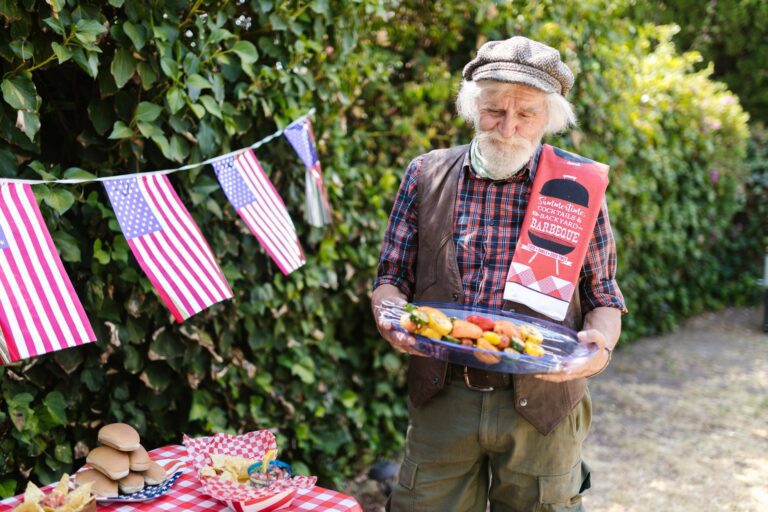
We live two miles outside town on eleven acres that used to belong to my grandfather, down a county road that turns to gravel after the second cattle guard. Every Fourth of July since we bought the place, we have hosted the same cookout. My side of the family. A few of Fenris’s coworkers from the church and the two farms he does work for. Whoever from our little Baptist congregation does not have anywhere better to be. It is not a big production. Folding tables under the maple trees, a smoker Fenris built out of an old propane tank, my sister’s potato salad, sparklers for the kids once it gets dark enough, and the flag my grandfather flew for forty years still hanging off the porch post. It is the one day a year our quiet, closed off little household opens all the way up.
My own people have been in this part of Kentucky for four generations, which is part of why the silence around Fenris’s side always stood out so plainly against the noise of mine. My father drove a school bus for thirty one years and still shows up to help every neighbor’s calving season. My mother ran the nursery at Cedar Branch until her knees gave out. Between the two of them I have more cousins than I can name off the top of my head, a standing invitation to Sunday dinner at three different houses, and a VFW hall two streets off Main where half the men my father’s age still meet on Friday nights to swap the same twenty stories they have been telling since Vietnam. I married into that world assuming Fenris would eventually be folded into it the same easy way, the way everybody around here eventually gets folded in if they stay long enough and show up to enough potlucks. He came to every one of those potlucks. He carried casserole dishes and fixed church gutters and shook every hand in that VFW hall at least once. He simply never once mentioned having a mother of his own to bring to any of it, and after a while I stopped noticing the absence the way you stop noticing a scar on someone you love, because it has just always been part of the shape of them.
Fenris never talked about his family. Not his mother, not his father, not one cousin or aunt or childhood friend. In fourteen years of marriage I had learned to read the exact shape of the silence he put around the subject, the particular way his jaw would set if I asked, and I had learned, the way you learn the boundaries of any land you love, exactly where not to walk. Early on I pushed a little. He would say his father was a hard man who drank and that there was nothing worth telling, and something in his voice told me the true weight of it lived somewhere past the edge of what he was willing to say out loud. So I let it be. I told myself some men build their whole adult lives as a wall against where they came from, and that loving him meant not asking him to tear the wall down for my curiosity. I did not know I was married to a man the state of Tennessee had, at some point, quietly stopped counting among the living.
Nine days before the Fourth, the co-op hired a new man to work the loading dock and help with deliveries, and that is how I met Aurelius.
He came in with the kind of resume that told you he had moved around a lot for work, three years here, two years there, always utility or line crew jobs, always somewhere new. He was polite in the overly careful way of someone who has learned not to expect much from strangers right away, and it took him about four days to loosen up enough to make a joke at the counter that actually made me laugh. He had just relocated to Sorrel Gap for a job with the regional electric cooperative, renting a room above the old hardware store on Main until he found something more permanent, and he did not know a single soul in three counties.
Two days before the holiday, we were both eating lunch in the break room, him with a gas station sandwich, me with leftovers from Sunday dinner, and I asked what his plans were for the Fourth.
He shrugged and said he figured he would sit on the balcony above the hardware store and watch whatever fireworks the town put up over the ball field, alone, same as most nights since he got here.
I know what it is to be new somewhere. My mother moved us to Sorrel Gap when I was eleven and it took years before this town stopped feeling borrowed. So I did what I think most people around here would have done. I told him we host a big cookout every year, more food than any dozen families could eat, and that he was welcome to come sit under our maple trees instead of a hardware store balcony by himself.
He looked almost embarrassed by how grateful he was. He thanked me three separate times before lunch was over, and again the next morning at the counter, like he could not quite believe a stranger had handed him a holiday.
The Fourth came in hot and clear, the kind of Kentucky summer day where the cicadas start up before nine in the morning. By noon our yard was full. My sister and her husband had the folding tables set with red checked cloths. Fenris had the smoker going since sunup, working it the way he does everything, without a wasted motion, sleeves rolled, not saying much but somehow making sure every person’s plate got filled before his own. Our son, fifteen and already taller than me, ran the cornhole tournament with his cousins. Somebody’s radio was playing an old country station low enough to talk over. My grandfather’s flag hung still in the heat until a breeze came through and lifted it every so often, and for those few seconds it looked like it was waving on purpose. Two of the VFW men my father runs with had already claimed the shade under the maples with paper plates balanced on their knees, arguing good naturedly about whose smoker technique was superior, and the church ladies had set up a second table of nothing but pies and deviled eggs, the unofficial rule of every Cedar Branch gathering being that there is no such thing as too much food on a holiday. It was, in every way that mattered, an ordinary good day in a small town that knows how to throw one.
Aurelius arrived a little after two, later than most everyone else, holding a bag of store bought chips like a boy bringing a present to a party he was not sure he had really been invited to. I met him at the gate myself, introduced him around to my sister and a couple of the church families, put a cold sweet tea in his hand, and told him to make himself at home, because in this yard, on this day, that was true for anybody who showed up hungry and decent.
Get a new story in your inbox every morning.
Facebook doesn’t show you every story we post. Our free newsletter does. Join 2,500+ readers.
He was still standing near the gate, chatting with my nephew about the electric co-op job, when Fenris came around the side of the smoker carrying a tray of ribs toward the serving table.
I did not see Fenris’s face in that first second. I saw Aurelius’s.
His whole body went still the way a deer goes still, that fraction of a second before it either bolts or freezes for good. The color left his face so fast I actually took a step toward him, thinking he might be having some kind of spell in the heat. His sweet tea slipped straight out of his hand and shattered on the flagstone path, and the crack of that glass cut through every conversation in the yard at once. Kids stopped mid throw. My sister turned around with a spoon still in her hand. Even the radio seemed too loud in the sudden quiet.
Aurelius did not look at the broken glass. He did not look at me. He was staring past me at my husband with an expression I had never once seen on a grown man’s face, something between disbelief and grief and pure animal shock, all three at the same time.
Fenris had stopped walking. The tray of ribs sat forgotten in his hands. He was staring back at Aurelius with a look I could not place either, because I had truly never seen it on him before in fourteen years, not once, and I have seen that man’s face across a hospital bed and a graveside and the worst nights of both our lives. He looked like a man watching a door he had bricked shut a long time ago come open on its own.
Nobody moved for what felt like a full minute but was probably four seconds.
Then Aurelius took one step backward, raised a shaking hand, and pointed it straight at my husband.
“You’re supposed to be dead,” he said, and his voice cracked on the last word like it did not have enough air behind it to finish the sentence properly. “I was at your memorial. I stood in that church and watched your mama cry over an empty casket. You drowned in the Coldwater fifteen years ago. Everybody in Cutter’s Bend knows you drowned.”
I want to tell you I laughed it off, that I assumed the poor man had heat stroke or had mistaken my husband for someone else entirely, some cousin, some near stranger who happened to share his build. For half a second I almost did think that. Then I looked at Fenris’s face again, and I understood, the way you understand a diagnosis before the doctor finishes the sentence, that there was no mistake happening in my backyard. There was only a truth arriving fifteen years late, in front of my entire family, on a folding chair afternoon that had started with sweet tea and cornhole.
Fenris set the tray of ribs down on the nearest table with a hand that was not quite steady. He did not deny it. He did not ask Aurelius what he meant. He looked at him for a long moment, and then he said, quiet enough that most of the yard did not catch it, “Not here, Aurelius. Please. Not in front of everybody.”
He knew his name. That detail landed on me harder than the scream had. My husband knew this stranger’s first name before I ever introduced them.
The two of them walked off toward the barn, and the party did the thing parties do when something has gone wrong that nobody understands yet, which is to keep half performing normal while everyone’s eyes track the two men crossing the yard. My sister came and stood next to me without a word, the way she has done since we were girls whenever the floor tilts under me. Someone turned the radio up a notch. Someone else herded the kids back toward the cornhole boards. I stood there holding a paper plate of food I no longer wanted, watching my husband’s back disappear around the corner of the barn with a man I had met nine days earlier, and I understood that whatever conversation was about to happen in there was going to rearrange every year I thought I had already lived.
They were gone almost twenty minutes. When they came back, Aurelius looked wrung out, apologetic, his eyes red rimmed. He found me by the drink cooler and said he was sorry, truly sorry, that he never should have made a scene, that it was not his place, and that he hoped I would forgive him for ruining our holiday. I told him it was all right, though at that moment I had no idea if that was even close to true. He left not long after, quiet and shaken, and the party limped along for another hour before people started finding reasons to head home early, the way Kentucky cookouts do when the weather of the afternoon has changed even though the sky stayed clear the whole time.
Fenris did not say one word about it until our son was asleep and the last car had pulled off our gravel drive.
We sat on the back steps in the dark, the citronella candle guttering between us, and I asked him straight out who Aurelius was and what he meant by fifteen years and drowned.
Fenris was quiet long enough that I thought he might not answer at all. Then he told me, in a voice I had never heard him use, flat and careful, like a man walking across ice he was not sure would hold.
He grew up in a town called Cutter’s Bend, Tennessee, on a dirt road that ran along the Coldwater River, in a house with a father who drank hard and hit harder, and a mother who loved him with everything she had and could not protect him with any of it. He told me things that night I will not repeat in full, because some of it is not mine to hand out, but I will tell you this much. By the time he was eighteen, he had learned to read that man’s mood from the sound of the truck in the driveway, and he had learned that the safest place in that house was wherever his father was not.
The summer he turned eighteen, the Coldwater flooded. It had happened before, but never like that year. Days of hard rain upriver sent a wall of brown water through the low part of Cutter’s Bend overnight, and half the town spent that week in church basements and relatives’ living rooms watching the water take porches and pickup trucks and, in three cases, people. Fenris was down along the bank helping a neighbor’s family get livestock to higher ground when the water rose faster than anyone expected and took him with it.
He does not remember most of what happened in the river itself. He remembers cold, and the particular kind of exhaustion that stops being pain and starts being something closer to peace, and then he remembers lying in the mud almost four miles downstream, alive, alone, with no idea for a long while whether he had actually survived or not.
Search crews worked that stretch of river for eleven days. They found his boot caught in a fence line and, later, enough to call off the search and let his mother bury an empty casket at Cutter’s Bend First Baptist, in a service Aurelius, who was fourteen at the time and had grown up on the next farm over, apparently never forgot standing through.
What nobody in Cutter’s Bend knew was that the boy they buried a story for was sitting in a diner in the next county over that same week, alive, unhurt beyond some bad bruising, staring at a paper cup of coffee and understanding, for the first time in his life, that he had been handed something he had never once let himself imagine. A door. An accident had done what he had never had the courage to do himself. Everyone he knew already believed he was gone. Nobody was looking for a boy who did not want to be found, because as far as Cutter’s Bend was concerned, there was no boy left to look for.
He told me he sat in that diner for three hours turning it over, and that the ugliest, truest thing he came to that day was this: if he walked back into Cutter’s Bend, he was walking back to that house, to that man, to years more of learning how to disappear inside his own skin while his body stayed put. If he stayed gone, he got to actually disappear, and build something else in the space where that boy used to be.
So he did not go home. He got work where nobody asked hard questions, first in Georgia, then Ohio, then back down through Tennessee under a different route entirely, never staying anywhere long enough to be known, never giving anyone a last name if he could help it. He landed in Sorrel Gap almost seven years after the flood, twenty five years old, hollowed out in a way he said he did not have words for even now, and took a job unloading feed trucks at the co-op because the man who hired him did not ask for references, only a strong back.
That is where he met me, two years later, ringing up his work gloves at the front counter, laughing at something I said before either of us meant to laugh at anything. He told me that night on the back steps that marrying me was the first time in eight years he had let himself want a future instead of just surviving toward the next town. When we filled out our marriage license, he used the name he had been going by for years, the only name he had left after he stopped being willing to answer to his father’s. Kestrel was already my name. When we married, it simply became his too, and nobody in three counties ever thought to ask why a grown man with no family listed at his own wedding did not have a last name to bring to it.
“I have spent fifteen years being a dead man on purpose,” he told me, staring at the candle instead of at me, “because being dead was the only version of freedom I thought I was allowed to have.”
I sat with that a long time before I said anything back.
I will not pretend the next few days were easy. There is a particular kind of grief in learning that the man you have shared a bed with for fourteen years has an entire buried life you never once suspected, a mother you never knew existed, a grave with his name on it in a state two hours south of us. I felt betrayed in a way that took me a while to untangle from the compassion I also felt, because both of those things were true at the same time, and neither one canceled the other out. I had married a man who let his own mother bury him rather than face his father again, and I understood exactly why, and I was still angry that I had not been trusted with it sooner.
What broke the anger loose, more than anything he said, was watching him with our son two nights later, sitting on the porch step describing his mother’s face, her cooking, the sound of her voice, in the halting way of a man remembering a language he had not spoken aloud in fifteen years. Somewhere in that fear of his father, he had also buried a woman who loved him and never got the chance to grieve him properly, because grief needs an ending, and all she had gotten was an empty box lowered into ground that held no part of her son at all.
Aurelius called the co-op two days later asking to speak with me directly, worried sick that word would get back to Cutter’s Bend before Fenris had a chance to control how it landed. It turned out his mother and Fenris’s mother had stayed close for all those years, two women a field apart who had leaned on each other through a flood that took one woman’s son and, everyone believed at the time, nearly took the other’s whole family besides. Aurelius had grown up in and out of that house. He told me Fenris’s mother never remarried, still lived in the same place, and had kept his old bedroom exactly as it was the summer he disappeared, right down to a little tin whistle on the dresser Fenris used to carry in his coat pocket as a boy.
He also told me something that undid me more than anything else that week. Every few months, for as long as he could remember, an envelope with no return address would show up in that mailbox with a modest little money order tucked inside, forty or fifty dollars at a time, postmarked from wherever Fenris happened to be living that year. His mother had never once mentioned who she thought was sending them. She had simply kept every envelope, saved in a shoebox on her closet shelf, the postmarks tracking a slow drift north through three states over fifteen years, like a man circling closer to home without ever quite arriving.
Fenris had never told me about the money orders. When I asked him, he admitted it quietly, said it was the only way he had let himself stay connected to her at all without risking his father finding out he was alive, some thin, guilty thread he had never had the courage to follow all the way back.
We decided together that he needed to be the one to walk back into Cutter’s Bend, before anyone else’s version of the story got there first. His father, it turned out from a call Aurelius made on our behalf, had died of liver failure eight years earlier, which took at least the physical fear off the table, even if it did nothing for the rest of it.
We drove down on a Saturday in the middle of July, our son in the back seat with more questions than any of us had good answers for, two hours of county highway that got narrower and more familiar to Fenris with every mile, though he had not driven it in fifteen years. Aurelius met us at the edge of town and rode the last stretch with us, saying he owed his own mother, and Fenris’s, at least the courage of being there when the door opened.
The house sat exactly where he remembered it, small and white with a porch that sagged a little more than it used to, a garden along the side fence that his mother clearly still kept up herself. She was out front deadheading marigolds when our car pulled into the gravel drive, and I watched her from the passenger seat straighten up, shade her eyes against the afternoon sun, and go completely still in the exact same way Aurelius had gone still in my backyard two weeks earlier, as if stillness ran in that whole valley like a family trait.
Fenris got out of the car first. He did not say anything clever or rehearsed. He just said, “Mama,” the way a boy says it, not a grown man of thirty three, and she made a sound I have never heard another human being make before or since, somewhere between a scream and a prayer, and crossed that gravel drive faster than I would have believed a woman her age could move.
She held onto him for what felt like a very long time. Over her shoulder, Fenris looked at me with an expression I understood completely, because I had been carrying a version of it myself since the Fourth of July. Relief and grief arriving in the same breath, because you cannot get fifteen years back, only the years that come after.
She told us later, sitting at her kitchen table with sweet tea going warm in front of us, that she had never fully believed the river took him. She said a mother knows the shape of her own child’s absence, and that his had always felt wrong to her, more like distance than death, though she had no way to explain that to anyone without sounding like a woman who could not accept an obvious truth. She had kept his room the same because some part of her was always waiting, not for a body to be found, but for a knock at the door. She had kept every one of those unmarked envelopes in a shoebox because somewhere underneath the not knowing, she had already guessed exactly who was sending them, and had decided a long time ago that she would rather hold onto a quiet, unspoken hope than say it out loud and risk being wrong.
At some point that first evening, she disappeared down the hallway and came back carrying the little tin whistle from the dresser in his old room, wrapped in a handkerchief gone soft with age. She set it in his palm without a word and closed his fingers around it herself, the way you hand something back to someone rather than give it to them for the first time. Fenris held it a long moment, turned it over once, and I watched fifteen years pass across his face in about three seconds. He did not say anything either. Some things, I have learned, do not need a sentence attached to them to land exactly where they are supposed to.
She met her grandson that afternoon for the first time in his life. She cried through most of it, and laughed through the rest, and by the time we left that evening she had already made Fenris promise to bring him back before the summer was out, and had pressed a small paper bag of tomatoes from her garden into my hands like that was the most natural thing in the world for a woman to do with a daughter in law she had known for exactly six hours.
We have been back twice since. Fenris walked into Cutter’s Bend First Baptist the second visit, found the small memorial marker the congregation had placed near the flood monument fifteen years ago with his name on it, and stood in front of it for a long while without saying anything. The church has since quietly removed it, replaced with a small plaque instead marking the flood itself and the families it touched, which felt like the right kind of ending for that particular piece of the story.
Aurelius still works the loading dock two days a week alongside my husband whenever their schedules line up, and there is an ease between them now that I think comes from having stood on both sides of that scream in my backyard. He has become something like family himself, which feels fitting, since it was his shock that finally cracked open a door Fenris had spent fifteen years holding shut with everything he had.
Fenris’s mother is coming up for this year’s Fourth of July. She already asked, on the phone last week, whether she should bring her potato salad recipe or defer to my sister’s, and I told her there is more than enough room at our tables for both. My grandfather’s flag will hang off that same porch post, and this year, for the first time since I have lived in that house, every single person standing under those maple trees will actually know the whole truth about who is at that table with them.
I used to think the hardest thing in a marriage was forgiving somebody for what they did. I have learned this summer that sometimes the harder thing is forgiving somebody for what they survived, and for the strange, broken shape survival forced them to live inside for far too long. Fenris did not lie to me because he did not love me. He lied because a boy from Cutter’s Bend, Tennessee, once decided that being dead was safer than being his father’s son, and it took a stranger, a broken drinking glass, and one loud scream on a hot Fourth of July afternoon to finally teach him that being alive, fully and honestly alive, in front of the people who love him, was the freedom he had been circling toward the whole time without ever quite letting himself arrive.
This story is a dramatization. Names, characters, and details are invented, and any resemblance to real people or events is coincidental.