
Nineteen days before Thanksgiving, my phone rang while I was scrubbing a casserole dish that didn’t need scrubbing anymore, just something to keep my hands busy in a kitchen built for two that had shrunk down to one. It was Iolanthe. My sister in law never called just to talk. She called with agendas, the way other people call with weather updates, and I dried my hands on my jeans and picked up expecting to hear something about the church coat drive or a coupon she wanted to pass along.
“Lenore, hon, I need to run something by you before it gets awkward,” she said, and I knew from the word “awkward” that it already was.
The short version, once she got past the throat clearing, was this. Her sister Deidre had married into the Draeger family that past spring, out at the Lutheran church on Route 9, and the Draegers were not a small family. They were twelve people counting the grandbabies, they had just moved to Alder Creek from three counties over, and Iolanthe wanted this Thanksgiving to be the one where everybody saw how well the Byrnes could host. New people, new impressions, and Iolanthe had never in her life let an impression go to waste.
“The table only seats so many,” she said. “We’ve got the Draegers, we’ve got Garland’s side, we’ve got the kids. I did the numbers four different ways and there’s just no room for extra people this year.”
I stood there with a wet dish towel in my hand and I did not say anything, because I already knew what was coming, the way you know a storm is coming from the color the sky goes an hour before the first drop falls.
“It’s just numbers, Lenore,” Iolanthe said, and her voice had that bright, brisk, problem-solved tone she used when she had already decided something and was only calling to inform me of it. “The Draegers are twelve, we’re doing our very best here, and it’s not as though you have anyone to bring anyway. There’s simply no room for extra this year. You understand.”
You understand. As if understanding were the thing being asked of me, and not forgiveness.
I did not cry on the phone. I want that noted, because it would be easy to imagine me falling apart right there over the sink, and that is not what happened. What happened is that I said, “Sure, Iolanthe. I understand,” in a voice so calm it surprised even me, and I hung up, and I stood in my kitchen for a long time looking at a dish that was already clean.
I am fifty-eight years old. Eight months ago my husband of twenty-nine years, Beauregard, moved out of this house with two suitcases and a woman named Rochelle he’d met at a sales conference in Omaha, and since then I have been relearning, slowly and without much grace, how to be one person instead of half of two. I had gotten used to being the extra place setting nobody quite knew what to do with. I had not gotten used to being told so plainly, by family, that there wasn’t room for me at all.
The divorce itself came quietly, the way the worst ones do. There was no screaming match, no thrown dishes, nothing a neighbor could have overheard through an open window. Beauregard sat me down at this same kitchen table on a Tuesday in March, still in his work clothes, and told me he’d “found something he thought he’d lost,” which is a strange, cowardly way for a man to tell his wife of twenty-nine years that he has fallen for a woman fourteen years younger who sells medical equipment out of Omaha. I remember I was more embarrassed than angry, at first, embarrassed that I had not seen it, embarrassed that twenty-nine years of packed lunches and folded laundry and Sunday drives had come down to a man across a table using the word “lost” about a marriage I had thought was simply ordinary and therefore safe. The anger came later, in waves, usually at inconvenient times, once in the cereal aisle at the IGA over a brand of oatmeal he used to like. By the time Iolanthe called about Thanksgiving, I had mostly stopped crying at the cereal aisle. I had not stopped feeling, underneath everything, like a woman whose worth had just been publicly reassessed and found wanting, and Iolanthe’s phone call landed on that exact bruise, whether she meant it to or not.
I want to tell you about my brother’s table before I tell you about the call, because you have to understand what that table was, and what it meant to be cut from it, to understand what happened next.
Our father, Falconer Byrne, built that table with his own two hands in 1979, the year Garland turned ten and I turned seven, out of a stand of white oak that had come down in a windstorm on the back forty of the family farm. He was not a man who talked much about love. He was a man who showed you, in the things he made. He spent that whole winter in the barn with a kerosene heater and a radio tuned low to the farm report, and by spring he had a table eight feet long and six chairs to go with it, one for each of us, my mother, my father, Garland, me, and two empty ones he said were “for whoever needed a place, when the time came.” He sanded every inch of those chairs by hand. He carved a small oak leaf into the crest rail of each one, so small you’d miss it unless you knew to look, and he told us once, only once, that the leaf meant the table would always grow, the way a tree does, one ring at a time, and there would always be room for one more.
That table came to Garland when Dad passed, fourteen years ago now, because Garland had the farmhouse and I had my little place in town, and it never occurred to either of us to argue about it. It was right that the table stay in the family house. What I did not expect, what I don’t think anyone could have warned me about, was how a table built to always have room could end up being the very place I got told there wasn’t any.
For years, I had a seat at the Byrne farmhouse for every holiday there was. Not always at that table itself, mind you. As the family grew, as Garland and Iolanthe had Colby and then two more after him, as spouses and grandbabies stacked up, extra folding chairs got pulled in from the garage and set at the ends, and more often than not I was the one at the folding chair, the one balancing a plate on her knee at the corner by the china hutch. I never minded that. A person can sit at a folding chair and still feel like family, as long as somebody looks at you like you belong there.
What I minded, what I only let myself really feel this year, was the slow arithmetic of being subtracted. Iolanthe had never loved me, not the way you’d hope a sister in law might, but for years she’d tolerated me the way you tolerate a stain on a rug you can’t be bothered to replace. I was Garland’s spinster older sister, and then I was Garland’s sister who was married but strange about it, quiet, never had children, kept to herself. And then, eight months ago, I became Garland’s sister who got left. That last one changed something in the way Iolanthe looked at me, I noticed it even before the phone call. A softness in her voice when she said my name that wasn’t kindness so much as a kind of pity that curdles fast into contempt if you’re not careful with it.
Get a new story in your inbox every morning.
Facebook doesn’t show you every story we post. Our free newsletter does. Join 2,500+ readers.
I had gone to a church potluck in September, the first one since Beauregard left, and I’d overheard Iolanthe at the coffee urn telling Deidre, who hadn’t married in yet but was already circling the family like a scout, “Poor Lenore. It’s a shame, but you know, some women just aren’t built for keeping a man interested for the long haul.” She hadn’t seen me behind the pie table. I had stood there holding a plate of pecan squares I’d made from my mother’s recipe, and I had felt something in my chest go very still and very cold, and I had not said a word. I had put the pecan squares down and gone home and not eaten dinner that night.
So when Iolanthe called nineteen days before Thanksgiving to tell me there was no room, some part of me was not surprised at all. Some part of me had been waiting for the arithmetic to finally land on my name.
I did not tell Garland. That’s the part that still shames me a little, looking back, though I understand now why I did it. I did not want my brother to have to choose between defending me and defending the peace of his own household, because I had watched him make that choice before, quietly, wordlessly, by simply not making it, and I had watched Iolanthe win every single time without ever having to raise her voice. Garland is not a bad man. He is a tired man who married a woman who runs a tight ship, and somewhere along the way he decided that keeping the peace at home mattered more than keeping his sister’s dignity, and I don’t think he’s ever once said that sentence to himself in those words, but I’ve lived it from the other end for a long time.
I did not tell my daughter either, not right away. Paige lives four hours south with her husband and my two grandbabies, and she has her own in laws to contend with this time of year, and I told myself I didn’t want to make my heartbreak her problem. The truth, if I’m honest, is that I was ashamed. There is a particular shame in being the aunt nobody made room for. It doesn’t matter that it isn’t your fault. It sits on you like a stain anyway.
So I made my plans. Quiet ones, small ones, the kind of plans a woman makes when she has decided not to make a scene about her own erasure. I told myself Thanksgiving is just a day, that a turkey breast for one from the IGA on Route 9 would be perfectly fine, that I would watch the parade with a cup of coffee and call it restful instead of lonely. I bought a single Cornish hen instead of a turkey breast, actually, because the woman at the meat counter, Colleen, who has known me since I was in pigtails, looked at me funny when I said “just for one” and I couldn’t stand to say it twice. I planned to drive out to the cemetery in the morning, the way I do most Thanksgivings anyway, to sit with my mother’s stone and tell her about the year, and then I planned to come home to an empty house and a small hen and a television and call the whole thing a kind of peace.
I told exactly one person the truth. My nephew Colby.
I should tell you about Colby, because none of what happened next makes sense without him.
Colby is Garland and Iolanthe’s oldest, twenty-four now, and he has been mine in a way that has nothing to do with paperwork since the summer he was seven years old and got it in his head that he wanted to learn to build things the way his grandfather Falconer had. Garland didn’t have the patience for it, and Iolanthe had no interest in sawdust on her kitchen floor, so it was me who drove him out to the barn on Saturday mornings, me who dug through my father’s old workshop and found the hand planes and the chisels still hanging where Dad had left them, me who stood over that boy for four summers teaching him what my own father had taught me before he passed, how to read the grain of a board, how to cut a joint so tight it didn’t need a single nail, how a thing built with your hands and enough patience will outlast almost everything else you make in this life. I did not know how to do most of it well. I learned it alongside him, out of my father’s old notebook of measurements, and some of the finest afternoons of my adult life were spent in that barn with sawdust in my hair and a boy asking me a hundred questions I only half knew the answers to.
Colby enlisted in the United States Marine Corps two weeks after he turned eighteen, against Iolanthe’s wishes and with my full and loud support, and by the time of this Thanksgiving he had made Sergeant, had done a deployment to Okinawa that kept him away for the better part of two years, and was home on ten days of leave, his first Thanksgiving on American soil since he’d shipped out. The whole town of Alder Creek had thrown him a small welcome at the VFW hall the week before, folding chairs and a sheet cake and old men in Legion caps shaking his hand, and I had sat in the third row and cried without trying to hide it, because that boy in his dress uniform still had the same serious eyes he’d had at seven years old, measuring a board twice before he ever let the saw touch it.
I told Colby the truth about Thanksgiving three days after Iolanthe’s call, not because I meant to, but because he called me the way he always does when he’s home, just to check in, and he asked what my plans were for the holiday, and something in my voice must have cracked a hairline before I could stop it.
“Aunt Lenore.” His voice went flat and careful, the voice he probably uses on duty when something’s gone wrong and he needs the facts before the feelings. “What plans.”
I tried to make it small. I told him it was just numbers, that his mother had a lot of new family to accommodate this year, that it was nobody’s fault, that I was going to have a nice quiet day and he shouldn’t worry about it one bit.
He was quiet for a long moment on the other end of the line. Long enough that I thought the call had dropped.
“Okay,” he finally said. “Thanks for telling me the truth, Aunt Lenore. I’ve got to go.”
I didn’t think much of it at the time. I thought he was upset on my behalf and needed a minute, the way any good nephew would be. I did not know, could not have known, that Colby Byrne had just started building something in his head that he would not stop building until it sat, finished and sanded and stained to match a table older than he was, at the head of his mother’s dining room.
What I found out later, piece by piece, mostly from his younger sister Vashti who cannot keep a secret to save her life, is this. Colby went straight from that phone call to the barn behind the farmhouse, the same barn where I’d taught him as a boy, and he found our father’s old workshop exactly where I’d left it, because nobody else in that family had ever once set foot in it. He found the notebook. He found the can of the specific stain Dad had mixed himself, the one that had gone slightly amber with age and that Colby, God love him, remembered the smell of from the time he was seven. And for the next six days, every single day of the ten he had at home, he got up before the house woke and drove out there in the dark and worked by lantern light on a seventh chair for that eight foot oak table, matched crest rail, matched oak leaf carved so small you’d miss it unless you knew to look, matched joinery cut the way our father had taught us both, twelve years apart, in the same barn.
He told no one. Not his father. Not his mother. He worked around his family’s noise and his welcome home parties and the whole busy blur of a Marine’s first leave in two years, and every spare hour he had, he was out in that cold barn with sawdust in his collar, building me a place at a table I had been told I no longer had room at.
Thanksgiving morning I drove to the cemetery like I always do and sat with my mother’s stone for a while and told her, the way I do every year, what had happened since I’d seen her last. I did not tell her about the phone call. I did not want to say it out loud twice in one lifetime. I drove home, and I put my little hen in the oven, and I told myself it smelled just fine, and I sat down at my kitchen table for one and I did not let myself cry until the doorbell rang at eleven in the morning and it was Colby, standing on my porch in his dress uniform, the khaki and green of his service alphas pressed sharp enough to cut paper, his sergeant’s chevrons dark against his sleeve, holding his cover under one arm the way his grandfather had taught him a Marine holds a cover indoors.
“Aunt Lenore,” he said. “Get your coat. You’re coming with me.”
I told him about the hen in the oven. I told him I was fine, truly fine, that he didn’t need to do this, that his mother had a house full of new family to impress and I wasn’t going to be the thing that ruined his first Thanksgiving home in two years.
“You’re not going to ruin anything,” he said, and there was something in his voice I had never heard from him before, not as a boy, not even in the VFW hall the week before when he’d stood up straight in front of the whole town. It was the voice of a man who had already decided something and was not asking my permission, only informing me, the same way Iolanthe had informed me nineteen days earlier, except this time the decision ran the other direction. “You raised half of who I am in that barn behind Dad’s house. You’re not sitting in this kitchen alone eating a chicken built for a person who ate alone. Get your coat.”
I got my coat.
He didn’t say another word on the ten minute drive out to the farmhouse. I remember watching the fields go by, the stubble corn and the gray November sky, and thinking that whatever was about to happen, I no longer had the strength to stop it, and some small, tired, hopeful part of me didn’t want to.
We pulled up at the farmhouse a little before noon, an hour before the meal, cars already lining the gravel drive, a whole family’s worth of noise spilling out of the windows. Colby didn’t take me in through the front. He drove around back to the barn first, and there, under a canvas drop cloth, was the seventh chair.
I put my hand on it before I understood what I was looking at. The oak leaf on the crest rail. The stain, that particular amber my father had mixed himself and never written down the exact ratio for, close enough that I don’t think anyone but Colby and I would ever know the difference. The joinery, tight enough to hold without a single nail, exactly the way Falconer Byrne had taught two Byrne children to build a thing that lasts.
“You made this,” I said, and it wasn’t a question, and my voice didn’t work right when I said it.
“I had a lot of free time this leave,” Colby said, which was the kind of thing his grandfather would have said, downplaying the size of a thing his hands had just done. “Grab the other end.”
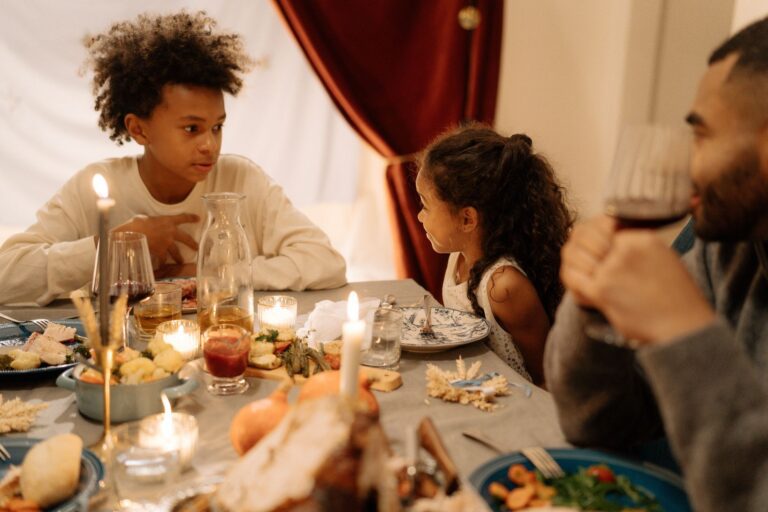
We carried that chair through the back door of the farmhouse together, me and my nephew in his dress uniform, straight through the kitchen where Iolanthe was pulling rolls out of the oven and straight into the dining room where the table was already set, eleven places for the Draegers and Garland’s side and the kids, not one of them mine.
The room went quiet the way a room goes quiet right before a storm breaks. Deidre’s new mother in law, a broad, kind faced woman named Vashti Draeger, stopped mid sentence with a serving spoon still in her hand. Garland came around the corner from the living room with a beer in one hand and froze in the doorway.
Colby set his end of the chair down at the foot of the table, square between two of the Draeger place settings, and started, without asking anyone, to move plates.
“Colby, honey, what on earth,” Iolanthe said, coming out of the kitchen with an oven mitt still on one hand, and I watched her face do the thing it does when she is trying to smile and correct a problem at the same time, a kind of stretched, brittle brightness. “We don’t have room to just rearrange the whole table, sweetheart, everything’s set, the Draegers are our guests, we can’t just.”
“Aunt Lenore has a seat,” Colby said. He did not raise his voice. That was the thing I will remember longest, that he never once raised his voice, not that day and not any day I’ve known him. He said it the way a man reads a fact off a report, level and finished. “That’s not up for debate, Mom.”
“Colby, we talked about numbers, this isn’t the time to.”
“I know exactly what you talked about.” He finished setting the plate, straightened a fork that didn’t need straightening, and looked at his mother across the table he had spent six days building a seventh chair for. “Aunt Lenore drove me to the recruiter’s office when Dad wouldn’t. She taught me everything I know about working with my hands in that barn out there, the same barn Grandpa built this table in. She wrote me every single week of two years in Okinawa when some people in this family managed a card at Christmas. She has a seat at this table for every single Thanksgiving there is for the rest of her life, and mine, and I built the chair myself so nobody could ever tell her again that there wasn’t room.”
Deidre, standing near the window with a toddler on her hip, looked at Iolanthe and then at me and said, quiet enough that I almost missed it, “Iolanthe, you told me she had somewhere else to be.” Iolanthe did not answer that. I noticed she did not answer that.
Nobody said anything for what felt like a very long time. I stood there in my church coat, a woman who twenty minutes earlier had been eating a hen for one in an empty kitchen, and I watched my brother’s family absorb what had just happened in their dining room.
It was Vashti Draeger, the new in law, the very woman Iolanthe had rearranged an entire holiday to impress, who broke the silence. She looked at Iolanthe, then at the extra chair, then at me, standing awkward and coated and unsure in the doorway, and she said, in the plainest, kindest voice, “Well for heaven’s sake, Iolanthe, of course there’s room. We’ll scoot down. That’s what a table’s for.” And she picked up her own place setting without being asked and moved it herself, and one by one the Draegers did the same, shifting down the length of that eight foot oak table my father built forty seven years ago with two extra chairs he said were “for whoever needed a place, when the time came,” until there was a gap at the foot of the table exactly the width of a seventh chair.
Iolanthe stood there with the oven mitt still on her hand and her mouth slightly open, and I watched something move across her face that I had never once seen there before, not shame exactly, something closer to it, a woman realizing in front of twelve strangers that the numbers she’d been so proud of doing four different ways had never once included the one column that mattered.
Garland finally moved. He crossed the room and put his hand on my shoulder, and he didn’t say much, my brother has never been a man of many words, but he said, “Sit down, Lenore,” and there was something cracked in his voice that told me he was sorry, in the only language he had for it.
I sat down. I put my hand flat on that table my father built the year I was seven years old, and I felt the same wood grain under my palm that I’d felt as a girl, and I looked down the length of it at a room full of new people I’d never met and old family who had almost let me disappear, and I did not cry, not yet, because I did not want to make a scene out of a moment that had already made its own point better than tears could.
The meal that followed was, by any measure, a strange one. Careful, at first, the way a room is careful after a storm has just passed through it and everyone is checking to see whether the roof held. But Vashti Draeger had a gift for filling silence with something warm, and she asked me about the pecan squares Iolanthe mentioned I made every year, the ones from my mother’s recipe, and before long I was telling that whole table about my mother’s kitchen, and Colby was telling a story about a chicken that got loose at a fire base in Okinawa, and somewhere in the middle of the noise and the gravy and the second round of rolls, Iolanthe came around the table and refilled my glass without being asked, and when she leaned down she said, low, just for me, “I was wrong, Lenore. I got caught up trying to impress people who were never going to think less of this family for having one more chair at the table. I’m sorry.” It wasn’t a grand apology. It didn’t need to be. It was true, and it was enough, and I told her so.
Later that afternoon, after the pie, after the Draeger grandbabies had run themselves out on the back lawn and the men had drifted onto the porch to talk about the weather the way men do, Garland found me alone in the kitchen drying the good china, the way I always used to when I was young and useful and unnoticed in that house.
“I should have said something nineteen days ago,” he said. “I knew about the call. Iolanthe told me right after she made it, and I let it go because I didn’t want the fight before the holiday. That’s on me, Lenore. Not on you, and not really on her either, not all the way. On me, for letting it be easy.”
“You said something today,” I told him. “Your son said it for you. But I heard it.”
He nodded, and he didn’t try to explain himself any further, and I loved him for that too, because some things don’t need more words put on them, they just need to be true from here forward.
Colby found me on the porch as the sun was going down, still in his uniform, though he’d loosened the collar by then. He sat next to me on the porch swing, the one our father had also built, and for a while neither of us said anything, because we’d learned that from him too, that some of the best things pass between people in silence.
“Grandpa always said the table would grow one ring at a time,” Colby finally said. “I figured somebody ought to make sure that stayed true.”
I told him that in twenty four years of loving that boy, in every version of him, the seven year old with a chisel too big for his hands and the young man in a dress uniform standing in his mother’s dining room refusing to back down, I had never once been prouder of him than I was in that doorway that afternoon.
“You gave me the barn,” he said. “The barn gave me the rest.”
We sat like that a while longer, the porch light not yet on, the noise of the family drifting out through the screen door behind us, dishes clinking, somebody’s laugh rising up over the rest. I thought about my father, who never said much either, who had built two extra chairs into a table for people who did not exist yet, on the theory that love ought to plan ahead of itself. I thought about how strange it was that it had taken his grandson, a boy who barely remembers him, to prove out that theory in front of a room full of strangers and a family that had needed the reminder.
“Your mother apologized to me in the kitchen,” I told him. “I believe she meant it.”
Colby nodded slowly, the way he does when he’s turning something over and deciding how much weight to give it. “Good,” he said. “I wasn’t trying to make her the villain of the story. I was just done letting her make you disappear from it.” That was Colby all over, even then, even at twenty-four. He had no interest in punishing his mother. He only wanted the ledger set right, the way his grandfather would have wanted it set right, quietly, with his hands, without a single raised voice in the whole affair.
Before he left the porch he told me one more thing, almost as an afterthought, pulling his cover back on as the temperature dropped with the sun. “I’m not going to always be here to carry the chair in, Aunt Lenore,” he said. “Next deployment, or the one after that, I might not make it home for the holiday at all. But the chair doesn’t need me anymore. It’s built. It stays.” I have thought about that sentence more than almost anything else he said that day. He was twenty-four years old and he already understood something it had taken me half a lifetime to learn, that the point of building a thing right is that eventually it can stand on its own, without the person who built it having to keep holding it up.
That chair has sat at the foot of my brother’s table every holiday since. Nobody moves it, nobody folds it up and puts it back in the garage between Thanksgivings the way we used to do with the spare chairs, and nobody, not even Iolanthe, not even in the busiest, most crowded years since, when the Draegers brought more cousins and Deidre had a baby and the table filled clean out to both ends, has ever once suggested there wasn’t room. It has its own name in that family now. It gets mentioned before the seating even starts. “Where’s Aunt Lenore’s chair going this year,” somebody will ask, and the answer is always the same. At the table. Where it belongs. Where a Marine with sawdust still under his fingernails made sure it would always belong, the year his mother forgot, for one bad phone call, what her father in law had spent a whole winter in a cold barn trying to teach an entire family: that a table built right will always find one more ring to grow.
I still keep the pecan squares recipe in my mother’s handwriting on the counter every November. I still drive out to the cemetery Thanksgiving morning and tell her about the year. But I don’t cook a hen for one anymore. I haven’t had to, not once, not since the year my nephew came home on leave and built me a place at a table I was never supposed to lose in the first place.
This story is a dramatization. Names, characters, and details are invented, and any resemblance to real people or events is coincidental.