
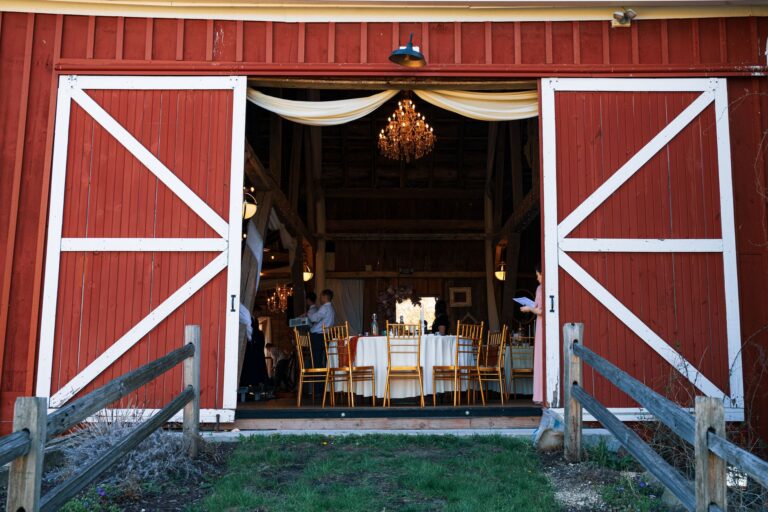
The morning of my son’s wedding, I was up at five feeding my own chickens, same as any other Saturday, because a wedding does not know or care that the hens still expect their scratch grain on time. I remember standing in the yard in my robe and boots with the bucket in my hand, looking at the farmhouse my husband and I built with our own hands the summer we married, and thinking that in twelve hours I would be watching my only son promise himself to a woman I had never fully trusted. I did not know yet that by that night I would be standing in the middle of a rented event hall, raising my voice loud enough to silence a live band, asking a room full of my neighbors to bear witness while I called the Cherokee County Sheriff’s Office on my own daughter-in-law’s family.
My name is Huxley Applewood. I am sixty-three years old. I have spent almost every one of those years on the same forty-one acres outside Chalk Ridge, Oklahoma, a stretch of red dirt and post oak that came down through my grandmother’s people from back when the government still handed out allotments instead of apologies. My husband and I built the house that sits on it. We raised our son, Trevino, in it. I buried my husband out of it four years ago, from a heart that gave out in the barn on an ordinary Tuesday, and I have kept the place running every day since, because that farm is not a possession to me. It is the only inheritance my grandmother had left to give, and I was raised to understand that land like that does not get sold, does not get signed away, and does not get handed to strangers, no matter how politely they ask.
I want to tell you what my son’s new wife tried to do with it, in front of two hundred people, on the happiest day of her own life. And I want to tell you what happened after, because the part everybody hears about, the part that gets repeated at the feed store and the beauty shop until it turns into a rumor with its own life, is only half of it. The other half is the part that actually matters.
Let me back up first, though, because you need to understand what that farm cost before you understand what almost got taken from me on it.
My grandmother was Cherokee, born not far from where I live now, and she spent most of her life watching land that should have stayed in the family slip away a piece at a time, sold off cheap in hard years or lost to men in county offices who knew exactly what a signature on the wrong line could do to a family that could not read the fine print. By the time she died, she had exactly one thing left to leave anybody, and that was forty-one acres along a dry creek that nobody else wanted because the soil ran to red clay and the well was stubborn. She left it to my mother, my mother left it to me, and when I married, my husband looked at that hard, unglamorous piece of ground and said the thing that made me marry him faster than I probably should have. He said, “Well, it’s not going anywhere. Let’s build something on it that isn’t going anywhere either.”
We did. We poured the foundation ourselves, the two of us and his brother and a borrowed cement mixer, the summer I was twenty-four. We framed the house over two years of weekends. We raised cattle on it, then leased most of the pasture out when my husband’s knees gave out and kept a smaller herd close to the house. We built a second, smaller structure near the tree line, a two-room guest cottage my husband’s own father had lived in during his last years, plain but sound, wired and plumbed, the kind of place you put a hired hand or a grown child between jobs or an elderly relative who needs to be close but not underfoot. We never had a name for that cottage other than the guest house. We never expected it would become the center of the worst afternoon of my life.
Trevino grew up on that land the way I did, up before light to help with chores, home covered in dust, knowing the names of every fence line and every neighbor’s dog. He was a good boy. He is, underneath everything I am about to tell you, still a good man, and I want that said plainly before I say anything else, because it would be easy to make him sound like a villain in this story and he is not. He is something harder to forgive, which is a man who let someone else’s wants get so loud in his ear that he stopped being able to hear his own conscience.
He met Ravenscroft three years ago at a co-op equipment auction, of all places, where she had come with her father to bid on a used disc harrow. She was sharp and funny and quick with a number, and I liked her, at first, the way you like anybody your son brings home smiling. Her family ran a hardware store in town, three generations of it, and they lived comfortably enough by Chalk Ridge standards, though nothing like the wealth some folks in this story might picture. Ravenscroft herself lived in a small one-bedroom apartment above the store, the same apartment her mother had lived in before her, small rooms with a hot plate and a window unit and a view of the town square.
I want to be fair to her. In the beginning, she was polite to me, even warm. It was only after the engagement, once the wedding planning started in earnest, that I began to notice the small ways she talked about my farm like it was a problem waiting to be solved rather than a life someone had spent forty years building. She would ask, in that light voice people use when they think they are being casual, whether I had “thought about what happens to all this” once I got older. She would mention, more than once, how big the guest cottage was for “just sitting empty most of the year.” She would look around my kitchen, the one my husband and I had put in ourselves, and say something about how “cozy” it was, in a tone that made cozy sound like a diagnosis.
Trevino brushed it off every time I mentioned it. “That’s just how she talks, Mom,” he would say. “She doesn’t mean anything by it.” I wanted to believe him. A mother wants very badly to believe her son has chosen well, and I told myself I was being an old woman guarding her nest, and I let it go more times than I should have.
There was one evening, the Thanksgiving before the wedding, that I have gone back over in my mind more than any other, looking for the warning I should have taken more seriously. Ravenscroft had come out to the farm with her mother to help me set the table, which I appreciated at the time, and somewhere between the sweet potatoes and the cornbread dressing, her mother asked, in the same light voice her daughter would later use, how many bedrooms the guest cottage had, and whether the well out there was on its own line or shared with the main house. I remember answering the question honestly, the way you answer any question a guest asks you at your own table, because it did not occur to me yet that I was being surveyed rather than visited. Ravenscroft laughed it off when I gave her a look, said her mother was just making conversation, and changed the subject to the centerpiece. I let it go, the way I let go of a dozen small comments that season, because calling out every uneasy feeling a woman gets about her son’s fiancee is a good way to become the mother-in-law nobody wants at Christmas, and I did not want to be that woman. I wanted to be wrong about her. I have thought since that wedding night about how much easier everything would have been if I had trusted that unease instead of talking myself out of it, and I share that here because I know there are other mothers reading this who have felt that same unease and swallowed it the same way I did, hoping it was nothing.
Get a new story in your inbox every morning.
Facebook doesn’t show you every story we post. Our free newsletter does. Join 2,500+ readers.
The bridal shower brought its own small warning too, one I did not understand until much later. Ravenscroft’s younger sister, opening gifts alongside her that afternoon in my church fellowship hall, made an offhand joke to the table about how their parents were “between addresses” and might need to “crash somewhere nice for a while.” The room laughed the way rooms do at a joke that sounds harmless, and I laughed along with it, because nobody at that shower, least of all me, understood yet that the joke was closer to a plan than a punchline. I think about that shower often now. I think about how a family can announce its intentions plainly, in front of witnesses, weeks before it acts on them, and still catch you by surprise, because you were too busy being polite to hear what was actually being said.
What I did not know, in those months of wedding planning, was that Ravenscroft’s parents had a problem of their own. The building that housed their hardware store and the apartment above it had been sold out from under them the winter before the wedding, bought by a developer out of Tulsa who had plans for the whole block that did not include a family hardware store or the apartment on the second floor. They had six months to relocate the business and find somewhere to live. Ravenscroft never mentioned a word of this to me directly. I only found out afterward, in the ugly light of everything that happened, that she and her mother and her younger sister had spent that whole engagement quietly deciding, without ever once asking me, that the answer to their housing problem was sitting empty on my land.
The wedding was held at Millpond Hall, a rented event barn just outside town strung with string lights and long tables covered in checked cloth, the kind of venue every family in Chalk Ridge uses for weddings and quinceañeras and the occasional retirement party, because it is the only room in three counties big enough to hold everybody you are obligated to invite. I wore a navy dress I had bought for the occasion and stood near the family table trying to be gracious, because whatever doubts I carried about Ravenscroft, this was still my son’s day, and I had promised myself I would not let anything I felt show on my face.
The ceremony went fine. The dinner went fine. It was during the toasts, after Trevino’s best man had made everyone laugh and cry in equal measure, that Ravenscroft took the microphone herself, which nobody had planned on and which I should have read as a warning the second she reached for it.
She thanked her parents. She thanked Trevino. And then, still holding her champagne glass, she turned and looked straight at me, in front of every table in that hall, and said something close to this, close enough that I will never forget the shape of it even if I cannot swear to every word: that she wanted everyone to know what a generous, welcoming family she was marrying into, and that as proof of it, she had decided that I, her new mother-in-law, was welcome to move into her old apartment above the hardware store whenever I felt I could no longer keep up a big place like mine. She said it with a smile. She said “welcome” like she was handing me a gift. Three tables near us actually turned to watch, because it was such a strange thing to announce at a wedding, a room offer instead of a toast.
For one long second I heard nothing but my own pulse in my ears, over the band, over the clinking glasses, over the low laughter that follows any toast whether or not the joke landed. I had spent sixty-three years learning exactly one useful thing about moments like that, which is that letting a certain kind of person keep talking does more damage to them than interrupting them ever could.
So I smiled, and I said, calm as I could manage, that I appreciated the thought, but I already lived quite happily on my own place, and had for forty years, and did not plan on trading it for an apartment above a hardware store anytime soon.
A few people at the nearer tables laughed, the kind of laugh that comes from folks who know the Applewood land and know exactly how absurd the offer was. I watched something flicker across Ravenscroft’s face, there and gone, and I thought that was the end of it. I truly did.
It was not.
Trevino, who had been standing just behind his new wife, stepped toward me with a look on his face I had not seen since he was nine years old and had to tell me he’d broken the tail light on the truck. “Mom,” he said, low, like he was hoping only I would hear it, though the hall had gone quieter than a wedding hall has any business being, “I should have told you before now. Ravenscroft’s parents lost the store building. They’ve been looking for somewhere to stay while they get back on their feet, and, well. They’re moving into the guest cottage. This week.”
I stood very still.
“Moving in,” I repeated. “Where, exactly, is ‘in’?”
“The guest house,” he said. “Out at the farm. It’s not permanent. Just until they find something.”
I looked around that hall then, at every table I could see, and it hit me with a kind of cold clarity what was missing. Ravenscroft’s parents were nowhere. Her younger sister was nowhere. I had seen all three of them circling the dessert table not thirty minutes before, and now, during the very toast in which their daughter was publicly offering me somewhere to live, they had vanished.
They were not late to a toast. They were not in the restroom. They were, I understood in that instant, already forty minutes down the county road, at my house, moving boxes into a cottage nobody had asked me about, timing their arrival to my absence at my own son’s wedding.
Ravenscroft lifted her chin at me, the smile gone now, replaced by something flatter and more honest. “My family needed somewhere to land,” she said, loud enough now that she clearly no longer cared who heard it. “You have more room out there than one widow needs. It’s not like you’re using the cottage.”
I looked at my son. I looked for some flicker of the boy who had once cried in my arms over a broken tail light, some sign of shame or hesitation, anything at all that told me he understood what had just happened. Instead he said, in the reasonable voice of a man repeating a talking point he had rehearsed, “It makes sense, Mom. They’re only going to be in the cottage. It’s not like they’re in the house.”
The cottage where my husband’s father had spent his last years. The cottage that still had my husband’s old tools in the shed beside it, that I kept locked out of respect for a life that had ended in it. The cottage that sat on land my grandmother had held onto through hardships neither Trevino nor Ravenscroft would ever have to understand.
I set my champagne glass down on the nearest table, and I did the thing I imagine people at that wedding are still talking about at the feed store.
I raised my voice, not to a shout, but to the kind of clear, carrying pitch a woman learns after decades of calling cattle in from a back pasture, and I said it plainly enough that the band actually stopped playing.
“If there are people on my property right now who have not been given permission to be there,” I said, “then I need someone to call the Cherokee County Sheriff’s Office and report a trespass at my address.”
The hall went dead silent, the particular silence of two hundred people realizing, all at once, that a wedding had just turned into something else. Ravenscroft’s bridal smile cracked down the middle. Trevino grabbed my arm, saying my name like a man trying to talk someone down off a ledge, and I looked at him and pulled my arm free, gently but completely, and told him this had stopped being a family discussion the moment his wife decided to make it a public one.
My cousin, who farms two sections over from me and has my number memorized, already had his phone out. He made the call from the parking lot while I stood in that hall in my navy dress, shaking, not from fear but from the particular fury of being made a fool of at your own son’s wedding by people who had clearly discussed and planned this for weeks. The dispatcher told my cousin a deputy would be dispatched to the address. I thanked him, straightened my dress, and told the stunned room, as calmly as I could, that the wedding should go on, that this was between me and my family and not anyone else’s evening to lose. Some of the guests actually applauded, quiet and awkward, the way people do when they do not know what else to do with their hands.
I did not stay for the cake. I got in my truck still in my good dress and drove the fourteen miles home with my heart going like a jackhammer, and Trevino, to his credit for the first time all evening, left his own reception to follow me.
What we found when we pulled up my gravel drive told me everything the toast had already promised. There was a rented box truck backed up to the guest cottage, its ramp down, and Ravenscroft’s mother and younger sister were carrying a mattress frame through the door while her father directed traffic from the porch like he already lived there. Boxes lined the little front room, dishes and lamps and a rolled-up rug I recognized from photographs of their old apartment. They had a key, I would later learn, because Ravenscroft had taken one from the hook in my kitchen months earlier, during a visit, and had a copy cut without telling me, planning for exactly this day.
The deputy arrived eleven minutes after we did, a young man Trevino would later shake hands with more than once at church, and he walked the property with a flashlight and a clipboard while Ravenscroft’s father tried, first, to explain that this was a “family arrangement,” and then, when that did not work, to explain that his daughter had told them it was fine. The deputy was polite but plain with them. There was no lease, no rental agreement, no written or witnessed permission from the property owner, who was me, and who was standing right there in a navy silk dress with dried tears making tracks through the base of my makeup, telling him clearly that I had never given consent for anyone to move onto my land.
The deputy gave them a choice, load the truck back up tonight or be cited for criminal trespass and have the truck’s contents held pending a hearing. Ravenscroft’s mother started to cry, not from remorse, I think, but from the humiliation of doing in front of a uniformed officer what her daughter had failed to do quietly. Her father argued for a while longer, the way men argue when they know they have already lost but cannot stand to say so, and then, an hour before midnight, on the same day his daughter had married my son, he loaded the mattress frame back onto the truck himself.
Trevino stood in my yard the whole time, silent, watching his new in-laws pack a life they had unpacked only hours before, and I watched something finally break loose in him, some cord that had been pulled too tight for too long between what his wife wanted and what he actually believed.
He did not come inside that night. He drove back to the reception hall, I found out later, to collect Ravenscroft, and the two of them had words in the parking lot that half the remaining guests overheard, about honesty and about respect and about the difference between asking a mother for help and simply taking from her while her back was turned celebrating your own wedding.
The weeks that followed were not simple, and I am not going to pretend they were. Ravenscroft did not apologize to my face for a long time, and when she finally did, it had the careful, coached quality of something her own mother had likely insisted on, more about repairing the family peace than about actually understanding what she had done. But she did apologize, eventually, sitting at my kitchen table with her hands wrapped around a coffee cup she did not drink from, and she told me, in a smaller voice than the one from the wedding hall, that she had grown up watching her own grandmother lose a home to a bank, and that some old fear in her had decided the answer was to grab hold of security wherever she found it, even if it meant taking it from someone who had not offered it. I do not know that I believe every word of that explanation. But I believed enough of it to let her finish the sentence, and that is more grace than I felt like giving her the night the deputy’s flashlight swept across my own front yard.
Trevino and I talked more plainly than we had in years. I told him that I understood a man wants to keep peace in his own marriage, but that peace built on quietly letting his wife take from his mother was not peace, it was cowardice dressed up in a nicer word. He did not argue with me. He said he was ashamed, and I believed that part completely, because shame looks the same on a grown man’s face as it did on the nine-year-old who broke my tail light, and I have never once mistaken it for anything else.
We had that conversation sitting on the porch steps of the very house he grew up in, well past midnight, both of us still in our wedding clothes, him with his tie long gone and his collar open, me with my good shoes kicked off in the grass. I asked him the question that had been sitting in my chest since the toast, which was whether he had known, really known, what his in-laws planned to do that night, or whether he had only found out at the last minute the way he claimed. He was honest with me, more honest than I expected. He said he had known for almost two weeks, that Ravenscroft had told him the plan and asked him to keep it quiet until after the wedding so it would not “cause drama” before the big day, and that he had gone along with it because he did not want a fight with his new wife during the one week everyone kept telling him should be the happiest of his life. I told him that a plan you have to hide from your own mother for two weeks is not a plan, it is a scheme, and the difference matters. He did not argue with that either.
The weeks that followed were quiet in a way that felt less like peace and more like a held breath. Trevino called me most evenings, something he had not done regularly since he moved out of the house, small calls, nothing important, just checking that I had eaten and that the fence line on the north pasture was holding after a bad windstorm. I understood those calls for what they were, a son trying to rebuild trust one ordinary phone call at a time, and I let him do it without making it easy or hard on him either way. Ravenscroft, for her part, kept her distance for almost a month, which I think was its own kind of admission.
When she finally did come out to the farm, it was on a Tuesday afternoon, alone, without Trevino, which told me she had worked up to it herself rather than being sent. She sat at my kitchen table with her hands wrapped around a coffee cup she never drank from, turning it in slow circles the way people do when they are choosing their words carefully, and she told me about her grandmother losing a rental home to a bank one October when Ravenscroft was nine years old, and how the family had lived out of a relative’s basement for four months while her parents scraped together a deposit for somewhere new. She said watching that happen to her grandmother had planted something in her that never fully went away, a conviction that security had to be grabbed with both hands the moment it appeared, asked or not, because asking politely had never once worked for her family before. I told her I was sorry that had happened to her grandmother, and I meant it. I also told her that whatever fear she carried from that October did not give her the right to plant her family on my land behind my back, and that an apology that leads with an explanation is still an apology, but only if it is followed by different behavior, not just better words. She nodded at that, and I have watched, in the months since, for the different behavior, and mostly I have found it. Mostly.
I sat down not long after with a lawyer in Tahlequah, a woman my late husband had trusted with our affairs for twenty years, and I made sure, in plain written language that no toast or apartment key could ever undo, that the farm and everything on it would stay exactly where my grandmother meant for it to stay, in the hands of the family that had actually kept faith with the land. I did it not out of spite, but because a woman who has watched her own grandmother’s inheritance nearly slip away once already does not leave that kind of thing to chance twice.
Ravenscroft’s parents did eventually find a rental in town, a modest two-bedroom above the old feed store, paid for honestly, with a signed lease and a landlord who knew exactly who was living there. I have run into her mother at the grocery store since, and we are civil, the careful kind of civil that two women manage when they both know exactly what happened and have simply decided not to say it out loud in the cereal aisle.
Trevino and Ravenscroft’s marriage survived that night, though it did not come through unmarked, and I do not think it should have. He tells me now, on the Sunday dinners he has started making sure to keep, that the day he watched his in-laws reload that truck was the day he understood the difference between loving his wife and letting his wife’s family run through his mother’s life unopposed. I believe him, because I have watched him prove it in smaller ways ever since, in the calls he makes before he brings anyone onto my land now, in the way he stopped saying “it’s not like they’re in the house” about anything at all.
As for the guest cottage, it still sits empty most of the year, same as it always did, waiting for whoever might actually need it honestly someday, a hired hand between jobs, a grandchild home from college, anyone who asks first. I still lock the shed with my husband’s tools in it. I still feed my chickens at five in the morning, wedding or no wedding, because the land does not care what happened the night before, only whether you show up for it the next day.
I think about my grandmother sometimes, standing on this same red dirt in a harder century than mine, watching land slip away from people who looked like her one piece at a time because nobody thought a widow’s word was worth defending in a courthouse or a church hall. I think about her more than usual since that wedding. And I think, if she could have seen me standing in that rented hall in my navy dress, raising my voice loud enough to stop a band and a bride both, she would have recognized exactly what I was doing. Not causing a scene. Keeping faith with everything she left me, the only way I knew how, in front of everyone.
This story is a dramatization. Names, characters, and details are invented, and any resemblance to real people or events is coincidental.