
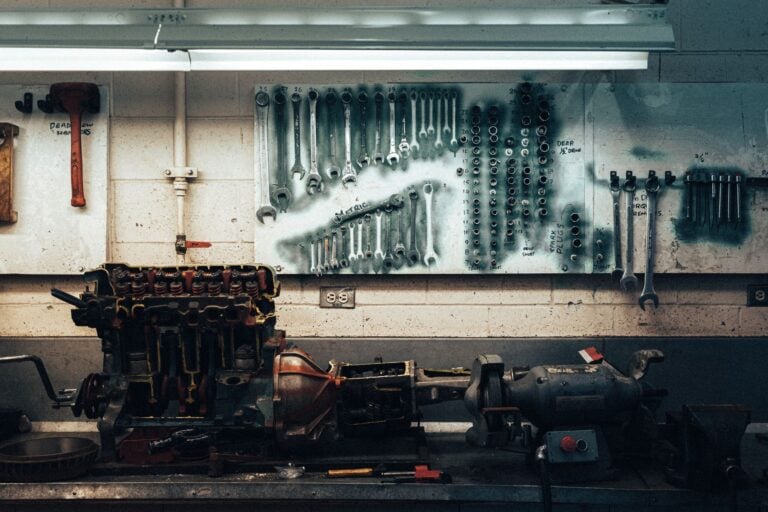
“That toolbox goes with the building, Mr. Garrity, same as the drill press and the parts shelving. You should have filed a personal property claim before the sheriff posted the sale, not after.”
Garland Pruett said it standing in the doorway of my father’s shop with a clipboard under his arm and an orange sticker gun in his hand, and he said it the way a man says something he has said a hundred times to a hundred other people who were about to lose everything. Like it cost him nothing. Like the box sitting on its casters six feet behind me, dented and gray and older than I was, belonged to a bank in Ohio I had never set foot in.
I want to tell you what was welded inside the bottom of that box before I tell you how close I came to losing it, because you need to understand what Garland Pruett almost took from me without ever knowing what it was.
My name is Elwood Garrity. I am sixty six years old. For forty one years I fixed lawnmowers, tillers, chainsaws, and generators in a cinderblock building on Route 9 outside a town most people drive through without slowing down. My father built that shop with his own hands in 1969, the year after he came home from Vietnam with a bad hip and a habit of not talking about it. His name was Silas Garrity, and everything I know about patience, about machines, and about keeping a promise, I learned standing next to him at that workbench.
This is the story of the receivership notice that came in April, the man who tried to walk off with a piece of my father, and the forty years he spent hiding something in plain sight so that on the worst week of my life, it would still be there waiting for me.
*The shop my father built twice*
Understand something about small engine repair. Nobody gets rich doing it. My father used to say the job was ninety percent listening, because a man who brings in a mower that won’t start is really telling you a story about his yard, his back, his father who taught him to mow it, and you had better listen to the whole story before you touch the carburetor.
Silas Garrity rented the cinderblock building from a man named Chester Boone for the first seventeen years he ran the shop. Boone owned half the commercial block on that stretch of Route 9 and he was, by every account I ever heard, a decent enough landlord until the recession years hit him hard in his other holdings. In 1986 Boone came to my father with a proposition. He needed cash fast. He’d sell my father the shop building outright, cheap, if my father could close in thirty days.
My father did not have that kind of money. What he had, instead, was a habit of reading the classifieds in the county legal notices every single week, the small print nobody reads, the tax delinquency auctions and the sheriff sale postings. And that same month, the county was auctioning off a parcel of unclaimed land for back taxes. A narrow strip that ran under and around three buildings on that block, including ours, left over from a boundary dispute nobody had bothered to resolve since the 1930s. Most people didn’t understand what it was. My father did, because he had asked a surveyor friend of his to explain it to him two years earlier, back when the same strip almost got auctioned the first time and nothing came of it.
He couldn’t buy the building. But he could buy the ground.
My father took every cent he had, borrowed the rest from my mother’s brother, and bought that strip of land at the county courthouse steps for four hundred and ten dollars. He never told Chester Boone. He never told the bank. For years he never even told me, not really, not in words I understood at the time.
“Insurance,” he said once, when I was maybe twelve and asked him why he kept a locked steel toolbox bolted to the shop floor that nobody, not even my mother, was allowed to open. “A man builds a thing his whole life, Elwood, somebody’s always going to try and take it from him one way or another. I bought myself some insurance.”
I thought he meant a spare set of keys. I thought he meant cash. I did not understand, and by the time I was old enough to ask better questions, my father had the kind of pride that did not explain itself twice.
*What the years did to the shop, and to us*
My father ran that shop until his hip finally quit on him for good in 2003. I had been working beside him since I was sixteen, and I took it over the way you take over a family business, which is to say without ever really deciding to, one Saturday at a time until decades had gone by. He died in 2011. On his last good week, in the hospital, he grabbed my wrist harder than I thought he had strength for and said, “Don’t ever let that box leave the shop floor, son. Whatever happens. Whatever they tell you it’s worth.” I told him I wouldn’t. I thought he was confused. He was on a lot of medication by then and said plenty of things that didn’t track, and I filed that one away with the rest, grief mixing up his last words with everything else, the way it does.
Get a new story in your inbox every morning.
Facebook doesn’t show you every story we post. Our free newsletter does. Join 2,500+ readers.
The shop did fine for years after that. Not rich. Fine. Enough to keep the lights on, keep two part time guys on the payroll, keep my wife Beatrice and me in the same house we’d lived in for thirty years two miles down the same road.
I want to say a word here about what that shop meant to this stretch of road, because it matters for understanding why I fought as hard as I did later. Route 9 is not a place with a lot left on it. A feed store, a diner that changes owners every few years but never changes the menu, a church with a gravel lot, and my shop. When old Mrs. Petrakis two farms over needed her tiller running before spring planting, she brought it to me, the same way her husband brought it to my father, and his father brought it to my grandfather before that, if you go back far enough. That kind of continuity is worth something in a small town that most of the world has stopped paying attention to. It was never just an engine repair business. It was one of the last threads tying this stretch of road to the way it used to be, and I understood, even before Garland Pruett ever showed up, that if the shop went, it wasn’t just my family that lost something.
Then Bea got sick.
Ovarian cancer, stage three, diagnosed in the fall four years ago. I am not going to walk you through every round of chemo and every insurance denial letter, because if you have lived it, you already know, and if you haven’t, I hope you never do. What I will tell you is that by the second year, we had gone through our savings, we had gone through a home equity line, and I sat down with a loan officer named Priscilla Todd at the bank that had held our business account since my father’s day, and I took out a commercial loan against the shop building itself. Not the land underneath it. The building. I signed papers I understood maybe seventy percent of, because my wife needed a treatment our insurance had just decided not to cover, and there was no version of that day where I was thinking clearly about anything except getting her into that infusion chair.
Bea is alive. She is in remission and doing well, and I would sign every one of those papers again tomorrow morning without reading a word of them. There were nights that second year I sat in a recliner beside her hospital bed at two in the morning, listening to the IV pump click through another bag, doing math in my head that never came out right no matter how many times I ran it. Shop income against chemo copays. Chemo copays against the mortgage on our house. Our house against the loan I hadn’t taken out yet but already knew I would need. A man finds out fast, in a season like that, exactly what he is willing to sign his name to, and I signed for the building without a second thought, because the alternative was watching my wife lose a fight I could have helped her win.
But six months after we signed, the small local bank that held the note got bought out by a regional holding company, and eighteen months after that, our loan got bundled and sold off to an outfit called Ridgeline Capital Partners, an investment group out of a city three hours from us that had never once set foot in my shop and never would, until they needed to send someone to clear it out.
I fell behind. Not wildly behind. Four months, then five, catching up two, falling behind three, the way it goes when you’re running a small shop and carrying medical debt at the same time. I called Ridgeline’s servicing department a dozen times trying to work out a modified payment plan. I got a different person every time and never the same answer twice. And then in April, I got a certified letter instead of a phone call. A receivership had been filed. A receiver would be taking possession of the property and its contents pending a sheriff’s sale in sixty days.
The receiver’s name was Garland Pruett.
*The man with the sticker gun*
Garland Pruett arrived on a Tuesday morning in a gray suit that did not belong anywhere near a small engine repair shop, with two men in matching windbreakers who did not say a single word the entire time they were there. He had a clipboard, a stack of blank orange stickers, and a printed inventory sheet with the receivership order attached, the kind of document with case numbers and legal citations that are designed to make an ordinary man feel like arguing is pointless before he’s said a word.
He walked my shop floor like he owned it already, which in his mind, functionally, he did.
He stickered the drill press. He stickered the parts washer, the compressor, three lawnmowers waiting on repair that weren’t even mine to give him, they belonged to customers. And then he walked to the back corner of the shop, to the rolling steel toolbox my father bolted to the concrete floor in 1986, gray and dented, “S. GARRITY” stenciled on the side in paint that had faded to almost nothing, and he pressed an orange sticker onto the lid like it was nothing more than a shelf.
That’s when I said something. I don’t remember exactly what, only that my voice came out rougher than I meant it to. And that’s when Pruett gave me the line, the one I opened with, the one about the drill press and the parts shelving. He told me the receivership order covered all fixtures and contents of the building as collateral securing the loan, that a toolbox bolted to the floor for four decades met the legal definition of a fixture whether I liked the sound of that or not, and that if I had wanted to exempt personal family items I should have filed a claim with the court before the sale was posted, not after two men in windbreakers were standing in my shop.
Then he told the men in windbreakers to see about getting a locksmith out by Thursday, because the box was padlocked and he intended for it to be inventoried, appraised, and included in the estate lot for the sheriff’s sale.
A customer of mine, a farmer who’d brought in a tiller that same morning and had the bad luck of standing in the doorway for the whole exchange, told me afterward that he almost said something to Pruett himself. He didn’t, because none of us knew yet what that box actually was, only that it felt wrong, the way it feels wrong to watch a stranger pick through a dead man’s coat pockets at a funeral. Pruett must have clocked the reaction, because he softened his voice for exactly one sentence, the practiced kind of soft a man uses when he wants witnesses to remember him as reasonable. “I understand it’s hard, Mr. Garrity. Sentiment doesn’t change what the collateral schedule says.” Then he went back to stickering my compressor like nothing had happened at all.
I watched him work that floor for another twenty minutes, tagging things my father bought with cash he’d saved a dollar at a time, and I did not trust myself to speak again until he and his windbreakers were back in their car.
I want you to understand what that box actually was to me before I tell you what was welded inside it, because those are two different things and I did not fully have either one until that week.
To me, up until that Tuesday, “S. GARRITY” stenciled on a dented gray box was simply my father. It was the box he stood beside every working day of his life. It still smelled faintly of the cutting oil he used on his hands. I had touched that box a thousand times and never once, not one time in fifty years, seen what was inside the bottom drawer, because my father kept it welded shut, and told anyone who asked that it jammed years ago and wasn’t worth the trouble to fix.
*Forty years of a man not talking about it*
I did not sleep that Tuesday night. I sat in my kitchen with a cup of coffee going cold and I thought about my father’s last words to me in that hospital room, don’t ever let that box leave the shop floor, whatever they tell you it’s worth, and for the first time in thirteen years those words did not sound like a dying man’s confusion. They sounded like an instruction.
I called my oldest friend, a man named Nolan Kraft who had worked the parts counter for my father back in the eighties and still lived two towns over, and I asked him if my dad had ever said anything to him about that box. Nolan went quiet on the phone for a long moment and then said something that put a chill straight through me.
“He told me once, must’ve been ninety two, ninety three, that if anything ever happened to this shop, the answer was under his feet the whole time. I thought he meant the floor safe. Man had a floor safe, Elwood, you know that?”
I did know about the floor safe. It held nothing but old receipts and a coffee can of silver dollars. It was never the point. My father had been telling people the truth in riddles for thirty years and none of us, including me, had bothered to take him literally.
Thursday morning, before the locksmith Pruett hired could show up, I went into the shop alone at five a.m. with an angle grinder and forty years of guilt for never asking my father the right question while he was alive to answer it.
The bottom drawer of that toolbox was not jammed. It was welded shut on all four sides, a clean, careful bead of weld my father had clearly done himself, a man who could weld a hairline seam in his sleep after four decades of small engine repair. My hands were shaking too badly the first two times I brought the grinder up to the seam, and I had to set it down on the workbench and just breathe for a minute, because some part of me was still convinced I was about to destroy the last thing my father ever touched with his own hands over nothing, over a hunch built on a dying man’s cryptic sentence and an old friend’s half memory of a conversation from thirty years back.
I thought about Bea asleep at home, not knowing where I’d gone before dawn. I thought about the sheriff’s sale date circled in red on the calendar by the register, eleven days out by then. And I thought about my father’s hand gripping my wrist in that hospital bed harder than I believed a dying man had left in him. That was what finally got the grinder moving again.
It took me twenty careful minutes, sparks flying across the shop floor at five in the morning while I said something between a prayer and an apology out loud to an empty building, before the drawer finally came free. When it did, it didn’t fall open. It sat there, seated tight in its frame the way my father had built everything, needing one more firm pull before it gave, and when it gave, it gave all at once, and I sat down hard on the concrete floor next to it, because my legs would not hold me anymore.
Inside, wrapped in oilskin that had kept out forty years of moisture, damp cloth, and cutting oil fumes, was a manila folder gone soft and brown at the edges, a small bundle of cash that turned out to be four hundred and ten dollars in bills from another era, and a single folded letter in my father’s handwriting.
The folder held the original 1986 deed to a narrow strip of land, purchased at county auction, running under and around three buildings on that block of Route 9, including the building I was standing in. It held the tax certificate from that sale. It held a surveyor’s report from 1984, the one my father’s friend had drawn up two years before he ever bought the parcel, explaining exactly what it was and exactly why nobody else understood its value.
The letter was two pages, dated the week my father closed on that land, addressed simply “For Elwood, whenever you need it.”
In it, my father explained, in his own plain words, what he had never explained to my face. Chester Boone had tried, in 1986, to sell him a building Boone did not fully control, because the land beneath three of those buildings had never been properly resolved after an old county boundary dispute. My father figured out that whoever owned that strip of land held more leverage over that whole block than whoever’s name was on any building deed, because no lender, no buyer, and no sheriff’s sale could ever convey clean title to a building sitting on land somebody else owned outright. He bought the ground instead of the building on purpose, quietly, and told no one, “because the day you need this, Elwood, it’ll only work if nobody saw it coming, including the bank.”
He had welded the deed into the bottom of that toolbox instead of a safe deposit box specifically because banks fail, records rooms flood, and a fireproof box bolted to a concrete floor in a building he owned the ground under was, in his words, “the one place on this earth nobody’s going to think to look, because nobody thinks a repairman’s toolbox is where the important things live.”
My father had been dead thirteen years, and he had just reached out of that grave and handed me the exact thing I needed, on the exact week I needed it, forty years early.
*Taking it to Warren Sipes*
I drove straight from the shop to the office of a lawyer I trusted, a man named Warren Sipes who had handled my father’s estate and knew this town’s courthouse records better than anyone alive. I laid the deed, the tax certificate, and the surveyor’s report on his desk at seven thirty in the morning, still smelling like grinder smoke, and I told him everything.
Warren went quiet the way careful men go quiet when they realize they are holding something bigger than the client in front of them understands.
He explained it to me like this. In 1994, the county courthouse basement flooded during a storm, and a chunk of older land records from the boundary-dispute era got water damaged and were re-indexed by hand over the following two years, badly, by an overworked clerk’s office that merged a lot of ambiguous small parcels into the “assumed” ownership of whatever building sat on top of them, rather than tracking down the actual owner of record. My father’s 1986 purchase of that narrow strip had technically been recorded correctly at the time, but it never got carried forward properly into the digitized records after the flood, because the clerk doing the re-indexing in 1996 saw a building called Garrity’s Small Engine Repair sitting on that ground and simply assumed, incorrectly, that the land was part of the building’s original parcel.
Which meant that for thirty years, every title search anybody ever ran on that building, including the one Ridgeline Capital’s lawyers ran before filing the receivership, showed clean, unified ownership. Building and land, one parcel, easy collateral for a loan.
It was never true. My father owned that ground the entire time, free and clear, and it passed to me, legally, the day he died, whether the county’s computer system knew it or not.
Warren filed an emergency motion the next morning. Not to stop the receivership outright, that would take longer, but to put the sheriff’s sale on hold pending a title correction hearing, on the grounds that the collateral described in Ridgeline’s loan documents, “the building and its improvements,” did not and could never include a separately owned parcel of land the building happened to sit on, and that no sheriff’s sale could convey clear title to a buyer without resolving that first.
*What happened when the bank’s lawyers understood what they were holding*
Ridgeline Capital Partners sent two attorneys and a regional vice president to the title correction hearing three weeks later, and Garland Pruett came too, sitting in the back row in the same gray suit, there, I assumed, to testify to the condition of the property if it came to that. It did not come to that.
Warren laid it out for the judge the way he’d laid it out for me at his desk, slower, with exhibits numbered and tabbed, the 1984 surveyor’s report first, then the 1986 tax deed and its county stamp, then a certified letter from the current county clerk’s office, the one my clerk friend had helped push through fast, confirming the 1994 flood and the botched re-indexing that followed it. He walked the judge through it like a man laying bricks, one flat and certain fact at a time, and I watched the two Ridgeline attorneys lean toward each other and start writing notes to one another on a legal pad instead of listening, which I have since learned is what lawyers do when the case they walked in with has just come apart in front of them.
I will tell you, watching Garland Pruett’s face go a slow shade of white somewhere around the second exhibit, was worth every sleepless night of the previous month.
Here is the plain truth of what my father figured out forty years before anyone else in that courtroom did. A bank can foreclose on a building. A bank cannot foreclose on land it never had a lien against, and it cannot force a sale of a building that would leave a buyer holding a structure with no legal right to the ground it sits on. Ridgeline’s entire receivership was built on a title search that was wrong, through nobody’s malice, just a lazy re-indexing job three decades old, and once that was in front of a judge, their sixty-day sheriff’s sale evaporated. They could still pursue me for the loan balance on the building itself. They could not sell it out from under a business sitting on land I owned outright, not without my consent, and not without paying me a fair settlement for that land first, because any buyer at that sheriff’s sale would have been buying a lawsuit, not a shop.
The math changed for Ridgeline that afternoon. A drawn-out quiet title fight against a documented forty-year-old deed was going to cost them far more than restructuring my loan and letting me keep operating. Within six weeks, their vice president sat down with Warren and me and agreed to a modified loan, reduced principal, a payment schedule that actually fit what the shop takes in, and a signed release of the receivership entirely. Garland Pruett was, according to a clerk friend of mine at the courthouse who enjoyed telling me this more than she probably should have, pulled off the file within the month and reassigned to a different region.
I never saw him again. I understand he still says that toolbox line to somebody else’s shop, somewhere else, right now. I hope, wherever he says it next, the man across from him had a father as careful as mine.
Word travels fast on a road with as few businesses left on it as Route 9. By the time the receivership was formally dismissed, half the town had heard some version of the story, and for about two weeks I could not walk into the diner without somebody buying my coffee before I got to the counter. Mrs. Petrakis brought me a casserole like I’d had a death in the family instead of a legal victory, which, in a way I understood exactly what she meant by it. The church put my name in the bulletin under a category I’m still not sure was appropriate, “answered prayers,” and I did not correct them, because after that month, I was not inclined to argue with anybody about where help comes from.
What mattered more to me than the coffee or the casserole was watching people bring their mowers and their tillers back in that same week, the ones who’d started quietly taking their business to a shop two towns over once word got around that we might be closing. They came back before I’d even fixed the sign out front that still had an orange sticker glue-mark on the window from where Pruett’s crew had tagged it. That told me everything about what that shop still meant to this stretch of road, and it told me my father had been right about more than just a strip of land under a building. He’d been right that some things are worth forty years of quiet insurance to protect.
*The shop today, and what’s welded shut now*
I still run Garrity’s Small Engine Repair. Bea comes by most Fridays with lunch and sits in the folding chair by the parts counter the way she has for thirty years, and business is steady, not rich, the way my father always said it would be. The toolbox sits in the same corner it always has, on the same casters, “S. GARRITY” still faded on the side.
The bottom drawer is empty now. The deed and the tax certificate live in a safe deposit box downtown, recorded properly this time, indexed correctly this time, because Warren made sure of that personally. But I welded that drawer shut again anyway, the same clean bead my father used to run, and I don’t fully know why except that it felt like the right way to close the door on it. Some things you keep sealed not because there’s treasure inside anymore, but because a thing your father built with his own hands deserves to stay exactly the way he left it.
Nolan asked me once, not long after the hearing, if I was angry it took me fifty years to find out what my own father had done for me. I told him no. I told him I think my father knew exactly what he was doing, keeping it quiet for forty years, because the day I needed it, I needed to need it badly enough to grind that weld off myself at five in the morning, alone, with nobody’s help but his last words in a hospital room ringing in my ears. Some inheritances aren’t meant to be handed to you easy. Some are built to be earned back open, one careful pass of the grinder at a time, exactly when a man is desperate enough to finally listen to what his father was trying to tell him all along.
Garland Pruett stood in my shop and told me a toolbox belonging to my father was a fixture of the building, the same as a drill press, something to be inventoried, appraised, and sold off to strangers.
He was wrong about what it was. It was never a fixture. It was the last thing my father ever built for me, forty years before I knew I’d need it, and it is still sitting in the corner of my shop today, exactly where it belongs.
This story is a dramatization. Names, characters, and details are invented, and any resemblance to real people or events is coincidental.