
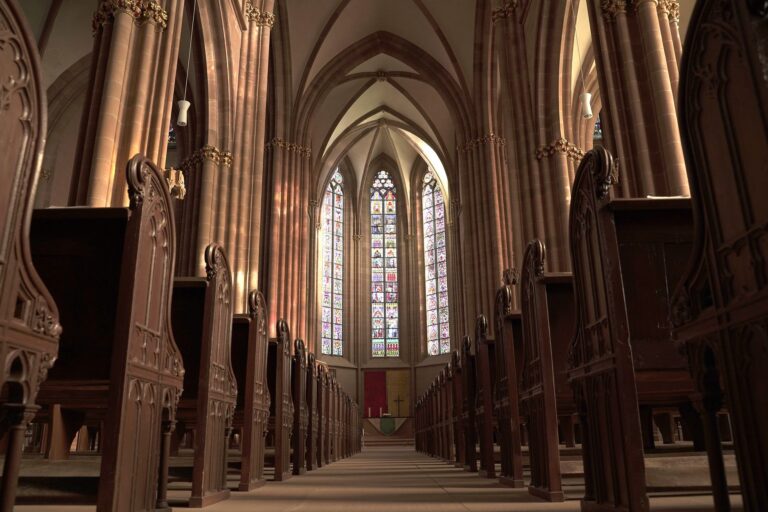
Deidre Fossum looked up at me from the third pew on the left side, the one my family has filled for forty years, spread her coat another six inches down the cushion, and said, “This pew is taken now, Marjorie. You’ll have to be flexible like everyone else.”
She said it kindly. That is the part people don’t believe when I tell it, but it’s true, and it matters. She said it the way you’d tell a child the pool is closed. A little smile. A little tilt of the head. Her daughter’s family was lined up beside her, two grandchildren in matching jumpers, a son-in-law studying the bulletin like it was a contract, and every one of them looked at me and then looked away, the way people do when something embarrassing is happening and they’ve decided it isn’t happening to them.
I was seventy-one years old, standing in the center aisle of the church I was married in, holding my purse with both hands, and I had nowhere to sit.
I want to tell you what I did, and what the church did eight days later, because it is the finest thing I have ever seen a congregation do and nobody raised their voice to do it. But first you have to understand what that pew was. Because Deidre was right about one thing. It’s a bench. It’s oak and a thin red cushion and a rack on the back with hymnals and offering envelopes and those little pencils that never have any point to them. Nobody’s name is on it. Nobody holds a deed to it.
She was right about all of that, and she was wrong about everything.
My name is Marjorie Quandt. I have lived in Cedar Bend my whole life, all seventy-one years, most of them within a mile of the grain elevator. I was baptized Lutheran, if you want the whole truth, but I married a Methodist named Alton Quandt in June of 1976, and his mother made it gently clear that Quandts sat at Bethel United Methodist, third pew from the front, left side, and had since the sanctuary was rebuilt after the hail-and-lightning summer of 1954. Alton’s father helped lay the floor that pew is bolted to. I have seen the photograph: six men in undershirts, sleeves of sawdust, and a boy off to the side holding a thermos too big for him. The boy was Alton. He was nine.
So when I say forty years, I am being modest and only counting my own. I slid into that pew as a bride of twenty-one with a home permanent and dyed-to-match shoes, and Alton’s mother patted my knee once, like a stamp on a document, and that was that. I sat there through four pastors, two boiler failures, one tornado warning where we all filed down to the fellowship hall and Vesta Coyle kept playing the piano the whole way down the stairs, and every Sunday of my married life except childbirth, gallbladder, and the ice storm of 1996.
I could walk to that pew blind. Third from the front because Alton’s mother was hard of hearing and too proud for the front row. Left side because the morning sun comes through the east windows on the right and Alton’s father said no man could be expected to examine his conscience while being broiled. There is a heat vent under the left end that comes on with a clank like a dropped skillet, and in January it is the best seat in the house and everyone knows it. The cushion has a long dip in it, our dip, worn by fifty years of one family’s weight. My daughter Fern put a scratch in the pew back in 1988 with her patent leather shoe during the children’s sermon, a little white comma in the varnish, and I have covered that scratch with my hand every Sunday since, without thinking, the way you touch a scar.
Fern was baptized eleven feet from that pew. So was her son. Alton’s mother was funeralized from it, then his father, and I sat in it with a casserole-brigade schedule in my purse and made it through both services because the wood held me up when I couldn’t.
And then, a year and eight months ago, it was Alton.
I’ll keep this part short because I still can’t do it long. Forty-three years of marriage. He got up one October morning to fix the storm door before the cold came, and he was gone before the ambulance made the county road. Aneurysm. The men from his Tuesday coffee table were his pallbearers. Purnell Ott, who rebuilt the church boiler with Alton in 1989 and argued with him about torque for thirty years after, stood up at the funeral and couldn’t say his piece, just stood there with his jaw working, and finally said, “He was the other half of every job I ever did,” and sat down. That was the best eulogy anybody gave.
After the funeral, people expected me to fall out of the world, and I’ll admit I considered it. The house got so quiet I could hear the refrigerator change its mind. Fern wanted me to move to Wichita, closer to her, and I told her I’d think about it, which we both knew meant no. Because I still had one hour a week where the world made sense, and it was Sunday, ten o’clock, third pew on the left.
Here is what nobody tells you about grief. You don’t feel the person everywhere. You feel them in maybe four places, and you guard those places like a dog. For me it was his side of the bed, his workbench, the passenger seat of the Buick, and that pew. Alton’s hymnal was still in the rack, the one he’d penciled all through, little checkmarks next to the hymns he loved and one exclamation point next to number 557, Blest Be the Tie That Binds, which he sang loud and flat and joyfully wrong for four decades. I would sit in our dip in the cushion with my hip against where his hip should have been, and put my hand over Fern’s scratch, and for one hour I was not a widow. I was a wife whose husband was just elsewhere in the building, ushering, or downstairs checking on that boiler.
That is what Deidre Fossum was asking me to be flexible about.
I should tell you about Deidre fairly, because this is a church story, and in a church story you are not allowed to make a person into a cartoon. The Lord knows her whole ledger and I only know a page of it.
Get a new story in your inbox every morning.
Facebook doesn’t show you every story we post. Our free newsletter does. Join 2,500+ readers.
She came to Bethel in February. Moved from Indianapolis to be near her daughter Tressa, who married a Cedar Bend boy and lives out on the Halsey road. Deidre is maybe fifty-eight, dresses like the president of something, and has the kind of energy that gets things done and knocks things over, both, usually in the same hour. Within a month she was on the hospitality committee. Within two she was running it, and I want to be honest: she ran it well. The coffee got better. The greeters got name tags. The bulletin stopped having those typos we’d all politely read around for years, like “Please join us for fellowship in the hell downstairs.”
But she had a way about her. Everything old was a problem to be solved. She reorganized the fellowship kitchen and labeled every cabinet, which sounds helpful until you understand that Vesta Coyle is eighty-eight and has known where the coffee urn lives since Eisenhower, and now it lives somewhere else under a label she can’t read without her other glasses. Deidre moved the memorial poinsettias off the altar rail in December because they were “cluttering the sight lines,” and every one of those poinsettias had a dead person’s name on a little card, and she stacked the cards on a table by the door like receipts. She said at Bible study, in March, laughing, that she’d never seen a church where everybody had “assigned seats,” and wasn’t it funny, and a few people laughed with her because she meant it to be funny, and I laughed too. I did. I want that written down. I laughed along at the joke, not knowing I was the punch line being loaded into the gun.
Because here’s the thing about our seats. Nobody assigned them. They grew. The Hollisters sit back right because their boy ran the sound board twenty years ago and they liked being near him, and he’s in Omaha now and they still sit there, near where he was. Beulah Rasp sits front left because her husband was the organist and she likes to watch the organist’s hands, any organist’s hands, still. You could read our whole congregation’s history off the seating like rings in a tree. Deidre looked at it and saw a rulebook nobody would show her. I understand that now. I did not understand it in April.
The Sunday it happened was the last one in April. Tressa’s whole family had come, plus another couple Deidre knew from her new subdivision, and Deidre wanted them all together, and she wanted them close to the front, where visitors could see that she was somebody here. I got there at 9:42, same as always, and there they were, seven of them, spread the length of my family’s pew, coats and Bibles staking out the margins.
I stopped at the end of the pew and I suppose I just stood there. I wasn’t going to say anything. I’ve been a Kansas churchwoman for seven decades; I’d have wedged myself onto the end or slipped into row four and died a little and said nothing to anyone forever. But my stopping made Deidre look up, and something in her decided to settle the matter out loud.
“This pew is taken now, Marjorie. You’ll have to be flexible like everyone else.”
Ten seconds, maybe. That’s all it was. But church gets quiet before the prelude, and the words carried, and I felt the whole sanctuary go still behind me the way a field goes still when a hawk crosses it. Nobody said anything. I want to be clear that I don’t blame them, because I have been the person in the pew watching someone else’s ten seconds, and you always think surely this isn’t what it looks like, and by the time you know it was, it’s over.
I said, “Of course.” I heard my own voice say it, bright as a nurse. “Of course, enjoy the service.”
And I walked to the back of the church, past pews of people I have known my entire life, with my face on fire, and I sat in the last row next to the sound board, where the speaker buzzes, in a seat that held no one’s memory, and I looked at the back of a hundred heads, and one of them should have been Alton’s, and the vent clanked on up front, warming the ankles of strangers.
I don’t remember the sermon. I remember the doxology, because I opened my mouth to sing it and nothing came out, and an usher looked over at me kindly and I pretended to cough. When they stood for the last hymn I slipped out the side door by the cradle roll room, the door you use for funerals, and I was in the Buick before the postlude.
I did not go to coffee hour. I went home and I sat at my kitchen table with my coat still on until almost two o’clock, and the worst thought I have ever had about my church came and sat down across from me, and the thought was: maybe it was never your place either. Maybe it was Alton’s place, and his mother’s place, and you have just been sitting in the family’s spot like a coat saving a seat, and now the family is gone, and the church has told you so.
I know that thought was a liar. I knew it then, mostly. But grief opens the door for thoughts like that, and once they’re in the house they put their feet up.
The week that followed, I did something I am not proud of. I decided to quit. Quietly, the way widows quit things, no announcement, just a slow fade. I looked up the livestream on my tablet. I told myself the back row was fine, actually, or the livestream was fine, or the Methodist church over in Halstead was fine, forty minutes away where nobody knew me, and if you have ever heard a lonely person say “it’s fine” three different ways in one afternoon, you know what was happening.
But Cedar Bend is a small town, and a small town is a body: pinch it anywhere and the whole thing knows.
Tuesday, Beulah Rasp appeared on my porch with a chicken and rice casserole, which in our language is not food, it is a telegram, and it says: WE SAW. She didn’t mention the pew. She talked about the weather and her sister’s hip and left the casserole like a flare on a highway.
Wednesday, Fern called, and Fern already knew, which tells you the phone lines had been busy, and Fern was ready to go to war. She wanted to call Pastor Winona. She wanted to write a letter. She used words about Deidre Fossum that I will not repeat and that she did not learn in Sunday school, or maybe she did, we had some colorful Sunday school teachers. I talked her down. I said, “Fern, I will not become the pew lady. I will not be a seventy-one-year-old woman fighting over a bench in the house of the Lord.” And Fern said the thing that broke me a little. She said, “Mama, you’re not fighting over a bench. You’re the only one who’s NOT fighting over the bench. That’s the problem.”
Thursday evening, Purnell Ott came by with his toolbox, claiming Alton had promised to help him look at a pressure valve and that a promise passes to the widow, which is not a rule but sounded like one when Purnell said it. He is not a talking man. He looked at my storm door, the one Alton never got to fix, and he fixed it, twenty minutes, hardly a word. At the truck he stopped, one hand on the door, looking at the middle distance the way he had at the funeral.
“Come Sunday,” he said. “Ten minutes early. Center door.”
“Purnell,” I said, “I don’t want anybody making a fuss.”
“No fuss,” he said, and got in the truck, and then he rolled down the window, which for Purnell is an oration, and he said: “Marjorie. Forty years, that church watched your family hold that pew. One Sunday, you might let the church show you what it was watching FOR.” And he drove off before I could argue, which is the only way anyone has ever won an argument with me.
I didn’t sleep much Saturday night. I ironed a blouse I didn’t wear. I put Alton’s hymnal in my purse and took it back out twice. That was another wound from the week I haven’t told you: when I’d fled out the side door that Sunday, I’d left his hymnal in the rack, of course, where it had always lived, and by Wednesday word reached me through the church grapevine, through Beulah, that the hymnal racks in the front pews had been “tidied out” as part of a hospitality refresh, old donated hymnals and tattered envelopes cleared away. Alton’s hymnal, with forty years of his pencil in it, with the exclamation point next to 557, was gone. Beulah heard it went out with a box for the church rummage sale, or the recycling, nobody was sure. I cried harder over that book than I had cried over the pew. The pew was a place. The book was his hand.
Sunday came up cool and bright, the kind of May morning where the wheat looks like it’s been combed. I sat in the Buick in the church lot at 9:35 with my hands at ten and two, going nowhere, and I watched the lot fill early, earlier than usual, and I nearly drove home. What got me out of the car, honestly, was vanity: Beulah had seen me pull in, and driving off would have been a bigger scandal than the pew.
Purnell was waiting inside the center doors in his usher suit, the navy one, with a fresh haircut that made his ears look surprised. He offered me his arm like it was 1958. I took it because refusing would have meant discussing it.
And we came through the doors into the sanctuary, and I stopped walking.
Every pew was full. Fuller than Easter. The Hollisters, the Rasps, the whole Tuesday coffee table, the Klotz family who mostly come at Christmas, faces I hadn’t seen in months, farmers who smell like they did chores in their church clothes because they did. Full, every row.
Except the third pew on the left. Empty. Not roped off, not marked, not guarded. Just empty, in a packed church, the way a chair stays empty at a table where everyone has agreed on something without a word.
And lying on the cushion, right on our dip, squared up neat like an offering: a hymnal.
Purnell walked me down the center aisle, slow, his arm steady under my hand, and nobody clapped, thank God, nobody made it a show, there was just a kind of settling, a hum, the sound a congregation makes when it approves of itself for once. I got to the third pew and I picked up the hymnal and it was Alton’s. His pencil checkmarks. His exclamation point at 557. The spine had been re-glued and taped inside with careful old-man tape work, and there was a new inscription inside the front cover, block printing I’d know anywhere because I’d watched it label a boiler diagram in 1989: RESCUED FROM THE RUMMAGE BOX. SOME THINGS ARE NOT SURPLUS. P. OTT.
He’d gone through the rummage boxes. Purnell Ott, seventy-four years old, had spent some hour of that week on his knees in the fellowship hall going through boxes of discarded books until he found his friend’s hand in one of them.
I sat down in my family’s dip with Alton’s hymnal on my knees, and I put my hand over Fern’s scratch, and the vent clanked on, and I wept like a faucet, and half the church wept with me, and the organ started the prelude a little early to give us all some cover, which was Beulah’s doing, I found out later, a musician’s mercy.
Now. Here is where I have to slow down and tell it carefully, because this is the part that makes it a church story and not a revenge story, and if I tell it wrong you’ll cheer at the wrong spot.
Deidre Fossum was there. Second pew, right side, across the aisle, with Tressa and the grandchildren. And no one had shunned her, and no one had spoken to her coldly at the door, and her name tag project was still in the narthex, and she had been handed a bulletin with the same smile as anybody. The congregation had not punished her. They had simply, silently, unanimously, made the truth visible: they filled every seat in the church and left one open, so that anyone with eyes could see what kind of empty that was. It was not an empty that said KEEP OUT. It was an empty that said SOMEBODY BELONGS HERE, AND WE KNOW WHO.
Pastor Winona Dahl has been ours for six years, a straight-backed woman who grew up on a dairy and preaches like she’s handing you tools in the order you’ll need them. She stood up and she did not mention me, or Deidre, or pews, and I thanked God for that with my whole chest. She read from Luke 14. The wedding banquet. When you are invited, take the lowest place, so that your host may say to you, friend, move up higher.
“Every church has an architecture nobody drew,” she said. “Not the pews. The invisible church, the one made of forty-year habits and casseroles and who sits where and who checks on whom. Newcomers can’t see it, and that is not their fault. Old-timers forget it’s invisible, and that is not their fault either. But friends, when those two blindnesses meet, somebody ends up standing in the aisle. And the gospel’s answer to the person in the aisle has been the same for two thousand years.” She let it sit. “The gospel says: friend. Move up higher.”
I did not look at Deidre during the sermon. I am telling you the truth: I didn’t have any anger left to aim at her. It had all been washed out of me by that hymnal. But I could feel her across the aisle, very still, the particular stillness of a person who has understood something in public and has to sit with it for forty more minutes.
At the passing of the peace, I did what I’d decided somewhere in the second hymn I was going to do, or maybe what Alton decided in me. I crossed the aisle. Deidre’s face when she saw me coming was braced, the face of a woman who has been on the wrong end of church ladies before, I’d learn soon what that sentence meant, and I put out my hand and I said, “Peace of Christ, Deidre. There’s room in three. There always was. That was never the trouble.”
She shook my hand. Her chin was doing something complicated. She said, “Peace of Christ,” on autopilot, and I went back to my pew, and I’ll be honest, I assumed that was that. A handshake and a lesson and everybody keeps their dignity. It would have been enough.
But during the last hymn, which was, because Pastor Winona misses nothing, number 557, Blest Be the Tie That Binds, sung by the whole packed church while I held Alton’s book open to his exclamation point, I felt someone slide into the pew beside me. Right into the family dip. And it was Deidre Fossum, who had crossed the aisle in front of God and Cedar Bend and everybody, in the middle of the verse, leaving her family behind, and she stood beside me and shared my hymnal, his hymnal, because there wasn’t another one in the rack.
She didn’t sing. She stood there with her finger and thumb pinching the corner of the page like it might fly off, and when the verse turned, she leaned toward my ear, and what she whispered was:
“Nobody ever saved me a seat before.”
Not once, she told me later, over coffee that stretched to noon. Not in the church in Indianapolis where she’d worshiped for thirty years and where, after her husband, Gale, died of a stroke two autumns back, her whole circle had dissolved inside of six months. The couples’ Sunday school class quietly stopped calling, because she was a fifth wheel now. The pew she and Gale had sat in got absorbed by a young family, and she came in one Sunday and stood in the aisle, and nobody said a word, kindly or unkindly. Nobody said anything at all. She just wasn’t anywhere anymore. So she moved to Kansas to be near Tressa, and she walked into Bethel with one governing resolve: this time I will not wait to be given a place. This time I will take one.
“I looked at that pew,” she said to me, both hands around her cup, “and I could see it was the best seat in the church. Everybody’s eyes went to it. I thought it meant status. I didn’t know it meant a story.” She looked up at me. “You were standing in the aisle, Marjorie, and I put you there, because someone put me there once and I swore it would never be me again. That’s the whole ugly truth of it. I’m ashamed.”
And here is where I get to tell you the thing I actually sat down to write, the reason I’m telling this story at all, because it is not about a pew and it was never about a pew.
I said to her, “Deidre, you were right about one thing. It’s a bench.”
She laughed, one of those wet laughs that’s half a sob.
“But you were wrong about what taken means,” I said. “A pew isn’t taken like a parking spot. It’s taken like a hand. It’s the place where somebody knows to look for you. Forty years, anybody in this town who needed a Quandt knew exactly which oak plank to find one on. That’s all it ever was. And you didn’t need to take that from me.” I put my hand over hers, an old woman’s hand over a slightly less old woman’s hand. “You needed somebody to look for YOU. That’s a different problem. And it’s one this church actually knows how to fix.”
She sits with me now. I want that on the record, because the town tells this story their way and they always end it at the hymn, and that’s a fine ending, but it’s not the real one. The real ending is slower and better. Deidre Fossum sits in the third pew on the left at Bethel United Methodist, most Sundays, with me, in the dip that two more people are now wearing deeper. Tressa and the grandchildren spill into row four, and the little ones have put two new scratches in the varnish, and I have not covered those scratches with my hand even once, because some scratches are supposed to show. Her hymnal lives in the rack next to Alton’s. She has started penciling checkmarks in hers. I never told her to. She saw his and understood.
She still runs hospitality like a railroad, and the coffee is still better, and last December the memorial poinsettias went back on the altar rail, every card attached, arranged by Deidre herself with a printed list so none would be misplaced, and if you think a woman can’t apologize with poinsettias, you have never been a Methodist.
In October, on the anniversary of Alton’s death, which I dread every year the way you dread a bridge that’s out, there was a knock on my door at eight in the morning, and it was Deidre with two coffees and her car keys, and she said, “I thought today you might not want to rattle around this house. I have errands that could take until suppertime if we let them.” And we let them. We drove half the county. We ate pie in Halstead. Neither of us said his name until three in the afternoon and then we said nothing else for an hour. A widow knows what a widow needs, and what she needs is not to be handled. It’s to be accompanied.
Fern says I have Stockholm syndrome. Fern is not entirely joking, and I let her have it, because a daughter’s anger on your behalf is a kind of love and you don’t refuse love on a technicality. But I told her what I’ll tell you, and then I’m done, because the roast is in and Deidre and Tressa are coming at noon.
Anybody can defend a pew. Fence it, fight for it, put a brass plate on it, and you’ll win, and you’ll sit in your defended seat in a church that has learned to fight over furniture, and every year the benches will matter a little more and the people a little less, and that is how a church dies with all its pews intact. What my church did instead, without a meeting, without a vote, without one raised voice, was fill every seat in the sanctuary and leave one empty, and let the emptiness preach. They didn’t guard my place. They revealed it. And a place that has been revealed doesn’t need guarding ever again, because now everybody can see what it is, including the woman who tried to take it, who found out it was never a trophy at all. It was a hand held open. All she had to do was put hers in it.
Blest be the tie that binds. Alton put his exclamation point on the right hymn.
He always did sing it flat. I’ve started singing it a little flat myself, on purpose, on the last verse. Deidre noticed the first time and looked at me sideways, and I said, “Family tradition,” and she nodded like that settled it, and now, God help us both, she sings it flat too.
This story is a dramatization. Names, characters, and details are invented, and any resemblance to real people or events is coincidental.