
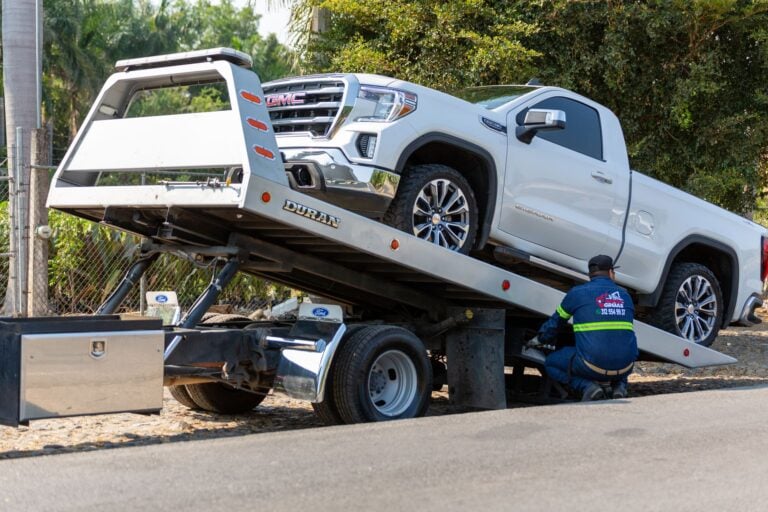
Rex Callum leaned on the counter of his impound office, looked me dead in the eye, and said, “The fee schedule is the fee schedule.” Then he smiled at me the way a man smiles when he knows you cannot do a thing about it.
It was day three. My truck, a 2004 Ford F-250 with 212,000 miles and every tool I owned bolted into the bed, was sitting forty feet away behind his chain-link fence, and the number on the yellow carbon-copy invoice he slid across the counter had grown from $325 to $780. By his math it would pass $1,500 before the week was out. The truck itself, on a good day, might have sold for $6,000. He knew that. That was the whole point.
“You can’t charge a processing fee, a gate fee, an admin fee, and an after-hours fee on the same tow,” I told him. I kept my voice level. Sixty-six years of practice keeping my voice level.
“Says who?” Rex said.
“Says the county contract you signed.”
He laughed. Not a big laugh. A small one, which is worse. “Old man, you go on and read whatever you want to read. The fee schedule is the fee schedule. Cash only. Gate closes at five.”
I want to tell you what I did about that. But first you need to understand who I am, and why a man like Rex Callum picked the wrong truck in the wrong county to steal.
The paper remembers
My name is Nathaniel Boykin. I have been a handyman in this county for forty-one years. Porches, gutters, water heaters, storm doors, wheelchair ramps, whatever a house needs and a homeowner cannot do. I never had a storefront and never needed one. My storefront was that truck and my reputation, and in a county of eleven thousand people, reputation is currency you spend carefully your whole life.
My daddy farmed on shares two counties over. He could not read well, but he could count, and he made me learn both, and he taught me the one rule that has run my life like a rail runs a train: paper remembers what people decide to forget.
He learned that rule the hard way. In 1961 a landlord told him the books said he’d come out forty dollars in the hole for the year, after twelve months of cotton. My daddy had kept his own tally in a nickel notebook, every weight ticket, every advance, every sack of seed. He was owed $211. He never got it. A Black sharecropper in that time and place did not take a white landlord to law over a tally book and expect to keep his roof. But he kept the notebook anyway. He kept every notebook. When he died I found thirty-two years of them in a footlocker, each one ruled in pencil, each one balanced to the penny.
“They can lie to your face,” he told me once, “but it is hard work to lie to a filing cabinet.”
So I keep records. Not casually. Religiously. Every job I have done since 1985 has a folder: the estimate, the receipt for materials, the paid invoice, and since phones started carrying cameras, photographs. I photograph a job site before I start and after I finish. I started doing that in 2009 after a customer’s son claimed I cracked a window I never touched, and the habit saved me twice more after that. Before-and-after pictures, timestamped, every job, no exceptions. My late wife Ruthie used to tease me about it. “Nathaniel Boykin, you’d keep a receipt for a glass of water.” She passed six years ago, and I still keep her grocery lists in a shoebox, because paper remembers, and some things I do not want forgotten.
I am telling you all this so you will understand: when Rex Callum decided to take my truck on a lie, he was not up against a man with a grudge. He was up against a man with a filing cabinet.
The day the truck disappeared
It was a Tuesday in March. I was rebuilding a porch rail for Miss Odessa Greer, a widow on Route 9 whose steps had gone soft enough to scare her family. Her house sits on a wide gravel pull-off, county right-of-way, where cars have parked for church suppers and funerals for fifty years. I parked the F-250 there at 7:42 in the morning. I know it was 7:42 because I photographed the porch before I started, like always, and the truck is sitting in the corner of the second picture, all four tires on gravel, fifteen feet off the pavement, nowhere near the road.
I worked through the day. Around four o’clock I walked out to get my chop saw and the truck was gone.
I stood there in the road for a full minute, holding a level, looking at the empty spot like the truck might be hiding behind the mailbox. My first thought was theft. Miss Odessa called the sheriff’s office for me, and the dispatcher checked her screen and said no, it wasn’t stolen, it had been towed at 1:15 that afternoon. Callum Towing and Recovery. Violation: obstruction of a designated emergency access lane.
I asked her to say that again.
There is no emergency access lane on Route 9. There is no designated anything on Route 9. There is a gravel pull-off, a ditch, and Miss Odessa’s mailbox. I have parked work trucks on that pull-off for four decades and so has every propane man, well driller, and UPS driver in the county.
“You’d have to take that up with the tow operator,” the dispatcher said. “It’s a civil matter.”
I would hear those words, civil matter, so many times over the next month that I started hearing them in my sleep.
Miss Odessa drove me out to the Callum lot in her Buick. It sits on the east edge of town behind eight-foot chain link with green privacy slats, next to the old grain co-op. And there was my truck, parked in the mud in the back corner, my ladder rack, my toolboxes, forty-one years of my working life impounded behind a padlocked gate with a hand-painted sign that said CASH ONLY. NO EXCEPTIONS. NO LOITERING.
Get a new story in your inbox every morning.
Facebook doesn’t show you every story we post. Our free newsletter does. Join 2,500+ readers.
That was the first time I met Rex Callum face to face. Big man, maybe fifty, camo cap, the kind of fellow who talks to you while looking just past your shoulder like you are barely worth the focus. I explained the situation calmly. Wrong truck, no violation, private work on private property, photographs to prove it.
He didn’t even pretend to check a clipboard.
“Hook fee’s $325,” he said. “Storage is $95 a day, and today counts. Administrative processing is $150. You want it out after five, that’s an after-hours release, $125. Cash.”
“For a violation that doesn’t exist,” I said.
And that is when he said it the first time, the sentence I would come to know like a scar: “The fee schedule is the fee schedule.”
The arithmetic of a trap
Here is what I want you to understand about what Rex was running, because it took me two weeks to see the whole shape of it, and once you see it you cannot unsee it.
A predatory tow is not really about the tow. It is about the meter. The moment that truck rolled onto his lot, a clock started that only he could stop, and every day I spent disputing the tow was a day he charged me for the privilege of disputing it. Fight him, the fees grow. Pay him, the lie wins. Either way, Rex gets fed.
And he had tuned the machine perfectly for people like me and Miss Odessa and half of this county. Cash only, because cash leaves no processing trail and poor folks have to make three trips to raise it. Gate hours from ten to five, so a working person loses a day’s wages to stand at his counter. An “administrative fee” for the paperwork, a “gate fee” to open his own gate, a “fuel surcharge” on a four-mile tow. And behind it all, the quiet threat he saved for anyone who pushed: after thirty days, state law let him file for an abandoned-vehicle lien and auction the truck. He would take my $6,000 truck for a $325 lie and sell it, and the law would hand him the pen to sign it over.
I did not have $780 in cash that Thursday. I am not ashamed to say it. I am a self-employed handyman, Ruthie’s medical bills took our savings down to the studs before she passed, and March is my thin month. I had about $400 on hand and four jobs that week I could not do without the truck. No truck, no work. No work, no cash. The meter running the whole time. That is not a fee schedule. That is a snare, and it was built by a man who knew exactly what he was building.
I went home that night to a quiet house and sat at the kitchen table where Ruthie used to sit across from me, and I will be honest with you, for about an hour I felt like a poor old man in a small town who was about to lose his living to a smirk behind a counter.
Then I got up, went to the hall closet, and took down a fresh three-ring binder.
The runaround
I tried the front doors first, because that is what you do, and because I wanted every closed door on paper.
Wednesday morning I was at the sheriff’s office when it opened. A young deputy heard me out, looked up the tow, and told me Callum Towing was on the county’s rotation list, meaning when the county needs a wreck cleared or a violation towed, Callum gets the call. Except nobody at the county had called this one in. Rex had “self-initiated” the tow, which the deputy admitted was odd, and then he said it: civil matter. Take him to small claims if you want. Next.
I asked him to write down what he had just told me. He blinked at me. I asked again, polite as Sunday. He wrote two sentences on a report form and signed it. Into the binder.
Thursday I went to the county administration building. The road department confirmed, in writing after I stood at the counter and would not leave without it, that there is no designated emergency access lane on Route 9 and never has been. Into the binder.
Friday I called the state’s towing complaint line and learned the state regulates tow rates from public highways but leans on counties to police their own rotation contracts. The lady on the phone was kind and useless and mailed me a pamphlet. Into the binder.
Meanwhile the meter ran. $95 a day. I borrowed Miss Odessa’s late husband’s hatchback, a little silver thing I could fit maybe a tenth of my tools in, and I lost the water-heater job, and the fence job, and the ramp job for the Methodist church, one call at a time, each one an apology I hated making. I photographed the truck through Rex’s fence every single day, timestamped, so no man could ever claim I had abandoned it. On the sixth day Rex came out of his office and watched me take the picture.
“You can photograph it all you want,” he called across the lot. “Camera don’t pay storage.”
Into the binder went a note with his exact words, the date, and the time. He thought he was mocking me. He was testifying.
The table at Dot’s
The turn came at the diner, the way most things turn in a town like this.
I eat breakfast at Dot’s on Saturdays, a habit Ruthie and I kept for thirty years that I keep now for both of us. I was telling the counter my troubles, not looking for anything but sympathy, when a young man two stools down set his coffee cup in its saucer, careful, like he was setting down something heavier.
“Callum got my Silverado in November,” he said. “Said I was blocking a hydrant on Mill Street. Wasn’t no hydrant within a hundred yards. Cost me $1,140 to get it back. I got a baby girl. I just paid it.”
His name was Denny, a diesel mechanic, twenty-eight years old. And once Denny said it out loud, the whole counter came open like a seam. The waitress’s brother-in-law: towed from a church parking lot during a funeral, $890. A farmer at the corner table: hay truck towed off his own field entrance on an “abandoned vehicle” call, $1,300, paid it because harvest doesn’t wait for arguments. Miss Odessa, it turned out, had her own story from two years back that she had been too embarrassed to tell me while I stood in her yard raging about mine: $640 for a “meter violation” in a town that has never had a parking meter.
Every one of them had paid. Every one of them had been told: civil matter, fee schedule, cash only. Every one of them had swallowed it alone, because that is what the machine counts on. A hundred people cheated one at a time is a hundred people who each think it happened only to them.
I sat there with my coffee going cold and felt something shift in my chest, and it was not just anger anymore. It was purpose. Because here is what forty-one years of receipts had prepared me for, better than any lawyer in the state: I knew that one man’s complaint is a grudge, but a pattern on paper is a case.
“Denny,” I said, “you still got your invoice?”
He did. His wife keeps everything, he said, in a shoebox.
“Go get it,” I said. “And tell your wife I said God bless the shoebox.”
The courthouse basement
Everything Rex Callum was hiding turned out to be sitting in the county courthouse, in the public record, waiting for one stubborn old man with a library card and a binder to come ask for it. It always is. That is the secret nobody tells you about men like Rex: their whole game depends on nobody ever looking.
I started with the clerk’s office. A county rotation tow contract is a public document, and the deputy clerk, a patient woman named Verna who I once fixed a sump pump for, pulled Callum Towing’s file for me and let me pay a dime a page for copies. And there it was, page four, in plain type: the fee schedule. The real one. The one Rex signed his name under.
Maximum hook fee for a standard tow: $185. Storage: $35 per day, with the first 24 hours free. And then the sentence I read four times to be sure: “No additional administrative, gate, release, fuel, or after-hours fees shall be assessed for tows performed under this agreement.”
Rex had charged me $325 to hook, $95 a day from hour one, plus $150 admin, plus a gate fee, plus the rest. Nearly triple his own signed contract, on a tow he invented. His smirking little sentence was true after all. The fee schedule is the fee schedule. He had just been praying no one would ever read it.
Next I filed an open-records request for the county’s tow logs, every Callum tow reported through dispatch for three years. Verna helped me word it right. Two weeks later I picked up a stack of paper four inches thick, and I spent five nights at my kitchen table with a ruler and a yellow highlighter, the way my daddy balanced his nickel notebooks, and I built a spreadsheet the old way, by hand, in the binder.
Two hundred and fourteen tows in three years. I mapped every one against the county road department’s own records. Sixty-one of them cited violations at locations where the cited condition did not exist: fire lanes that were not fire lanes, hydrants that were not there, no-parking zones on roads that have never had a posted sign. I drove to thirty of those spots myself and photographed them, timestamped, empty of any sign or hydrant or lane. And the addresses told their own story. The invented tows clustered out in the county, on the poor side, on gravel roads and trailer courts and the streets around the AME church. Places where folks pay cash, keep their heads down, and do not call lawyers. Rex was not just a cheat. He was a cheat with a map.
Then Denny’s invoice came in, and Miss Odessa’s, and once word moved through Dot’s and the feed store and two church bulletins, they started arriving at my door like casseroles after a funeral. By the end of April I had thirty-eight invoices in plastic sleeves, every one of them charging fees that the signed contract flatly forbade. I tabbed them. I indexed them. I cross-referenced each invoice to the dispatch log and each location to a photograph.
The binder was three inches thick and it weighed, by the bathroom scale, six and a half pounds. I have built porches my whole life. This was just another one: one board at a time, every nail where it belongs, and when you are done a person can stand on it.
The auction notice
Rex found out, of course. In a county this size, a man cannot photograph thirty roadside ditches without word getting around.
On day twenty-six, a certified letter came to my house. NOTICE OF INTENT TO FILE LIEN AND SELL ABANDONED VEHICLE AT PUBLIC AUCTION. My truck. My tools. Sale date set for the thirty-eighth day. Storage and fees now totaling, by his arithmetic, $3,240.
And under the certified letter, in my regular mail, a plain envelope with no return address. Inside was a single page, typed: “Some people are too old to start trouble. Hope your health holds up.” No signature. It did not need one.
I want to tell you I laughed it off. I did not. I am a sixty-six-year-old widower who lives alone at the end of a dirt lane, and I sat with that page in my hands for a long while. I thought about my daddy, who kept thirty-two years of notebooks on men he could never take to court, because the courthouse in his day was not built for him. He kept the books anyway. He kept them for a day he knew he would not live to see.
I put the letter in a plastic sleeve, tabbed it EXHIBIT 44, and drove to the courthouse in Miss Odessa’s hatchback.
I filed in small claims court that afternoon: wrongful tow, conversion, and every dollar of fees charged above the contract, plus my lost work, itemized by job, with the customer calls to prove it. Filing fee was $46. Verna notarized my affidavit. And then I did the thing that turned one man’s case into a reckoning: I sat at Dot’s the next three mornings with a stack of blank small-claims forms, and I helped anybody who came fill one out. Denny filed. Miss Odessa filed. The farmer filed. The waitress’s brother-in-law filed. Nine cases in one week, all naming Callum Towing and Recovery, all citing the same contract page, all set before the same judge.
A man can smirk at a grudge. It is harder to smirk at a docket.
The fee schedule is the fee schedule
The hearing came on a Thursday morning in May, in the small courtroom on the courthouse’s second floor, the one with the tall windows and the radiator that knocks. Judge Marla Hutchins presiding, a straight-backed woman around sixty who is known in this county for two things: an even temper and a low tolerance for being taken for a fool.
Rex came in a pressed shirt with a lawyer from the city, which told me he was worried, because you do not bring a $300-an-hour lawyer to swat a $780 small claim. Half of Dot’s morning counter was in the gallery. Denny sat behind me with his little girl asleep on his shoulder. Miss Odessa wore her funeral hat, which she informed me was also her justice hat.
His lawyer went first and was smooth about it. Mr. Callum operates under a lawful county contract. Fees are posted at his place of business. The plaintiff’s vehicle constituted an obstruction in the operator’s good-faith judgment. Regrettable, but lawful. Civil matter, in other words. The same two words this county had been feeding us for years, wearing a nicer suit.
Then it was my turn, and I laid the binder on the table, and I heard it thump, and I do not mind telling you that thump was one of the finest sounds of my life.
I am not a lawyer. I did not try to sound like one. I walked the judge through it the way I would walk a customer through an estimate. Here is the photograph of my truck, legally parked, timestamped 7:42 a.m. Here is the county road department’s letter confirming no emergency lane exists or has ever existed on Route 9. Here is the contract Mr. Callum signed, page four, and here is the fee schedule he agreed to. Here is his invoice to me. Here they are side by side. Your Honor can do the arithmetic as well as I can, but I did it anyway, in the margin, in pencil.
Judge Hutchins read page four for a long, quiet minute. Then she looked over her glasses.
“Mr. Callum. Can you show me where in the county ordinance the violation you cited exists?”
Rex looked at his lawyer. His lawyer looked at his legal pad, and the legal pad had nothing to say. Rex cleared his throat and offered that his drivers rely on their best judgment in the field.
“That is not what I asked,” the judge said. “I asked you to point to the violation. In the ordinance. Take your time.”
He could not. There was nothing to point to. Sixty-one times he had written violations that did not exist onto invoices for fees his own contract forbade, and it had worked for three years because no one had ever asked him to point. I watched the smirk leave his face by inches, like water finding a crack, and I thought about my daddy at that landlord’s table in 1961, holding a nickel notebook full of truth that no one in the room would look at. Somebody was looking now.
Then I said the only clever thing I had saved up, because I had earned it. “Your Honor, Mr. Callum told me three times that the fee schedule is the fee schedule. I have come to agree with him. It’s Exhibit 12.”
There was laughter in the gallery. The judge did not laugh, but she did not gavel it down either, and I saw the corner of her mouth fight her for a second before she won.
She ruled from the bench. Wrongful tow. Every fee above the contract rate unlawful, and since the tow itself was baseless, every fee, period. Judgment for me: full fees to be returned, $1,830 in documented lost work, court costs, and my truck released that day, with an order that not one additional dollar of storage be charged. Then she picked up the binder, all six and a half pounds of it, and said the words that broke the racket’s back:
“The court is also going to direct that a copy of the plaintiff’s documentation be forwarded to the district attorney and to the county commission. Mr. Callum, I would locate my own copy of that contract before your next eight hearings. You are going to need it.”
Eight more hearings. Nine of us had filed. She had read every case on her docket, and she knew exactly what had walked into her courtroom.
What fell afterward
Things moved fast after that, the way a rotten porch holds and holds and then goes all at once.
The county commission met in June, and the little meeting room was standing room only, farmers and church folks and Denny’s whole shop crew in their work shirts. The commissioners had the binder copies in front of them, sixty-one flagged tows, thirty-eight unlawful invoices, and a map with pins in it that made the pattern plain enough for a child to read, showing whose side of the county Rex had been farming. They voted unanimously to terminate Callum Towing’s rotation contract and to refer the matter to the district attorney. Two commissioners apologized out loud, on the record, for every constituent who had been told “civil matter” and sent home.
The DA’s office called me in July. So did an investigator from the state attorney general’s consumer protection division, a young woman who went through my binder page by page for four hours and finally sat back and said, “Mr. Boykin, do you know what we usually have to subpoena to get half of this?” The state filed suit that fall: deceptive practices, unlawful fees, the works. Rex settled before it ever saw a jury, because his lawyer could read page four as well as anybody. Full restitution to every documented victim, three years of tow records opened for claims, civil penalties on top, and a consent order barring him from municipal or county towing contracts in this state.
The checks went out in the spring. Two hundred and six people in this county got money back. Denny got his $1,140, and his wife framed the check stub and hung it next to the baby pictures, which I consider the correct use of a wall. Miss Odessa got her $640 and donated every dollar of it to the fund that fixes up housing for widows, and then she hired me, at full price, over my objections, to build the first ramp.
The lot on the east edge of town is chained shut now. The green slats are falling out of the fence one by one, and the hand-painted CASH ONLY sign has faded down to a rumor. Rex still lives in the county. I see him at the co-op now and then. He does not look past my shoulder anymore. He does not look at me at all.
The binder on the seat
I got my truck back the same afternoon the judge ruled, before Rex’s gate closed at five.
Denny drove me over, and half the gallery came along, a little parade of Buicks and work trucks, and we stood at the gate while Rex’s yard man walked back and unlocked it without a word. The F-250 turned over on the second try, faithful as a mule. My tools were all there. I checked them against my inventory sheet while Rex watched from his office window, because paper remembers, and I wanted him to watch me remember.
I drove it home the long way, out Route 9, past Miss Odessa’s porch with the rail I finished the week after the hearing, straight and square and strong enough for her grandbabies to swing on. The binder rode on the bench seat beside me, where Ruthie used to ride. She would have teased me the whole way home. You’d keep a receipt for a glass of water, Nathaniel Boykin. Yes I would, sweetheart. And it turns out that if you keep them long enough, the receipts keep you.
Here is what I know now, at sixty-six, that I want to leave with you. Men like Rex Callum do not fear big and loud. Big and loud is weather to them; they wait it out. What they fear is small and permanent. A date. A timestamp. A signed page four. A widow’s invoice in a plastic sleeve. They build their whole lives on the bet that ordinary people will not write anything down, and they win that bet every single day, in every county, until they run into somebody’s daddy’s oldest rule.
Paper remembers what people decide to forget.
My daddy kept thirty-two years of notebooks against a debt no court would ever pay him. I used to think that was the saddest thing I knew about him. I do not think that anymore. I think he was building a porch he knew he would never stand on, one board at a time, every nail where it belongs, trusting that someday somebody who loved him would walk out on it and find it held.
It held, Daddy. Six and a half pounds. Exhibit 12.
The fee schedule is the fee schedule.
This story is a dramatization. Names, characters, and details are invented, and any resemblance to real people or events is coincidental.