
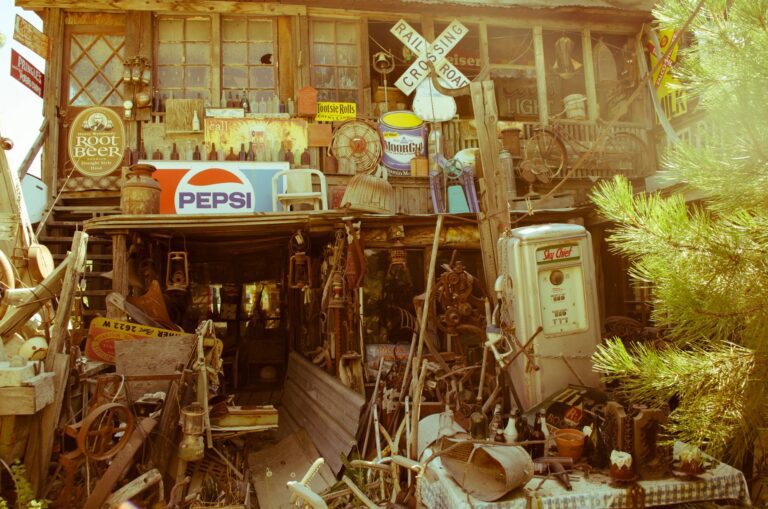
For most of my life I was ashamed of my father’s barn.
I need to say that plainly, right at the start, because everything else I am about to tell you only matters if you understand how completely I had given up on the place. That barn sat at the end of our gravel lane in Quill Hollow, Nebraska, a town so small that the welcome sign and the thank-you-for-visiting sign were nailed to the same post. It was a swaybacked old structure my father, Otho Lindgren, had let fill up over four decades with what I can only call the refuse of other people’s lives. Rusted weathervanes. Cracked butter churns. License plates from states that had changed their slogans three times since. Crates of bottle caps. A wall of cabinet doors with no cabinets attached to them. To me it was junk, and I told him so, and he would just smile under that white mustache and say, “Everything’s worth something to somebody, Marlys. You just haven’t met the somebody yet.”
I was forty-eight years old before I found out he was right, and by then the town that I thought was dying had about six months left in it, or so we all believed.
Let me back all the way up. You deserve the whole thing, because the whole thing is what changed my mind.
I grew up in Quill Hollow when it still had a pulse. We had a creamery, a feed store, a five-and-dime run by a sharp-tongued widow named Ottilie Vance who could add a column of figures in her head faster than you could write them down, and a Friday-night football team that lost most of its games but filled every bleacher anyway because there was nothing else to do and nothing else we would have rather done. My father drove a school bus in the mornings and farmed two hundred acres of corn and soybeans the rest of the day, and on Saturdays he went to auctions.
That was the thing about my father. He went to auctions the way other men went fishing. Not to buy anything in particular. Just to be there, to watch the bidding, to talk to the old farmers and the estate sellers and the pickers who drove in from three counties over. And he always, always came home with something nobody else had wanted. A box lot he had bought for a dollar because it had one good hand-plane in it and forty things that were, in my opinion, garbage.
By the time I was in high school the barn was full. By the time I left for the community college over in Hagen County, it was full enough that he had started stacking things in the corn crib too. My mother, Verna, used to stand in the kitchen window and watch him carry yet another armload of somebody’s discarded history across the yard, and she would shake her head and say, “Otho, when you’re gone, your daughter is going to have to haul all of that to the dump, and she is going to curse your name doing it.” And he would say, “She might. Or she might not.”
My mother passed in the spring of 2009. After that the barn got worse, the way a thing does when half the reason for restraint is gone. But my father never let it become a mess. That is the part people misunderstand when I tell this story. It was full, but it was not chaos. He knew where everything was. He had a system that lived entirely inside his own head, and if you asked him for the cream separator with the cracked bowl, he would walk to the right corner in the dark and put his hand on it. He kept little paper tags tied to things with string, and on the tags, in his small square pencil handwriting, he wrote where a thing had come from. “Knutsen farm dispersal, 1987.” “Dietz lantern, bought off a man in Aurora who cried selling it.” “Schoolhouse bell, District 14, closed 1961.”
I thought the tags were the saddest part. I thought they were the proof that my father had spent his retirement years curating other people’s grief. I did not understand yet that he was doing the opposite.
Quill Hollow started dying the way most of these towns die, which is to say slowly and then all at once. The creamery closed when I was thirty. The feed store hung on until a co-op out on the highway undercut it. The school consolidated with Hagen County in 2014, and the morning my father drove his last bus route, with eleven kids on it instead of the forty he had carried in his prime, he came home and sat at the kitchen table for a long time without taking his coat off. The five-and-dime shut its doors when Ottilie Vance finally retired at eighty-one, and nobody bought the building. By 2024 the only businesses left on Main Street were the post office, which the federal government kept threatening to close, and the Sunrise Cafe, where a woman named Lovell Bricker served coffee and pie to the dozen or so of us still rattling around in a town built for five hundred.
We were down to a hundred and ninety people. I know because I helped take the count. The average age was somewhere north of sixty. The young ones left for Omaha and Lincoln and Denver and did not come back, and I did not blame them, because what was there to come back to? A church we could barely keep heated. A water tower that needed paint nobody could pay for. A Main Street with more plywood in the windows than glass.
I had stayed. I want to be honest that I am not sure it was courage that kept me. I had married a good quiet man named Sorenson Klein, who everybody called Soren, and we ran a hundred and sixty acres and I kept the books for a few of the farms around us, and Quill Hollow was simply where my life was. But I will tell you that by the spring my father turned eighty-three, I had started to feel the town settling down around me like a house with the heat shut off. I had started to do the math on what it would mean to be the last person to lock the church door.
And then my father got sick.
It was his heart, which I found grimly funny in a way I never said out loud, because my father had the biggest one of anybody I ever knew and it was the one part of him I assumed would never quit. The doctor in Hagen County said congestive heart failure and used words like “manage” instead of “cure,” and I started spending my evenings out at the home place, sitting with him on the porch as the light went long and gold over the soybeans.
It was on one of those evenings that he told me what he wanted.
“When I go,” he said, “I don’t want you to dump the barn.”
I had been waiting for this. I had been dreading it. I had already priced out the roll-off containers in my head, already made peace with the three weekends of misery it would take to clear forty years of accumulation. “Dad,” I said, as gently as I could, “I can’t keep it. I can’t run two farms and curate a museum of bottle caps.”
Get a new story in your inbox every morning.
Facebook doesn’t show you every story we post. Our free newsletter does. Join 2,500+ readers.
“I’m not asking you to keep it,” he said. “I’m asking you to let somebody see it first.”
“See it? See what? It’s a barn full of stuff, Dad. It’s stuff.”
He was quiet for a while. The cicadas were going in the windbreak. Then he said, “There’s a fella. Comes through every few years. Buys at the big auctions, sells to the picker shows, the magazine people, the city folks who pay money for old. His name is Thelonious Boddiker, and he gave me his card once and said if I ever wanted to sell the whole barn as a lot, to call him. I never called. I didn’t want to sell it. But after I’m gone, you call him. Promise me. Let him walk through it once before you call the dump truck.”
I promised him. I would have promised him anything that spring. I tucked the wrinkled card he handed me into my coat pocket and I did not think about it again for four months, because four months later my father died on a Tuesday in September, in his own bed, with the window open so he could hear the geese going over.
I am not going to dwell on the grief. You have your own; you do not need mine. I will only tell you that the church was full for his funeral, fuller than it had been for anything in a decade, because it turned out that half the county had a story about something Otho Lindgren had quietly done for them, and a surprising number of those stories started with the words “he had this thing out in his barn that I needed.”
I should have heard it then. I did not.
For six weeks after we buried him I could not make myself go into the barn. Then on a raw morning in late October, with Soren’s help, I slid the big door open and stood there looking at four decades of my father’s heart, and I felt the old shame come up in me, and underneath it something I had not expected, which was the strange certainty that I was about to throw away something I did not understand.
So I dug the card out of the drawer where I had put it, and I called Thelonious Boddiker.
He called me back the next day. He had a voice like gravel under a slow tire, and when I told him whose daughter I was, there was a pause, and then he said, “Otho Lindgren passed?” and I said yes, and he was quiet, and then he said, “I’ll be there Thursday. Don’t move anything. Don’t sell anything. Don’t throw out one single thing until I’ve walked it. You hear me?”
I heard him. I did not understand him yet, but I heard him.
He came on Thursday in a mud-spattered Suburban with a clipboard and a pair of reading glasses on a string and a younger woman named Sigrid who carried a camera. He walked into that barn the way some people walk into a church, slow, with his hat in his hands. And then for three hours he went through it, aisle by aisle, reading my father’s pencil tags, picking things up and turning them over and setting them down exactly where they had been. He barely spoke. Now and then he would make a sound, a low hum, the way a man hums when he has found something. By the end his hands were trembling a little, and I assumed it was age.
It was not age.
He came and found me where I was sitting on an overturned milk crate by the door, and he took off his glasses, and he said, “Mrs. Klein, I want to be careful how I say this, because I have been doing this for thirty-one years and I have learned not to get excited. But I need to ask you a question, and I need you to answer it honest. Does anyone else know what’s in this barn?”
“It’s junk,” I said. “It’s my dad’s junk. The whole town knows it’s full of junk.”
“It is not junk,” he said. “Not most of it. Your father did not buy junk. Your father bought the one good thing out of every box of junk in three counties for forty years, and he kept the tag on it that says where it came from, and that, Mrs. Klein, that provenance, is worth more than the objects. Do you understand? An old lantern is worth forty dollars. An old lantern with a tag in the original owner’s barn that says it came off the Dietz farm and your father’s note about the man who cried selling it, that is a story, and people pay for stories. You have a building full of documented American history, sorted and labeled by a man with a better eye than half the dealers I know. I have walked through estate auctions of so-called serious collectors that did not hold a candle to this.”
I just looked at him. I think my mouth was open.
“There’s more,” he said, and he sat down on the milk crate next to mine, which put us both at a strange height, two middle-aged-and-older people sitting on dairy equipment in a cold barn. “In the back corner, under a tarp, behind the cabinet doors. Did you know what’s back there?”
“I never went back there,” I admitted. “It was too full.”
“Come look,” he said.
He led me to the back corner I had avoided my whole life because it was the densest, most impassable part of the whole barn. He pulled the tarp off, and Sigrid lifted her camera, and I looked at what my father had been quietly hiding under a canvas sheet for I do not know how many years.
It was a sign. A hand-painted, gold-leaf, twelve-foot wooden sign, the kind that used to hang over a storefront, and the lettering on it, faded but unmistakable, read QUILL HOLLOW MERCANTILE EST 1889. And behind it, leaned and stacked and wrapped in old quilts, was the rest of it. The original brass cash register from the mercantile, with the keys that rang up amounts in a currency of trust. The oak post-office boxes with the little glass windows and the combination dials, the ones from before the federal building, the ones our great-grandparents had checked for letters. The barber pole from Halvard’s shop. The marble soda fountain counter from the drugstore, in pieces, every piece numbered in my father’s pencil. The schoolhouse bell from District 14. The hand-lettered ledgers. The photographs in their frames, hundreds of them, faces from a town that had forgotten it ever looked like that.
My father had not been hoarding junk.
My father had been saving the town.
For forty years, every time something in Quill Hollow closed, every time a building came down or a family left or a business gave up, my father had been there at the dispersal sale, and he had quietly bought back the bones of the place, and he had carried them home and tagged them and tucked them under a tarp where the shame of his junk-collecting daughter would never make him explain himself. He had watched the town die piece by piece, and he had refused, all by himself, in secret, to let any of the pieces leave.
I sat down right there on the cold concrete floor of the barn and I cried in a way I had not cried at the funeral, because at the funeral I had been mourning my father and here I was finally meeting him.
Thelonious Boddiker let me cry. He was a man who understood that some moments are not to be hurried. When I was done, he handed me a clean blue bandana from his coat pocket and he said, “Mrs. Klein, I came here to make you an offer on the contents of this barn. I’m not going to do that.”
“Why not,” I said, half afraid he was about to tell me it was worthless after all.
“Because if I buy it,” he said, “I’ll break it up. That’s my business, I buy collections and I sell them in pieces, a lantern to this fella, a sign to that one, and they go all over the country and they never come back. And I have been sitting here for three hours realizing that this collection should not be broken up. This collection is the only complete record left of a town, gathered by the one man who loved it enough to do it. Break it up and it’s worth a good deal of money. Keep it together and it’s worth something I don’t have a price for. I’m a dealer, ma’am, and I’m telling you not to sell to a dealer. Don’t ever let anybody tell you we don’t have a conscience.”
“Then what am I supposed to do with it?” I asked. “I can’t keep a barn museum nobody comes to.”
And Thelonious Boddiker, picker, dealer, thirty-one-year veteran of estate sales, looked around that barn, and then he looked at me, and he said the thing that changed everything.
“You don’t keep it in the barn,” he said. “You put it back where it came from. You’ve got a whole dead Main Street full of empty buildings out there, don’t you? With the original signs and registers and fixtures sitting right here in this barn? Mrs. Klein, you don’t have a junk collection. You have an entire historic town in a box, ready to be set back up. People drive four hours to walk through a place like that. They pay to do it. I have seen towns smaller than yours bring in fifty, eighty thousand visitors a year on less than what’s under this one roof.”
I told him he was dreaming. I told him Quill Hollow was a hundred and ninety old people and a coffee shop. I told him nobody was going to drive four hours to see a fake old town.
“It wouldn’t be fake,” he said quietly. “That’s the whole point. It would be the realest one in the country, because every single piece is the actual piece, off the actual building, with your father’s note saying so. There is not a restored historic district in America that can say that. They buy reproductions. You have the originals, and you have the paperwork.”
He left me his number and he drove off into the gray afternoon, and I sat in the barn until it got dark, looking at the gold-leaf sign that said EST 1889.
I would love to tell you I leapt up that night full of vision and purpose. I did not. I am a practical woman and I had a hundred and sixty acres and a dead father and a grief I had not finished, and the whole idea sounded like the kind of thing that ends with you broke and embarrassed. For three weeks I did nothing. I let it sit.
What got me off the milk crate was Lovell Bricker at the Sunrise Cafe.
I had gone in for coffee on a Monday, and Lovell, who has known me my whole life and who buried two of her own that same year, set the cup down in front of me and said, “I’m closing in March, Marlys. I can’t make the rent on twelve customers. I wanted you to hear it from me before the sign goes in the window.”
And something in me, some part of me that had been sitting in a cold barn next to a man who told me not to sell, stood straight up.
I told her not to put the sign in the window. I told her to give me until spring. And then I went home and I called Thelonious Boddiker, and I said, “Tell me how this works.”
It worked the way good things work in small towns, which is to say it worked because of people, and the people came out of the woodwork the minute they understood.
I called a town meeting in the church basement on a Sunday in November. I expected maybe fifteen people. Sixty came. I stood up at the front, with Soren’s hand steadying me, and I told them what was in my father’s barn. I told them about the mercantile sign and the post-office boxes and the soda fountain and the bell. I told them what Boddiker had said. And then I said the thing I had practiced in the truck on the way over: “My father spent forty years saving this town one piece at a time, in secret, because he believed somebody would need it someday. We’re the somebody. He met us. He just did it before we got here.”
There was a silence in that church basement that I will remember until the day I die. And then a man stood up in the back. It was Erling Haugland, who had run the lumberyard before it closed, eighty years old and twice as stubborn. And he said, “My father’s hardware-store cash drawer in that barn?” And I said, “Tagged. Nineteen seventy-one. He bought it at your family’s sale.” And Erling Haugland, who I had never once seen show an emotion that was not irritation, put his hand over his mouth and sat back down.
After that the whole room came loose at the seams in the best possible way.
We formed the Quill Hollow Heritage Society in that basement that night, with Lovell Bricker as president because she was the only one of us who knew how to run a meeting. We had no money. What we had was a hundred and ninety people, most of them retired, all of them with time and tools and a sudden ferocious refusal to let the town go dark.
It took us fourteen months.
I am not going to pretend it was easy or smooth, because the truth is more interesting than that. We fought about everything. We fought about which empty building should hold what, and whether to charge admission, and whether old Halvard’s barber pole should go back in the actual barber shop or in the front window where tourists could see it from the street. Erling Haugland and a retired electrician named Cassius Pelletier did not speak to each other for a month over the wiring in the mercantile and then made up over a shared mistrust of the county inspector. A woman named Drusilla Aldous, who had taught at District 14 before it closed and who everyone assumed was too frail to do anything, turned out to have kept forty years of the school’s records in her own attic, and she walked into a planning meeting with three boxes of them and a look that dared anybody to underestimate her again.
We restored the buildings ourselves, mostly. The men who had spent their lives building barns and grain bins and machine sheds turned out to know exactly how to rehang a hundred-year-old storefront door. The women who had kept those buildings’ books and counters and kitchens turned out to know exactly how a mercantile was supposed to be laid out, because they remembered. We were not guessing. That is what nobody on the outside understood when the newspaper people finally came. We were not reconstructing a town from photographs. We were the town, putting our own furniture back.
And every single thing came out of my father’s barn, with his pencil tag still tied to it, telling us where it went.
We put the gold-leaf sign back over the mercantile in April, fourteen men and a crane borrowed from the co-op, and when it settled into place and Erling Haugland’s grandson knocked the last bolt home, a hundred and ninety people standing in the street made a sound I have never heard a town that small make.
We opened on the Fourth of July.
I had told everyone to keep their hopes low. I told them we might get a few curious folks from Hagen County. I told them not to be disappointed if it was quiet.
By ten in the morning there were cars parked the length of Main Street and out onto the county road. By noon Lovell Bricker had run the Sunrise Cafe out of pie, all of it, every slice, and was on the phone begging her sister in Aurora to bake more. By the end of that first day, eleven hundred people had walked down a Main Street that six months earlier I had been preparing to lock up for good.
It turned out Thelonious Boddiker had not been dreaming. He had been low.
The thing that put us on the map, the thing that I still cannot fully explain, was the provenance. Boddiker had been right about the tags. A travel writer came through that first August, a young woman from a Sunday magazine, and she did a story about us, and the line in her article that everyone remembers is this: “Most historic towns ask you to imagine the past. Quill Hollow lets you touch it, because every object is the real one, saved by a single farmer who refused to let his town disappear, and tagged in his own hand so you would know it was true.” That story went everywhere. After that the buses started coming.
We are three years on now. Quill Hollow has two hundred and forty people, which does not sound like much until you know that we had been losing people for fifty straight years and now we are gaining them. Young families have moved back, some of them descendants of the very people whose cash drawers and lanterns and ledgers fill our buildings. The Sunrise Cafe expanded into the building next door. There is a new bakery, and a woman who does pottery, and a young man named Whitfield Aldous, Drusilla’s great-nephew, who came home from Denver to run the heritage society’s website and never left. The post office is not just open, it is busy. We had to repaint the water tower because so many people were taking pictures of it.
My father’s barn stands empty now, for the first time in forty years. We left it empty on purpose. There is a little sign on it, and the sign says: “This barn held the town of Quill Hollow for forty years, until the town was ready to take itself back. It belonged to Otho Lindgren, who knew everything is worth something to somebody. He was right.”
I go out there sometimes, in the evening, when the light goes long and gold over the soybeans the way it did the night he made me promise. I sit on an overturned milk crate in the empty barn where I spent so many years being ashamed, and I think about how I almost called the dump truck. I think about how close I came, how the whole town came, to throwing away the only thing that could save it, because it looked like junk and we were too tired and too sad to look closer.
I have a tag of my own now. I made it myself, in pencil, in the small square handwriting I learned from watching my father fill out his. It is tied to a nail by the barn door, and it says: “Everything is worth something to somebody. You just haven’t met the somebody yet.”
He met us.
It just took him forty years, one auction at a time, to do it.
This story is a dramatization. Names, characters, and details are invented, and any resemblance to real people or events is coincidental.