
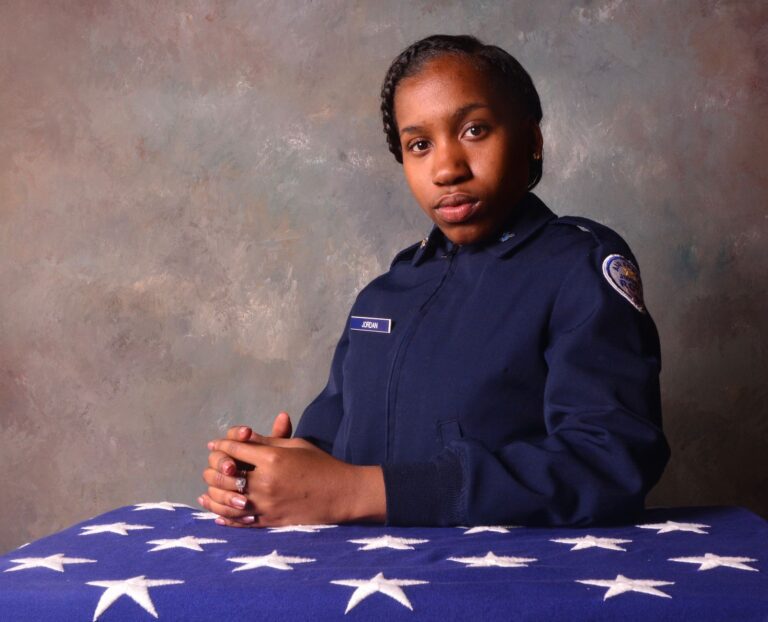
For twenty years I kept my son’s dress blues pressed and waiting in the hall closet, and every single Sunday I took them out, and I ironed a uniform that no one was ever going to wear again.
I know how that sounds. I knew how it sounded the whole time I was doing it. There is a kind of grief that other people can understand, the kind that fits inside a casserole and a card and a hand on your shoulder at the grocery store, and then there is the kind that lives in a hall closet for two decades and gets the iron set to medium every Sunday at four in the afternoon. I had the second kind. I have it still, if I am being honest with you, although it is a different shape now than it was before the knock on my door.
My name is Margaret. I am seventy-one years old, and I live in the same gray house in eastern Tennessee where I raised my boy, and I am going to tell you about the Sunday a young Marine I had never seen before stood on my porch in the rain, and held his cover in his hands, and gave me back a piece of my son I did not know was missing.
Let me start at the beginning, because the knock only means what it means because of everything that came before it.
My son’s name was Daniel. Daniel Ray. He was born in the spring of 1981, and he came out of me red and furious and squalling, and the nurse laughed and said he had a Marine’s lungs, which is a thing people say to new mothers in towns like mine where every other man has served, and it was a joke, and then twenty years later it stopped being a joke and started being the truest thing anyone ever said about him.
He was an easy child and a hard teenager and a good man, in that order. He was the kind of boy who brought home stray dogs and stray people. He sat with the kid nobody sat with. When he was nine he gave his winter coat to a boy at the bus stop who did not have one, and he walked home shivering and lied to me about losing it because he did not want the other boy to get in trouble, and I did not find out the truth for two years. That was Daniel. He could not stand to see somebody left out in the cold. I should have known then what he would grow up to be. Some people are made to stand between other people and the cold, and they do not get to choose it any more than they get to choose the color of their eyes.
He told me he was joining the Marine Corps the summer he turned eighteen. We were standing in the kitchen. I was snapping beans into a bowl, and I remember my hands just stopped, right in the middle of a bean, and I looked up at him, and he had that set to his jaw that his father used to get, God rest him, the set that meant the decision had already been made somewhere private and he was only telling me now as a courtesy. I did not cry in front of him. I want you to know that. I waited until he was asleep that night and I cried in the bathroom with the fan on so he would not hear me, and in the morning I made him pancakes and I told him I was proud of him, and both of those things were true, the crying and the proud, and they have been true together every day since.
He went to Parris Island in the fall. The day he left, the boy I drove to the bus station was still mine, still slouchy and grinning, still smelling like the cheap cologne he thought made him a man. The young man who came back at Christmas was not. He stood straighter. He looked me in the eye when he talked. He said yes ma’am and no ma’am to me, his own mother, and the first time he did it I almost laughed, and then I saw he was not joking, and something in my chest went very still and very proud and very afraid all at once. They had taken my slouchy grinning boy and given me back a Marine. Lance Corporal Daniel Ray, United States Marine Corps. He let me iron his uniform that first leave. He stood in the kitchen and showed me how, the exact way the creases had to fall, and he was so particular about it, so careful, and I teased him for being fussy, and he said, “Mama, this isn’t just clothes. You wear this right or you don’t wear it.” I did not understand then how much those words would come to mean to me. I learned to iron that uniform the way he taught me. I am glad of that now. I am glad my hands learned it while he was alive to correct them.
He was deployed twice. I do not need to walk you through the years of waiting, because if you have ever loved someone who serves, you already know exactly what those years feel like, and if you have not, I do not have the words to make you. I will only tell you that I learned to hate the sound of a car slowing down on my street. I learned that a knock on the door at the wrong hour could empty all the blood from your body in a single second. I learned to pray in a way I had never prayed before, not asking for anything grand, just asking the same small thing over and over, bring him home, bring him home, bring him home.
I kept a calendar on the side of the refrigerator and I crossed off the days with a red marker, and I will tell you, there were nights I sat at that kitchen table and stared at that calendar like it was an enemy, like if I just stared hard enough I could pull the squares closer together and bring him home faster. The letters came slow and old. By the time I read that he was fine, weeks had already passed, and I knew the boy who wrote fine could be anything by now, and there is a particular kind of helplessness in loving someone whose present tense you cannot reach. I taped his letters to the inside of the cabinet door over the coffee maker so I would see his handwriting first thing every morning. I have them still. I know them by heart. He always signed them the same way. Your son, Daniel. As if I might forget whose he was. As if I could ever.
During the first deployment I made a deal with myself that I would not let the fear win the house. I planted a garden that spring, the biggest garden I had ever planted, tomatoes and beans and squash and more zinnias than any one woman needs, because I decided that if my hands were in the dirt they could not be wringing themselves raw at the window. I canned all summer. I gave vegetables to every neighbor on the street whether they wanted them or not. The truth is I was not feeding anybody. I was holding the panic down with both hands and calling it gardening, and it worked, mostly, the way anything works when the only other option is to come apart. When Daniel came home from that first tour, the first thing he did was walk out back and stand in my garden with his hands on his hips and laugh, that big easy laugh, and he said, “Mama, you grew enough food to feed the whole battalion.” And I laughed too and I did not tell him that every single tomato had been a prayer. He found out eventually, I think. He was a smart boy. He knew his mother.
Get a new story in your inbox every morning.
Facebook doesn’t show you every story we post. Our free newsletter does. Join 2,500+ readers.
He came home from the first deployment. He did not come home from the second.
I am going to tell you about the day the car slowed down on my street and did not pass by, but I am going to tell it quickly, because I have lived inside that day for twenty years and I cannot live inside it for you too.
It was a Tuesday. It was raining, the soft kind of rain we get in the mountains in early spring. I saw the sedan from the kitchen window, government plain, the kind of car that does not belong on a street like mine, and I knew. I want you to understand that I knew before it stopped. A mother knows. I watched two Marines in their dress blues get out of that car in the rain, and they put their covers on, and they squared their shoulders, and they started up my walk, and I stood in my kitchen with a dish towel in my hands and I did not move to open the door because as long as I did not open the door it had not happened yet. They knocked. I opened it. One of them said, “Mrs. Ray,” and I said, “No,” and he said it again, gently, “Mrs. Ray,” and I said “No” again, like a child, like saying the word could push the whole world back into the shape it had been an hour before. It could not. They told me my son had been killed. They told me he died doing what he had done his whole life, standing between other people and the cold. They told me he had pulled two other Marines out of the line of fire before the round found him, and that he was being put forward for a decoration, and I heard the words and none of them landed, because the only word in the whole world that meant anything to me was the one they had just taken away, and that word was Daniel.
They gave me a folded flag. They gave me his personal effects in a plain box. They gave me the practiced, terrible kindness of men who have stood on too many porches like mine. And at some point, in the days that blurred together after, they gave me back his dress blue uniform, cleaned and pressed, the uniform he would have worn home, and I hung it in the hall closet because I did not know what else on this earth to do with it.
That was where it stayed. For twenty years.
I want to be careful here, because I do not want you to picture something morbid, a shrine, a sick thing. It was not like that. Or maybe it was and I could not see it from the inside, I do not know anymore. What I know is this. The first Sunday after the funeral, I could not get out of bed. The second Sunday, I got up, and I did not know what to do with my body, my hands, the terrible empty hours, and I found myself standing in front of that closet, and I took out his uniform, and I saw a crease that had gone soft, and I heard his voice in my kitchen saying you wear this right or you don’t wear it, and I set up the ironing board, and I pressed it. And for the length of time it took to press that uniform, I was not a woman whose son was dead. I was just his mama, taking care of his things, the way I had taken care of his things his whole life. For those forty minutes the world was the right shape again.
So I did it the next Sunday. And the next. Four o’clock, the iron on medium, the careful creases the way he showed me. I did it through the first year, when people still came around, and I did it through the second year, when they stopped, and I did it through all the long gray years after that when it was just me and the house and the rain. I did it when my hands got the arthritis and the iron got heavy. I did it on the Sundays I could barely make myself eat. Twenty years of Sundays. A uniform pressed sharp enough to cut bread, hanging in a closet, waiting for a young man who was never going to walk through my door and put it on.
My sister thought I had lost my mind. She told me so once, kindly, the way you tell someone a hard thing you have been holding for years. “Margaret,” she said, “honey, it has been twelve years. He is not coming back to wear it.” And I told her I knew that. I told her I was not confused. I told her I was not waiting for him to come back. I just did not have anywhere else to put the love. That is the thing nobody tells you about losing a child. The love does not go anywhere. It is the exact same size it always was. He is gone and the love is not, and you have to do something with it every single day for the rest of your life, and I did mine on Sundays at four o’clock with an iron in my hand.
I never thought anyone would understand that. I had made my peace with not being understood. And then, this past spring, twenty years almost to the day, somebody knocked on my door in the rain, and for the first time in two decades it was not the wrong kind of knock.
It was a Sunday. Of course it was a Sunday. I had just finished pressing the uniform, the board was still up in the front room, and I heard a knock, three knocks, firm and even, and my whole body went cold the way it always does, the old animal fear, because I have never once heard a knock on a rainy day without my body going back to that Tuesday. I went to the door. I opened it.
There was a young man on my porch. A Marine. He was in his dress blues, soaked through at the shoulders, holding his white cover in both hands the way they hold it when they have come to say something serious, and for one terrible swimming second I thought I was losing my mind, I thought it was twenty years ago, I thought, no, not again, I do not have another son to give you. And then he spoke, and his voice was young and unsteady, not the practiced voice of the men who had come before, and he said, “Mrs. Ray? Mrs. Margaret Ray? Ma’am, you don’t know me. My name is Caleb. I’m sorry to come to your door like this. I’ve been trying to find you for a long time.”
I did not know what to say. I just looked at him. He was maybe twenty-five. He had a kind face, a nervous face, and rain was running off the bill of the cover in his hands, and I finally found enough voice to ask him what he wanted.
And he said, “Ma’am, your son saved my father’s life. And I came to tell you that I’m only standing here because of him.”
I had to hold on to the doorframe.
I brought him inside. I could not leave a boy standing in the rain, not a Marine, not one who had come all that way, whatever he had come to say. He wiped his boots three times on the mat, this nervous polite boy, and he stood in my front room dripping, and he saw the ironing board, and he saw the uniform hanging on it, pressed sharp and ready, and he went very still. He looked at that uniform for a long moment. And then he looked at me, and his eyes were full, and he said, “Is that his, ma’am?”
I said it was.
He asked if he could sit down. We sat at my kitchen table, the same table where I had snapped beans the day Daniel told me he was joining up, and Caleb wrapped his hands around the mug of coffee I gave him like he needed something to hold onto, and he told me his story.
His father had been one of the two Marines my son pulled out of the line of fire. I had known there were two. The men on my porch twenty years ago had told me that much, two Marines, Daniel got them clear before the round found him. But they were names on a citation to me, abstractions, two men in a country I would never see. I had never let myself think about them too hard, because thinking about them meant thinking about the seconds when my son was still alive and choosing to run toward the fire instead of away from it, and I could not survive thinking about those seconds. So they had stayed abstractions. Two men. Alive because of my boy.
One of them was Caleb’s father. A sergeant named Tom. He had been pinned down, wounded, and Daniel had come back for him, had dragged him to cover, and gone back out for the second man, and it was on that second trip that he was killed. Tom went home. Tom got married. Tom had a son.
And the son was sitting at my kitchen table, twenty-five years old, in dress blues, telling me that he had grown up his whole life hearing one name spoken in his house like a prayer. Daniel Ray. His father had named him after a saint, Caleb said, but he had grown up understanding that the real saint in the house was a man named Daniel Ray, a Marine from Tennessee, the man who was the reason Caleb existed at all. “My dad used to say it, ma’am,” Caleb told me, and his voice broke on it. “Every year. Every single year on the day it happened. He’d get real quiet, and he’d say, there’s a woman in Tennessee who paid for my whole life, and I never even told her thank you.”
His father had wanted to come. For twenty years his father had wanted to come and find me and thank me, and for twenty years he could not make himself do it, because how do you knock on the door of the woman whose son died saving you. What do you possibly say. The guilt of it, Caleb said, the guilt of being alive, of having a wife and a son and a whole life, all of it bought with another woman’s child. His father carried it like a stone. He never came.
And then last year, his father got sick. The kind of sick you do not get better from. And near the end, Caleb told me, his father took his hand, and he said, “Son, there is one thing I never did that I should have. There’s a woman in Tennessee. Find her. Tell her thank you. Tell her her boy made a good man out of me, and a good man out of you, because everything good I ever taught you came from a second chance I didn’t earn. Go and tell her. Don’t wait twenty years like I did.”
His father passed in the winter. And in the spring, Caleb, who had joined the Marine Corps himself, who was now a Marine because his father was a Marine because my son had let his father live to come home, put on his dress blues and got in his truck and drove four hundred miles to eastern Tennessee to keep a promise to a dying man.
“I didn’t know if you’d want to see me,” he said. “I almost didn’t knock. I sat in my truck out there for an hour. I figured, what right do I have. But my dad said don’t wait, so.” He stopped. He looked at the uniform on the ironing board again. “Ma’am, can I ask. The uniform. Do you. Is somebody.”
And I told him. I told him about the Sundays. I told him about the iron set to medium and the careful creases and twenty years of not having anywhere else to put the love. I had never told a living soul the whole of it, not my sister, not anyone, and I told this stranger at my kitchen table because he had driven four hundred miles in the rain to tell me my son’s life had bought a good man and a good man’s good son, and because for the first time in twenty years I was sitting across from somebody who I knew, I knew in my bones, would not think I was crazy.
He did not think I was crazy. He cried. This grown Marine sat at my kitchen table and put his face in his hands and cried, and then he stood up, and he asked me if he could see the uniform up close, and I said yes, and he walked over to it, and he stood in front of my son’s dress blues the way you stand in front of something holy, and he raised his hand and he saluted it. He saluted the empty uniform of a man he had never met. And he held that salute for a long time, longer than I knew a person could, his arm rock-steady and the tears running down his face, and I stood in my own front room and watched a young Marine render honors to my son twenty years too late and exactly on time, and I tell you, something in me that had been clenched shut for twenty years finally, finally came open.
I had thought I was the only one who remembered him. That is the thing. That is the thing I never said out loud, not even to myself, in twenty years of Sundays. The fear underneath all of it. I had thought I was the last person on this earth who carried Daniel, that when I was gone he would be gone too, all the way gone, that I was holding the entire weight of him alone in a hall closet in Tennessee and one day my arms would give out and that would be the end of him. And here was proof, standing in my front room in soaked dress blues with his hand at his brow, that I had been wrong. My son was not only in my closet. He was in this young man’s name. He was in the life of a sergeant named Tom who had gotten to grow old. He was in a whole family tree that existed because Daniel ran toward the fire. He had been out there in the world the whole time, doing what he always did, standing between people and the cold, and I just could not see it from inside my grief.
Caleb stayed for hours. I made him supper. He told me everything his father had ever told him, every detail, and I drank in each one like water in a drought, because they were new pieces of my son, and after twenty years there are no new pieces, there is only the same finite handful of memories worn smooth from handling, and this boy had brought me new ones. He told me his father said Daniel was funny. He told me Daniel used to do an impression of their drill instructor that made the whole platoon nearly choke trying not to laugh. He told me Daniel kept a photo of me in his gear, a little creased photo, me in my garden, and that his father had seen it, and that Daniel used to say, “That’s my mama. She’s the toughest person I know.” I did not know about the photo. Twenty years, and a stranger brought me the fact that my son carried my picture into battle, that the last things he loved were the same things he had always loved, and one of them was me.
Before he left, Caleb asked me something. He asked me, very carefully, like he was afraid of overstepping, whether I had ever donated the uniform, or thought about it, whether I might ever want it to be somewhere people could see it. There is a museum, he said, a small Marine Corps heritage museum near the base where his father served, and they have a wall, and his father had always wanted Daniel’s story up on that wall, and if I ever, only if I ever wanted to, he would carry it there himself and make sure it was done right.
I told him I would think about it. And I have been thinking about it. I think I am going to do it. Not yet. I am not ready yet. But I think that the uniform I have been keeping in a closet so that one young man would never have to be cold and forgotten ought to be somewhere that other people can come and stand in front of it the way Caleb stood in front of it, and remember that a boy from Tennessee ran toward the fire so that strangers could go home to their mothers. I think Daniel would want his dress blues to do a job. He never could stand for anything good to go to waste, including himself.
I still iron it every Sunday. For now. Caleb calls me every Sunday too, it turns out, at four o’clock, on purpose, because I told him that was when I did it, and now he calls and we talk while I press the creases, and he tells me about his week, this boy, this Marine, this gift his dying father sent me four hundred miles through the rain. He calls me Miss Margaret. His own mother passed a few years back, he told me, and I have no other children, and neither of us said the thing out loud but we both know what we are to each other now. My son reached across twenty years and two deaths and four hundred miles and put a son back in my house. That is the kind of man Daniel was. He was still taking care of me even after he was gone. He found a way.
People ask me, the few people left who know the whole story, whether the knock on the door healed me. Whether I am at peace now. I want to be honest with you, because Daniel hated a lie more than anything in this world. The knock did not bring him back. Nothing brings them back. There is no version of this story where my boy is alive, and there is no young Marine kind enough or true enough to fill the chair at my table that has been empty for twenty years. The grief is not gone. It will never be gone. I will carry it until they fold a flag for me.
But it is not lonely anymore. That is what changed. For twenty years I carried my son alone, and I thought I always would, and then a stranger knocked on my door in the rain and showed me I never had been alone at all, that there were people out there in the world carrying Daniel right alongside me, people I had never met, people who owed their whole lives to a boy who gave his winter coat away at a bus stop and never stopped giving his coat away until the very last day of his life.
So I will tell you the same thing I told Caleb before he drove back home into the dark. I told him that his father was wrong about one thing. His father said he could never repay the woman whose son bought his life. But he did. He raised a good man. He raised a son who kept a promise to a dying father and drove four hundred miles to give an old woman back her boy. That is the repayment. That is exactly the repayment. The only way you ever pay back a man like Daniel is to become the kind of person worth saving, and then to go and save somebody else, and Tom did that, and Caleb is doing that, and somewhere down the years Caleb’s son will do it too, and it will go on, my Daniel running toward the fire forever in the lives of people who will never know his name.
I am seventy-one years old. I do not have many Sundays left, I expect. But every one I have got, I am going to keep ironing that uniform until the day I give it to the museum, and I am going to keep answering the phone at four o’clock, and I am going to keep being Miss Margaret to a Marine in another state who calls me because my son saved his father’s life.
The love does not go anywhere. I told you that. It is the exact same size it always was. I just finally found out where else to put it.
His name was Daniel Ray. Lance Corporal, United States Marine Corps. He ran toward the fire. And twenty years later, a young man I had never met stood in my front room and saluted his empty uniform, and for the first time since a sedan slowed down on my street in the rain, I was not the only one left holding my son.
This story is a dramatization. Names, characters, and details are invented, and any resemblance to real people or events is coincidental.