
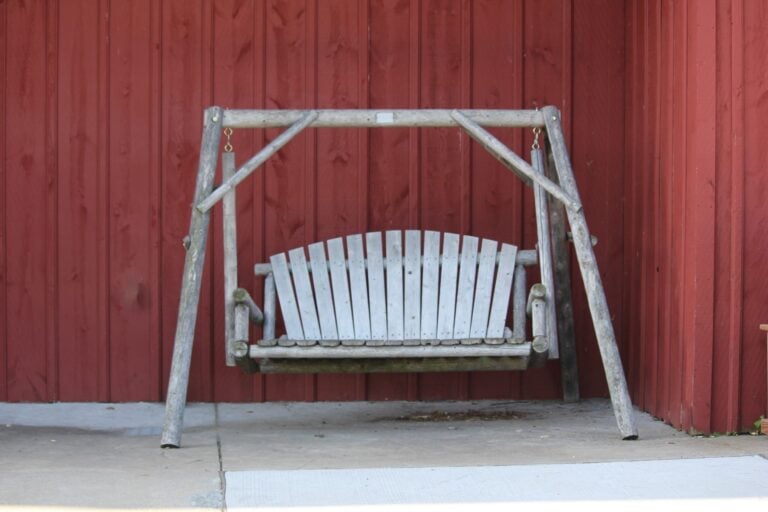
For twenty years there was a porch swing in my father’s barn that had no seat.
The frame hung from two chains my father had bolted into the rafters himself, back when I was sixteen and still thought he could do anything. The slats for the seat were stacked on the workbench under a feed sack, cut and sanded and never joined. He had drilled the holes. He had even sorted the screws into a baby-food jar with the lid screwed onto a board over his head so he would never lose them. And then he had stopped. For twenty years he stopped, and the chains hung there over a dirt floor, swinging a little whenever the big door slid open and the wind off the soybean fields came through.
I am telling you about a porch swing because a porch swing is where my father and I learned how to talk to each other again. But I have to start before that. I have to start with the years we did not talk at all, because if I do not, you will not understand why two pieces of poplar and a handful of brass screws felt, the day we finally set them, like the heaviest thing I had ever lifted.
My name is Oralee. I grew up on a hundred and sixty acres outside Tipton, Indiana, where the corn comes up to the road in July and the whole town empties out into the high school stands on Friday nights in the fall. My father is Wendell Cobb. He is a corn and soybean farmer, the third Cobb to work that ground, and for most of my life he was a man who said about four hundred words a day and meant every one of them. He was not cruel. I want that understood before anything else. He was not a man who yelled or drank or raised a hand. He was a man who went quiet, and in our family quiet was the loudest thing there was.
I disappointed him when I was nineteen. That is the plain way to say it, and I have learned that the plain way is usually the truest. I left.
The leaving
I was supposed to go to Purdue, which was forty minutes up the road and might as well have been the moon, the way my father saw it. The Cobbs did not leave. The Cobbs stayed and worked the ground and were buried in the little Methodist cemetery at the edge of town where the headstones go back to 1881. My grandmother is there. My father’s two brothers are there, one of them younger than I am now. The ground holds us, was the idea, and you do not argue with the ground.
But I did not go to Purdue, and I did not stay either. I met a boy named Castle Renfro at the county fair the summer I was eighteen, a guitar player from over in Kokomo with a van and a band and a plan to drive to Nashville, and three weeks after my high school graduation I climbed into that van and left a note on the kitchen table. I want to tell you the note was a good note. It was not. It was the note of a nineteen-year-old who thought her father did not love her because he did not know how to say that he did. It said I was going to live my own life. It said do not come looking. It said some things about the farm and about being trapped that I would give a great deal to take back now.
My father did not come looking. That was the thing about Wendell Cobb. You told him not to do something and he would honor it to the grave, even when honoring it broke his heart, and I did not understand for a very long time that a man can keep your worst instruction out of respect and have it cost him everything.
Castle Renfro and I lasted nineteen months. Nashville was not what the songs said it was. He found someone else and I found myself twenty-three years old in a duplex in Murfreesboro waiting tables at a pancake house, and I did not call home. Pride is a strange engine. It will run for years on almost nothing. I built a life down there, a smaller and harder life than the one I had left, and I let the silence between me and my father grow until it was a wall, and then until it was just the shape of the world, the way you stop noticing a water stain on a ceiling after enough time. I told people my parents were gone. It was easier than the truth. The truth was that I was the one who had gone.
I missed my mother’s funeral. I want to say that out loud because it is the worst thing I have ever done and I have stopped trying to soften it. My mother, Ardith, died of a stroke in the spring I was thirty-one, and by the time my aunt finally tracked down a phone number for me, the service was four days past. I sat on the floor of a bathroom in Tennessee and I understood that my mother had died believing I did not love her enough to come back, and that was not even the worst part. The worst part was that my father had buried his wife alone, in a church full of people who had known me since I was in diapers, every one of them wondering where the Cobb girl was.
I did not go home even then. I told myself there was nothing to go home to. The wall was the whole world by then.
Get a new story in your inbox every morning.
Facebook doesn’t show you every story we post. Our free newsletter does. Join 2,500+ readers.
The phone call
I was forty-one when the phone rang. Eleven years more of silence had stacked up between me and that farm, and I had a life by then, a real one, a small accounting practice I ran out of a strip mall and a one-bedroom apartment with a balcony where I grew tomatoes in buckets because some part of me could not stop putting things in the ground. I had not married. I had not had children. I had built a life with no doors in it, and I called that being free.
The call was from a woman named Lurene Stutz, who said she was my father’s neighbor and that she hoped I would forgive her for finding my number. She talked for a while in the way that country women talk before they say the hard thing, asking about the weather in Tennessee, telling me about her grandkids, and I knew before she got to it that someone was sick or someone was dead. It was my father. He had been diagnosed with congestive heart failure that spring. He was seventy-three. He was still trying to put in the crop himself, Lurene said, and the men from church were doing what they could, but he was a stubborn old thing and he would not slow down and she was scared and somebody had to tell me.
I said I did not think he would want to see me.
Lurene was quiet for a second. Then she said something I have never forgotten. She said, “Oralee, that man has kept your school pictures on the refrigerator for twenty-two years. He turns them so they face the table where he eats. I have seen it. You can decide what that means, but I am not going to let you decide it wrong from four hundred miles away.”
I drove up the next week. I did not have a plan. I did not have a speech. I had a tomato plant in a coffee can on the passenger seat, which I cannot explain except that I needed to bring him something living, and the corn was just coming up green along the road when I turned in at the mailbox that still said COBB in my father’s handwriting from when I was a girl.
He was on the porch. The front porch, the wood one my great-grandfather built, the one where the swing was supposed to hang and never had, because the swing was in the barn with no seat. He was thinner than I had ever seen him and there was an oxygen line under his nose, and he stood up when my car came up the lane and he held onto the rail, and we looked at each other across forty feet of gravel for a long time.
I thought he might yell. I almost wanted him to. I had built him into something hard in my mind so that leaving him made sense, and a hard man would have been easier to face than what I got.
What I got was my father, with his hat in his hand, saying, “You hungry? I got a chicken thawed.”
That was it. Twenty-two years and he offered me supper. I sat down on the porch steps and I cried in a way I had not cried since the bathroom floor in Tennessee, and my father lowered himself down beside me one slow inch at a time with his bad heart and his oxygen line, and he did not touch me, because he did not know how, and he did not say it was all right, because we both knew it was not. He just sat there with me while I came apart on his porch steps, and when I was done he said, “There’s a swing supposed to go here. I never finished it. You feel up to it, maybe you and me get that thing hung before I’m too wore out to help.”
The barn
I want to tell you about the swing, because I have come to believe that my father knew exactly what he was doing when he pointed me at it, even though he was not a man who could have told you why.
The next morning I went out to the barn. The dew was still on everything and the swallows were going in and out of the eaves, and there in the back, hanging from two chains over a dirt floor, was the frame of a porch swing with no seat. My father had built the frame the winter I was sixteen. I remembered it. I remembered him out there with the shop light and the radio, and I remembered him saying it was for the front porch, for him and my mother to sit in of an evening, and that he would have it done by spring.
He never did. I asked him about it that first morning, standing in the barn with my coffee going cold, and he was a long time answering. Then he said, “Your mother liked to sit out there. After you left she didn’t anymore. Just sat inside. I figured a swing without her in it wasn’t much of a swing, so I quit.”
And there it was. The reason the swing had no seat for twenty years was me. Not in any way you could put your finger on. But my leaving had taken something out of that house, some reason to sit on the porch of an evening, and my father had set down his tools and never picked them up again, and a half-built swing had hung in the dark for two decades like a held breath.
I almost could not do it. I almost said I had to get back to Tennessee. The weight of it was that heavy. But my father came out to the barn behind me, slow, with his oxygen tank on a little cart he hated, and he stood next to me looking at that frame, and he said, “Wood’s still good. Poplar don’t rot in here. We could finish it. Wouldn’t take much.” And I understood that he was not really talking about the swing.
So we started.
The work
I do not know how to make you understand what it is to relearn your father at forty-one through a woodworking project, so I will just tell you what we did, day by day, and you will have to feel the rest of it underneath.
The first thing we found was that the seat slats my father had cut twenty years before had cupped a little in the dry barn air, bowed up in the middle the way old boards do, and could not just be screwed down flat. They had to be planed. My father could not stand long enough to plane them. His heart would not let him. So he sat on an overturned bucket with a quilt my mother had made over his knees, and he taught me to run a hand plane, which I had never in my life done, because at sixteen I had not been interested and he had not known how to make me be.
“Long strokes,” he said. “Let the iron do it. You’re fighting it.” His hands shaped the air over the board, showing me, because he could not do it himself anymore. “There. You hear that? When it sings like that, that’s right.”
I planed slats on the barn floor for three days while my father sat on a bucket and listened for the sound of the iron singing. We did not talk about Nashville. We did not talk about my mother’s funeral. We did not talk about the note I left on the table. We talked about wood. We talked about whether the grain was running the right way and whether to use brass screws or stainless and whether my mother would have wanted the swing stained dark or left natural, and somewhere in all that talk about wood we were saying the other things too, the way you can carry a heavy thing together more easily than you can hand it back and forth.
On the fourth day my father told me about the war. He had been in Korea, which I knew, but he had never once spoken of it, and that afternoon while I was drilling the pilot holes he started talking about a man named Ozro Pfeatherston from his unit, a farm kid from Nebraska who had died next to him in the cold, and how he had promised Ozro he would not waste his life, and how he had come home and put his head down and worked the ground and never wasted a day, and how somewhere in all that working he had forgotten that not wasting your life and not living it are two different things. “I gave you the working,” he said. “I never gave you the living. Your mother kept saying it. I couldn’t hear it.” He had to stop then to catch his breath, and I set down the drill and sat next to him on the floor of the barn, and that was the closest we came, that first week, to saying the real thing.
The bad night
There was one night in the middle of the work that I almost lost him before we ever hung the seat, and I have to tell it, because it is the night I stopped being a daughter who had come to visit and became a daughter who had come home.
It was the eighth or ninth day. We had planed the slats and were drilling, and my father had been short of breath all afternoon and would not admit it, the way he would not admit anything that suggested the body had a vote in his plans. I had gone to bed in my old room around ten, listening to the house tick and settle the way it had when I was a girl, and around two in the morning I heard a sound from his room that was not a sound a sleeping man makes. I went in and found him sitting on the edge of the bed fighting for air, his lips a color lips are not supposed to be, his oxygen line tangled and pulled loose from the concentrator in his struggle.
I got the line back on him. I got him propped up the way the cardiologist had shown me, and I sat on the floor in front of him holding both his hands and counting his breaths out loud so he would have something to follow, the way you would talk a person down off a ledge. For a long time I did not know if I was going to have to call the squad, and I did not know if the squad would get there in time on our gravel roads in the dark, and I sat there at two in the morning realizing that I had wasted twenty-two years of the man whose hands I was holding, and that I might have come home only in time to watch him go.
He came back from it slowly. Around three the color came back into his face and his breathing eased, and he looked at me sitting on the floor in front of him in my mother’s old nightgown that I had found in a drawer and started wearing because it smelled like the house, and he said, “You stayed.” Not a question. Like he was checking a fact against the world. I said of course I stayed. And he said, “Your mother used to count my breaths like that.” Then he was quiet a while and he said, “I’m glad it was you. At the end of a thing like that, I mean. I’m glad I opened my eyes and it was you.” We did not finish drilling the next day. We just sat. But something had changed in the night, and I think both of us knew the swing was no longer the thing we were building.
What the neighbors did
Word gets around in a town like Tipton. By the second week, men I had known my whole life were finding reasons to come by. Delbert Yonce, who farmed the next section over, showed up with a belt sander he thought we could use and stayed two hours. The minister, a young fellow named Pastor Errett who could not have been thirty, came out and held boards while I screwed them and asked my father about the old days. Lurene Stutz brought a casserole every few days and pretended she was just passing, and once I caught her standing in the barn door watching my father teach me to set a screw without stripping it, and she had her hand over her mouth and her eyes were wet, and she saw me see her and she just shook her head and went back to her car.
These were the people who had watched my father bury his wife alone. These were the people who had wondered where the Cobb girl was. Not one of them said a word about it to me. In a city I think someone would have. Out there the way they forgive you is they hand you a board and they hold the other end. The whole town was finishing that swing with us and not one of them ever said so out loud.
There was an evening in there I keep coming back to. My father got tired early and went in to lie down, and I stayed out in the barn alone to finish sanding the armrests, and Delbert Yonce was still there, sweeping up shavings he did not need to sweep. After a while he said, not looking at me, “Your dad talked about you every Friday at the feed store. Twenty years. Always ‘my girl down in Tennessee.’ Never once said a hard word about you. Folks took their cue from that.” Then he set the broom against the wall and said goodnight and went home, and I sat down on an upturned crate and understood that my father had spent twenty years protecting my name in a town where everyone knew exactly what I had done, and had never told me, and would have died without telling me if a porch swing had not forced us into the same room for long enough.
Finishing it
It took us nineteen days to finish a porch swing that two healthy men could have built in a weekend. I am glad it took that long. I have come to think the slowness was the whole point, that God or my father or the both of them stretched the work out so that we would have to keep showing up, morning after morning, until the showing up became its own kind of language.
We planed the slats flat. We drilled the pilot holes and set the brass screws from the baby-food jar my father had filled twenty years before, and I want you to know that not one of those screws was rusted, because my father had put the lid on tight, the way he did everything, with a faith in the future he could not feel but could not stop practicing either. We stained it natural, the way my mother would have wanted, because my father decided, on the bucket with the quilt over his knees, that Ardith had been a natural-wood kind of woman and he was not going to start guessing wrong about her now.
And on the nineteenth day we hung the seat.
My father wanted to be the one to set the bolts that joined the seat to the chains. He could not really do it. His hands shook and he could not raise them over his head for long. So we did it together. I held the seat up at the height and he started the bolt and I turned the wrench, his hand over my hand on the wrench, my hand over his on the cold iron of the chain, and between the two of us, one whole person, we hung the seat that had waited twenty years in the dark.
Then we carried it out of the barn. It is not a long walk from the barn to the front porch, but we made it last, the two of us shuffling across the yard with a porch swing between us, the cart with his oxygen tank dragging along behind, and we hung it from the chains my great-grandfather’s grandson had bolted into the porch ceiling, and my father sat down in it first.
He sat down in the swing he had built for my mother twenty years before, on the porch where she used to sit before I broke something that took twenty years to mend, and he patted the seat next to him, and I sat down, and we swung.
We did not say anything for a long time. The corn was up green to the road. The swallows were working the evening for bugs. Somewhere off toward town the lights were coming on at the high school field for the first football scrimmage of the year, that particular glow on the underside of the sky that means fall in a town like ours. My father pushed us with one foot, slow, the way you would rock a baby, and the chains made a small sound, a settled sound, the sound a thing makes when it is finally where it was always supposed to be.
“There,” my father said. Just that. “There.”
The last summer
My father lived fourteen more months. I would like to tell you the swing fixed his heart, but it does not work that way. What it fixed was the other thing, the thing between us, and that turned out to be the thing worth fixing.
I did not go back to Tennessee. I closed the accounting practice over the phone and I moved home, into my old room, which my father had not changed, which I had been too ashamed to look at the first week and which I came to love. I drove him to his cardiologist in Indianapolis. I learned to cook the few things he could still eat. And every evening, every single evening that the weather allowed, we sat in that swing on the front porch and we swung, and we talked, and over fourteen months I got back nearly everything I had thrown away in a van when I was nineteen.
There was a night a thunderstorm came through, one of those flat-country storms that you can watch coming for an hour, the whole western sky going green-black over the corn while the air goes still and the birds quit. Anyone with sense would have gone inside. My father wanted to sit in the swing and watch it come. So we did. We sat on the porch under the overhang with the rain finally coming in sheets across the yard and the lightning standing up white over Delbert Yonce’s section, and my father held my hand on the swing and was not afraid of any of it, and he said, “Your mother loved a good storm. Said it was the only time the sky was as honest as she was.” We sat there until the worst of it passed and the frogs started up in the ditch, and I thought, this is what the swing was for. Not for fair evenings. For this. For having somebody’s hand to hold when the sky goes honest.
He told me about my mother, all the things I never knew, how they met at a barn dance in 1968 and how she beat him at euchre the first night and how he knew right then. He told me about his brothers. He told me about Ozro Pfeatherston in the cold in Korea, the whole story this time, and he cried, and I held his hand on the swing while the chains creaked. I told him about Nashville, the real version, the hard version, and he did not flinch from any of it. One evening near the end he said, “I’m sorry I made you feel like the ground was a cage. It was the only thing I knew how to give you. I should have given you the door too. Your mother knew that. I’m slow. I always was slow.” And I told him the leaving was mine, not his, that I had been a frightened girl who mistook silence for coldness, and we forgave each other out there on the swing in a way that did not need a lot of words because we had already said most of it through nineteen days of poplar and brass screws.
He died on an October morning the next year, in his sleep, in the house. I was in the next room. The last evening of his life we sat in the swing and watched the combines work the field across the road under the harvest lights, and he said the corn looked good this year, and it did.
What I know now
I still live on the farm. I rent the ground out to Delbert Yonce’s son now, but I kept the house and the barn and the porch. I am fifty-one years old and I sit in that swing nearly every evening, alone now, and it does not feel empty the way my father once said a swing without my mother in it felt empty. It feels full. It holds all of them, somehow, my father and my mother and Ozro Pfeatherston from Nebraska and Lurene Stutz who would not let me get it wrong from four hundred miles away and Delbert Yonce who told me the truth with a broom in his hand.
I tell young people now, the few who will listen, that the thing you are most ashamed of is usually a door, not a wall, and that you do not have to know the right words to walk back through it. My father and I did not have the words. We had a half-built swing in a dark barn and the willingness to pick up the tools, and it turned out that was enough, that the words come after, that you can build your way back to a person one brass screw at a time when the talking is too hard.
If there is someone you have gone quiet with, someone you have built into something harder than they really are so that the silence makes sense, I will tell you what Lurene Stutz told me. You can decide what their silence means, but do not decide it wrong from far away. Go and stand in the same room with them long enough to find out. Find the thing you both left unfinished, the swing in the barn, the garden gone to weeds, the recipe never finished, the song never recorded, and pick up the tools, and start.
My father left a porch swing half built for twenty years. I came home and we finished it together, his hand over my hand on the wrench. He has been gone six years now. The swing still hangs. The chains still make that settled sound. And every evening when I sit down in it and push off with one foot, slow, I am sitting in the proof that it is never, ever too late, right up until it is, and that the trick is to not wait twenty years to find out which one it is.
It was the last thing my father and I built. It was the first thing we ever finished together. And it was worth coming home for.
This story is a dramatization. Names, characters, and details are invented, and any resemblance to real people or events is coincidental.