
For forty-one years I slept beside a man who never told me about the war, and I made my peace with the quiet long before I understood it. I want to start there, with the quiet, because if you knew Daniel only by his silence you would have thought him cold. He was not cold. I know that now. I know it the way you know a thing too late, sitting on a closet floor at midnight with a shoebox in your lap and your own husband’s handwriting blurring under your eyes.
His name was Daniel Reese. He served in the United States Army, an infantryman, a sergeant by the time he came home in 1969. I met him two years after he got back, at a church social in Marietta where neither of us wanted to be, and I have told the story of that night so many times it has worn smooth, like a stone in a river. He brought me a paper cup of weak punch and said almost nothing, and I thought he was the most serious man I had ever seen. I was twenty-three. I mistook his silence for depth, and I was not entirely wrong, but I did not understand yet how much that silence had cost him, or how much it would cost us both.
This is the story of what I found after he died. It is the story of a box he hid for half a century, and the man inside it I never got to meet until he was gone.
The recliner and the quiet
Daniel passed on a Tuesday in March. He was seventy-four. His heart, which had carried him through things I am only now learning, simply stopped one afternoon while he sat in his recliner with the television off and the window open. The doctor said it was peaceful. I believe that, and I am grateful for it, and I will also tell you that there is a special cruelty in losing a quiet man, because the silence he leaves behind sounds exactly like the silence he lived in. For weeks I could not tell the difference. I would walk past his chair and half expect him to be sitting there not talking, the way he always was.
We had a good marriage. I want that on the record before I tell you the rest, because what I found could be read as a sad story, and it is not, not entirely. We raised two children. We paid off a house. We danced badly at weddings and held hands at funerals and argued about the thermostat for forty years. Daniel was a kind man, a steady man, the kind who fixed the neighbor’s fence without being asked and never mentioned it. But there was a room in him I was never allowed into. I knew where the door was. I had stood outside it our whole life together.
He never talked about Vietnam. Not once, not really. When the children asked, when they were small and cruel the way small children are cruel without meaning it, he would say “that was a long time ago” and change the subject so gently you did not notice you had been moved. On the Fourth of July he found reasons to be in the garage. He flinched at fireworks but pretended he did not. Some nights he woke up with his hands working at the blanket like he was looking for something, and I learned not to ask what. I learned a great many things not to ask. A wife of a quiet man becomes fluent in the questions she will never get to ask, and I told myself that was love. Maybe it was. Maybe it was also fear, mine and his both, dressed up as respect.
So when he died I did not expect to learn anything new about him. That is the thing about a quiet man. You assume the silence is empty. You assume there is nothing in the locked room but more of the same dark. You never imagine the room is full.
The closet
It was three weeks after the funeral when I started on his closet. Everyone tells you to wait, and everyone is right, and I waited as long as I could stand. The casseroles had stopped coming. The phone had gone quiet. My daughter offered to fly back down and help me, and I told her no, this was mine to do. I think I knew, even then, without knowing why, that whatever was in that closet was meant for me alone.
His shirts still smelled like him. That is the part nobody warns you about. You can survive the funeral, you can survive the paperwork, you can survive the casseroles, but then you press your face into a flannel shirt that has not been washed and forty-one years come down on you all at once and you sit on the floor and you are no use to anyone for an hour. I let that happen. I gave myself the hour.
Then I started boxing things up, the way you do, and that is when I found it. Up on the high shelf, behind the winter blankets, all the way in the back where you would have to be looking. A shoebox. Old, the cardboard gone soft and furred at the corners, held shut with two rubber bands so old they had half melted into the lid. There was no label. There was nothing to tell me what it was. But I knew Daniel, and Daniel did not keep things without reason, and a box hidden that carefully behind that many blankets was a box that did not want to be found by accident.
I sat down on the edge of the bed and I worked the rubber bands off and they crumbled in my fingers. I lifted the lid.
Get a new story in your inbox every morning.
Facebook doesn’t show you every story we post. Our free newsletter does. Join 2,500+ readers.
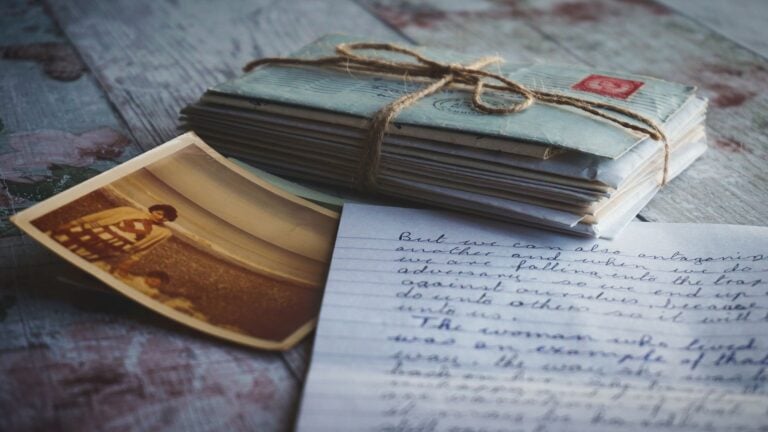
It was letters. Dozens of them. Envelopes, the thin blue airmail kind they used to use, every one of them addressed in Daniel’s careful hand to the same place. To his mother’s house on Pickett Street, the house he grew up in, the house that had been gone twenty years. Some were addressed to me, though we had not met yet when he wrote them, addressed to “my girl, whoever she turns out to be.” Every single envelope was sealed. Every single one had a stamp. And not one of them, not a single one in that whole box, had ever been mailed.
He had written home from the war for two years. And he had never sent the letters.
The first one
I did not read them all that night. I want to be honest about that, because it would make a tidier story if I told you I sat there until dawn and read every word, but the truth is I read three and then I could not breathe and I put the lid back on and I went and sat in his recliner in the dark, which I had not done before, and I stayed there until the sky turned gray.
The first one I opened was the oldest, the one on the bottom, dated October of 1967. He was nineteen years old. I had forgotten he was nineteen. You forget, with a man you knew as old, that he was ever that young, that the hands you held when they were spotted and shaking were once the hands of a boy.
He wrote: “Dear Ma. I am all right. Do not believe what they say about over here, it is mostly waiting and heat and I am getting good at cards. The food is bad but there is plenty of it. Tell Pop I am keeping my boots dry like he said. I will write again when there is something worth saying.”
That was the whole letter. Cheerful. Careful. A boy reassuring his mother. I read it twice and I thought, this is sweet, this is nothing, why did he never send this, and then I understood, slowly, the way the cold gets into a house. He never sent it because it was a lie. Not a cruel lie. The kindest kind. He was writing the letters a mother would want to read, and then he was not mailing them, because to mail them was to make her live in the lie with him, and he could not do that to her. So he wrote the comfort, and he kept the comfort, and he carried the truth alone.
The later letters told me that. The later letters are how I know.
What he could not send
They changed. You could watch it happen across the box, the way you can watch a season change if you have the patience to sit still. The handwriting stayed careful, Daniel was careful to the end of his life, but the words underneath it started to crack.
There was one from the spring of 1968. By then he had stopped pretending the letters were going anywhere, I think, because this one did not start with “Dear Ma.” It started with “I have to tell somebody.” And then it told. I am not going to put all of it here, because some of it belongs only to him and to me, and because there are things a nineteen-year-old saw that no mother on Pickett Street should ever have had read to her at her kitchen table, which is exactly why he never sent it. But I will tell you the shape of it.
He wrote about a boy named Tomlin. Private Tomlin, from Ohio, eighteen, who carried a photograph of a girl he was going to marry and showed it to anyone who would look. Daniel wrote that Tomlin was loud and clumsy and got on everyone’s nerves and that he, Daniel, had been short with him the day before, had told him to shut up about the girl already. And then he wrote, in that careful hand, that Tomlin had stepped where Daniel had told him not to step, and that there had not been enough left to send the photograph home with.
He wrote: “I keep thinking I should write his girl. I have her name. But what would I say. That he was annoying and I told him to shut up and then he was gone. That is the last thing I gave him. There is no letter for that. There is no letter you can mail for that.”
I sat with that one a long time. There is no letter you can mail for that. He was nineteen when he understood something it has taken me seventy-some years and his death to understand. Some things cannot be sent. Some grief has no address. So he wrote them anyway, into a box, to a house, to a mother, to a girl he had not met yet, and he sealed them and stamped them and sent them nowhere, because the writing was the only part he could do and the mailing was the part that would have broken the people he loved.
The man at the breakfast table
I have to back up now and tell you about our life, because the letters changed everything I thought I knew about it, and I cannot make you feel that unless you knew it the wrong way first, the way I did.
There was a morning, this would have been 1974 or so, when Daniel did not come to breakfast. Our son was a baby. I had eggs going and I called for him and he did not come and I found him standing in the back doorway looking out at nothing, at the yard, at the gray morning, and when I touched his arm he came back from somewhere very far away and he said “sorry” and sat down and ate and we never spoke of it. I filed it under “Daniel is strange in the mornings sometimes.” I was young. I had a baby and a budget and a list. I did not have room to wonder where my husband went when he stood in the doorway, and he did not have words to tell me, and so a moment that I now know was him standing in a rice paddy ten thousand miles and seven years away got filed under “strange in the mornings.”
How many of those were there. That is the question that will not let me go now. Forty-one years of mornings. How many times did he go back to a place I did not know existed, and come back, and butter his toast, and ask me to pass the salt, and never let on, because letting on would have put me in the doorway with him and he would not do that. He carried it the way he carried the letters. Written, sealed, stamped, and never sent. The cost of it always paid by him and never by us.
There was a letter in the box from late 1968, near the bottom of that year, that I think about more than any of the others. It was addressed to “my girl, whoever she turns out to be.” Me. He was writing to me before he knew my face. He wrote: “I do not know who you are yet but I am going to find you when I get back and I am going to be good to you and I am never going to make you carry this. You are going to think I am quiet. I am sorry about that ahead of time. Just know the quiet is a gift. The quiet is everything I am not going to put on you. I love you already, whoever you are.”
I am going to be good to you and I am never going to make you carry this.
Forty-one years. He kept that promise to a stranger he had not met. He kept it so completely that the stranger, who became his wife, who became me, spent the whole marriage thinking the locked room was empty. He let me think he was simply quiet. He let me think it because the alternative, the truth, was a thing he had decided, at twenty years old in a war, that he would carry alone so that I would never have to. The cruelty of war is loud. Daniel’s answer to it was the quietest thing I have ever known, and I lived inside that quiet for four decades and mistook the gift for the man’s whole nature.
The ones for the children
There were letters for the children too, though they were born years after the war. He must have written them later, must have taken the box down sometime in the seventies or eighties when the house was asleep, and added to it. The handwriting was older. The paper was different.
There was one for our daughter Ruth. She had been a difficult teenager, the way bright girls are, and there had been a stretch of years where she and Daniel barely spoke, where she found him cold and unreachable and told me so, told me her father did not love her, and I defended him without being able to explain him, because I could not explain him to myself. In the box there was a letter to her, never given, that read: “Ruthie. You think I am hard on you. You think I do not feel things. I feel everything. I just learned a long time ago in a bad place that if you let it out it does not stop, so I hold it in, and sometimes holding it in looks like not caring, and I am sorry. You are the best thing I ever did. I would tell you that out loud if I knew how. I am putting it here in case I never learn.”
In case I never learn. He never learned. He never said it out loud to her. But he wrote it, and he kept it, and the night I found it I called my daughter at one in the morning, which I never do, and I read it to her over the phone, and we both cried for a long time on a long-distance line, and when she could finally speak she said “all those years,” and I said “I know,” and we left it there, because there is no end to that sentence. All those years. The letter was forty years late and it arrived exactly when she needed it, which is to say after she had spent half her life believing a thing about her father that was the precise opposite of the truth.
There was one for our son too, our Michael, and it was a harder thing to read because Michael had wanted to enlist at eighteen, the way boys do, and Daniel had said no. Had put his foot down in a way he almost never did. There had been a terrible fight, the only real shouting I ever heard from Daniel in our whole life, and Michael had called his father a coward and a hypocrite, a veteran who would not let his own son serve, and Daniel had taken it, had stood there in the kitchen and taken every word and not defended himself, and I had not understood that either. Michael went to college instead and grew up and forgave it, the way you do, and decided his father had just been overprotective. In the box there was a letter that explained the silence in that kitchen. It read: “Mikey. You think I am a coward for telling you no. Someday you will have a son and you will understand. I have seen what it does. I have carried what it does for twenty years and you do not know I am carrying it because I made sure you would not know, and that is the whole point, that is the entire reason I will not let you go. I am not protecting you from dying. I am protecting you from coming home. There are worse things than not going, and I know every one of them by name, and I am never going to teach them to you. Call me a coward. I would rather be your coward than your ghost.”
I would rather be your coward than your ghost. He stood in that kitchen and let his own son believe he was small, because the truth, the real reason, would have meant opening the box, and he had decided the box would never open while he lived. He absorbed his son’s contempt the same way he absorbed everything else, silently, completely, alone, and he wrote the answer down and sealed it where no one would find it until it could not hurt anyone anymore. Forty years that boy carried a wrong idea of his father, and his father chose that, chose to be misjudged by his own child rather than lay the weight of the truth on him for even one afternoon.
Why he could not say it
I have read every letter now. It took me a month. I could only do a few at a time, and then I would have to stop and go sit in his chair. I know things about my husband now that I did not know when he was alive to be asked, and the strangest part, the part I keep turning over, is that I am not angry. I thought I would be angry. I thought I would feel cheated, all those years of not knowing, all those mornings in the doorway I could have stood beside him for if he had only let me. But I am not angry. Because the letters explain the only thing I never understood, and the explanation is not coldness. The explanation is love so heavy he could not lift it onto anyone else.
There is a letter from his last year over there, 1969, that says it plainest. He wrote: “When I get home I am going to be quiet. I have decided. I am going to find work and find a girl and be quiet. People are going to ask me what it was like and I am going to say it was a long time ago. That is not a lie. It is going to be a long time ago, soon, and I am going to make it a long time ago by not letting it be now. The only way out of this is to not bring it home. So I am leaving it here, in this box, and I am going home empty-handed and I am going to fill my hands with something better.”
I am going home empty-handed and I am going to fill my hands with something better.
He filled them with me. With the children. With the fence he fixed and the weddings he danced badly at and the recliner he died peaceful in. He took the war and he sealed it in a box and he hid it behind the winter blankets, and then he went out and built a whole quiet good life on top of it, and he never let the war into one single day of that life if he could help it. The silence I spent forty years not understanding was not the absence of a man. It was the daily, deliberate, exhausting work of a man keeping a promise to people he loved more than he loved his own need to be understood.
Do you know how lonely that is. I do now. I learned it from a box. He chose it every morning for forty-one years and he never once made me share the weight, and the only way I ever found out was because he could not take the box with him when he went.
The one he wrote at the end
The last letter in the box was on top, the newest, and it was the only one not in an envelope. It was not sealed. It was not stamped. It was folded once, and it had my name on it, my real name, the name he called me, and the date was just two months before he died. He had taken the box down one last time and he had written one more, and this one he had not sealed, because I think, I have to believe, that this one he meant for me to find.
It said: “If you are reading this then I am gone and you have found my box and I am sorry and I am not sorry. I am sorry you had to find it this way. I am not sorry I kept it from you. I would do it again. You gave me the life I promised that girl I would have, the one I did not know would be you. I kept the worst of it off of you for forty-one years and that is the thing I am most proud of in my whole life, more than the war, more than the medals, more than any of it. You will read these now and you will know me finally and I am sorry it is too late to talk about it but you know how I am. I was never going to be able to say it out loud. So it is here. Everything I could not say is here. I loved you in a way I did not have the words for, so I am leaving you all the words I did have. They were just in the wrong box the whole time. They were always for you.”
They were always for you.
What I do with it now
I had the letters bound. There is a man in town who does that kind of work, and I gave him the whole box, gently, the way you hand over something alive, and he made them into a book, and I keep that book on the table by Daniel’s chair. My children have read it. My grandchildren will read it when they are old enough to understand that the quiet grandfather they barely remember was, the whole time, a nineteen-year-old boy writing letters home that he loved his family too much to send.
I sit in his chair in the evenings now. I did not used to. It felt like trespassing while he was alive and it felt like grief at first after he was gone, but now it feels like company. I sit where he sat and I look out the window he looked out and I understand, finally, where he used to go. He was not gone when he sat there quiet. He was holding the box shut. He was doing the work. He was keeping me out of the doorway one more evening, one more evening, for forty-one years.
People ask me sometimes, the ones who know, whether it hurts to have found out so late. And I tell them the truth, which surprises them. It does not hurt the way they think. What I feel, mostly, is honored. He picked me to be the one he was good to. He picked me to be the life he built on top of the box. Out of the whole world, out of all the noise and the loss, that boy decided that some unknown girl was going to get a quiet, gentle, faithful man and never have to know what it cost him, and that girl was me, and he kept that promise to the last morning of his life.
I would have stood in the doorway with him. I want you to know that. If he had ever once let me, I would have stood there and held his hand and looked at the gray morning and gone wherever he went. I would not have been afraid. But I understand now why he never asked, and I cannot even be angry about it, because the reason he never asked is the same reason I loved him in the first place. He was the most serious man I ever met. I mistook his silence for depth. I was right. I just did not know how deep, or what was down there, or that all of it, every word of it, had been written down and sealed and stamped and saved, forty-one years, in a shoebox behind the winter blankets, addressed to a girl he had not met yet.
It was me. It was always me.
If you have a quiet one in your life, a husband or a father or a brother who came home from somewhere and never talked about it, I am not going to tell you to make him talk. The letters taught me better than that. Some men carry their war so the rest of us can carry nothing, and the carrying is the love, and you cannot make a man set down a thing he has decided to hold for your sake. But I will tell you this. Sit with him. Sit in the quiet and do not fill it. Let him know the doorway is not lonely even if he will not let you in. Because the only thing worse than carrying it alone is thinking that no one ever even wondered what you were carrying.
I wondered, Daniel. I always wondered. And now I know. And I am keeping the book by your chair, and I am sitting in it every evening, and I am not afraid of the quiet anymore, because I finally know what it was. It was the loudest love I ever heard. It just took you forty-one years and a shoebox to let me hear it.
I am all right, my love. Do not believe what they say about over here. It is mostly waiting now, and quiet, and I am getting good at it. I will write again when there is something worth saying.
There is always something worth saying. You taught me that. You taught me with a box of letters you never mailed. I am mailing this one. I am sending it to wherever you are.
I love you already, you wrote, whoever you are.
It was me.
This story is a dramatization. Names, characters, and details are invented, and any resemblance to real people or events is coincidental.