
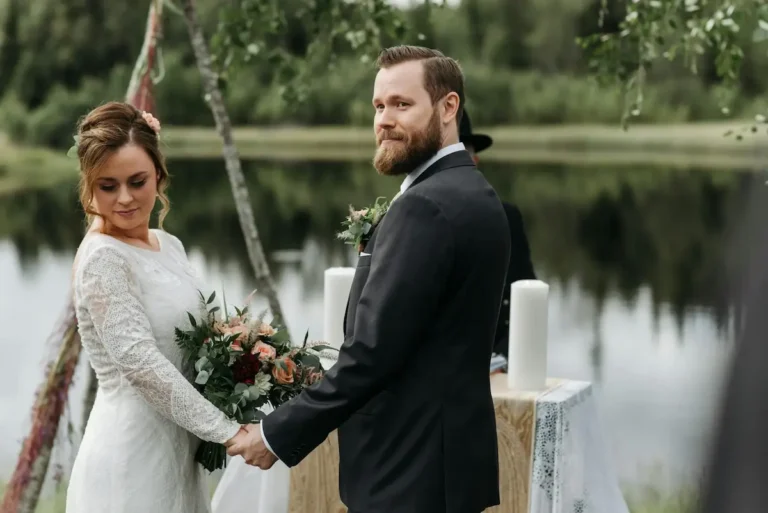
Stephanie was already crying before she reached the end of the aisle. I watched her walk toward Marcus through a blur of my own tears, holding David’s arm, and I thought: we almost didn’t make it here. Not to this garden, with its string lights and white chairs and the smell of jasmine in the June air. We almost didn’t make it to each other.
David squeezed my hand. I let him.
Ten years ago I would not have let him.
The ceremony was everything Stephanie had wanted. Simple. Honest. The officiant talked about marriage being a choice you make not once but every morning, and I felt David go still beside me. I kept my eyes on our daughter. I kept my breathing even. I have had a lot of practice keeping my breathing even.
It was 2015 when I found the credit card statements. Four of them, tucked inside an old shoebox on the top shelf of David’s closet, behind his winter sweaters. I wasn’t snooping. I was looking for the Christmas ornament box. That’s the thing nobody tells you about discovering your husband has been lying to you for three years: it happens on an ordinary Tuesday in December when you are just trying to find the ornaments.
Sixty-two thousand dollars. That was the number. Sixty-two thousand dollars in debt David had accumulated and hidden from me while we talked about refinancing the house and saving for Stephanie’s college and whether we could afford a new furnace. While I clipped coupons. While I said no to things and told myself we were being careful, being responsible, building something solid.
We were not building something solid. We were building on sand, and only one of us knew it.
He had started with one card during a slow period at his business. Just to cover payroll, he told me later. Just until things picked up. But things didn’t pick up fast enough, and he opened another card, and then another, moving balances around, paying minimums, telling himself it was temporary. He told himself that for three years. He told me nothing.
I asked him once, during those two years we were trying to find our way back, why he hadn’t just told me. We were sitting at the kitchen table at eleven o’clock at night, the way we sat at that table dozens of times during that period, talking in circles, trying to understand something that resisted understanding.
Get a new story in your inbox every morning.
Facebook doesn’t show you every story we post. Our free newsletter does. Join 2,500+ readers.
He said: I was ashamed.
I said: I know. But you chose your shame over our family.
He didn’t have an answer for that. I didn’t expect one. Some things are true and painful and don’t have answers, and that was one of them.
We went to counseling. We made a budget. We sold the boat David loved and I didn’t care about and put the money toward the debt. We had hard conversations and then harder ones and then some that were so raw I would get up from the table and stand at the kitchen sink and look out at the backyard until I could breathe again. Stephanie was seventeen then, away at her first year of college, and I was grateful she didn’t see most of it.
We made it through. That is what I tell people when they ask, the ones who know. We made it through. Which is true, and also incomplete. You can make it through something and still carry the weight of it. You can forgive someone and still feel, some mornings, the echo of the old wound.
The thing I never said: I forgave him for the debt. I forgave him for the lies. What I never fully said, out loud, to his face, was that what broke me wasn’t the money. It was the three years of looking at him across the dinner table while he knew something I didn’t. The three years of him watching me worry about smaller things while he sat with the real thing locked inside him. I felt like a fool. I felt like someone who had not been trusted with her own life.
I never said that exactly. I came close a few times. But saying it felt like it might break something that was finally, carefully, starting to hold.
At the reception, after the toasts and the first dance and the moment when Marcus dipped Stephanie and everyone laughed, David and I found ourselves at a table alone for a few minutes. The band was playing something slow. The grandchildren were chasing each other near the fountain. The sky had gone that deep blue it goes in June just before full dark.
David said: I keep thinking about how close we came.
I said: I know.
He said: I don’t think I ever told you what it was like. From my side. The weight of it.
I looked at him. After thirty-one years I know his face the way I know my own hands. I can read him in the set of his jaw, the way he holds his shoulders. He was not making excuses. He was trying to finally give me something.
He said: Every single day I woke up knowing. And every single day I told myself today would be the day I’d fix it enough to tell you. And it never was. And I watched you, and I hated myself, and I couldn’t find the door out. I was so far inside it. I couldn’t see how to come back without losing everything.
I said: You almost lost everything anyway.
He said: I know. I know that. What I’m trying to say is that I wasn’t choosing my pride over you. I was terrified. I was more terrified than I have ever been in my life and I made the worst possible choice and I have never stopped being sorry for it.
Something shifted. Small, but real. The way a window lets in air you didn’t know you needed.
I said: I felt like you didn’t trust me. Like you didn’t think I could handle the truth.
He said: You could have. You’re the strongest person I know. That was never the question. I didn’t trust myself. I was so ashamed of what I’d done that I couldn’t stand for you to see it. It was never about you not being enough. It was about me being too small to face what I’d done.
Across the garden, Stephanie was laughing at something Marcus had said, her head thrown back, completely happy. She has his eyes, David always says. She has my stubbornness, I always say. She has, I think, the best of both of us, which is what you hope for.
I took David’s hand. His hands have gotten older. Mine have too.
I said: I needed to hear that. I didn’t know I still needed to hear it, but I did.
He said: I should have said it years ago.
I said: You’re saying it now.
The band shifted into something livelier and a group of Stephanie’s college friends pulled each other onto the dance floor. David looked at me with that look he has, the question in it, and I nodded, and we walked out there together, two people who almost didn’t make it, dancing at our daughter’s wedding in the June dark.
I have thought about that conversation many times in the months since. About how long I carried a thing I didn’t know I was still carrying. About how a few true sentences, said honestly and without defense, can open a door that has been quietly closed for years.
Marriage is long. That is what nobody tells you when you are standing at the altar. It is longer than you can imagine, and it will ask more of you than you think you have, and there will be seasons of it that feel like pure survival. But if you stay, if you both choose to stay and do the work and keep turning toward each other even when it’s hard, you get something you could not have gotten any other way. You get a person who has seen the worst of you and is still there. You get a history that belongs to no one else.
You get to dance with them at your daughter’s wedding, in a garden full of string lights, when the sky has gone that deep June blue.
That is not nothing. That is, I think, everything.