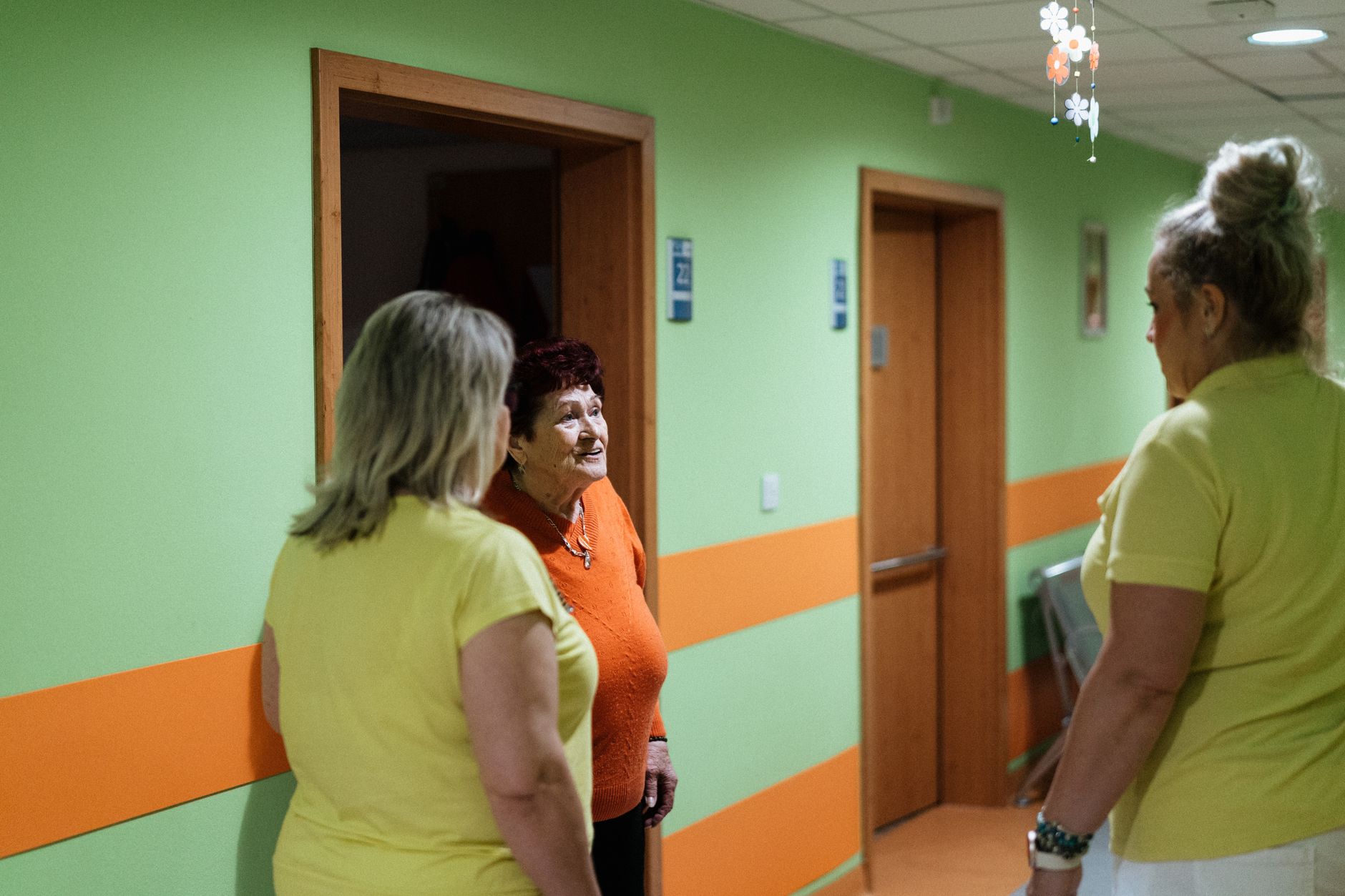
The Chair in the Hospital Hallway
I do not remember calling 911. I remember the paramedic, a young man named Tyler who used to be in my cafeteria line, and holding my husband’s hand in the back of that ambulance with the siren going, and him saying, over and over, in a voice I barely knew, “Don’t let me go in there by myself.”
“I won’t,” I told him. “I’m right here.”
A heart attack, the doctor said, a bad one, and worse than that, because his heart had been quietly failing for a while and none of us had known. They moved him up to the fourth floor, to a small unit of six beds. By noon he was sedated and on a breathing machine. A cardiologist named Dr. Rao sat me down in a little consultation room and told me in plain words that Ed’s heart was not going to recover. He said we might have days.
I called Kristen from that little room. It was the hardest call I have ever made, and the shortest.
“Your daddy’s in the hospital,” I said. “It’s his heart. It’s bad. You need to come.”
She was quiet for about three seconds.
“I’m on my way,” she said. And she hung up.
For the first couple of hours, before she arrived, I sat at Ed’s bedside, and no one stopped me, because I was his wife and nobody had written anything down.
At two in the afternoon Kristen came through the double doors, hair pulled back, car keys still in her fist. She went to her father’s bed. She did not look at me. She stood over him a long time and put her palm flat on his forehead the way you do with a child who has a fever, and her face crumpled once and then closed again, the way a fist does. Then she went to the desk and asked to see the paperwork.
Here is the part I need to be fair about. Twelve years ago, after Ed’s first stent, a lawyer in Glasgow sat the two of us down to do our wills and what they call advance directives. Ed told me privately that he did not want me to carry the decision of who should speak for him. “You’d never be able to make the call, Marcie,” he said. “Kris has a head for it.” I told him he was right. I put our daughter’s name on that line myself, and I would do it again.
What neither of us thought about was that a paper which gives a person the right to speak for a man’s medical care does not give her the right to be cruel. But it does not say she cannot be, either. And a hospital, with no way to know what is in anybody’s heart, hands a frightened daughter a clipboard and says, “Who may visit?”
By four that afternoon Kristen had written: Kristen Hargis. Brad Hargis. Wyatt Hargis. Ellie Hargis. Harold Dole, Ed’s brother, who lives in Nashville.
She did not write mine.
I found out at suppertime, when I came back from the cafeteria downstairs with a paper cup of coffee and the doors would not open for me.
Do you want to know what I felt? I will tell you, since this is a confession and I do not want you to think I am a saint. I felt like someone had reached into my chest and slammed a drawer. I felt a rage so clean that my hands shook around the coffee cup. I thought of thirty years of ball games and the screen door hinge and every Sunday Ed had spent in the middle, and the fact that this was his last Sunday and she had decided I was not allowed to share it.