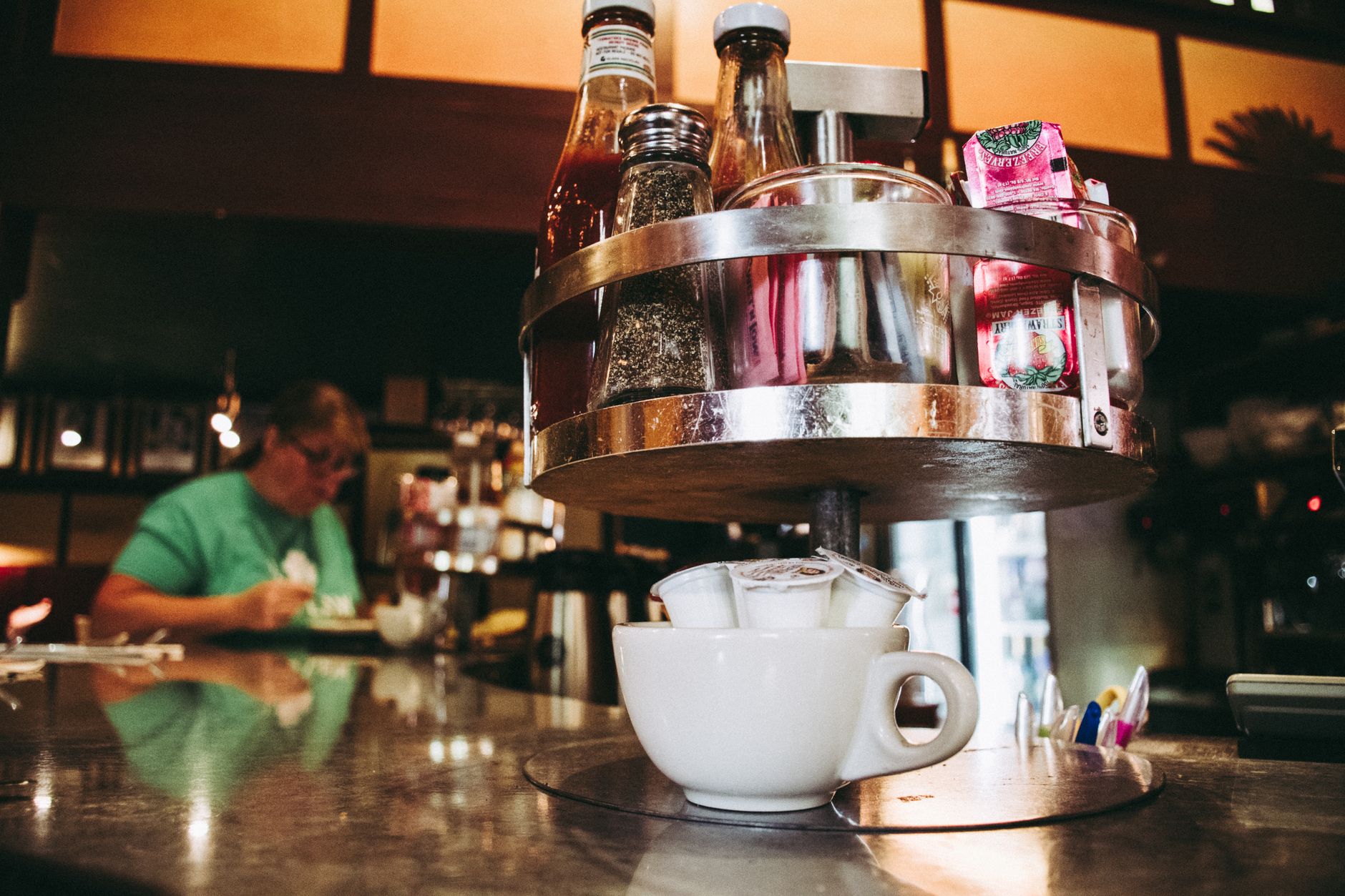
The Mason Jar by the Pie Case
Thirty years of coffee
My name is Gail Torvik. I am fifty-nine, and I have worked the counter at Quam’s Cafe in Glenrose, Minnesota, for thirty years this past March.
Glenrose sits twenty-two minutes east of Fergus Falls, on the highway, between a grain elevator and a feed store. We have a Lutheran church, a Catholic church the Lutherans pretend not to notice, a Lions Club, a gas station, and Quam’s. If you live here, you eat at Quam’s at least once a week. If you farm here, you eat there most mornings.
It is not fancy. Eleven stools, six booths, a pie case Harvey bought secondhand from a bakery in Alexandria in 1991. Tater tot hotdish on Wednesdays, fried walleye on Fridays. If you ask for anything with a sprig of something on it, Darlene Hjelle, who runs the grill, will look at you the way you look at a man who parks across two spaces.
I was twenty-nine when I walked in and asked if he needed anybody. My husband, Rolf, had just started on the county road crew. Our daughter, Kari, was four. We needed the tips more than we needed the sleep.
I never meant to stay thirty years. Nobody does. You take a job to get through a winter, and then you know that Sig Skarie from the feed store takes his coffee black and scalding, and Norbert Solberg wants his cream in the cup first, and Ione Fossum will tell you she does not want pie and then look at the case with such sorrow that you bring her a slice and charge her for a cup of tea.
By the second year I knew forty people’s orders without asking. By the tenth I knew whose wife was sick before the wife did, because a man starts leaving his eggs half eaten and you just know.
That is the job, if you do it right. Nobody puts it in the ad. You pour the coffee and you watch the room.
I am not saying this to brag. I am saying it because of what I did with it, which nobody ever asked me to do.
When a hog farmer came in the spring prices fell through the floor and ordered only coffee, I wrote “coffee” on the ticket and brought him two eggs and toast he had not ordered. When Sig’s father was dying, I kept a booth open for Sig at two every afternoon for five weeks, so he would have somewhere to sit between the hospital and the feed store.
I did not mark any of it down. Harvey saw the tickets and said nothing and took the loss out of the till. I figured that was the arrangement. I gave a little, quietly, and nobody had to talk about it.
What I did not figure, in thirty years, was that anybody was keeping count.
The Tuesday my appendix quit
It was the second Tuesday in July, in the middle of the lunch rush.
I’d had a stomachache since breakfast. I blamed Darlene’s chili, which is how you can tell it was a bad day, because Darlene’s chili has never once given anybody a stomachache. I took two antacids and kept pouring.
By one o’clock I could not stand up straight. I was carrying two plates of walleye to booth five, and I told myself I would set them down and then be sick in the back. I set them down. I remember Gunnar looking up from his pie.
Then I was on the floor by the pie case with my cheek against the linoleum, looking at the underside of the booths. It is the cleanest floor in Otter Tail County. I mop it myself.
Ione called the ambulance. Norbert took my hand. Gunnar got down on one knee, which I am told took him some time, and said, very loud, “Gail, you stay right here.”
As if I had somewhere to go.
The ambulance took fourteen minutes. Rolf met us at the hospital in Fergus Falls still wearing his orange county vest. The doctor said my appendix had burst and I had been walking around on it most of a day, and that I was a tough old bird who should have said something sooner.
I had five nights in that hospital. The surgery went well. A young nurse named Tyler brought me ice chips and told me about his grandmother’s farm outside Ashby, and I decided I loved him.
Then I was home on the couch for six weeks without a paycheck, because a waitress at a cafe with four employees does not have a sick-leave policy. She has a boss who tells her to take all the time she needs, and means it, and cannot afford to mean it any further than that.
People brought food. Ione showed up on our porch the second week with a pot roast, and I told her we had plenty, which we did not, and I sent her home with the roast still in her hands. Rolf watched from the kitchen window and shook his head.
Then the first envelope came.