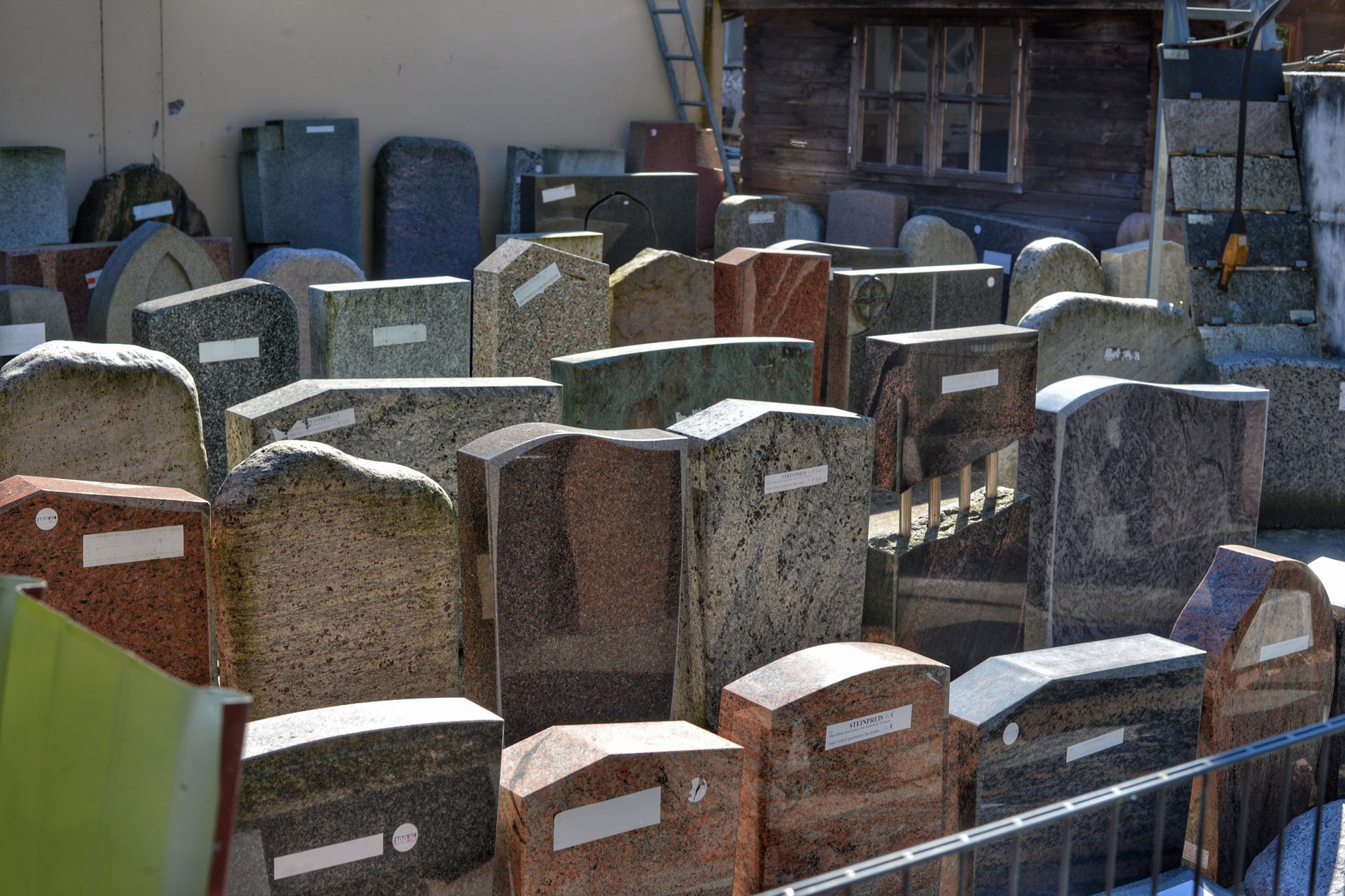
The Word Missing From His Headstone
He was Del Strand, seventy-two, his hair gone the white of the dust that clung to him. He had come to the funeral and sat in the back row.
“Eileen,” he said, when I came in. He took his cap off. “I am sorry for your loss. I told Roy’s boy so.”
“Thank you, Del.”
“What can I do for you?”
“I would like to see my husband’s stone.”
He looked at me, and for a moment he seemed about to say something about the order, and then he did not. He led me through a swinging door.
The back shop was one long room with a concrete floor, lit by high windows, cold the way a barn is cold. It smelled of wet stone and rubber. A blasting booth stood in one corner.
And in the middle of the floor, standing upright on a heavy cart, was a block of gray granite as wide as my outstretched arms.
The face of it was polished so smooth I could see the window in it. At the top was the cross, already cut, a clean pale line. Across the middle, our name, Tisdale, set deep. And over the lower half, pressed flat to the stone, were two panels of dark red rubber with the letters cut out of them like a paper doily.
“That’s the stencil,” Del said quietly. “We lay it on, and the sand goes through the openings and nowhere else. Wednesday’s the blasting. If a stencil’s wrong, you peel it and cut another. Once it’s blasted you can’t take it back out.”
I went close. I read the left-hand panel with my finger an inch from the rubber, not touching.
Roy E. Tisdale.
It was the same as on the paper. I think I had hoped, driving out, that the shop had known better than the sheet.
“Del,” I said, “will you read something for me?”
I took out the folded newsprint and laid it on his workbench under the window, and I set my husband’s papers next to it, and I smoothed them with the flat of my hand.
Del put on a pair of glasses from his apron pocket. He read the discharge first, and I watched his eyebrows go up at the dates and the convoy road. When he was done he laid it down the way you lay down something that is alive.
Then he picked up the obituary. He did not say a word for a while. He got to the last line, and the rafters creaked in the cold.
“Roy Junior,” he said at last. “Roy was always Junior to us. I never once heard him called anything else.”
“Kim ordered his stone,” I said. “I was in the hospital. I told her whatever she thought. I did not see that the Junior was left off.”