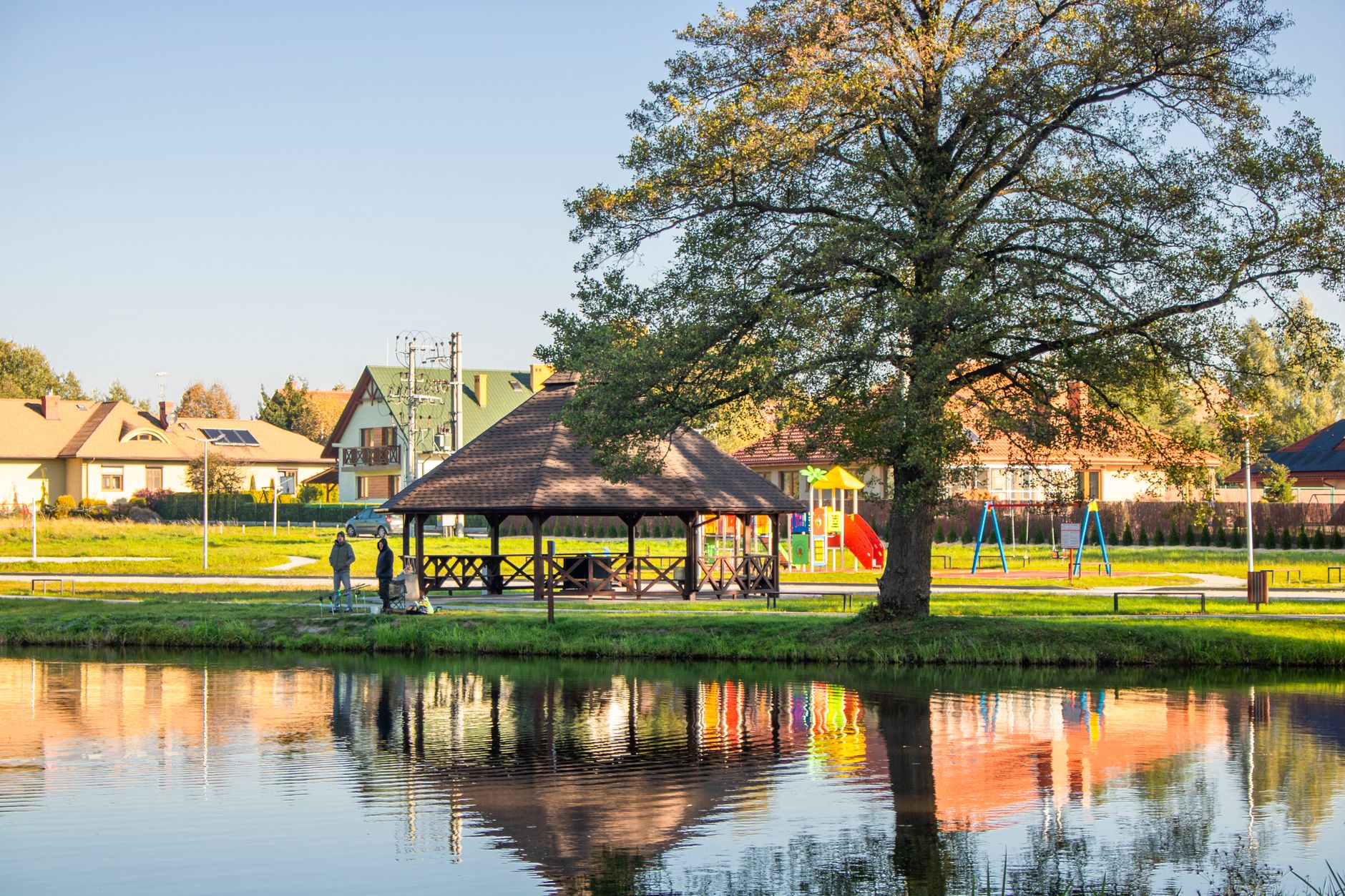
The Free Reunion at the Lake
I carried the album and my mother carried the rhubarb bars and Josh came down and carried the lawn chair from the trunk, and we walked Edna up the hill so slowly that three different cousins came down to help. She shooed every one of them away.
When she got to the top, she stopped and looked at the pavilion for a long time. At the kids in the lake. At the croquet game. At the tables.
“Well,” Edna said. “That’s more like it.”
We set her lawn chair up in the shade at the lake end of the pavilion, where she could see the water. People came to her in a line all afternoon, like she was the bride at a wedding.
Sixty-one people signed my guest book that day. The youngest was a baby born in March. The oldest was Edna. I counted three times to be sure.
Around one o’clock, after the first plates were cleared, Edna called me over and patted the arm of her chair. I knelt beside her in the grass, and she opened the brown album on her lap.
“I want every face in here named,” she said. “Before I can’t do it anymore. Nobody wrote anything on the back of these. My mother thought she’d always remember, and then she didn’t. So you hold this open and I’ll tell you, and you write it down.”
So I held the album open on her lap, and Josh brought me a pen and a pad from the truck, and Edna went page by page.
Some of the pictures were from the 1930s. The farm before they sold it, the barn with the hex sign on it, a row of children standing in a line by height in front of a Model A. Edna touched each child with one finger and said their names.
“That’s your great-grandpa. That’s me, the little one with the mouth open. That’s Walt, he died in Korea. That’s your grandma, she was bossy even then.”
She knew all of them. Every face. She knew who had a temper and who was sweet and who had run off to the Cities and never come back. I wrote it all down, every word, while kids ran past us with sparklers somebody’s uncle had brought, even though it was broad daylight.
Around three o’clock, a truck door shut down in the lot.
I didn’t look up at first. But the pavilion got a little quieter, the way a church gets quieter when the bride’s mother comes in late, and so I looked up.
Tracy was walking up the hill alone. She had on a gray T-shirt and jeans, and she was holding a paper plate. There was nothing on it.
She stopped at the edge of the pavilion, by the first table, and she stood there. She did not look at me. She looked at the food and the kids and the lake, like she was trying to decide which one to run to.
I found out later that Edna had called her. Edna had gotten her number from my mother the night before, and called her herself on the phone in her apartment, and said, “Tracy Ann, I am 93 years old and I would like to see you tomorrow. Come to the lake.” And then hung up.
Tracy came.
Edna saw her before anyone else did. She laid one spotted hand flat on the album.